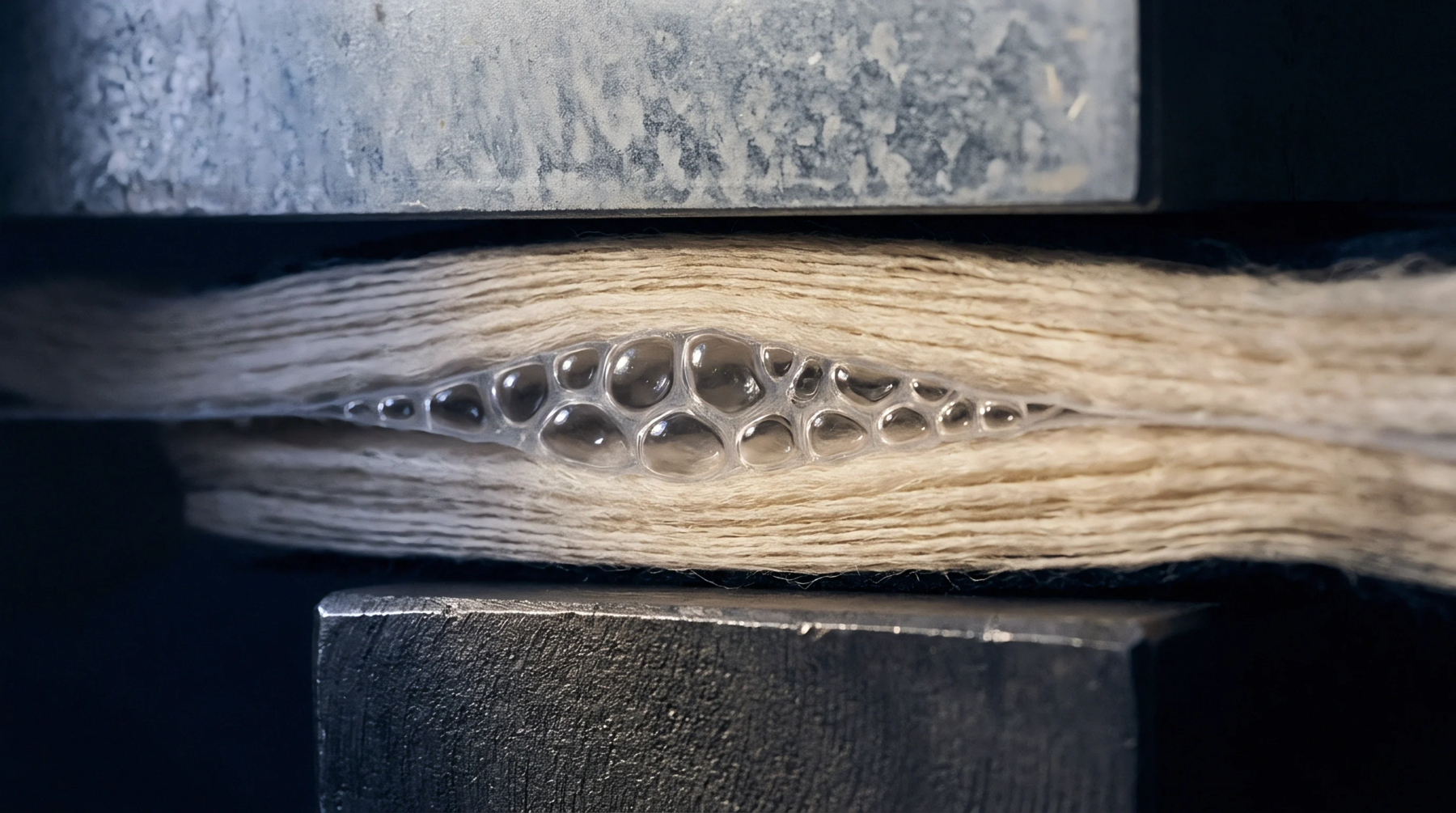
Micro Shed Dusting Accumulation Dynamics inside Air Jet Relay Nozzles under High Humidity
Humid air plasticizes sizing dust into sticky cakes inside relay nozzle bores, distorting airflow profiles and causing costly pick insertion stops.
Progressive accumulation of particulate matter, size residues, oil aerosols and airborne debris inside the internal bore and exit aperture of high-speed fluid nozzles constitutes a functional failure mode. Nozzle orifice fouling in air-jet weaving represents the physical encrustation of relay nozzles and main nozzle tips by microscopic contaminants delivered through compressed air systems or pulled in from shed environments. This clogging restricts the effective cross-sectional area, distorts the fluid velocity profile and degrades aerodynamic propulsive force.
The term applies strictly to internal and exit orifice contamination, excluding mechanical pipe collapses, structural nozzle fractures or external collisions with the reed dent array.
High-velocity air exiting a small orifice creates localized pressure gradients that interact aggressively with ambient dust. Compressed air lines frequently carry sub-micron traces of degraded synthetic compressor oil, condensed moisture and desiccant dust past primary filtration banks. As this moist, oiled air stream accelerates toward choked conditions at the nozzle throat, thermodynamic cooling causes lubricants and moisture to condense along internal bore surfaces.
Simultaneously, external air laden with fiber fragments and sizing dust gets pulled into the boundary layer through jet entrainment. These airborne contaminants impact the oily aperture margins, baking into a hard, sticky matrix under frictional heat and repetitive pressure cycling. Consequently, nozzle orifice fouling reduces the discharge opening, generating irregular wall friction and skewing the exiting air plume off its intended axis.
Disruption of clean flow geometry compromises yarn propulsion across the woven shed. A fouled nozzle produces an asymmetric jet cone with diminished axial momentum, causing rapid dispersion of relay air energy. Yarn propelled by a degraded relay system experiences insufficient downstream flight velocity, resulting in loose filling picks, tip curling and late pick arrivals that trigger optical sensor stops.
Loom operators frequently compensate by raising pneumatic supply pressure across the entire line, which elevates plant compressor energy consumption without restoring the true laminar velocity profile. Asymmetric airflow vectors also push the yarn out of the profiled reed guide, causing direct mechanical abrasion against warp ends and producing broken picks, looped filling and reed-edge fabric defects.
Prevention of orifice buildup requires multi-stage compressed air purification and regular scheduled pneumatic maintenance. Standard air treatment systems employ particulate filtration down to zero point zero one microns, paired with refrigerated or desiccant air dryers to maintain low pressure dew points. Automated ultrasonic cleaning cycles dissolve adhered polymeric size and carbonized oil deposits from dismounted nozzle tips, restoring original bore dimensions.
In-line flow sensors and digital manometer gauges compare baseline discharge pressures across relay nozzle banks to detect early stages of constriction. Maintaining clean, unobstructed nozzle passages stabilizes filling transport dynamics, protects air-jet weaving efficiency and avoids compressed air waste across high-speed fabric manufacturing facilities.
Humid air plasticizes sizing dust into sticky cakes inside relay nozzle bores, distorting airflow profiles and causing costly pick insertion stops.
Expertise is a utility, not a secret. sentiention™ publishes its working knowledge as open reference: intelligence layer covering the materials it sources, the markets it enters, and the reference that serves both.