Cotton Yarn Selection for Continuous Wet Processing Lines
Continuous wet processing requires combed ring-spun cotton yarns with high cell wall maturity and low hairiness to prevent line breaks and shade streaking.

Fiber
Raw cotton selection establishes the physical baseline for open-width chemical preparation. Once grey goods hit continuous bleaching and dyeing ranges, variations in staple quality show up immediately as uneven pickup, differential shrinkage, or localized shade bands. At line speeds above one hundred metres per minute, the fabric runs under steady mechanical tension while taking on alkaline and oxidative liquors, and the fiber itself determines whether the yarn holds together or breaks down.
Dye uptake depends directly on fiber maturity.
Micronaire readings bundle fineness and secondary wall development into a single value. For continuous processing ranges, cotton lots with Micronaire values between 3.8 and 4.2 provide the practical balance between strand strength and chemical absorbency. Stock under 3.5 indicates a high share of thin-walled, immature fibers.
Under pad pressure, these hollow filaments collapse into flat ribbons that cannot take up reactive or vat dyes at the same rate as mature cotton, leaving the un-dyed specks dyehouses call dead cotton across the fabric face.
| Fiber Parameter | Test Standard | Optimal Target Range | Continuous Processing Failure Limit |
|---|---|---|---|
| Upper Half Mean Length | ISO 6989 / HVI | 28.5 mm to 31.0 mm | Less than 26.5 mm increases lint shedding |
| Micronaire Value | ISO 2403 | 3.8 to 4.2 Premium | Below 3.4 causes dead cotton dye specks |
| Maturity Ratio | ASTM D1442 / HVI | 0.85 to 0.92 MR | Below 0.78 creates shade band variations |
| Short Fiber Content | ISO 12027 / AFIS | Below 7.5 percent | Above 9.0 percent increases fly accumulation |
| Uniformity Index | ISO 6989 / HVI | 83.0 to 85.5 percent | Below 81.0 percent increases warp breaks |
Staple Length Distribution and Short Fiber Content
Longer mean staple lengths leave fewer loose fiber tails exposed along the yarn body. Fibers under 12.7 millimetres contribute almost nothing to tensile strength, functioning as structural filler rather than bearing load within the strand. In continuous scouring above ninety degrees Celsius, liquid shear pulls these short fibers out of the yarn, generating surface lint that fouls chemical baths and wraps around expander rolls on pad-dyeing units.
Bale laydowns therefore require strict limits on short fiber content. A high short-fiber fraction cuts wet yarn tenacity until line speeds have to be dropped to prevent warp breaks. These unanchored fibers also wash out in continuous desizing boxes, driving up preparation mass loss.
Micronaire and Cell Wall Maturity Mechanics
Immature raw cotton fibers have thin secondary walls that collapse into flat ribbons during ginning. Lacking the internal crystalline cellulose bulk needed to bind hydroxyl groups with reactive dyestuffs, these fiber clusters absorb less liquor during continuous pad-steam runs, showing up as pale or white specks against dark grounds.
Combed long-staple yarns with high cell wall maturity prevent differential dye uptake and shade streaking during rapid pad-dyeing.
A maturity ratio above 0.85 ensures the secondary lumen wall has developed a dense crystalline cellulose lattice. These dense cell walls swell uniformly in caustic soda during mercerization, rounding out into smooth cylinders that reflect light evenly. Buying cotton on Micronaire alone without verifying maturity ratios leads directly to shade variation across long continuous dyeing runs.
Non-Lint Content and Trash Particle Morphology
Trash left in the carded web interrupts continuous desizing and scouring. Fragments of seed coats, leaf, and stem contain lignified tissue that survives standard hydrogen peroxide bleaching recipes. When these hard particles hit continuous calender nips or rubber pad rolls, they puncture surrounding fibers and cut yarn strands under the applied pressure.
Carded yarns carry higher trash levels into preparation.
Seed coat fragments with attached cotton fibers cause the most damage in wet processing. In hot alkaline scours, the attached cotton swells while the woody fragment remains dimensionally stable, concentrating shear stress at the interface until the fragment breaks loose into the bath. Once floating in the liquor, it redeposits on the moving fabric web and blocks dye penetration at the padder, leaving permanent pale resist spots.
Clean raw stock with uniform fiber maturity provides the only reliable baseline for continuous preparation and dyeing.

Twist
Twist applied during ring or rotor spinning governs yarn cohesion under wet longitudinal tension. On continuous ranges, grey goods run through successive chemical boxes where liquor drag, expander rolls, and steam chests maintain steady directional tension. Too few rotational binder turns allow wet fibers to slip past one another; too many turns pack the strand so tightly that chemical penetration stalls.
Twist levels control wet yarn strength.
The spinning geometry changes how liquor and water enter the fiber core. Ring spinning lays fibers in concentric helical paths from the center out, providing high tensile strength and predictable capillary wicking. Rotor yarns form a looser, randomized core wrapped by surface filaments; they shed less lint but need higher twist factors to match ring-spun breaking loads.

Twist Multiplier Calibration for Penetration Efficiency
Dialing in the twist multiplier is a compromise between yarn cohesion and capillary absorption velocity during pad immersion. English twist multipliers between 3.6 and 3.8 give warp yarns adequate dry and wet tenacity without closing off the surface. Above 4.2, internal pore channels narrow, raising the hydrostatic pressure required to force chemical liquors into the core of the yarn bundle.
Lower twist multipliers between 3.2 and 3.4 speed liquor absorption, which suits filling yarns in woven constructions. Running low-twist warp yarns through high-tension continuous bleaching ranges, however, leads to excessive elongation and fabric neck-in. The operating window has to balance line tension against the wetting speed demanded by the dye pad.
Ring versus Rotor versus Vortex Spinning Routes
Air-jet vortex spinning produces a true core-and-sheath structure that handles the friction of high-velocity guide rolls without fuzzing. Parallel core fibers locked inside tight surface wrappings resist pilling while preserving void space inside the inner bundle. As a result, vortex yarns wick dye liquor rapidly while holding their shape under heavy nip pressures.
| Spinning System | Fiber Alignment | Hairiness Index (Uster H) | Wet Tensile Retention | Liquor Absorption Rate |
|---|---|---|---|---|
| Ring Spun (Combed) | Concentric Helical | 4.2 to 5.0 | 110 to 115 percent | Moderate to High |
| Ring Spun (Carded) | Disordered Helical | 6.5 to 8.0 | 100 to 105 percent | Moderate |
| Rotor Spun | Core with Wrapper Fibers | 3.5 to 4.5 | 85 to 90 percent | Slow to Moderate |
| Vortex Spun | Parallel Core Sheath | 2.2 to 3.0 | 95 to 100 percent | Rapid Capillary Wicking |
Vortex yarn structures shed markedly less lint.
Protruding fibers longer than three millimetres ~ measured as Zweigle S3 ~ largely determine lint buildup on wet processing equipment. High surface hairiness blankets the grey cloth face in loose fuzz that traps micro-air bubbles during continuous dye immersion. These air pockets insulate the fiber surface from the dye liquor, leaving pinhead-sized resist specks across the goods after drying.
Yarns with mismatched structural twist trigger several predictable processing failures on continuous lines:
- Wet Tension Breakage occurs when low twist multipliers allow fiber slippage under high longitudinal line strain, causing machine stops and stop-marks.
- Center to Edge Shade Skew develops when twist variation across yarn packages alters local capillary absorption rates across the pad-mangle width.
- Expander Bar Lint Buildup happens when high surface hairiness leads to fiber shedding in hot alkaline baths, fouling chemical rolls.
- Surface Fiber Pilling results from weak wrapper fibers in rotor yarns detaching under mechanical agitation during continuous scouring phases.
Purchasing contracts specifying ISO 2060 yarn linear density tolerances within plus or minus two percent prevent continuous pad-dye shade banding.
Continuous dye streaking often stems from incoming twist variation across yarn packages rather than chemical bath instability.
Tension
Continuous wet processing pulls fabrics under continuous axial tension through aggressive chemical baths. Moving across pad mangles, steam chambers, washing boxes, and stenter frames, the web undergoes constant machine-direction tension while aqueous fiber swelling tries to shrink individual yarns, setting up multi-axial internal stresses throughout the structure.
Tension control prevents fabric skew and distortion.
Cotton fibers swell up to fourteen percent in diameter during wet processing while showing virtually no longitudinal expansion. This radial expansion forces interlacing warp and weft yarns around wider curves, generating crimp forces that pull the fabric inward and shorten the running length. If line drives pull too hard against that contraction, warp yarns stretch past their elastic limit, resulting in permanent thinning and high residual shrinkage in the finished fabric.

Which Yarn Parameters Dictate Continuous Mercerizing Efficiency?
Caustic soda at twenty-eight degrees Baumé triggers rapid intra-crystalline swelling within the cellulosic lumen. In continuous mercerizers, the fabric enters the bath under warp tension while stenter chains grip the selvedges to pull the web out to width. This mechanical constraint forces the swollen microfibrils to align parallel to the main fiber axis, turning collapsed ribbons into round, light-reflecting cylinders.
Caustic swelling alters yarn pore structure.
Mercerizer line speed is capped by yarn tenacity in high-caustic environments. When single-end breaking loads are marginal, warp ends snap under the combined load of alkaline fiber swelling and stenter chain tension. Verifying yarn suitability for continuous mercerizing involves a defined test sequence:
- Evaluate dry single-end break force using ISO 2062 specifications to establish baseline strand tenacity.
- Measure wet break load after soaking test skeins in twenty-four degrees Baumé sodium hydroxide solution for two minutes.
- Calculate wet-to-dry tenacity ratios to ensure strength retention exceeds ninety-five percent under caustic swelling conditions.
- Measure percentage elongation at five newtons applied load to predict strand stretch behavior inside continuous drive zones.
- Perform thermal shrinkage testing at one hundred degrees Celsius to quantify heat contraction during direct-steam drying passes.
Cellulosic strand elongation under a ninety-newton tension load remains below three percent during high-temperature alkaline scouring at ninety-five degrees Celsius.
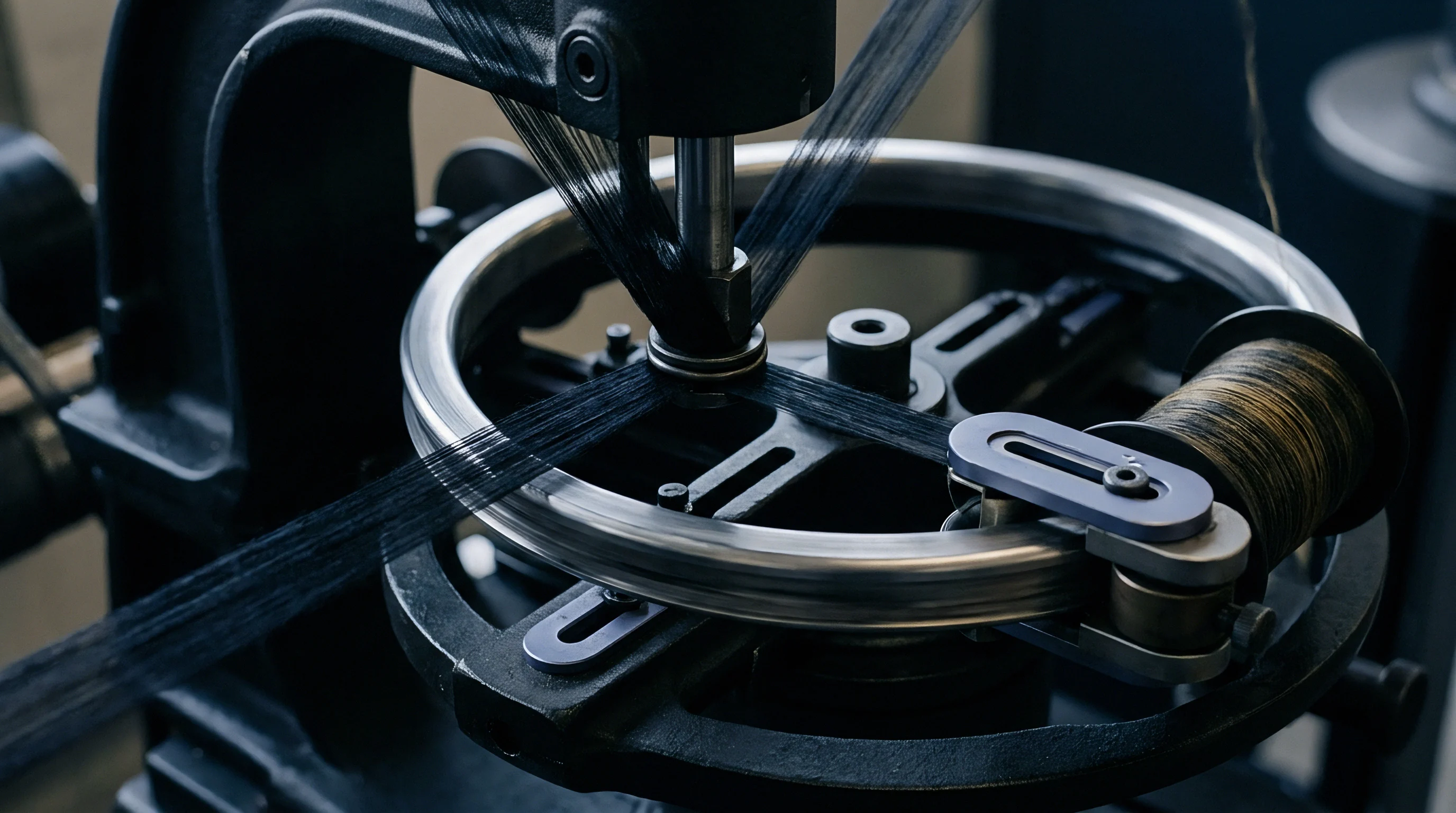
Singeing and Desizing Mechanical Resistance
Burners operating above one thousand degrees Celsius flash off surface hair without degrading the core bundle. Fabric passes the burner heads at speeds between eighty and one hundred twenty metres per minute under firm mechanical tension. If line tension slackens or speed drops, the flame sinks into the inter-fiber void space, singeing structural fibers and degrading tensile strength.
Tension spikes trigger immediate warp breaks.
Leaving the flame, the fabric plunges into the desizing saturator containing enzymes and wetting agents. Quenching triggers rapid fiber swelling while the goods remain under running tension. Without adequate wet elastic recovery, this sudden transition from dry heat to liquid shock creates micro-fissures along fiber surfaces, cutting the finished burst and tear strength of the goods.
Yarn tenacity and elongation that do not match the tension profile of the preparation range lead directly to fabric tears, width loss, excessive finished shrinkage, and line stoppages.

Penetration
Capillary action within yarn bundles governs how quickly and evenly chemistry enters during continuous immersion. Modern pad mangles run with cloth immersion times under two seconds. In that brief contact period, dye liquor must saturate the yarn core completely; otherwise, ring-dyeing occurs, resulting in poor crocking and wash-fastness.
Hydrostatic pressure drives chemical liquor uptake.
Penetration speed depends on the distribution of inter-fiber pores and the wetting angle against the fiber walls. Tightly twisted ring yarns form narrow capillary channels that generate strong suction once wetted, but initial entry is slow. Softer, low-twist structures wet out almost instantly on the surface but lack the capillary pressure needed to draw liquor into the innermost fibers.

Capillary Flow Mechanics and Pore Radius Distribution
Wicking rates follow the Washburn equation, where penetration depends on inter-fiber void dimensions. Fine counts spun from mature cotton produce small, uniform capillary networks that deliver consistent liquor uptake throughout long production runs. Coarser carded yarns have irregular pore channels that cause turbulent, uneven wetting through the pad nip.
Nip pressures determine total chemical wet pickup.
Mangle nip pressure forces dye liquor into the inter-yarn voids of the weave. Under thirty to forty kilonewtons per metre of roll pressure, surface fibers flatten and temporarily seal capillary openings. Resilient yarn structures spring back immediately on exiting the nip, creating internal suction that pulls surface liquor into the core of the strand.
Continuous Pad-Steam and Thermosol Dye Yield
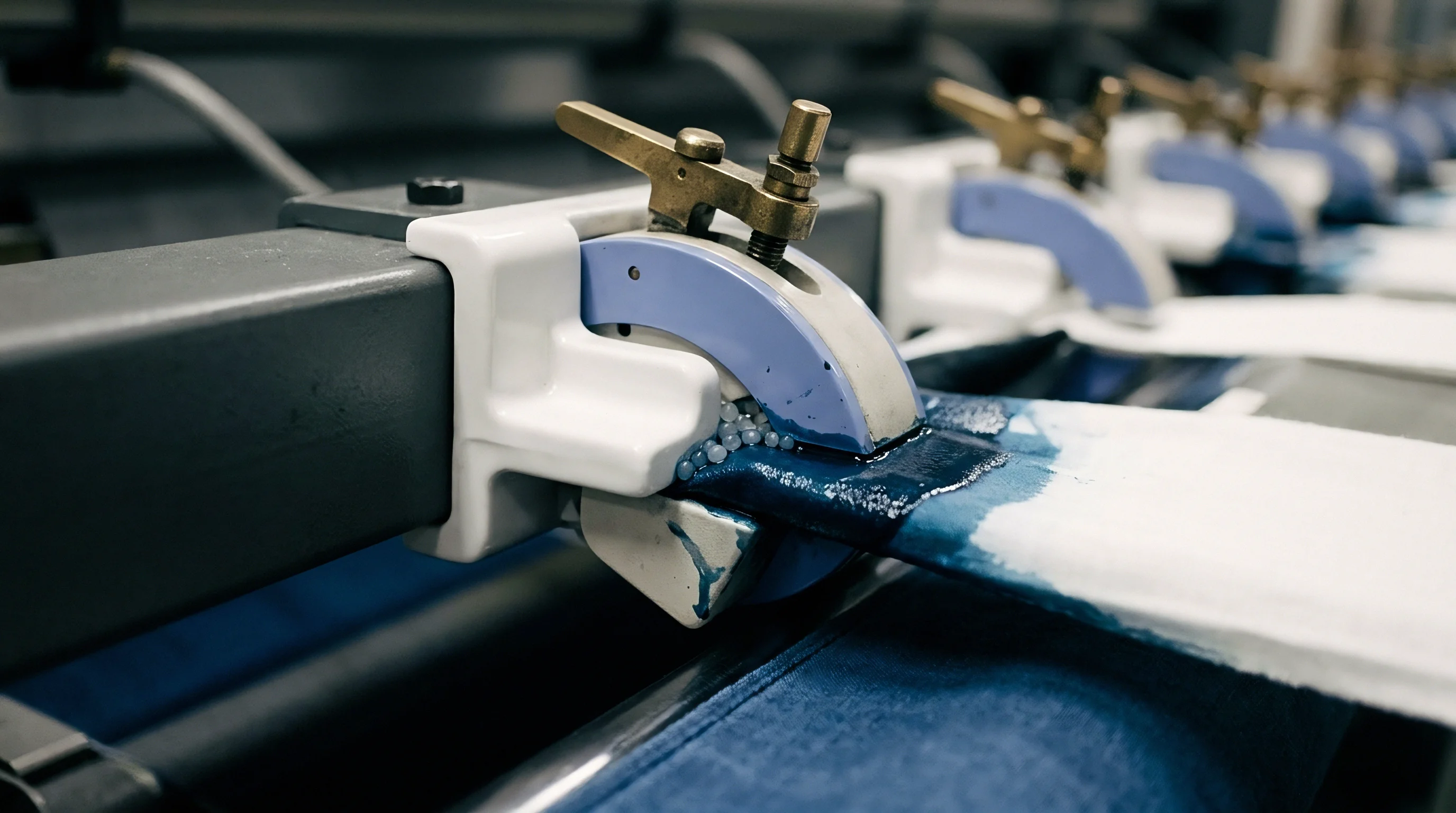
Wet pickup levels between sixty and seventy percent require fast, uniform absorption before goods hit infrared pre-dryers. In the drying zone, rapid surface evaporation draws moisture toward the outer faces of the fabric, dragging dissolved dyestuff with it. If the dye liquor was never absorbed into the yarn core, this migration produces severe face-to-back shading.
| Yarn Construction | Capillary Wicking Height (ISO 9073-6) | Pad Immersion Wetting Time | Core Dye Penetration Ratio | Infrared Migration Susceptibility |
|---|---|---|---|---|
| 30s Combed Ring (3.6 TM) | 75 mm per 10 min | 0.8 seconds | 88 percent | Low |
| 30s Carded Ring (4.2 TM) | 52 mm per 10 min | 1.4 seconds | 72 percent | High |
| 30s Rotor Spun (4.4 TM) | 45 mm per 10 min | 1.8 seconds | 64 percent | Very High |
| 30s Vortex Spun (3.8 TM) | 90 mm per 10 min | 0.5 seconds | 94 percent | Very Low |
Continuous dyeings require uniform yarn penetration.
The core penetration ratio measures the share of dye fixed in the inner yarn cross-section versus its outer rim. Solid core penetration prevents the pale, abraded centers of fibers from showing through when garments undergo industrial laundering. Vortex-spun yarns regularly reach core penetration ratios above ninety percent, which is why they perform reliably in continuous pad-steam dyed workwear.
Air-jet vortex structures accept continuous chemical dye liquor at higher diffusion rates than highly twisted ring-spun strands.
Meeting ISO 105-C06 wash-fastness requirements ~ specifically maintaining shade loss at or above Grade 4 on the gray scale ~ depends directly on achieving thorough core dye penetration during the pad-steam pass.

Splice
Yarn joints are the most frequent cause of breaks on continuous preparation ranges. Continuous lines do not stop for individual roll seams, relying on accumulators while operators sew roll ends together. Within the fabric itself, however, individual yarn splices must withstand longitudinal tension, strong alkaline liquors, and high nip pressures without opening up.
Pneumatic splices replace mechanical weaver’s knots.
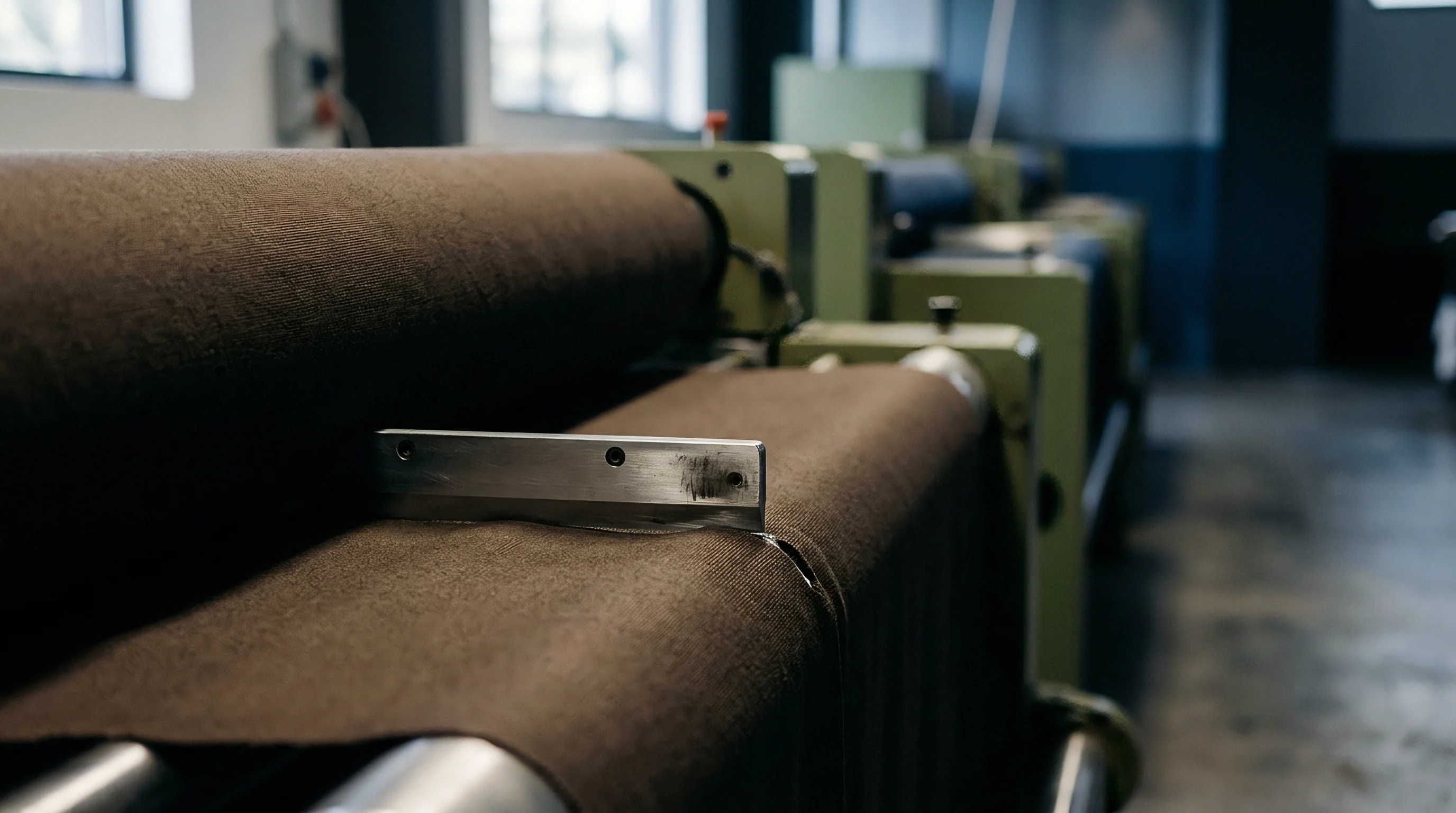
Knots create raised physical bumps in the fabric plane. When a knot hits a pad nip or calender roll, it concentrates roll tonnage onto a fraction of a square millimetre. That pressure spike can sever neighbouring warp ends, pit soft rubber roll coverings, and create localized dye puddles that dry into dark spots.
Air-Splicing Performance and Retained Tensile Strength
Pneumatic splicers entangle broken fiber ends with compressed air bursts, matching the profile of the original strand. Automatic winders running wet air-splicing introduce fine water mists into the chamber during intermingling. The moisture softens the cotton cellulose, allowing fibers to wrap tightly together and maintaining spliced strength above ninety percent of parent yarn tenacity.
Splice geometry requires tight physical control. Mill standards generally keep tail ends under five millimetres and limit splice thickness to no more than 1.2 times the base yarn diameter. Bulky splices hang up in the loom reed during weaving or create friction points across expander bars in wet finishing, initiating warp splits.
Neps and Hairiness Shedding in Dye Baths
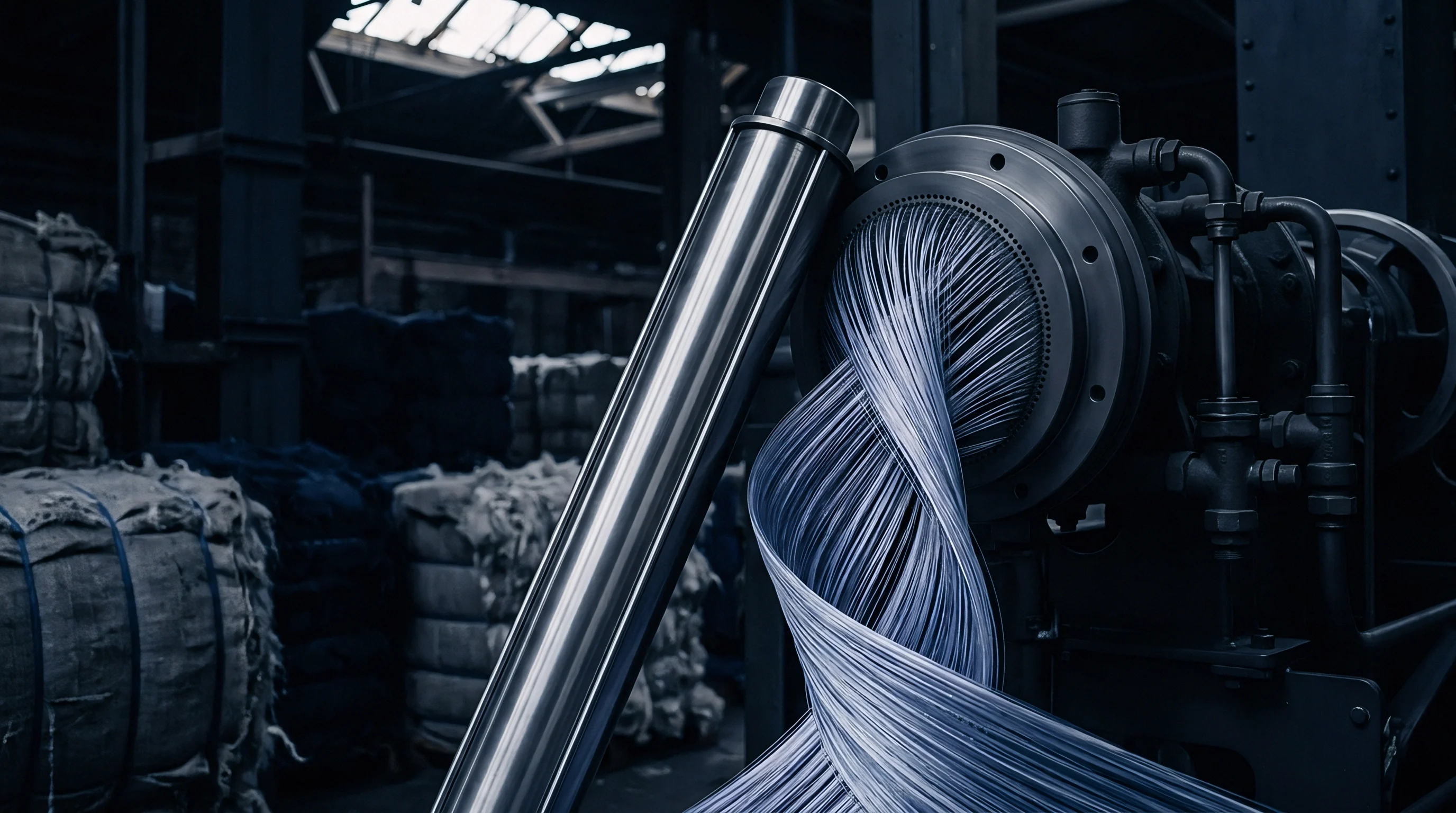
Loose fibers that wash off during scouring collect on expander bars and scraper blades. Dense clumps of lint, seed coat particles, and fiber neps accumulate inside continuous washer compartments. Eventually, bath agitation redeposits these floating lint mats back onto the fabric, where they travel through pad rolls and cause pale dye resist marks.
Immature fibers generate non-dyeing neps.
Fiber neps are tight clusters of thin-walled, immature fibers formed during ginning and carding. Having little internal cellulose body, neps flatten into shiny, impermeable discs under pad pressure. Specifying raw yarn lots with low nep counts on AFIS or Uster profiles avoids dead-cotton specks across dark reactive shades.
Splicing standards and defect limits for continuous processing lots include the following thresholds:
- Retained Splice Tenacity must exceed eighty-five percent of unimpaired single yarn strength measured under ISO 2062 test conditions.
- Splice Diameter Ratio must remain below 1.25 times parent strand diameter to clear continuous pad nip roll clearances.
- Nep Concentration Limits must not exceed two hundred total neps per thousand metres measured via AFIS testing protocols.
- Short Tail Control requires pneumatic splicer blades to shear trailing fiber ends within two millimetres of the splice core.
Whether pneumatic air-splicing or aqua-splicing holds up better through continuous mercerizing ranges running caustic above twenty-six degrees Baumé remains an open question among plant engineers.
Ledger
Yarn purchasing decisions govern preparation loss, line efficiency, and finished defect rates. Every technical parameter selected in the spinning mill ~ staple grade, twist multiplier, spinning method ~ shows up directly on the finishing plant’s cost ledger. Discount greige yarns frequently generate higher total processing costs once chemical consumption, line downtime, off-shade rework, and scrap are factored in.
Carded yarns carry higher trash, leading to elevated preparation loss.
Loss of mass in preparation directly affects finished fabric yield and meterage. Raw cotton carries natural waxes, pectins, proteins, and warp size that must be stripped out during continuous desizing, scouring, and bleaching. When greige yarns contain high trash or heavy size loads, mass loss can exceed eight percent, forcing converters to buy extra greige yardage just to hit target finished weights.
Yield Loss Math across Continuous Wet Processing Steps
Weight loss through desizing, scouring, and bleaching typically runs between four and eight percent of dry greige weight. Projecting finished costs accurately requires tracking dry mass across each stage. Sizing agents ~ usually corn starch or polyvinyl alcohol ~ make up six to ten percent of warp weight and are completely removed in enzymatic desizing.
Natural waxes and non-cellulosic impurities account for another 1.5 to 2.5 percent loss in alkaline scours. Bleaching removes remaining natural pigments and motes, taking off another 0.5 percent. Combed ring yarns show less loss here because the combing process has already removed short fibers and botanical trash, making yield conversions from greige to finished fabric much more predictable.
Worked Cost Model for Yarn Selection Trade-Offs
A forty-tonne production run highlights how yarn choice influences finishing margins. Assuming a standard 30s Ne warp and 30s Ne weft plain weave targeted at 130 grams per square metre finished, the economics compare three yarn routes: Option A uses 30s Carded Ring Spun Yarn, Option B uses 30s Combed Ring Spun Yarn, and Option C uses 30s Air-Jet Vortex Spun Yarn.
| Cost Component | Option A: Carded Ring Spun | Option B: Combed Ring Spun | Option C: Air-Jet Vortex |
|---|---|---|---|
| Yarn Input Purchase Cost ($/kg) | $2.85 | $3.35 | $3.15 |
| Greige Fabric Required (Tonnes) | 43.8 Tonnes | 42.5 Tonnes | 42.1 Tonnes |
| Preparation Mass Loss Rate (%) | 8.5 percent | 6.0 percent | 5.0 percent |
| Continuous Line Downtime Cost | $4,200 (14 stops) | $600 (2 stops) | $300 (1 stop) |
| Second-Quality Defect Scrap Rate | 4.5 percent | 1.2 percent | 0.8 percent |
| Total Manufacturing Cost ($/Metre) | $1.42 per metre | $1.38 per metre | $1.31 per metre |
Option A has the lowest initial yarn price at $2.85 per kilogram. However, high short-fiber content and trash yield an 8.5 percent preparation loss in scouring and bleaching. Weak single-end strength causes fourteen line stops, adding $4,200 in downtime charges and creating stop marks that push second-quality scrap to 4.5 percent.
Option B raises raw yarn expenditure to $3.35 per kilogram but brings preparation mass loss down to 6.0 percent. Improved yarn tenacity and splice strength reduce line stops to two, cutting scrap to 1.2 percent and yielding a total manufacturing cost of $1.38 per metre.
Option C proves the most cost-effective route, using air-jet vortex yarn at $3.15 per kilogram. Clean surface structure and parallel fiber orientation reduce preparation loss to 5.0 percent while speeding dye liquor uptake. Machine stops drop to a single event over the entire run, bringing total finished cost down to $1.31 per metre while meeting all tensile and fastness specs.
Costing yarn inputs against landed finished fabric yield rather than greige invoice price determines actual continuous wet processing margins.