Determining Yarn Buckling Thresholds under Stenter Longitudinal Compressive Pinning Forces
Exceeding yarn critical compressive buckling load during stenter overfeed causes irreversible out-of-plane cockling and catastrophic selvedge scrap.
Nip
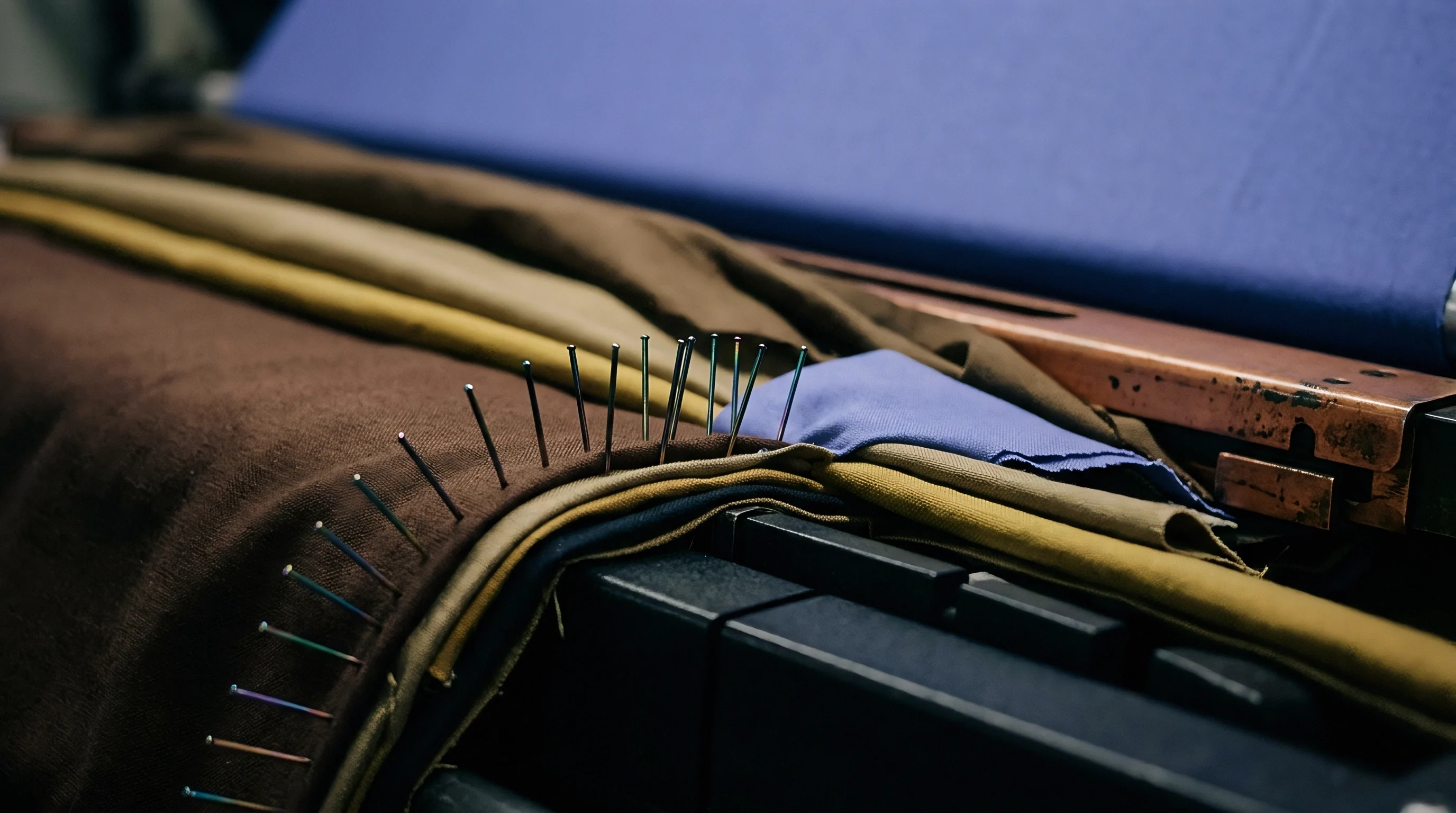
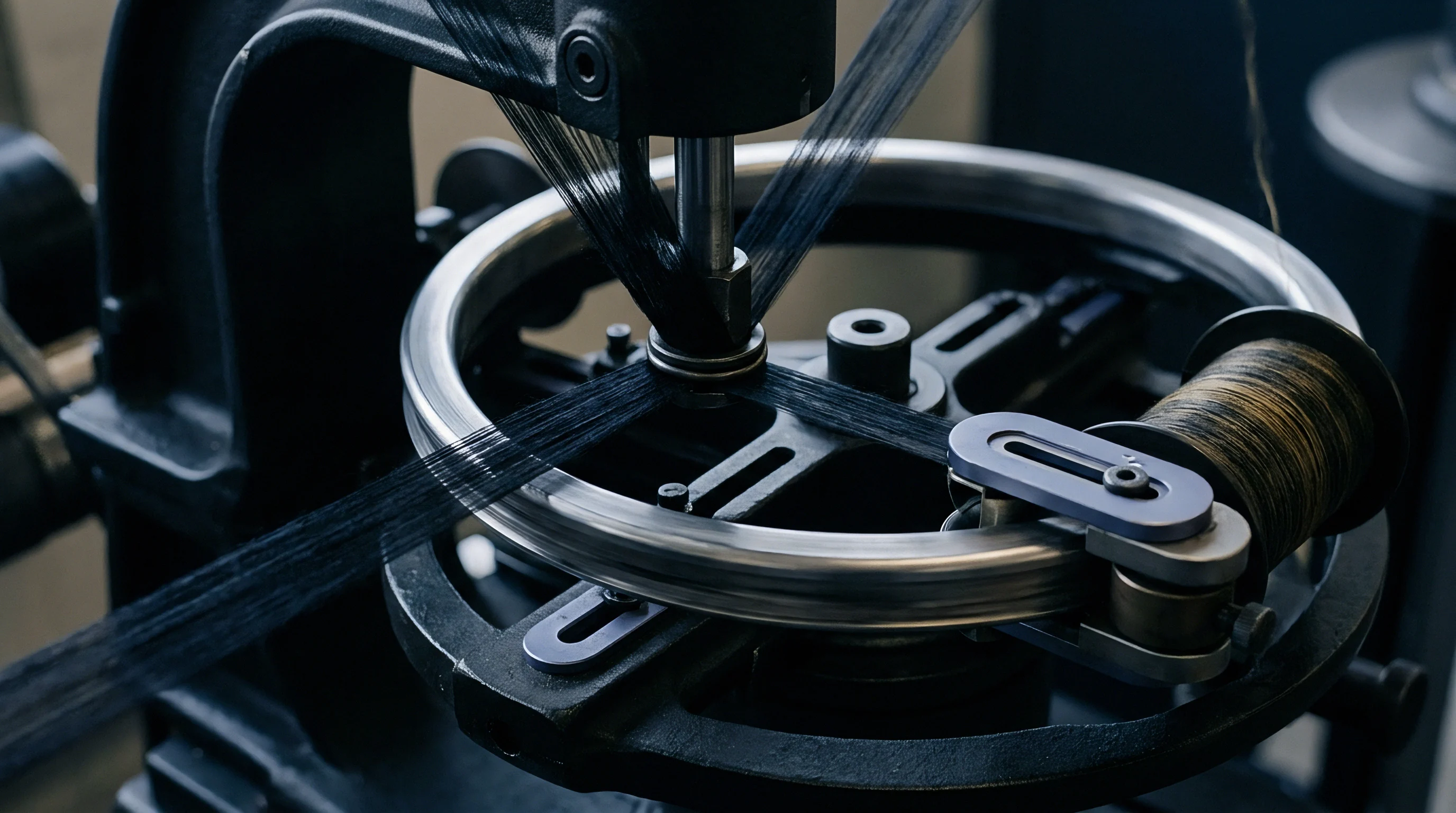
Pin plates grip the wet selvedge under active mechanical pressure while driven brush wheels push the moist web down onto the needle points. Feed rollers run at a peripheral velocity three to thirty-five percent faster than the tenter chain. This speed differential places a sustained longitudinal compressive load on every warp end.
When that pushing force exceeds the axial load capacity of the yarn, localized distortion replaces uniform longitudinal contraction.
Longitudinal overfeed mechanically condenses the warp yarns before the drying zone locks the fabric structure. In the pinning zone, force transfers directly through needle engagement, with pins spaced four to five millimetres apart puncturing the substrate border. As the overfeed roller presses the substrate forward against the slower chain, the unsupported length between nip point and pin seat absorbs the direct compression.
If this compressive stress exceeds the structural threshold of the yarn, the ends buckle into out-of-plane loops before heat can stabilize them.
- Entry Nip Delivery establishes base overfeed velocity using rubber-covered drive rollers fifty millimetres upstream of the pin chain.
- Brush Wheel Deposition drives the compressed selvedge onto brass pin plates, turning roller momentum into longitudinal pin reaction forces.
- Chain Acceleration Transition pulls the pinned selvedge into the first heating box, where evaporating moisture alters yarn flexural response.
- Width Divergence Rail Spread applies transverse tension while longitudinal compression stays locked between consecutive pin rows.
Pinning forces distribute unevenly across the border area. Yarns nearest the pin line take peak compressive force because the needles act as fixed boundary stops against forward transport. Moving from the selvedge toward the center of the web, compressive force per warp end drops off exponentially.
In lightweight fabrics with low yarn density, this localized gradient produces visible wavy edges known as cockling or pin-line puckering.
| Substrate Classification | Yarn Linear Density (tex) | Overfeed Ratio (%) | Longitudinal Pin Force (cN/end) | Observed Yarn Response |
|---|---|---|---|---|
| Ring-Spun Cotton Plain Sheeting | 20 tex warp / 20 tex weft | +8 | 4.2 | Stable crimp accumulation without distortion |
| Ring-Spun Cotton Plain Sheeting | 20 tex warp / 20 tex weft | +18 | 9.8 | Out-of-plane warp yarn buckling at selvedge |
| Polyester Filament Taffeta | 8.3 tex warp / 8.3 tex weft | +4 | 2.1 | Uniform filament compacting |
| Polyester Filament Taffeta | 8.3 tex warp / 8.3 tex weft | +12 | 6.7 | Severe longitudinal ridging and loop formation |
| Viscose Twill Lining | 15 tex warp / 15 tex weft | +14 | 7.4 | Diagonal ridge buckling along twill float lines |
Ripples can also stem from incoming yarn tension variance created during winding at the sizing plant.

Rigidity
Bending stiffness dictates how well a yarn tolerates axial compressive loads without bowing out of its interlaced axis. This flexural rigidity, expressed as product modulus E multiplied by moment of inertia I, depends on single-fiber modulus, cross-sectional fiber count, packing fraction, and spinning twist multiplier. High twist binds filaments into a cohesive column that resists lateral displacement, whereas low twist lets filaments slide past each other under modest compressive forces, reducing the bundle’s effective flexural rigidity.

What Triggers In-Plane Yarn Deflection under Pin Load?
Transverse pick density determines the unconstrained length across which a warp end can deflect under longitudinal stenter compression. In a plain interlaced grid, each crosswise pick functions as a lateral constraint. As stenter pins push warp yarns together lengthwise, warp crimp height increases while weft crimp flattens through crimp interchange.
High pick density keeps the free column length between interlacing points short, which raises the critical buckling threshold.
Inter-yarn friction resists slippage, with static friction at crossover points opposing upward or downward displacement of the compressed end. As heat and moisture enter the chamber, sizing agents or natural waxes soften, lowering the inter-yarn friction coefficient. This lubrication reduces the force needed to initiate yarn displacement.
In synthetic filaments, temperatures exceeding the glass transition point trigger a sudden drop in polymer tensile modulus, collapsing yarn flexural rigidity while pin compression continues.
A thirty percent decrease in yarn twist multiplier lowers critical compressive buckling resistance by more than half under ambient pinning moisture.
Asymmetrical weaves like twills or satins present variable buckling thresholds across the fabric face. Long warp floats lack the regular lateral support of plain weaves, buckling under lower pinning forces because their unconstrained column length spans several picks. These float yarns buckle predictably toward the fabric face, where contact with perpendicular picks is absent.
Coarser yarns with higher flexural rigidity withstand higher longitudinal overfeed percentages before out-of-plane cockling begins.

Equation
Euler elastica theory provides the framework for calculating the critical buckling load of an interlaced yarn under axial pinning force. A yarn segment between adjacent crossover nodes acts as an end-loaded column embedded in an elastic lateral medium. The critical compressive force P_cr scales directly with flexural rigidity B and inversely with the square of the effective unconstrained span length L_eff between crosswise yarns.

Can Mathematical Boundary Conditions Model Inter-Yarn Restraint?
Boundary conditions at pick crossovers determine whether a yarn behaves as a hinged strut or a clamped beam. Inter-yarn pressure and pick crimp provide semi-rigid rotational restraint, yielding a governing expression for critical longitudinal force that accounts for lateral elastic foundation stiffness k and frictional resistance f_s:
P_cr = (pi^2 B) / (L_eff)^2 + k (d_y / 2) + 2 mu N_c
Here, B is yarn bending rigidity in Newton square metres, L_eff is the unconstrained span length between adjacent pick contacts in metres, k is the transverse elastic constraint modulus in Newtons per cubic metre, d_y is yarn diameter in metres, mu is kinetic friction between crossing yarns, and N_c is the normal interlacing force in Newtons. Interlacing points function as hinges. As overfeed increases, normal force N_c shifts dynamically through crimp interchange until structural jamming occurs.
A worked calculation for a commercial 20 tex combed ring-spun cotton warp illustrates this boundary. The yarn has a bending rigidity B of 0.42 10^-6 N m^2 and an effective diameter of 0.18 millimetres. In a structure woven with 28 picks per centimetre, the pick pitch is 0.357 millimetres.
Subtracting a compressed weft diameter of 0.16 millimetres leaves an unconstrained span length L_eff of 0.197 10^-3 metres.
Assuming partially clamped end conditions with an effective length factor of 0.7, the classical Euler critical component evaluates to:
P_euler = (pi^2 0.42 10^-6) / (0.7 0.197 10^-3)^2 = 4.14 10^-6 / 1.90 10^-8 = 217.9 Newtons per thousand ends, or 0.218 Newtons per single yarn end.
Frictional contribution provides additional support. With a normal contact force N_c of 0.04 Newtons generated by loom beat-up tension and a dry cotton friction coefficient mu of 0.25, the frictional resistance term adds:
P_friction = 2 0.25 0.04 = 0.020 Newtons per end.
Combining these terms yields a critical buckling threshold of 0.238 Newtons per warp end, equivalent to 23.8 centinewtons. When stenter overfeed imposes a longitudinal force exceeding 24 centinewtons per yarn end in the entry field, steam softening allows the yarn to instantly leave the horizontal plane and form a buckle loop.
A calculated pinning threshold of 23.8 centinewtons per end marks the absolute boundary between elastic yarn compaction and irreversible structural rippling.
Whether dynamic thermal softening of sizing polymers during the first three seconds of chamber exposure reduces effective lateral foundation stiffness k to near zero remains unquantified on high-speed industrial finishing ranges.

Inspection
Visual and mechanical verification of yarn buckling takes place on the delivery frame directly downstream of the stenter cooling zone. Buckled yarns produce a distinct surface topography that degrades smoothness, alters light reflectance, and causes uneven dye appearance on finished fabric. Laser profile scanners mounted across the exit rail capture height deviations in the web plane, flagging areas where amplitude exceeds 0.4 millimetres over a ten-millimetre baseline.
Standardized test methods isolate the effects of excessive longitudinal pinning forces. Dimensional stability testing under ISO 5077 requires measuring benchmark distances on finished fabric before and after domestic laundering cycles defined by ISO 6330. An overfeed setting past the yarn buckling threshold fails to deliver stable shrinkage control, as buckled loops relax erratically during immersion to cause high post-wash dimensional growth or severe skewing.
- Cockled Selvedge Bands show periodic out-of-plane ripples within seventy-five millimetres of the pin line, caused by overfeed forces exceeding the edge warp critical load.
- Pin Tear Elongation manifests as torn needle apertures where localized compressive resistance forced the substrate off the pins during rail divergence.
- Transverse Pick Skew occurs when asymmetric warp buckling allows uneven lengthwise slippage of crosswise picks across the processing width.
- Reflective Banding Streaks appear under standardized illumination cabinets due to altered light scattering from tilted, buckled filament loops.
A structured assessment protocol verifies machine setup before running commercial yardage:
- Tension Meter Calibration measures continuous longitudinal web tension between the overfeed drive nip and entry pin wheels using three-roller load cells.
- Pin Needle Sharpness Audit checks for hooked or blunted brass pins that drag and distort the selvedge during needle disengagement at the exit rail.
- Laser Triangulation Mapping traces the horizontal surface profile across both selvedges and the center panel to record out-of-plane wave amplitudes.
- Optical Pick Counting uses digital traveling microscopes to confirm pick density matches target specifications without localized clustering.
While camera arrays log defects during production, offline verification uses ISO 3801 to measure mass per unit area across three-width cutouts. If longitudinal overfeed causes localized yarn buckling rather than uniform crimp accumulation, mass per unit area varies by more than eight percent between selvedge and center specimens. Tensile testing via ISO 13934-1 confirms whether buckled warp ends suffered permanent structural elongation during pinning.
| Defect Classification | Measurement Protocol | Acceptance Limit | Root Mechanical Condition |
|---|---|---|---|
| Selvedge Cockling Amplitude | Optical laser surface triangulation | Less than 0.35 mm vertical deviation | Overfeed force exceeds warp critical buckling load |
| Pin Aperture Distortion | Digital optical grid measurement | Maximum 1.2 mm longitudinal slot length | Excessive chain speed differential during pinning |
| Crosswise Pick Bowing | ISO 13937-1 geometric tracing | Less than 1.5% across finished width | Unequal longitudinal compression center-to-edge |
| Warp Wash Shrinkage Variance | ISO 5077 after 5x ISO 6330 wash cycles | Target +/- 1.0% between rolls | Incomplete crimp locking from unstable overfeed |
Under international delivery contracts operating under ASTM D5430 four-point inspection guidelines, continuous selvedge puckering extending beyond three linear metres triggers a four-point defect penalty per running metre, resulting in rejection of the entire roll for export.
Yield
Longitudinal overfeed settings directly dictate commercial yield by balancing finished linear metres against residual wash shrinkage. Finishing plants target minimal longitudinal shrinkage to meet consumer brand specifications, driving overfeed to the highest tolerable limit. However, operating right at the threshold of yarn buckling leaves the process vulnerable to lot-to-lot substrate variations.
When greige yarn friction, twist multiplier, or sizing pick-up drops slightly between spinning batches, an overfeed percentage that ran smoothly yesterday can cause immediate buckling across today’s yardage. The financial loss is substantial, as rejected yardage with cockled selvedges cannot be reclaimed through calendering or decatizing. That mechanical distortion remains permanently heat-set into synthetic fibers or resin-cured into cellulosics.
A two percent overfeed adjustment past the critical buckling threshold turns prime export yardage into cut-down secondary seconds.
Mills running high-speed tenter frames at eighty metres per minute can waste hundreds of metres of cloth before an operator spots selvedge cockling at the delivery winder. Where residual torque accelerates this cockling, trimming fifty millimetres of puckered selvedge from each edge converts full-width goods into narrow, sub-standard rolls that fail garment cut-order plans, leaving converters to absorb the margin hit.
Running tenters under excessive longitudinal compression without continuously monitoring yarn flexural limits leads to cutting-room rejections, unusable scrap selvedges, and financial chargebacks on unrecoverable yardage.