Dynamic Cuttable Width Variance across High-Elastane Knits during Continuous Wet Finishing Operations
Cuttable width in high-elastane knits depends on balancing stenter overfeed against thermal setting temperatures to prevent post-wash elastic shrinkage.

Elastomer

Structural Recovery Forces in High-Denier Knitting
Spandex filaments incorporated into single jersey or interlock structures exert continuous recovery force against knitting needles during loop formation. Feeding elastane under tension into circular knitting machines stores latent energy in the relaxed loop geometry, with the draft ratio governing how much. Higher draft ratios stretch the polyurethane segments before loop knock-over, building substantial elastic memory into the greige cloth.
Upon exiting the cylinder, the knitted web contracts instantly across courses and wales as internal filament stress seeks thermodynamic balance.
Circular knits containing twelve to twenty-five percent elastane display extreme width volatility in their unfinished state. Greige rolls off the machine exhibit roll-to-roll width variations up to ten percent depending on ambient room temperature, yarn lubricant viscosity, and machine stop times. Unprocessed greige tubes collapse inward, reducing nominal tube diameter while increasing mass per unit area.
Downstream continuous wet operations must handle this latent retraction without pulling the fabric in length so hard that course alignment is permanently distorted.
Loop Geometry and Core Insertion Parameters
Bending radius variations along the needle hook create asymmetric stress across adjacent courses. Plated constructions ~ where bare elastane sits behind a cotton or synthetic companion yarn ~ depend on precise feeder positioning to keep the strands from twisting. When bare spandex twists over the companion yarn during loop formation, localized strain peaks develop along the course line, causing erratic transverse recovery in subsequent wet processing.
Core-spun yarns offer greater structural stability than bare plated elastane. Wrapping an elastomeric core with staple fibers shields it from direct contact with machine guides and slows down immediate recovery kinetics. Bare elastane knits expand laterally under low longitudinal draft but collapse heavily when submerged in hot wet processing baths.
Machine gauge selection alters this equilibrium as well. Fine-gauge machinery running forty-denier elastane yields tight, highly stable loops, whereas coarse-gauge setups running the same denier permit greater yarn mobility and wider width swings on continuous finishing lines.
Greige width fluctuations often stem from natural variation in synthetic strand tension rather than machine mechanical drift.

Scouring

Lubricant Stripping and Open-Width Bath Tension
Continuous wet processing lines remove processing oils through hot surfactant baths, triggering immediate contraction of the relaxed loops. Silicone spinning oils applied during extrusion reduce friction during winding and knitting. If these lubricants stay on the synthetic strands through heat setting, thermal degradation causes yellowing and impairs stretch recovery.
Scouring ranges strip the oils using alkaline surfactant solutions running between sixty and eighty degrees Celsius.
Excessive longitudinal tension during continuous washing pulls course lines tight while narrowing horizontal dimension permanently.
As washing liquor strips protective oils, inter-yarn friction increases sharply inside each loop intersection. The knitted web contracts rapidly in length and width as structural resistance drops. Open-width washers equipped with driven scroll rolls and low-tension conveyor beds allow the fabric to relax naturally.
Drive synchronization controls this cross-web contraction; if any roller runs faster than the web velocity, the resulting draft pulls wales closer together, immediately reducing cuttable width on the final roll.

Relaxation Washers and Aqueous Thermal Contraction
Water baths operating at 80 degrees Celsius release mechanical strains imparted during circular knitting. Thermal relaxation unlocks locked-in yarn torque, allowing loop heads to rotate back toward baseline equilibrium. Relaxation tanks equipped with underwater jets create controlled turbulence that floats the open-width cloth, supporting its weight while internal stresses dissipate.
| Processing Stage | Bath Temp (°C) | Line Tension (N/m) | Gross Width (cm) | Wale Density (wales/cm) | Mass (g/m²) |
|---|---|---|---|---|---|
| Greige Unwind | 20 | 120 | 185 | 14.2 | 180 |
| Alkaline Scour | 75 | 45 | 162 | 16.1 | 215 |
| Hot Rinse | 80 | 35 | 154 | 17.0 | 230 |
| Vacuum Extraction | 20 | 85 | 148 | 17.8 | 242 |
Submerged relaxation units reduce physical width while sharply increasing fabric density. The table above illustrates how sequential tension reduction and thermal exposure systematically shrink gross width while building areal mass. Vacuum extraction units following the rinse tanks must apply uniform suction across the full web width.
Irregular vacuum slots create localized moisture variations that alter heat transfer during drying, causing uneven width contraction across the roll profile.
Uncontrolled mechanical draft during continuous wet processing causes immediate width loss across elastomeric knits.
- Wale Density Banding occurs when localized tension spikes alter course spacing across specific feeder tracks.
- Center-to-Selvedge Weight Variations develop when liquid extraction rollers squeeze edges drier than the central web area.
- Diagonal Distortions emerge when misaligned guide rolls displace course lines relative to the perpendicular wale axis.
- Dimensional Creep appears when wet rolls sit on A-frames under self-weight before entering the drying chamber.
Higher bath temperatures accelerate wet relaxation, while lower delivery tension prevents permanent cross-wise narrowing.

Heat

Thermodynamic Polymer Crystallization Windows
Exposure to 190 degrees Celsius for forty seconds melts amorphous regions within the polyurethane blocks, relieving residual tension. Stenter drying chambers fix high-elastane knits by setting cross-linked hard segments while soft segments remain amorphous. Thermal control governs final elastic performance: temperatures below one hundred eighty degrees Celsius fail to relieve internal knitting stresses, leaving high post-wash shrinkage, while temperatures exceeding two hundred degrees Celsius degrade the elastic core, causing permanent loss of recovery force and edge bowing.
Overfeed ratios exceeding thirty percent at one hundred ninety degrees Celsius yield lateral thermal contraction under two percent in subsequent laundry tests.
Dwell time in the stenter heating zones balances moisture evaporation against polymer crystallization. Water evaporates at constant temperature in the initial zones; polymer heat setting occurs only after the web reaches target thermal equilibrium in the final zones. Machine speed adjustments compensate for web mass, as heavy interlock structures running three hundred grams per square meter require lower line speeds or higher air velocity than light single jerseys to achieve identical results.

Pinning Chain Overfeed and Width Mechanics
Positive overfeed rates deliver excess fabric length onto needle chains to permit controlled lateral expansion. Direct mechanical pinning feeds the relaxed web onto stenter pins at speeds higher than the chain velocity. Settings between fifteen and thirty-five percent allow course lines to compress longitudinally while the pin chains draw the web outward to its target cuttable width.
Spreading pin chains wider than the thermodynamic relaxation width introduces structural strain. If a stenter pulls a twenty-percent elastane knit beyond its equilibrium width during heat setting, the finished cloth retracts severely once unpinned. Mechanical chain spread must track the natural thermal expansion of the polyurethane filaments to prevent selvedge tear-outs.
- Mount greige fabric onto pin chains with twenty-five percent positive longitudinal overfeed at entry.
- Engage edge un-curlers to lay curl-prone single jersey edges flat over the needle points.
- Apply high-velocity hot air at one hundred eighty-eight degrees Celsius across four sequential heating bays.
- Pass the expanded web into a cooling zone to freeze the crystal structure before pin disengagement.
- Trim pinned edges continuously using rotary shear blades operating under constant shear tension.
Writing standard heat-setting dwell requirements directly into purchase specifications places liability for post-wash width collapse squarely on the finisher.

Selvedge

Where Does Retraction Creep Degrade Cuttable Yield?
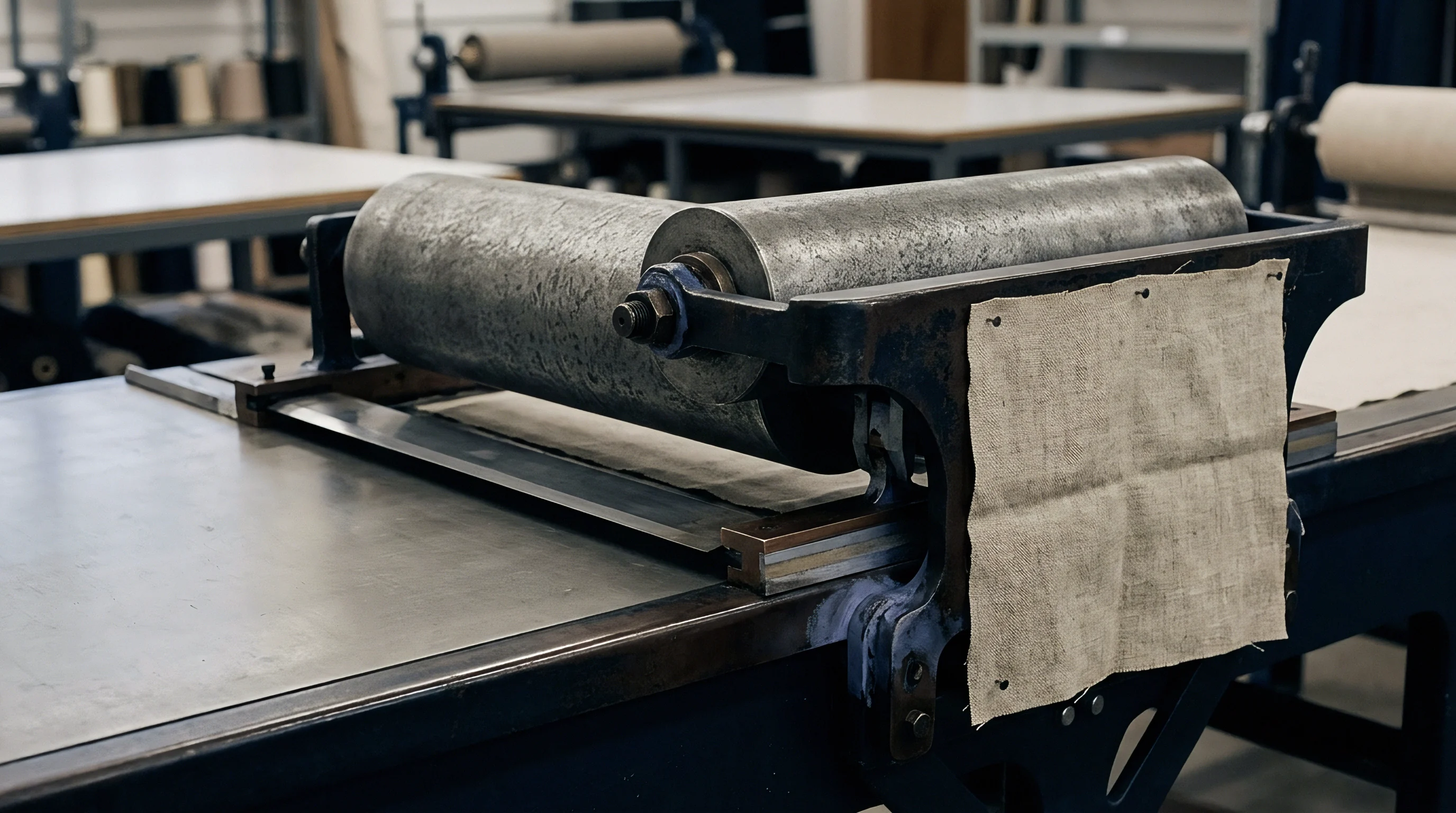
Un-curling guides positioned just before the drying chamber keep edges flat to prevent localized over-baking near edge tracks. Single jersey knits containing elastane curl toward the face along edges and toward the back along cut ends. If selvedges roll over before chain pinning, double-layer fabric passes through the pin plates, creating un-set, thick edge bands that must be trimmed away and reducing usable width.
Standard ISO 22198 measurements mandate exclusion of pinned or gummed edges from usable roll width metrics.
Mechanical gumming applicators place a narrow bead of fast-drying polymer adhesive along the outer fabric margins prior to trimming. Edge gumming seals the raw loop structure, preventing curl and holding cross-web dimension through garment cutting operations. High-viscosity water-based acrylic resins provide structural stiffness without bleeding into the usable cuttable field.

Worked Conversion Math for Usable Fabric Boundary
Garment markers require guaranteed flat, uniform material between usable edges. Gross width includes pin holes, adhesive gum lines, and curled border regions, whereas cuttable width measures only the flat, defect-free interior panel suitable for automated cutter blades.
Consider a bulk finishing lot run on a circular knitting machine producing twenty-five thousand meters of single jersey cloth, assuming a nominal invoice width of one hundred eighty centimeters. The table below demonstrates how edge treatment and mechanical pinning configurations dictate final usable cuttable area.
| Parameter | Standard Pinning | Optimized Gum & Trim | Un-Gummed High Overfeed |
|---|---|---|---|
| Gross Finished Width (cm) | 180.0 | 180.0 | 180.0 |
| Pin Track Waste Edge-Left (cm) | 2.5 | 1.5 | 3.5 |
| Pin Track Waste Edge-Right (cm) | 2.5 | 1.5 | 3.5 |
| Adhesive Gum Penetration (cm) | 0.0 | 1.0 | 0.0 |
| Edge Curl In-Roll Distortion (cm) | 3.0 | 0.0 | 5.0 |
| Net Cuttable Width (cm) | 172.0 | 176.0 | 168.0 |
| Cuttable Width Yield Loss (%) | 4.44 | 2.22 | 6.67 |
The math proves that edge-control choices directly govern delivered material value. A four-centimeter reduction in cuttable width across twenty-five thousand meters represents a loss of one thousand square meters of usable apparel components. When purchasing high-elastane rolls, marker width parameters must match the net cuttable line rather than the gross billable width printed on mill packing slips.
Whether mechanical edge-curling devices cause greater long-term width loss than high-viscosity acrylic edge gumming remains a point of debate.

Gauging

Standardized Dimensional Stability Verification
Testing according to ISO 5077 procedures establishes residual dimensional movement after five standard wash cycles. High-elastane textiles undergo rapid dimensional changes during domestic laundering if heat setting failed to lock internal polymer structure. Standardized verification isolates thermal shrinkage from moisture-induced swelling, requiring specimens to sit in standard atmospheres for twenty-four hours to eliminate pre-test tension storage.
Conditioning samples at twenty degrees Celsius and sixty-five percent relative humidity prevents ambient moisture from obscuring mechanical shrinkage values.
Testing procedures apply calibrated benchmark distances across warp and weft directions. After wash cycles complete, technicians measure dimensional changes to calculate percentage expansion or contraction. Cuttable width metrics must account for expected laundering shrinkage, as a roll meeting nominal width off the stenter that shrinks eight percent in laundering fails cuttable utility requirements for apparel production.
Wale and Course Density Verification Methods
Counting loop rows per centimeter using digital optical sensors provides real-time width predictions during continuous stenter passes. Linear loop density correlates directly with cross-web dimension; if course counts fall below specification, the fabric has been stretched excessively in length, forcing wales together and narrowing the cuttable panel.
| Property Measured | Standard Method | Specimen Condition | Acceptable Tolerance |
|---|---|---|---|
| Woven/Knit Usable Width | ISO 22198 / ASTM D3774 | Flat Relaxed, 24h ISO 139 | -0.5 cm / +1.5 cm |
| Dimensional Stability | ISO 5077 / ISO 6330 | 5 Cycles @ 40°C, Flat Dry | ±3.0% Max Variation |
| Loop Density (Wales/Courses) | ISO 7211-2 / ASTM D3887 | Optical Counting, 10 locations | ±2.5% against master |
| Elastane Heat-Set Quality | DIN 53845 / Internal Solv | DMF Solubilization Test | Zero core cleavage |
Automated width monitoring systems mounted at the stenter exit continuously read edge-to-edge span every five meters. Width profiles that fluctuate outside agreed tolerance windows indicate unstable tension control in cooling zones. Standardized testing sheets must report the minimum width recorded across the roll rather than averaged readings, because cutter marker layouts are limited by the narrowest point along the roll length.
- Conditioning Period specifies a twenty-four hour relaxation window on a flat surface before taking dimensional measurements.
- Pin Mark Exclusion Zone requires measuring width strictly inside edge perforation tracks according to ISO 22198.
- Multi-Point Sampling forces taking width readings at five separate locations along a roll to capture continuous line variance.
- Tensionless Laydown defines laying fabric flat on smooth inspection tables without manual smoothing or pulling force.
Failing to verify cuttable width under standard moisture equilibrium leads to marker overlap errors and high trim waste in the cutting room.

Reconciliation
Usable Area Billing and Penalty Calculations
Invoices calculated against gross roll width expose buyers to unrecoverable cost when edge pin marks exceed specification limits. Cross-border procurement contracts rely on square meter or linear meter billing backed by cuttable width guarantees. If a mill ships cloth declared at one hundred eighty centimeters, but unusable edges restrict cutter marker efficiency to one hundred seventy-two centimeters, the buyer loses over four percent of the purchased surface area.
Untrimmed pin tracks, adhesive bleed, and selvedge curling reduce usable surface area. Contracts must specify financial adjustments based on net usable area, applying deductions when width falls below minimum thresholds and escalating to lot rejection if cuttable width drops below minimum marker parameters.

Marker Yield Optimization and Width Tolerances
Garment cutting software relies on width stability across the lot to maintain pattern piece placement. Automated cutting rooms stack multiple plies of high-elastane knits onto long tables before applying vacuum compaction. If width fluctuates by three or four centimeters across rolls within the same dye lot, cutter operators must adjust master markers down to match the narrowest roll, which then sets the standard for the entire spread.
Adjusting markers down to match narrow rolls wastes material across all wider rolls in the spread. Sourcing teams reduce landed costs by establishing tight cuttable width tolerance bands with mills and enforcing financial penalties for rolls outside agreed ranges. Continuous monitoring during wet finishing ensures high-elastane knits deliver consistent cuttable dimensions from first meter to last.
Commercial agreements that tie billing strictly to verified cuttable width protect buying operations against edge waste variations introduced during continuous wet finishing.