Mechanochemical Ester Hydrolysis Kinetics in High-Tension Continuous Textile Mercerizing Range Baths
High tension during mercerization lowers ester activation energy, accelerating polyester breakdown and requiring draft control below 200 N/m to protect yield.
Strain
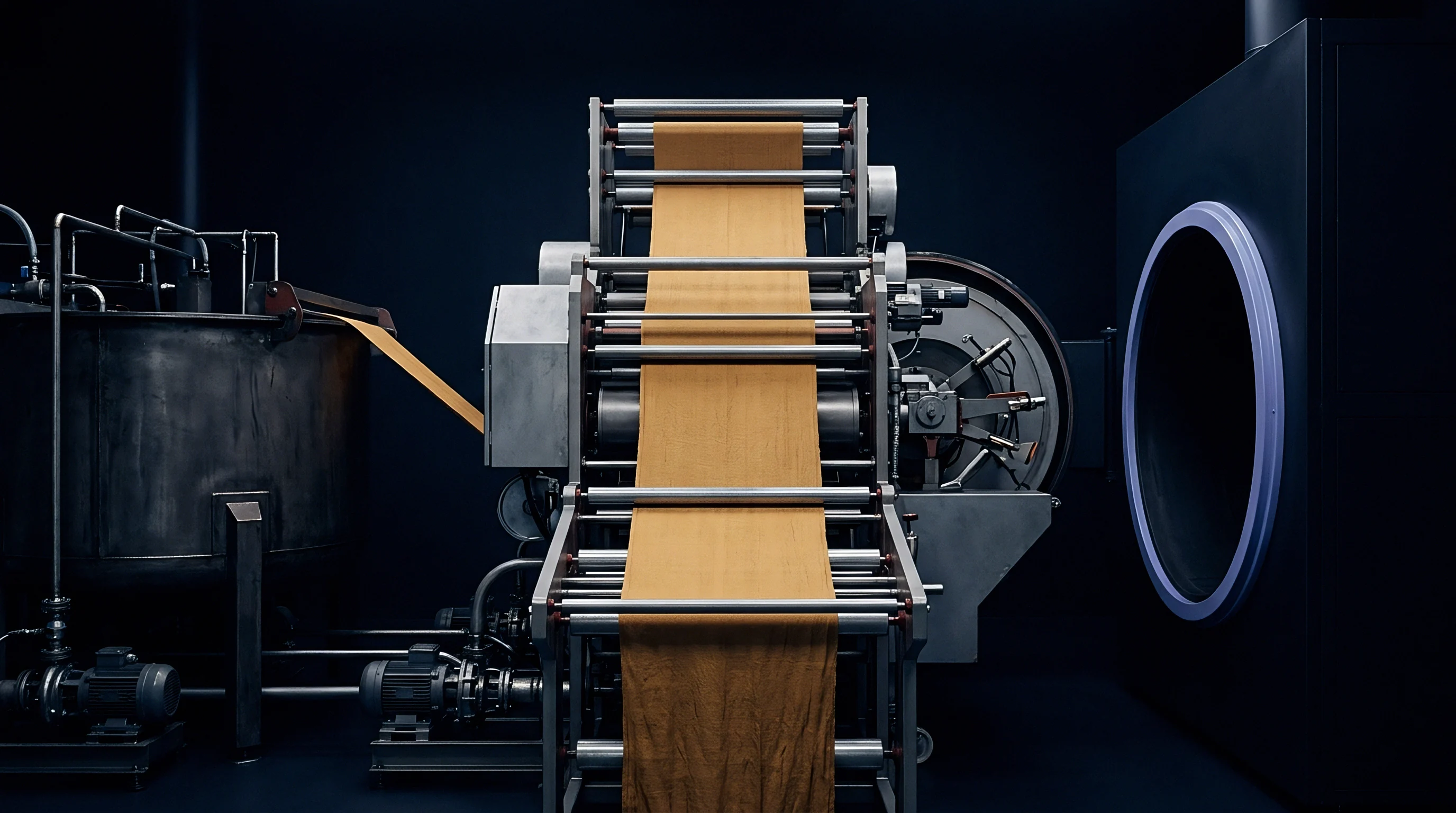
Continuous mercerization subjects woven and knitted goods to intense axial mechanical loads while submerged in concentrated sodium hydroxide solutions ranging from 28 to 30 degrees Baumé. Tensile loads applied by range draw rolls and clip tenter chains transform the chemical environment at the molecular level. Tensile stress accelerates cleavage.
When fabric passes through heavy nip rolls under warp tension levels exceeding 300 Newtons per metre, individual yarn filaments experience localized stress concentrations that alter bond geometries within synthetic and regenerated ester-containing fibers. The application of external mechanical energy lowers the thermodynamic barrier for base-catalyzed ester hydrolysis, shifting the standard equilibrium observed in un-tensioned, static immersion baths.
In high-tension continuous mercerization ranges, warp tension drives chain alignment. Polymer chains oriented along the stress vector undergo structural bond elongation. Carbon-oxygen single bonds in the ester backbone stretch beyond their equilibrium ground-state bond lengths.
This physical deformation reduces the activation energy needed for nucleophilic addition of hydroxide ions to carbonyl carbons. Consequently, saponification reactions that progress slowly in un-tensioned conditions proceed rapidly within the short 20 to 40 second dwell time of a high-speed continuous mercerizer.
The mechanical stress state within a continuous mercerizing range bath varies across the fabric assembly, creating distinct degradation zones between the surface and the core of blended yarns:
- Axial alignment stress stretches the amorphous regions of polyester and acetate filaments, exposing previously shielded ester linkages directly to hydroxide ion attack.
- Transverse compression loads generated by high-pressure nip rolls force caustic liquor deep into yarn bundle interspaces, maintaining high reactant concentration at stressed bond sites.
- Bending shear forces at expander rolls create localized stress peaks on outer filament crown surfaces, inducing micro-cracking and accelerated surface pitting.
- Weft clip tension generates biaxial stress profiles that alter the reaction kinetics in both warp and fills yarns simultaneously.
A warp tension of 350 Newtons per metre in a 28 degree Baumé caustic bath elevates ester bond cleavage rates by a factor of four relative to slack immersion at 20 degrees Celsius.
In blended fabrics containing polyester, cellulose acetate, or residual ester-based sizing agents, mechanochemical hydrolysis causes surface erosion and structural degradation. Sizing materials like polyvinyl acetate or polyester resins decompose rapidly under tension, releasing carboxylate species directly into the mercerizing liquor. When synthetic structural fibers carry the tension load, ester cleavage manifests as core filament thinning, loss of tensile strength, and mass loss exceeding standard process limits.
Understanding the distribution of strain across the fabric width enables precise machine setup, balancing the physical benefits of mercerization against chemical fiber destruction.
What remains unmeasured in continuous mill operations is the precise threshold where localized filament shear strain transitions from accelerating beneficial surface smoothing to triggering catastrophic core polymer chain scission.

Kinetics
Reaction rates for ester saponification in mercerizing baths follow a pseudo-first-order kinetic model driven by the high excess of hydroxide ions. High caustic concentrations aggravate damage. At sodium hydroxide concentrations between 220 and 300 grams per litre, hydroxide activity reaches levels where chemical kinetics control the initial reaction phase, limited only by diffusion rates through the liquid boundary layer surrounding the fibers.
The baseline rate constant depends heavily on bath temperature and caustic purity, but mechanical stress introduces an exponential multiplier to the classical Arrhenius equation.
Mechanochemical kinetics are modeled through stress-dependent modification of activation energy. Tensile tension applies mechanical work to the reactive ester linkages, destabilizing the ground state and pulling the carbonyl carbon into a quasi-tetrahedral geometry that mirrors the reaction transition state. Hydroxide ions attack carbonyl carbons.
The modified rate constant incorporates applied tensile stress through an activation volume tensor, causing exponential rate acceleration as axial stress increases.
| Applied Warp Tension (N/m) | Calculated Axial Stress (MPa) | Rate Constant k (s⁻¹) | Apparent Activation Energy (kJ/mol) | Relative Hydrolysis Acceleration |
|---|---|---|---|---|
| 0 (Slack) | 0.0 | 1.2 x 10⁻⁴ | 68.5 | 1.00x |
| 100 | 14.2 | 2.1 x 10⁻⁴ | 63.1 | 1.75x |
| 250 | 35.5 | 5.8 x 10⁻⁴ | 55.4 | 4.83x |
| 400 | 56.8 | 1.4 x 10⁻³ | 46.2 | 11.67x |
| 550 | 78.1 | 3.9 x 10⁻³ | 38.0 | 32.50x |
Temperature shifts alter reaction pathways. Raising bath temperature from cold mercerization conditions of 18 degrees Celsius to warm mercerization at 65 degrees Celsius shifts the rate-limiting step from chemical activation to boundary-layer diffusion. In hot mercerization ranges, the mechanochemical acceleration effect interacts with increased polymer chain mobility.
Thermal energy expands the amorphous polymer matrix, permitting faster penetration of caustic ions while mechanical stress simultaneously ruptures strained ester bonds.
Systematic reduction of activation energy under mechanical tension converts stable synthetic blend components into reactive substrates within standard range dwell times.
Ignoring stress-induced rate acceleration leads to severe fabric degradation, loss of burst strength, excessive weight reduction, and continuous contamination of reclaimed caustic streams with terephthalate salts.
Fibre
Polymer morphology dictates how individual fiber types respond to combined mechanical stress and caustic attack. In pure cotton, mercerization causes cellulose fiber swelling, conversion from Cellulose I to Cellulose II crystal lattices, and untwisting of the flat cotton lumen. In blended fabrics containing synthetic esters like polyethylene terephthalate or regenerated cellulose acetate, the high-alkali environment attacks the ester backbones while cotton undergoes desirable morphological transformation.
Tension amplifies chemical reactivity.
Surface erosion defines the physical breakdown of polyester fibers during continuous mercerization. Saponification occurs primarily at the liquid-solid interface because the large, hydrated hydroxide ions cannot readily penetrate the dense crystalline regions of hydrophobic fibers. Mechanical tension changes this dynamic by opening micro-voids in amorphous regions.
Hydroxide ions enter these stress-induced fissures, causing deep pitting and transverse stress-corrosion cracking rather than uniform surface erosion.
Uncontrolled mechanochemical attack converts smooth yarn filaments into pitted structures with poor abrasion resistance.
Dissolved ester breakdown products alter the chemistry of the mercerizing liquor. Saponification of polyethylene terephthalate yields soluble disodium terephthalate and ethylene glycol. Cellulose acetate hydrolysis releases sodium acetate into the bath.
These organic salts accumulate in continuous caustic recovery systems, elevating bath viscosity and suppressing caustic penetration into dense cotton yarns. As terephthalate concentrations exceed saturation thresholds in cooled recovery evaporators, solids precipitate on heating coils and piping walls, causing mechanical fouling and heat-transfer loss.
Converters frequently attribute sudden strength losses in polyester-cotton blends to supplier yarn defects, overlooking the reality that high machine tension during caustic immersion systematically strips structural cross-sections from synthetic filaments.


Draft
Machine configuration dictates the magnitude and uniformity of mechanical tension applied to fabric inside the caustic bath. Chainless mercerizers rely on driven concavo-convex roll stacks to maintain warp tension and manage fabric width through surface contact friction. Tenter clip mercerizers grip fabric selvedges mechanically, imposing direct transverse tension while roll drafts control longitudinal tension.
Chain tension governs weft stretch. Balancing draft ratios across individual drive zones remains necessary to avoid localized mechanical over-stressing of caustic-saturated yarns.

How Does Clip Tension Accelerate Core Fibre Degradation?
Clip tenters apply direct lateral forces that stretch fill yarns while the fabric passes through caustic dip tanks and timing sections. Wetting agents lower boundary resistance. When transverse stretch exceeds original greige loom state dimensions by more than two percent in the presence of 30 degree Baumé caustic soda, the mechanochemical hydrolysis rate on weft synthetic fibers accelerates sharpest at the selvedge zones.
The resulting differential strength loss across the fabric width produces center-to-selvedge variations in tear strength and shade depth during subsequent dyeing processes.
Establishing process boundaries requires a systematic operational approach to tension mapping across the continuous range:
- Measure fabric warp line speed at the entrance padder, timing section, section expanders, and discharge squeeze rolls using calibrated surface tachometers to calculate precise zone draft percentages.
- Extract caustic bath samples from each compartment to analyze dissolved organic carbon and disodium terephthalate content via ultraviolet-visible spectrophotometry.
- Install inline load cells on free-turning guide rolls to monitor real-time warp line tension in Newtons per metre across varying fabric styles and moisture pickup levels.
- Verify fabric width profiles across the tenter frame, recording width variations from clip entry to rinse zone discharge.
- Test residual tensile strength and weight loss on dry fabric samples taken immediately after the final acid neutralization and wash tanks.
Standard purchasing specifications require certified proof that tension control systems hold warp draft variations within plus or minus zero point two percent across the entire production run.
Contractual agreements specifying mercerized fabric quality require explicit limits on zone draft ratios; failure to state maximum allowed line tension leaves the buyer exposed to weakened blend goods produced on high-speed ranges operated for throughput over structural integrity.

Yield
Assessing the commercial impact of mechanochemical hydrolysis requires balancing fabric finish gains against material weight loss and strength reduction. Mercerization increases cotton luster, tensile strength, dye affinity, and dimensional stability. However, excessive mechanochemical degradation of blend components reduces total fabric weight, alters fiber ratios, and generates costly process waste.
Yield loss scales with dwell time. Excessive draft ruins yarn integrity.
Consider a continuous mercerizing operation running a 65/35 polyester/cotton twill fabric, weight 210 grams per square metre, through a 28 degree Baumé sodium hydroxide bath at 20 degrees Celsius with a dwell time of 30 seconds. The target output demands optimal cotton swelling without compromising the structural integrity of the load-bearing polyester filaments. The baseline process uses a moderate line tension of 100 Newtons per metre.
Increasing machine speed to maximize plant throughput demands elevating line tension to 350 Newtons per metre to prevent fabric sagging and edge curling in the long timing tanks.
| Operating Parameter | Low Tension Baseline (100 N/m) | High Tension Speed Run (350 N/m) | Over-Tensioned Failure (500 N/m) |
|---|---|---|---|
| Fabric Warp Tension (N/m) | 100 | 350 | 500 |
| PET Weight Loss Percentage (%) | 0.45 | 2.10 | 5.80 |
| Total Fabric Yield Loss (%) | 0.29 | 1.37 | 3.77 |
| Warp Tensile Loss (ISO 13934-1) (%) | 1.2 | 8.5 | 22.4 |
| Disodium Terephthalate Build in Bath (g/L) | 0.15 | 0.72 | 1.98 |
| Barré Defect Rate (Shade Variance) (%) | 0.1 | 1.8 | 6.4 |
The yield loss increases nearly fivefold when tension rises from 100 to 350 Newtons per metre, driven entirely by accelerated mechanochemical ester hydrolysis of the polyester component. At 500 Newtons per metre, the polyester filaments lose over five percent of their original mass, leading to severe strength drop and unacceptable barré defects during disperse dyeing. Standard test methods measure residual strength.
Saponification products build up in the bath, increasing recovery costs and shortening caustic recycling utility.
Controlling process yield requires clear criteria for machine operators and quality control managers during continuous range runs:
- Target draft boundaries must be set per fabric weight class to keep total axial tension below the threshold of mechanochemical kinetic acceleration.
- Caustic bath contamination limits demand continuous monitoring of disodium terephthalate levels, triggering bath replacement when concentrations exceed one gram per litre.
- Blend ratio verification testing must confirm that post-mercerization fiber distribution remains within international fiber content tolerances.
- Rinse efficiency protocols must strip residual caustic before fabric enters hot drying zones where elevated temperatures compound hydrolysis damage.
Fabric running under high tension in caustic liquor loses structural weight exponentially faster than fabric processed under minimal guidance tension.
Fabric line tension maintained below two hundred Newtons per metre protects synthetic blend components from mechanochemical attack while delivering complete cotton mercerization.
Expense
Financial parameters in high-tension continuous mercerizing ranges extend far beyond raw chemical consumption. Uncontrolled mechanochemical hydrolysis adds costs through fiber mass loss, compromised physical properties, increased chemical recovery expense, and fabric rejections. Caustic recovery demands continuous filtration.
Dissolved terephthalate salts reduce the efficiency of caustic recovery evaporators by forming insulating scale on heat exchangers. Removing this scale demands frequent chemical descaling acid washes, increasing plant downtime and reducing operational capacity.
| Cost Component | Controlled Tension Strategy ($) | High-Speed High-Tension Strategy ($) | Financial Difference (%) |
|---|---|---|---|
| Raw Caustic Soda Consumption | 420.00 | 445.00 | +5.95% |
| Fabric Fiber Yield Loss Value | 145.00 | 685.00 | +372.41% |
| Caustic Evaporator Descaling Expense | 60.00 | 280.00 | +366.67% |
| Quality Claims and Rejects Allowance | 110.00 | 950.00 | +763.64% |
| Total Processing Cost Impact | 735.00 | 2,360.00 | +221.09% |
Process economics favor low-tension range design and strict process control protocols. Operating ranges at maximum line tension to drive yardage output backfires through escalated yield losses and customer quality rejections. When buyer specs call for high tensile retention alongside mercerized appearance, setting tight warp draft tolerances on purchase orders prevents dyehouses from compromising blend integrity for machine speed.