In Line Spectrophotometric Control of Hydrolysis Kinetics in Ultra Low Liquor Jet Systems
In-line short-path spectrophotometry eliminates reactive dye hydrolysis in ultra-low liquor jets by dynamically locking alkali dosing to real-time exhaustion.

Absorbance

Spectrophotometric Flow Cells in Ultra Low Liquor Environments
Jet dyeing at liquor ratios between 1:3 and 1:5 alters the mechanical and chemical dynamics of reactive colouration on cellulose. The machine circulates a dense rope of fabric through a venturi nozzle where mechanical impingement forces dye liquor into the yarn interstices. In this low-volume bath, reactive dye concentrations run four to eight times higher than in conventional 1:10 liquor baths.
Hydrolysis kinetics accelerate under these conditions. The primary chemical competition pits the nucleophilic cellulosate anion against the hydroxide ion for the reactive group of the vinyl sulfone, monochlorotriazine, or heterobifunctional dye. In-line spectrophotometry monitors this exact race by tracking optical density in an external high-pressure bypass circuit.
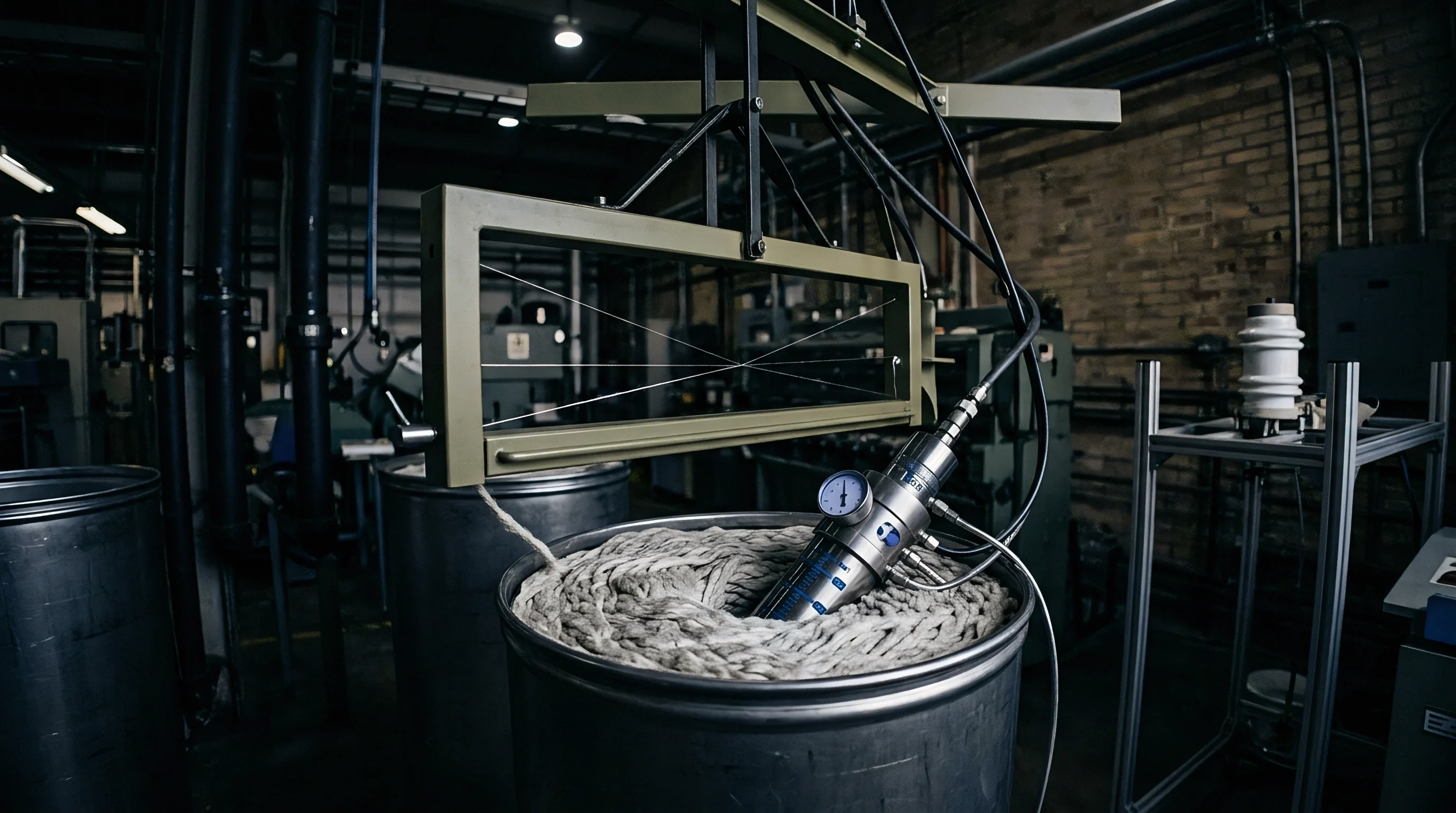
The core measurement hardware uses a continuous-flow cell containing sapphire windows separated by an optical path length adjustable from 0.05 to 1.0 millimetres. Standard 10-millimetre laboratory path lengths blind a photodiode array within seconds because liquor absorbance values exceed 3.5 optical density units at 40 grams per litre dye concentrations. The short optical path retains optical linearity between 0.2 and 1.8 units across the 380 to 750 nanometre spectral range.
Fiber-optic cables transmit light from a balanced deuterium-tungsten halogen source to the flow cell, returning the attenuated beam to a charge-coupled device detector. The detector records spectral sweeps every 250 milliseconds. Micro-pumps drive the liquor through an inline filtration unit before it reaches the optical cavity, stripping loose cotton lint down to five microns to eliminate optical scattering artifacts.
A short path length of 0.1 millimetres preserves Beer-Lambert linearity up to fifty grams per litre of reactive dyestuff without bath dilution.
Spectrophotometric monitoring separates active dye from hydrolyzed dye by resolving distinct absorption bands or deconvolving spectral shifts caused by molecular structure changes. Reactive dyes containing beta-sulfatoethylsulfone precursors convert to reactive vinyl sulfone forms upon alkali addition, shifting the peak absorption wavelength by three to seven nanometres before slowly decaying into the unreactive 2-hydroxyethylsulfone hydrolysate. Monochlorotriazine dyes experience a hypsochromic shift as the chlorine atom displaces in water to form the inactive hydroxy derivative.
The in-line system computes first-derivative spectra to isolate these overlapping bands. The calculation yields the instantaneous ratio of unreacted parent dye to hydrolyzed byproduct directly in the bypass loop.

Are Process Transients Distorting Inline Spectral Data?
Air bubble entrainment presents the most severe mechanical threat to spectral fidelity in ultra-low liquor machines. The venture jet nozzle operates by entraining liquor with air or inert gas to push the fabric forward through the transport tube. The returning dye bath contains dense microfoam.
When micro-bubbles traverse the spectrophotometric interrogation volume, they produce catastrophic baseline elevation across all wavelengths via Mie scattering. The flow cell must sit downstream of an inline debubbler operating at a line pressure exceeding three bar. The hydrostatic pressure collapses microscopic gas bubbles back into solution prior to entering the optical slit.
Sapphire windows prevent scratches from abrasive particulate matter, but require continuous ultrasonic transducer agitation to prevent dye deposition on the glass faces during salt dosing.
Temperature compensation represents the second measurement prerequisite. In-line flow loops pull hot dye liquor from the machine’s primary circulation line, which reaches fixation temperatures up to 80 degrees Celsius for triazine chemistry or 60 degrees Celsius for vinyl sulfone chemistry. The molar extinction coefficient of reactive dye chromophores varies inversely with temperature, drifting between 0.15 and 0.4 percent per degree Celsius depending on the chromophore class.
An in-line resistance temperature detector logs liquor temperature synchronously with each spectral sweep. The analytical processor applies an empirical polynomial temperature-correction matrix to align real-time absorbance values with calibrated 25-degree isothermal absorption standards.
The dyehouse manager faces immediate shade drift if this flow-cell loop drops below line pressure.

Pathway

Hydrolysis Chemistry of Bifunctional Reactive Dyes
Heterobifunctional reactive systems contain both a monochlorotriazine ring and a beta-sulfatoethylsulfone group on the same chromophore core. This dual architecture offsets the kinetic vulnerabilities inherent in single-group chemistries. The vinyl sulfone moiety undergoes an elimination reaction in alkaline conditions to eliminate the sulfate ester group, yielding the reactive vinyl sulfone species.
The vinyl group attacks the secondary and primary hydroxyl groups of the cellulose polymer chain through nucleophilic addition. Simultaneously, the monochlorotriazine ring undergoes nucleophilic substitution with the cellulose anion at elevated temperatures, releasing a chloride ion. Both reactive systems encounter identical competing nucleophiles: cellulose-O minus and OH minus from water.
Hydrolysis occurs when hydroxide ions successfully attack these reactive positions. The vinyl sulfone converts irreversibly into 2-(hydroxyethyl)sulfone, an inactive molecule incapable of covalent bonding to cellulose. The chlorotriazine hydrolyzes to form 2-hydroxy-4,6-dichloro-s-triazine derivatives, rendering the triazine ring unreactive.
In an ultra-low liquor jet system running at a 1:4 liquor ratio, the chemical consumption dynamics diverge from standard 1:10 liquor operations. While dye concentrations scale up by 250 percent, the chemical activity of the dissolved electrolyte scales non-linearly. The concentration of sodium chloride or sodium sulfate frequently approaches 80 to 100 grams per litre to force dye exhaustion onto the fibre matrix.
Electrolyte concentrations of this magnitude depress the ionization constant of water, altering the equilibrium between water molecules and active hydroxide ions. As dye molecules aggregate under heavy salt conditions, the internal diffusion of hydroxide ions into dye clusters changes the apparent hydrolysis rate constants. The in-line spectrophotometer tracks the consumption of both parent groups by monitoring multi-wavelength bands simultaneously.
Vinyl sulfone consumption correlates with absorbance changes in the 410 to 490 nanometre window for golden yellow dyes, whereas triazine reaction progress registers shifts in the secondary ultraviolet-visible transitions between 310 and 360 nanometres. The table below outlines the kinetic and mechanical distinctions observed across standard and ultra-low liquor environments.
| Process Variable | Standard Jet (1:10 Ratio) | Ultra-Low Liquor Jet (1:4 Ratio) | Kinetic Consequence |
|---|---|---|---|
| Dye Bath Concentration | 1.5 to 3.0 g/L | 3.75 to 7.5 g/L | Higher aggregation shifts extinction coefficients |
| Electrolyte Loading | 40 to 60 g/L | 80 to 100 g/L | Forces high exhaustion; depresses ionic mobility |
| Hydrolysis Rate Constant (k_h) | 0.012 to 0.018 min⁻¹ | 0.028 to 0.045 min⁻¹ | Hydrolysis accelerates due to high local base activity |
| Fixation Efficiency Target | 72 to 78 percent | 84 to 90 percent | Higher exhaustion yields more bound dye if base is controlled |
| Circulation Cycle Time | 45 to 60 seconds | 18 to 28 seconds | Rope speed must increase to prevent unlevel strike |
| Total Liquor Mass (500kg fabric) | 5000 kg | 2000 kg | Thermal and dosing shocks hit the bath faster |
High exhaustion achieved through elevated electrolyte additions provides a protective buffer against hydrolysis. Dye molecules residing within the cellulose diffuse-double-layer interface encounter lower effective concentrations of free hydroxide ions compared to dye molecules remaining in the bulk liquor phase. When dosing curves push exhaustion past 85 percent prior to alkali injection, the mass of dye vulnerable to bulk liquor hydrolysis drops dramatically.
The in-line spectrophotometric controller tracks this exhaustion curve in real time, calculating the absolute quantity of dye remaining in the liquid bath before alkali dosing begins.
A contract specification must mandate an exhaustion plateau verification step before alkali dosing can begin.
If alkali feeds into the system before exhaustion reaches its critical set point, unabsorbed dye molecules hydrolyze within the liquid phase. The resulting hydrolyzed dye cannot fix to the cotton substrate. It stays in loose solution, contaminating subsequent rinse cycles and demanding extensive washing off.
Wash-off lines consume thousands of litres of water, reversing the environmental gains of ultra-low liquor jet operations. Tracking hydrolysis kinetics allows the control system to hold alkali dosing until exhaustion reaches its target threshold, preserving bulk dye integrity.
Uncontrolled alkali timing leaves the finisher with sixty percent wash-off losses and unfixable unlevelness across the batch.


Drift
Alkali Dosing Control and Ph Boundary Conditions
Conventional jet dyeing controls the fixation phase through pre-programmed dosing ramps based on time elapsed rather than bath chemistry. Liquid caustic soda or soda ash meters into the machine along linear or progressive curves over 30 to 45 minutes. In ultra-low liquor systems, this rigid approach fails because small volumetric additions produce severe local pH spikes.
A dosing error of two litres of sodium hydroxide solution in a 2,000-litre bath shifts the pH by 1.2 units within two fabric rope cycles. The localized pH surge drives the hydroxyl ion concentration past optimal fixation boundaries, causing the hydrolysis reaction to outpace cellulose fixation by a factor of four.
In-line spectrophotometric closed-loop control replaces time-based profiles with adaptive rate control. The optical instrument monitors real-time dye exhaustion and the emergence of hydrolyzed spectral footprints. As the spectrophotometer detects an increase in the decay rate of active chromophores without a corresponding increase in exhaustion onto the substrate, the automation system throttles the alkali metering pump.
The dosing system holds bath pH precisely between 10.8 and 11.2 for vinyl sulfone groups, or 11.4 to 11.8 for monochlorotriazine structures. The controller uses feedforward compensation derived from real-time liquor volume calculations, balancing the pump stroke volume against the jet circulation cycle time.
The operational risks inherent in open-loop alkali addition manifest directly in fabric fastness and colour reproducibility:
- Premature Hydrolysis Runaway occurs when rapid alkali dosing elevates bath pH above 12.0 before dye finishes diffusing into the core of the cotton yarn structure. Dye molecules hydrolyze in the bath, leaving the fabric core unpenetrated and rings dyed.
- Localized Unlevel Strike happens when concentrated alkali injects without sufficient rope turnover, generating dark, over-fixed patches near the nozzle entry. The fabric takes twenty seconds per cycle, and a fast-acting dosing pump creates wide shade variations along the rope length.
- Fiber Tendering develops if caustic dosing exceeds critical limits at elevated temperatures, initiating cellulose depolymerization and reducing warp and weft tensile strengths below commercial apparel tolerances.
- Oligomer Precipitation emerges in blended goods when high alkali conditions leach polyester oligomers or cotton waxes into the reduced liquor volume. These compounds precipitate on machine surfaces and redeposit on the moving piece goods as insoluble spots.
The closed-loop architecture monitors spectral shifts in the 520 to 620 nanometre range every two seconds, translating spectral variations into an active reaction rate index. When this index moves outside pre-set tolerances, proportional-integral-derivative algorithms adjust variable frequency drives on the chemical dosing skid. The chemical delivery adjusts to the actual absorption behavior of that specific lot of fabric, absorbing variations in yarn maturity, greige preparation quality, and residual sizing materials.
Suppliers routinely claim their standard recipes run without adjustment across all liquor ratios.


Rig
Physical Integration of High-Pressure Bypass Loops
Installing an optical flow cell on a pressurized ultra-low liquor jet machine requires specialized mechanical layout and piping design. The sampling loop pulls directly from the main circulation line immediately after the heat exchanger and circulation pump, tapping the zone of maximum turbulence and complete chemical mixing. The takeoff point features a flanged, non-clogging sanitary port oriented at 45 degrees to the horizontal axis of the pipe.
This angle prevents the collection of settled particulates along the bottom of the pipe and prevents air accumulation from the upper surface. The liquor passes through a dual-stage stainless steel mesh filter before entering the measurement chamber.
The bypass loop incorporates an auxiliary positive displacement pump to maintain constant fluid velocity through the optical cell regardless of nozzle pressure settings. Variable fabric styles require the machine operator to adjust the main jet nozzle diameter and pump pressure. Without an independent bypass pump, alterations to the primary nozzle pressure alter the flow velocity through the optical cell, causing fluid dwell-time variations and calibration errors.
Fluid velocity through the flow cell must remain constant at 1.5 to 2.0 metres per second. This high shear rate keeps the sapphire optical windows clean, scouring away boundary layers and minimizing laminar dead zones that degrade dynamic response times.
System components require careful arrangement to guarantee measurement stability during severe hydraulic and thermal cycling:
- The sampling port taps into the primary circulation pipe downstream of the circulation pump discharge to secure maximum static pressure.
- A dual-basket automated backflushing filter housing containing forty-micron sintered wire cloth removes lint agglomerations without halting flow.
- A shell-and-tube micro-exchanger stabilizes the sample stream temperature within a narrow three-degree operating window.
- The high-pressure debubbler vessel removes dissolved micro-gas via controlled pressure drops and centrifugal fluid swirling.
- The sapphire optical flow cell, fitted with SMA-905 fiber-optic connectors, measures light transmission across a fixed 0.2-millimetre gap.
- A magnetic inductive flow meter verifies that sample velocity through the flow cell remains locked at the target setpoint.
- A pneumatically actuated three-way valve returns the analysed dye liquor directly to the suction side of the primary jet circulation pump.
Maintenance procedures require clear operational rules. Operators flush the bypass loop with an alkaline reduction-clearing solution containing two grams per litre of sodium hydrosulfite and two grams per litre of sodium hydroxide at 80 degrees Celsius after every dark shade run. This flush strips residual dye films off the cell windows, restoring 100 percent baseline transmission against demineralized water.
The spectrometer executes a dark-current subtraction and reference calibration sweep prior to charging the jet with fresh fabric. If baseline transmission drops below 92 percent of the factory calibration reference, the machine interlock blocks batch initiation until mechanical cleaning occurs.
A clean bypass loop operating under high shear preserves optical transmission above ninety-five percent without manual teardown.
Physical vibration from the main jet machine poses an additional risk to optical alignment. The spectrophotometer enclosure and light source mount to an isolated structural frame anchored directly to the dyehouse floor, decoupled from the vibrating jet shell. Armoured, stainless-steel-jacketed optical fibers connect the light source, flow cell, and spectrometer.
The fiber design uses low-OH silica cores to prevent hydroxyl absorption bands from distorting spectra between 600 and 700 nanometres. The entire optical assembly conforms to IP67 environmental ratings to resist humidity, steam exposure, and chemical splashes common in industrial dyehouse environments.
Skip the daily baseline sweep against demineralized water, and optical drift guarantees off-shade bulk within three cycles.


Yield
Worked Dyehouse Model: Fixation Efficiency and Financial Impact
To quantify the economic impact of in-line kinetic control, consider a high-capacity production run using reactive black heterobifunctional dye on 100 percent combed cotton single jersey knit. The fabric specification calls for a 30/1 Ne yarn count, 160 grams per square metre finished weight, knitted on a 28-gauge circular machine. The targeted bulk run comprises 10,000 kilograms of finished fabric, processed across five consecutive 2,000-kilogram dye machine charges.
Each charge runs in a modern multi-port jet dyeing machine configured for ultra-low liquor processing.
The comparative model evaluates two operational strategies on the same equipment. Strategy A uses conventional timed dosing, relying on manual lab-dip translation and standardized time-temperature recipes. Strategy B uses inline spectrophotometric feedback control that dynamically meters alkali based on real-time exhaustion and hydrolysis rates.
The dye formulation consists of Reactive Black 5 (vinyl sulfone) combined with Reactive Red 195 (heterobifunctional) and Reactive Yellow 145 (heterobifunctional) to yield a deep jet black shade. Total dye formula weight equals 6.5 percent on weight of fabric. Target liquor ratio is fixed at 1:4.5.
| Production Metric | Strategy A: Timed Open-Loop Dosing | Strategy B: Inline Spectrophotometric Control | Operational Variance |
|---|---|---|---|
| Initial Dyestuff Mass Charged | 650.0 kg | 650.0 kg | Zero formula change |
| Mean Final Bath Fixation Yield | 74.2 percent | 86.8 percent | Plus 12.6 percent effective fixation |
| Unfixed and Hydrolyzed Dye Mass | 167.7 kg | 85.8 kg | 81.9 kg less dye sent to effluent |
| Rinse Cycles Required | 6 baths | 4 baths | Reduction of 2 post-rinse baths |
| Process Water Consumption | 45.0 L/kg fabric | 28.5 L/kg fabric | 36.7 percent net water reduction |
| Total Cycle Time Per Batch | 385 minutes | 295 minutes | 90 minutes saved per charge |
| First-Time-Right Dyeing Rate | 86.0 percent | 98.5 percent | Eliminates re-dyeing and shading |
| Cost Per Finished Metre | $0.482 USD | $0.418 USD | $0.064 USD per finished metre savings |
The financial impact of Strategy B stems from three operational factors: dyestuff conservation, wash-off water reduction, and machine throughput acceleration. Operating under Strategy A, 167.7 kilograms of expensive reactive dyestuff hydrolyzes prematurely due to inaccurate dosing timing, becoming useless waste that must be rinsed away. Under Strategy B, dynamic dosing suppression maintains optimal pH, lifting overall fixation to 86.8 percent.
The increase in fixation yields identical colour depth with a lower volume of unattached dye molecules, allowing the plant to drop two hot wash-off baths per lot.
Eliminating two rinse baths saves 165,000 litres of heated water across the 10,000-kilogram program. Thermal energy savings scale directly with this water reduction, lowering natural gas boiler load. Furthermore, shortening cycle times from 385 minutes to 295 minutes recovers 7.5 hours of machine capacity over the five batches.
The plant processes an additional complete dye charge within the same machine run-time envelope. Factoring in utility costs, auxiliary chemical inputs, effluent discharge surcharges, and plant labor, total processing cost drops from $0.482 to $0.418 per finished metre. On an annual production volume of 2.5 million metres, this operational refinement yields savings of $160,000 USD.
Mills frequently absorb dyehouse losses until an off-shade batch triggers a retail rejection.


Audit

Verification Protocols and Buyer Due Diligence
A buyer sourcing reactive-dyed knit or woven piece goods must verify the mill’s dynamic control credentials long before fabric lands at the cut-and-sew factory. Technical auditors must evaluate physical installations rather than accepting marketing claims at face value. The factory audit begins directly at the jet dyeing machines.
Auditors must examine the bypass lines, checking for operational flow meters, active data cables connecting flow cells to industrial PCs, and evidence of functioning bypass backflush assemblies. An audit must confirm the presence of high-precision spectrophotometric components rather than simple single-wavelength photometers, which cannot deconvolute hydrolysis curves from bath exhaustion.
A rigorous mill qualification procedure inspects digital log architecture. Modern in-line spectrophotometric systems record time-stamped kinetic data for every production dye cycle. The auditor should extract raw comma-separated value log files for recent production runs, cross-referencing spectral readings with machine temperature and chemical dosing events.
A genuine dynamic run shows active modulation of the dosing pump frequency in response to shifting bath absorbance, visible as irregular, saw-toothed feed curves. A smooth, perfectly linear dosing profile reveals that the machine operates under static open-loop control, rendering the expensive spectrophotometric hardware nothing more than an uncoupled display gauge.
The auditor must examine specific data fields within the machine controller records to confirm dynamic process control:
- Spectral Wavelength Calibration Logs showing automated baseline referencing against demineralized water executed within the preceding 24 hours.
- Absorption Linearity Records verifying that the system optical path length maintains measurement linearity across target recipe concentration ranges.
- Time-Stamped Pump Modulation Traces showing active variable frequency drive feedback based on spectral exhaustion rates rather than elapsed time alone.
- Spectrally Derived Hydrolysis Indices recording the calculated ratio of active dye to hydrolyzed byproduct throughout the alkali dosing phase.
The sourcing contract must protect the buyer against shaded deliveries by tying acceptance criteria to instrumental colour tolerances across illuminants. While in-line systems stabilize exhaustion and fixation, laboratory spectrophotometers evaluate the ultimate physical proof on finished fabric swatches. Standard purchase terms should require Delta E CMC (2:1) values below 0.6 relative to the approved primary standard under D65, with secondary metameric tolerances held below 0.8 under Illuminant A and Illuminant F11.
Crucially, the testing protocol must measure five swatches taken from the head, middle, and tail of each processed jet rope to catch intra-batch shade drift.
Finished goods fastness testing validates whether the mill successfully managed hydrolysis kinetics on the production floor. Fabrics processed through an unstable dye bath contain elevated levels of hydrolyzed dye trapped within the fibre matrix, resulting in poor wash and rub fastness even if the initial colour match appears acceptable. Purchase specifications should demand ISO 105-C06 (Colour fastness to domestic and commercial laundering) ratings of Grade 4 to 5 for shade change and cross-staining across multi-fiber strips, coupled with ISO 105-X12 dry rubbing fastness of Grade 4.5 and wet rubbing fastness of Grade 3.5 minimum.
Failure to achieve wet rub standards indicates unwashed hydrolysate redeposited on the cotton surface, verifying poor bath control.
International buyers verify these parameters through strict contract clauses, ensuring technical specifications protect capital investments.