Predicting Woven Fabric Crimp Interchange in Thermal Processing
Coupled yarn balance during thermal exposure shifts crimp from tensioned warp to slack weft, dictating finished width and mechanical stability.

Balance
Orthogonal Yarn Equilibrium under Thermal Drive
Loom interlacement forces warp and weft yarns into tortuous three-dimensional paths around each other. As greige goods enter thermal processing chambers, applied heat mobilizes polymer chains while moisture or hot air releases frozen spinning and sizing strains. When longitudinal machine pull tensions the warp ends, the amplitude of warp undulation drops, pushing against intersecting weft picks and forcing those transverse yarns to bend further around straightened warp ends.
The physical displacement of yarn axes during this continuous interaction constitutes crimp interchange. Greige construction parameters fix total available yarn length per unit area, yet curvature distribution between warp and weft remains dynamic until cooling sets the matrix. In polyester, nylon, and blended textiles, heat setting temperatures soften yarn bending resistance, allowing mechanical forces on the pin chain or conveyor to redistribute crimp rapidly.
Loom cross-over points lock their geometry when thermal energy exceeds yarn draw temperature.
Mathematical representation of this structural shift relies on yarn modular length models established by Frederick Peirce and extended for viscoelastic mechanics by Bengt Olofsson. When cloth geometry undergoes heat relaxation, the sum of warp crimp amplitude and weft crimp amplitude remains constrained by yarn diameter and threadline spacing. A decrease in warp crimp produces an immediate, predictable increase in weft crimp unless lateral restraint holds the cloth edges.
- Excessive Warp Line Tension pulls the lengthwise ends taut, driving weft crimp upward and shrinking the cuttable width beyond salvage limits.
- Insufficient Transverse Pinning permits unrestrained thermal contraction in the filling direction, creating excessive selvage-to-middle pick density variance.
- Asymmetric Sizing Deposition locks individual yarn segments unevenly, preventing uniform crimp migration and generating optical barré across finished panels.
- Non-Uniform Thermal Fields create localized variations in yarn bending rigidity, producing erratic wavy edges along stenter exit rails.
The balance of mechanical forces across each interlacing node governs the final picks per inch and ends per inch delivered to the inspection table, where width contraction tightens pick spacing. Mills that fail to balance these coupled axes deliver goods with uncorrectable dimensional instability.

Predictive Equations for Threadline Crimp Migration
Calculations for crimp interchange begin with conservation of yarn modular path length within a single repeating unit cell. Let modular length be designated as l, yarn crimp as c, yarn projection length as p, and yarn wave height as h. Subscripts 1 and 2 define the warp and weft systems respectively.
The classical Peirce relationship establishes spatial boundaries within the orthogonal structure:
p1 = l1 (1 – c1) = ^0.5
p2 = l2 (1 – c2) = ^0.5
h1 + h2 = d1 + d2
In these expressions, d1 and d2 denote effective compressed diameters of warp and weft yarns at their intersection point. When thermal energy raises the substrate past the polymer glass transition point, yarn transverse compressibility increases, shrinking the combined sum (d1 + d2) by five to twelve percent depending on yarn twist factor and packing fraction. Concurrently, thermal shrinkage forces act along the axial path of both yarn systems.
Lowering yarn bending stiffness through thermal exposure allows c1 to decline if external longitudinal tension holds p1 constant or extends it. Because the sum of wave heights h1 and h2 must equal the compressed yarn diameter sum, any reduction in h1 directly forces an elevation in h2. The transverse projection p2 consequently contracts according to modular length constraints, pulling filling yarns inward and reducing finished cloth width.
| Cloth Construction | Processing State | Warp Crimp (%) | Weft Crimp (%) | Ends Per Decimetre | Picks Per Decimetre | Areal Weight (g/m²) |
|---|---|---|---|---|---|---|
| Polyester 150D / 150D | Greige Loom State | 8.4 | 7.2 | 280 | 240 | 142 |
| Polyester 150D / 150D | Relaxed Scoured | 6.1 | 12.8 | 292 | 238 | 154 |
| Polyester 150D / 150D | Heat-Set Finished | 4.2 | 15.6 | 304 | 236 | 158 |
| Polyamide 70D / 70D | Greige Loom State | 7.8 | 6.9 | 440 | 380 | 88 |
| Polyamide 70D / 70D | Heat-Set Finished | 3.5 | 14.1 | 472 | 376 | 96 |
| Cotton / Poly 40s / 40s | Greige Loom State | 9.2 | 5.8 | 520 | 280 | 118 |
| Cotton / Poly 40s / 40s | Finished Calendered | 5.4 | 11.2 | 548 | 278 | 126 |
Yarn crimp redistributes across orthogonal axes: whenever warp tension pulls loom cross-points flat, weft crimp climbs until the filling yarn jams against its neighbor.

Draft
Can Machine Overfeed Suppress Warp Crimp Transfer?
Continuous thermal ranges exert draw forces through infeed rolls, dancer arms, and tension bars. Positive pin overfeed delivers cloth onto stenter chains at a linear velocity exceeding rail travel rate, crowding warp ends into the entry zone. This controlled slackness reduces longitudinal stress, dampening the driver that pulls warp crimp into the weft path.
By varying overfeed settings between positive four percent and positive eighteen percent, finishing technicians control the mechanical exchange between warp and weft wave heights. When overfeed matches the thermal contraction potential of lengthwise synthetic fiber, warp yarn contracts freely without drawing amplitude out of filling picks.
A twelve percent longitudinal overfeed at two hundred degrees Celsius holds filling width loss below two percent in hundred-count poplin.
Adjusting differential overfeed operates under strict physical boundaries. Excessive entry slack allows cloth to sag between stenter pins, creating edge scuffs or uneven heat transfer across the web face. Insufficient overfeed transfers forward motor torque directly to heated warp ends, stripping their crimp and triggering uncontrollable lateral necking.
- Align the entry optical sensors to read filling alignment before cloth pins touch the stenter transport chain.
- Engage the master variable frequency drives to establish the designated lead ratio between entry nip rolls and chain sprockets.
- Verify load-cell readings across the immersion padder to prevent tension accumulation prior to pin engagement.
- Regulate rail width taper from entrance tracks through drying zones to control filling tension during water evaporation.
- Engage exit pull rolls at a surface speed calibrated precisely to chilled cloth delivery without inducing secondary draw.
Without exact synchronicity across every drive motor, longitudinal draft strips crimp from the warp and ruins calculated filling width before cooling locks the displaced geometry.
Tension Transducers along Continuous Finishing Ranges
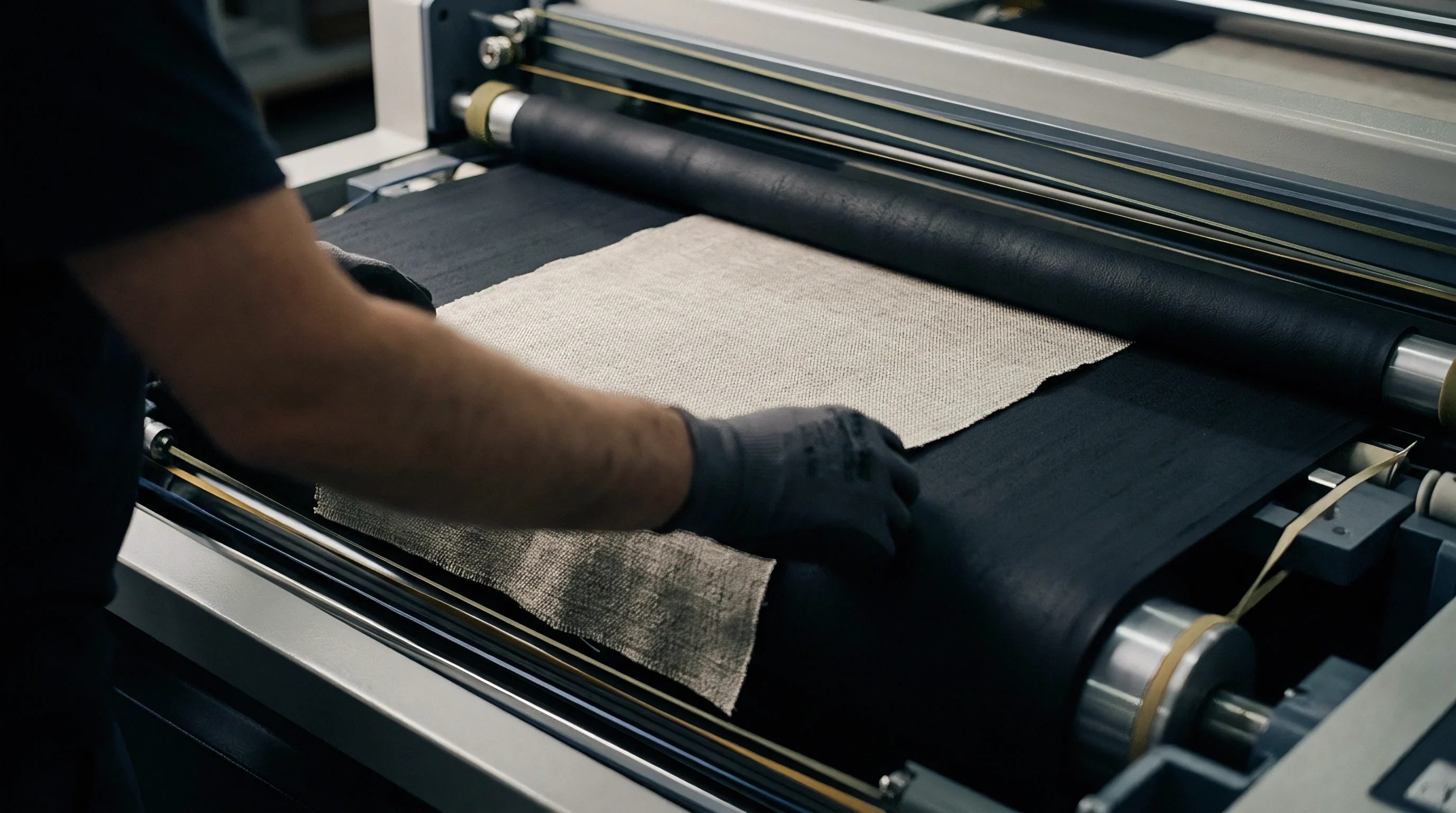
Modern thermal finishing ranges incorporate segmented load-cell rolls to measure line tension in real time. Running continuous synthetic goods under warp tensions above 0.8 Newtons per end causes irreversible crimp loss before the substrate reaches heat-setting temperature. Machine control systems must isolate tension spikes caused by roll runout, uncurler drag, or padder nip compression.
As cloth passes across internal heating fields, the thermal contraction force of warp yarn acts against machine haul-off tension, making dwell time critical to polymer relaxation. If the line drive fails to yield to this shrinkage force, resulting internal stress flattens warp curvature permanently. Greige weavers frequently face rejection when finishing plants run lines too fast to allow proper stress dissipation.
Incoming greige tension spikes can exceed the mechanical correction limits of stenter overfeed pins.

Bake
Why Polymer Glass Transition Alters Modular Resistance?
Thermal activation transforms the mechanical behavior of thermoplastic fibers by dismantling secondary intermolecular bonds. Below the glass transition zone, oriented yarns exhibit high initial tensile modulus and substantial bending stiffness. When heating elements raise web temperature above this transition boundary, flexural rigidity drops by up to eighty percent, permitting cross-sectional flattening and rapid crimp interchange under minimal external loads.
As polymer chains disengage from frozen configurations in hot air, entropy-driven shrinkage forces develop along each filament axis, accelerating polyester crystallization. If the yarn is restrained longitudinally by stenter pins, these axial forces manifest as immense tensile loads. The resulting cross-point reaction pressure indents the orthogonal filling yarn, forcing it to bend sharply around the taut warp axis.
In polyester substrates, heat setting between 190 and 215 degrees Celsius simultaneously drives recrystallization and relieves internal stress. Crystalline morphology developed in this thermal state permanently sets the yarn crimp geometry established by the machine tension profile. Once cloth exits the heat zone and cools below its secondary transition point, newly formed crimp balance resists mechanical deformation during garment manufacture and laundering.
Cross-machine shrinkage differences distort garment panels along cut marker lines.
If warp ends outnumber filling picks by more than two to one, thermal contraction energy of the warp system dominates the structure. The resulting lateral pressure forces weft picks into severe high-amplitude waves that destabilize selvages and promote fabric bowing across the web center, inducing edge curl.

Worked Calculation for Continuous Polyester Cotton Finishing
Evaluating crimp interchange in a production environment requires coupled structural equations. The following worked model examines high-density polyester and combed cotton plain sheeting processed through a six-chamber industrial stenter range.
The construction under analysis arrives with specific greige loom specifications:
- Yarn Specification consists of a 65/35 polyester/cotton ring-spun warp of 14.8 tex (40s Ne) and a matching weft of 14.8 tex (40s Ne).
- Greige Thread Density measures 512 ends per decimetre (130 ends per inch) and 276 picks per decimetre (70 picks per inch).
- Loom Crimp Values measured under standard conditioning show warp crimp c1 = 0.085 (8.5 percent) and weft crimp c2 = 0.055 (5.5 percent).
- Effective Yarn Diameter under greige compression is determined as d1 = 0.125 millimetres and d2 = 0.130 millimetres.
- Free Thermal Shrinkage of the isolated polyester component at 195 degrees Celsius is 7.2 percent in hot air.
During thermal treatment at 195 degrees Celsius with a line speed of 45 metres per minute and a dwell time of 28 seconds, the machine applies a positive warp overfeed of six percent while setting rail width to 162 centimetres against a greige width of 168 centimetres. Longitudinal tension corresponds to a residual warp draw of negative two percent relative to free contraction.
First, calculating finished modular lengths: accounting for thermal contraction and moisture desizing loss, warp modular length l1 reduces from 2.115 millimetres to 2.012 millimetres. Weft modular length l2 undergoes unrestrained swelling and minor synthetic contraction, moving from 2.004 millimetres to 1.945 millimetres.
Second, setting enforced warp projection length p1: given net machine draft and overfeed balance, finished pick spacing p1 locks at 0.352 millimetres, corresponding to 284 picks per decimetre. Solving for finished warp crimp:
c1 = 1 – (p1 / l1) = 1 – (0.352 / 2.012) = 0.046 (4.6 percent)
Third, applying Peirce wave height balance yields a reduced warp wave height of:
h1 = ^0.5 = ^0.5 = 0.605 millimetres
Under heat-setting compression, combined compressed diameter (d1 + d2) settles at 0.235 millimetres. The resulting weft wave height h2 shifts through mechanical displacement:
h2 = (d1 + d2) – h1 = 0.235 – 0.605
A negative mathematical sign indicates the structure has reached its jamming limit, forcing yarn flattening and ovalization. Compressed weft diameter drops to 0.095 millimetres while warp flattening increases to 0.140 millimetres. Recomputing with flattened axes yields h1 = 0.180 millimetres and h2 = 0.055 millimetres, expanding weft crimp c2 to 0.118 (11.8 percent).
Fourth, determining finished cuttable width gives a transverse projection p2 of:
p2 = l2 (1 – c2) = 1.945 (1 – 0.118) = 1.715 millimetres
Multiplying p2 by the total number of warp ends across the reed gives a finished width of 158.4 centimetres. This represents a width loss of 9.6 centimetres from the greige state, directly matching real-time inspection frame metrics.
| Trial Case | Temperature (°C) | Overfeed (%) | Finished Warp Crimp (%) | Finished Weft Crimp (%) | Finished Width (cm) | Residual Skew (deg) |
|---|---|---|---|---|---|---|
| Case A (Underfeed) | 195 | -2.0 | 2.8 | 15.4 | 152.0 | 2.8 |
| Case B (Nominal) | 195 | +4.0 | 5.2 | 11.1 | 159.5 | 1.1 |
| Case C (Target) | 195 | +8.0 | 7.6 | 7.8 | 164.2 | 0.4 |
| Case D (Excess) | 195 | +14.0 | 9.8 | 5.1 | 167.8 | 1.9 |
| Data compiled from continuous industrial trial runs on 14.8 tex 65/35 polyester/cotton plain sheeting at 45 metres per minute dwell. | ||||||
Tension differentials generate severe skew. Whether non-isothermal relaxation models can accurately simulate high-speed stenter zones without real-time yarn temperature telemetry remains an open technical challenge across industrial finishing.

Audit

Standardized Extraction Benchmarks for Crimp Testing
Accurate verification of crimp interchange requires standardized yarn dissection under conditioned laboratory atmospheres conforming to ISO 139. Technicians verify crimp percentages using ISO 7211-3 or ASTM D3883 test methods. These protocols isolate individual threads from conditioned cloth strips, applying precise straightening tensions to eliminate waviness without inducing tensile elongation.
Straightening tension calculations rely on yarn linear density, using standard loads of 0.5 centinewtons per tex for spun yarns and 0.75 centinewtons per tex for textured filament yarns, though greige sheets often hide residual strain. Applying uncalibrated weights to extracted ends invalidates the calculation by stretching unrelaxed synthetic filaments.
Failure to satisfy ASTM D3883 crimp tolerances allows the garment cutting plant to reject incoming goods without paying freight.
Technicians dissect ten warp strands and ten filling strands across three separate roll positions: left edge, center, and right edge. Variations in crimp exceeding 1.5 percentage points between edge and center signal uneven transverse tension or thermal airflow imbalances across the stenter box.
- Atmospheric Conditioning Chamber maintains 20 degrees Celsius plus or minus two degrees and 65 percent relative humidity plus or minus four percent per ISO 139.
- Precision Crimp Tester features optical displacement gauges and digital load cells resolving down to 0.01 centinewtons.
- Calibrated Specimen Cutters yield exact 500-millimetre strip lengths across warp and filling orientations.
- Magnified Inspection Bench allows verification of yarn cross-sectional profile and filament grouping without structural disturbance.
Once laboratory testing confirms that physical crimp ratios depart from contract specifications, the buyer holds verified grounds for financial arbitration as cold air freezes the yarn crimp.

Distortion Patterns across Roll Profiles
Unequal crimp distribution manifests visually as bow, skew, and edge curl. When stenter center zones heat faster than rail edges, warp yarns at the center undergo accelerated relaxation and crimp transfer before edges release, pulling filling yarns into a pronounced parabolic curve across the width.
Four-point inspection systems identify skewing by tracking filling pick deviation relative to a ninety-degree line projected from the selvage, since finished width fixes cutting markers. If crimp interchange raises weft wave height unevenly, fabric curls violently upon unrolling, jamming automatic cutting tables and skewing garment side seams.
Commercial arbitration under ISO 13934 test annexes assigns all finishing narrowness claims to the weaver if greige yarn contraction tests confirm unrelaxed loom tension.

Settlement

Commercial Reconciliation on Width and Cuttable Yield
Fabric purchase contracts define value based on cuttable width and linear yardage. When uncontrolled crimp interchange drives weft wave height upward, cloth contracts inward, sacrificing total usable width. A nominal 150-centimetre specification that finishes at 144 centimetres reduces garment marker efficiency by four to seven percent, directly increasing garment manufacturing unit costs.
Converting mills that accept greige goods without validating loom crimp ratios absorb substantial commercial exposure because greige specs omit thermal shrinkage. If the weaving mill delivered excessive warp crimp to hit greige weight targets, the finishing plant must stretch the warp during processing to hold finished width, degrading tear strength and increasing residual wash shrinkage.
| Metric Description | Specified Target | Actual Delivered | Variance Unit | Commercial Penalty |
|---|---|---|---|---|
| Finished Cuttable Width | 148.0 cm | 142.5 cm | -5.5 cm | 3.8% Invoice Deduction |
| Areal Fabric Weight | 160.0 g/m² | 168.5 g/m² | +8.5 g/m² | Airfreight Surcharge |
| Marker Efficiency | 88.5% | 83.2% | -5.3% | Garment Yield Chargeback |
| Warp Residual Shrinkage | 2.0% max | 4.8% | +2.8% | Full Batch Rejection |
| Weft Residual Shrinkage | 2.0% max | 1.2% | -0.8% | Within Tolerance |
When finished width drops below marker minimums, tension imbalances generate immediate losses as the cutter must redesign every pattern nested for that production run. Costs associated with extra yardage, delayed sewing schedules, and marker revisions transfer backward through the supply chain to the party responsible for out-of-specification crimp balance.

Contract Defenses against Off-Specification Deliveries
Sourcing agreements must establish explicit tolerances for both warp crimp and weft crimp alongside standard finished width and weight clauses. Mandatory crimp interchange verification clauses prevent converters from blaming greige weavers for processing mistakes while shielding buyers from receiving unstable, over-stretched goods.
Technical specifications that state only ends, picks, and overall weight leave buyers legally vulnerable. A supplier can deliver agreed weight per square metre while providing unworkable cloth where warp ends have been stretched flat to gain yardage at the expense of severe post-wash shrinkage. Enforcing dual-axis crimp metrics on all lab dips and initial bulk lots guarantees structural integrity before cutting begins.
Miscalculating thermal crimp interchange across high-volume production lots leads directly to narrow width rejections, seam distortion in sewn garments, and unrecoverable converter chargebacks.