Standardizing Interlaboratory Atmospheric Preconditioning Protocols for Bulk Fabric Acceptance
Standardizing atmospheric preconditioning eliminates hysteresis error and stabilizes fabric moisture regain for consistent cross-laboratory physical acceptance.

Vapor
Fabric mass changes constantly with ambient humidity and thermal conditions. Water molecules enter amorphous polymer regions inside cell walls, forming hydrogen bonds with accessible hydroxyl groups in natural cellulose or amino groups in proteins. Synthetic fibers take up water differently through micro-void storage and surface polar interactions.
When fabric moves between regions or sits in unconditioned transit containers, internal moisture shifts toward ambient relative humidity equilibrium. Testing fabric for physical acceptance before establishing structural moisture equilibrium distorts every measured mass, dimension, and mechanical boundary.
Thermodynamics of Fiber Moisture Absorption
Liquid and gas exchanges inside hydrophilic textile polymers depend on molecular energy states. As free ambient moisture enters dry fibers, binding energy is released as heat of sorption, slightly raising sample temperature until thermodynamic equilibrium stabilizes. Bound water within the crystalline matrix alters intermolecular chain distances, softening glassy polymer structures and changing yield behavior.
Wool absorbs up to thirty-three percent of its dry weight in water before saturation, whereas cotton reaches equilibrium near seven to eight percent under standard laboratory conditions.
Cellulosic fibers expand laterally as water molecules force polymer chains apart. This swelling alters yarn geometry, changing weave cover factors and knit loop densities before mechanical testing begins. Synthetic filaments like polyester or polypropylene maintain low moisture regain below one percent, keeping their mechanical properties relatively stable across humidity shifts.
Polyamide structures contain accessible amide linkages that absorb up to four point five percent moisture, reducing tensile yield strength while increasing impact resistance and elongation at break.
A roll of fabric weighed directly off a container truck in humid air carries excess bound water. Weighing that same roll inside a climate-controlled laboratory without preconditioning yields a lower mass per unit area reading once surface moisture evaporates. Establishing exact baseline weight requires controlling both relative humidity and atmospheric temperature across pre-treatment and conditioning phases.
Equilibrium Hysteresis in Textile Regain Mechanics
The path by which a fabric approaches atmospheric equilibrium dictates its final internal moisture content. A specimen approaching sixty-five percent relative humidity from a saturated state retains more bound water than an identical specimen approaching the same environment from a bone-dry state. This divergence creates a measurable regain hysteresis loop, causing up to two percent variation in final moisture regain at identical ambient humidity levels.
Fibers reaching equilibrium from a wet state retain a higher moisture content than fibers reaching the same atmosphere from a dry state.
Structural moisture history undermines interlaboratory testing consistency when facilities operate at opposite ends of the hysteresis loop. Lab A receives fabric shipped through arid desert transit and conditions the sample directly from a low-moisture state. Lab B receives sample material from humid maritime transit and conditions the cloth without preliminary thermal drying.
Even though both laboratories maintain twenty degrees Celsius and sixty-five percent relative humidity, Lab B records higher fabric mass, lower tensile strength, and altered tearing resistance.
Eliminating hysteresis error requires forcing every test specimen onto the adsorption curve through controlled preconditioning. Pre-drying fabric at elevated temperatures and low relative humidity removes residual bound water, ensuring all subsequent moisture exchange occurs along the rising adsorption pathway. This procedural alignment brings independent testing facilities into identical thermodynamic starting positions prior to final atmospheric stabilization.
Moisture exchange dynamics follow predictable sorption isotherms across natural and synthetic fibers. Preconditioning establishes the baseline state required to equalize internal energy levels before final testing commences.

Norm
Standardized testing environments isolate atmospheric variables to ensure repeatable laboratory measurement across global production networks. Standard laboratory atmosphere for textile testing specifies a temperature of twenty degrees Celsius, plus or minus two degrees, and a relative humidity of sixty-five percent, plus or minus four percent. Tropical regions permit an alternative standard atmosphere of twenty-seven degrees Celsius and sixty-five percent relative humidity within specified standard limits.
Preconditioning protocols mandate bringing specimens to low internal moisture levels before exposure to these standard testing atmospheres.
Environmental Conditioning Chamber Parameters
Climate control equipment must maintain steady air exchange rates and narrow environmental tolerance bands across continuous operational cycles. Air velocity across test specimens governs heat and vapor transfer speeds. Standard air movement rates between zero point one five and zero point three zero meters per second maintain uniform micro-climates around suspended swatches.
Air circulation speeds below this range create static boundary layers around dense fabrics, delaying moisture equilibration by several hours.
Relative humidity controls rely on sensor arrays capable of detecting sub-percentage drift. Direct capacitive polymer sensors monitor ambient moisture levels, triggering ultrasonic humidifiers or desiccant dehumidifiers to maintain target settings. Thermal control systems utilize proportional-integral-derivative controllers linked to platinum resistance thermometers to keep room temperature within the required two-degree envelope.
Spatial variation inside large conditioning rooms introduces hidden testing error when temperature or humidity gradients exceed published tolerance limits. Hanging specimens too close together restricts air movement, creating localized humidity micro-zones that prevent uniform conditioning. Testing laboratories stack specimen racks with minimum five-centimeter clear spacing between fabric layers to facilitate uniform air exposure.
| Parameter Specification | Standard Preconditioning (ISO 139) | Standard Conditioning (ISO 139) | ASTM D1776 Equivalent |
|---|---|---|---|
| Temperature Range | 50°C maximum threshold | 20°C ± 2°C standard | 21°C ± 1°C standard |
| Relative Humidity Range | 10% to 25% relative humidity | 65% ± 4% relative humidity | 65% ± 2% relative humidity |
| Target Moisture Regain Path | Adsorption state entry point | Equilibrium adsorption curve | Equilibrium adsorption curve |
| Air Flow Speed Range | 0.15 to 0.50 m/s continuous | 0.15 to 0.30 m/s continuous | 0.15 to 0.45 m/s continuous |
| Minimum Exposure Duration | 4 hours for light woven structures | 24 hours for cellulosic bulk | 4 to 24 hours depending on blend |
Standardized Preconditioning Temperature Boundaries
Thermal preconditioning drives off excess free moisture without damaging sensitive fiber structures or heat-reactive chemical finishes. Preconditioning environments maintain temperatures between forty and fifty degrees Celsius with relative humidity levels between ten and twenty-five percent. Heating air inside closed preconditioning cabinets lowers relative humidity naturally, accelerating water vapor migration out of dense fabric rolls and heavy woven structures.
Exceeding fifty degrees Celsius risks thermally degrading protein fibers or altering the heat-set geometry of synthetic filaments like elastane or textured polyester. Acrylic fabrics experience glass transition shifts when exposed to excessive heat, causing irreversible changes in yarn bulk and fabric drape. Maintaining the upper limit at fifty degrees Celsius protects specimen integrity while stripping excess moisture memory.
Compliance with ISO 139 mandates preconditioning at elevated temperatures between forty and fifty degrees Celsius when testing hygroscopic fabrics prone to desorption memory.
Chamber design flaws corrupt preconditioning consistency across commercial testing laboratories. Systemic hardware and layout errors generate interlaboratory discrepancies despite identical control room setpoints.
- Thermal Stratification Gradients develop inside tall conditioning cabinets when circulation fans lack sufficient volumetric flow rates, producing temperature spreads up to five degrees Celsius between top and bottom specimen shelves.
- Sensor Drift Decay reduces capacitive humidity probe accuracy over extended operational windows, causing control systems to misread local relative humidity by up to eight percent.
- Specimen Overcrowding Constraints block horizontal air circulation channels across hung swatches, extending the time required to reach dry equilibrium beyond standard four-hour preconditioning windows.
- Desiccant Saturation Failures allow incoming external air to inject unconditioned moisture into preconditioning chambers during high-volume sample loading sequences.
Preconditioning duration depends on fabric aerial mass and fiber composition. Light polyester single jersey fabrics reach dry equilibrium within two hours, whereas heavy cotton duck canvas requires up to six hours of elevated thermal drying to clear bound water reserves. Technical specifications define completion when successive mass weighings taken two hours apart show less than zero point one percent mass change.
Contractual bulk acceptance testing relies on strict compliance with standard preconditioning parameters prior to physical property verification. Testing laboratories incorporate these atmospheric parameters directly into standardized physical testing protocols.
Deviation
Unconditioned or improperly conditioned fabric specimens produce erratic physical test results that trigger false quality rejections or mask non-conforming bulk shipments. Mass per unit area, tensile strength, tearing resistance, bursting strength, and colorimetric shade readings shift dynamically with fiber moisture regain state. When two testing facilities evaluate the same fabric lot under different internal moisture states, their physical test reports diverge beyond acceptable tolerance limits.
Physical Property Shifts Driven by Atmospheric Moisture
Tensile performance in cellulosic fabrics increases with rising moisture content. Hydrogen bonding between swollen cellulose chains distributes applied mechanical tension across a wider network of polymer microfibrils. A cotton twill fabric tested at eight percent moisture regain yields up to ten percent higher tensile breaking force than the identical fabric tested at five percent regain.
Synthetic polyesters show minimal tensile strength variation across humidity shifts due to their hydrophobic molecular architecture.
Wool fibers display reverse behavior compared to cellulose when exposed to moisture. Absorbed water breaks hydrogen bonds within the keratin matrix, allowing protein chains to slip past one another under lower applied tensile force. Wet or high-regain wool displays reduced tensile strength alongside elevated elongation at break.
Bursting strength measurements on knitted wool fabrics drop by up to twelve percent when specimen moisture regain rises from eight percent to fourteen percent.
Cotton yarn mass varies by up to two point four percent across the standard atmospheric humidity envelope of sixty-five percent relative humidity plus or minus four percent.
Colorimetric shade evaluations depend heavily on specimen moisture levels. Absorbed water changes the refractive index of micro-void spaces inside natural fibers, darkening fabric appearance and shifting measured CIELAB color values. Wet-out or high-regain fabrics read darker and redder under spectrophotometer light sources compared to dry specimens.
Approving shade match swatches without verifying preconditioning compliance results in shade misalignments between laboratory dips and bulk dyehouse output.
| Fiber Type Classification | Standard Regain (%) | Regain Hysteresis Spread (%) | Mass Variance per 1% RH Shift (%) | Dimensional Skew Potential (%) |
|---|---|---|---|---|
| Combed Cotton Cellulose | 8.5 | 0.9 to 1.4 | 0.08 | 0.12 expansion |
| Scoured Wool Protein | 16.0 | 1.8 to 2.5 | 0.15 | 0.25 expansion |
| Viscose Regenerated Cellulose | 13.0 | 1.5 to 2.1 | 0.12 | 0.30 expansion |
| Polyamide 6,6 Synthetic | 4.5 | 0.4 to 0.7 | 0.04 | 0.05 expansion |
| Polyester Filament Synthetic | 0.4 | 0.0 to 0.1 | 0.00 | 0.00 stable |
| Data derived under ISO 139 conditioning protocols following four-hour preconditioning at 45°C and 15% RH. Variance values reflect linear single-end measurements. | ||||
Interlaboratory Discrepancies in Tensile and Weight Verification
Interlaboratory measurement errors propagate when testing labs skip preconditioning steps to accelerate turnaround schedules. A buyer testing a 300 GSM cotton canvas lot across three separate regional laboratories faces wide data variance if conditioning protocols differ. Laboratory A preconditions swatches at 45°C before 24-hour stabilization at 20°C and 65% RH.
Laboratory B skips preconditioning, placing swatches directly into a room at 68% RH. Laboratory C tests swatches immediately upon arrival from an unconditioned courier pouch.
Laboratory B records an aerial mass reading of 306 GSM due to desorption hysteresis retention. Laboratory C records 294 GSM because transit heat dry-out reduced moisture content below baseline equilibrium. Laboratory A records the true equilibrated mass of 300 GSM within published spec tolerances.
Skimming preconditioning guidelines creates artificial product failures that generate costly legal and commercial disputes between converters and apparel brands.
Executing accurate dual-path moisture conditioning requires following a strict, sequential laboratory workflow.
- Extract representative full-width fabric swatches at least one meter away from roll outer heads and selvage edges.
- Weigh specimens immediately on calibrated analytical balances to record raw incoming transit mass.
- Mount swatches onto open wire suspension frames inside the preconditioning cabinet maintained at forty-five degrees Celsius and fifteen percent relative humidity for four hours.
- Transfer specimens directly into the standard conditioning atmosphere chamber operating at twenty degrees Celsius and sixty-five percent relative humidity without exposing samples to unconditioned ambient room air.
- Weigh specimens at two-hour intervals until consecutive weighings demonstrate mass stability within zero point one percent, confirming complete adsorption equilibrium.
Skipping preconditioning distorts the fabric baseline, generating systematic interlaboratory error that invalidates bulk acceptance metrics and compromises quality verification procedures across global supply chains.
Audit
Verifying testing room compliance demands rigorous equipment calibration and procedural verification routines. Conditioning chambers require continuous environmental monitoring using independent reference instrumentation to confirm operational stability. Relying solely on internal equipment displays invites undetected drift, as built-in sensors degrade under continuous operation.
Quality management systems mandate third-party calibration against national measurement standards at six-month intervals.

Sensor Calibration and Airflow Measurement Practices
Chilled-mirror hygrometers provide absolute dew point measurements used to calibrate laboratory relative humidity sensors. Unlike capacitive sensors, chilled-mirror devices measure condensation temperatures directly, delivering high precision without sensor drift. Technicians map room environments by placing reference sensors at multiple vertical and horizontal grid points inside conditioning spaces, confirming temperature uniformity within the required two-degree band.
Air velocity verification requires hot-wire anemometer measurements taken directly at specimen hanging positions. Standard pitot tubes lack the sensitivity required to read low air velocities between zero point one five and zero point three zero meters per second. Technicians record air movement vectors across high, middle, and low shelf planes to ensure air circulates uniformly around suspended swatches.
Dead zones with static air delay specimen equilibrium times significantly.
Air movement inside conditioning chambers alters boundary layer heat transfer speed and shifts equilibrium times for heavy woven structures.
Systematic verification routines prevent environmental drift from corrupting physical test records. Audit protocols structure laboratory oversight into operational checkpoints.
- Multi-Point Sensor Mapping checks internal chamber volume uniformity by placing reference dataloggers across nine grid locations for twenty-four continuous hours.
- Gravimetric Baseline Verification tracks dry mass stability by weighing standardized control fabric swatches before and after preconditioning cycles.
- Anemometric Airflow Audits verify laminar air velocity profiles across specimen mounting frames using calibrated hot-wire sensors.
- Door Opening Recovery Testing measures the time required for chamber atmosphere to re-establish control setpoints following sample loading sequences.
Gravimetric Equilibrium Verification Procedures
Determining absolute equilibrium requires tracking specimen mass changes gravimetrically over time. Technicians suspend control swatches from internal analytical balances sealed inside the conditioning space, reading specimen weight without opening chamber doors. Mass readings logged at regular intervals produce real-time sorption curves showing exact moisture uptake rates.
When mass change drops below zero point one percent over a two-hour window, the specimen has reached practical moisture equilibrium. Heavy bast fibers like linen or jute exhibit slow sorption kinetics, requiring up to forty-eight hours of continuous exposure to reach full mass stability. Synthetic filament knits achieve mass stability within two to four hours of chamber insertion.
Interlaboratory weight discrepancies are often attributed to natural fabric moisture variation rather than a failure to execute required thermal preconditioning steps. This position collapses once gravimetric verification data confirms that preconditioned specimens reach consistent equilibrium values across independent testing facilities.
Tariff
Bulk fabric commercial transactions settle based on total lot mass, making internal moisture content a direct economic factor in invoice calculation. Purchasing bulk yarn or fabric by weight without correcting for moisture regain leads to overpaying for absorbed water. International trade standardizes commercial moisture regain values for each fiber type, allowing buyers and sellers to adjust invoiced weights back to a common commercial baseline.
Commercial Regain Allowances in Mass Calculation
Commercial moisture regain differs from standard laboratory regain values. Commercial regain figures represent contractually agreed moisture percentages used to calculate clean commercial mass for invoicing purposes. Cotton carries a commercial regain allowance of eight point five percent, while scoured wool carries a commercial regain of thirteen point six six percent.
Polyester maintains a low commercial regain allowance of zero point four percent.
Calculating commercial mass involves drying representative sample swatches to absolute oven-dry mass, then adding the agreed commercial regain percentage. Oven-dry mass determination requires heating samples to one hundred five degrees Celsius, plus or minus three degrees, inside ventilated drying ovens until all moisture evaporates. The resulting oven-dry mass forms the mathematical baseline for commercial weight calculations.
| Fiber Category / Blend Composition | Standard Laboratory Regain (%) | Commercial Regain Allowance (%) | Mass Correction Factor Calculation |
|---|---|---|---|
| 100% Combed Cotton Woven | 8.50 | 8.50 | Mass × (108.5 / (100 + Actual Regain)) |
| 100% Wool Apparel Grade | 16.00 | 13.66 | Mass × (113.66 / (100 + Actual Regain)) |
| 65/35 Polyester / Cotton Blend | 3.24 (Calculated) | 3.24 | Mass × (103.24 / (100 + Actual Regain)) |
| 100% Polyamide 6,6 Filament | 4.50 | 6.25 | Mass × (106.25 / (100 + Actual Regain)) |
| 100% Viscose Rayon Staple | 13.00 | 11.00 | Mass × (111.00 / (100 + Actual Regain)) |
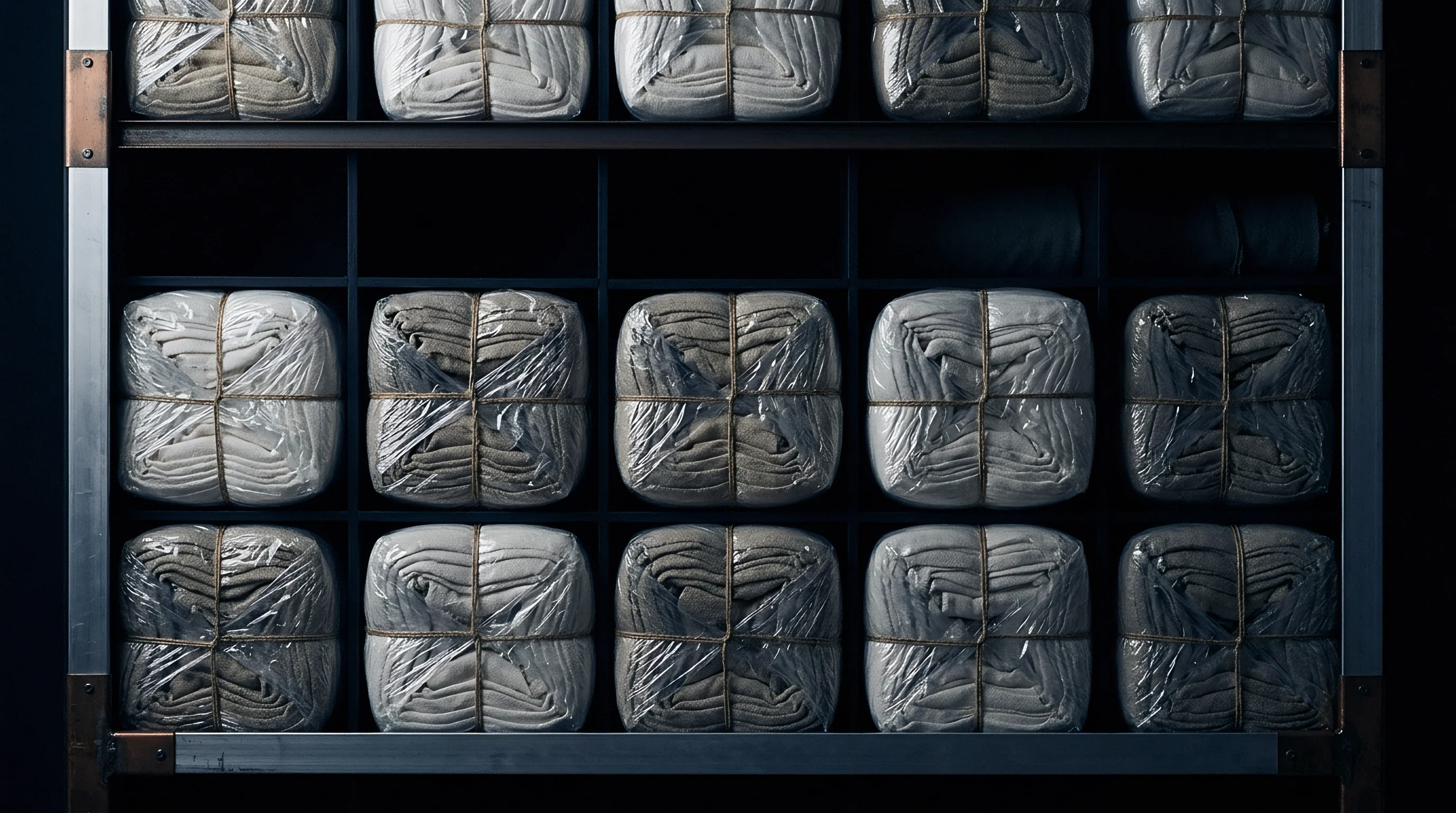
Financial Impact of Unconditioned Lot Invoicing
Invoicing high-volume fabric lots without applying commercial regain adjustments transfers substantial economic risk to the buyer. Consider a forty-metric-ton shipment of combed cotton fabric purchased at five dollars per kilogram. Shipping the lot at an elevated moisture regain of eleven percent due to humid regional warehouse storage adds two point five percent excess water mass above the standard eight point five percent commercial regain allowance.
Calculating landed invoice adjustments on this lot reveals the direct monetary exposure:
Dry mass equals forty thousand kilograms divided by one point eleven, yielding thirty-six thousand thirty-six kilograms of dry fiber. Applying the official commercial regain factor of eight point five percent yields a commercial billing mass of thirty-nine thousand ninety-nine kilograms. Invoicing the raw shipment mass of forty thousand kilograms forces the buyer to pay for nine hundred one kilograms of excess water, amounting to an unearned financial loss of four thousand five hundred five dollars on a single shipment.
Purchase contracts eliminate moisture gain penalties by inserting strict commercial regain adjustment clauses into standard fabric acceptance specs. Sellers must provide oven-dry mass test certificates issued by accredited laboratories following standardized conditioning protocols prior to releasing bulk shipping documents.
Disputes over lot mass settlement persist when trade contracts fail to specify whether invoice weight calculations draw from oven-dry testing methods or standard room equilibrium preconditioning routines.