Comber Noil Extraction Ratio Calibration for Optimizing Rotor Yarn Tenacity and Landed Fiber Cost
Calibrating comber noil between 18 and 25 percent preserves open-end rotor yarn tenacity above 12.5 cN/tex while reducing true landed manufacturing cost.

Flock
Open-end rotor spinning extracts strength from fibre alignment, length uniformity, and the clean removal of fragmented plant particles inside the opening roller housing. When mills feed cotton comber noil into rotor blends, the mechanical trade-off appears immediately at the rotor groove. Comber noil supplies cheap, short cellulose fractions rejected from ring spinning preparation.
These fibres drag lower mean staple lengths into the rotor, elevating the short fibre content and degrading yarn tenacity if the extraction ratio fluctuates past calibrated machine settings.
The operational balance demands continuous calculation between raw material discount and yarn tensile failure limits. Rotor yarn tenacity operates under strict linear dynamics dictated by the effective gripping length inside the rotor groove. If short fibre content beneath 12.7 millimetres exceeds 22 percent by weight in the finisher sliver, yarn tenacity drops steeply below commercial delivery thresholds.
Tenacity values below 11.5 centinewtons per tex cause severe downstream warping breakage in denim weaving operations.
A sliver short fibre content exceeding 22 percent by weight drives open-end yarn tenacity below 11.5 centinewtons per tex, provoking immediate warping shutdowns.
A buyer calculating cost per finished metre manages both raw bale expense and production stability. Comber noil traded at an index discount of 25 to 35 percent against base strict middling upland cotton offers significant raw material margin expansion. However, aggressive incorporation levels destroy spinning efficiency.
The balance points require absolute precision across drafting, opening roller speed calibration, and rotor groove geometries.
Linear density and twist configuration govern the tolerance band of noil inclusion. Coarser counts tolerate higher noil ratios. Finer counts break at high rotor speeds when the count-strength product drops below critical limits.
Spinners must calculate the breakeven point where the cash discount of reclaimed noil balances the operational losses of high end-break rates and reduced machine productivity.

Groove
Rotor spinning relies on centrifugal consolidation inside the rotor circumference. Fibre individualization takes place at the opening roller, where wire clothing combs the sliver into separated single fibres, stripping trash and microdust through an adjustable debris extraction port. The operational behavior of comber noil inside this airflow determines whether the fibre bridges the rotor gap successfully or curls into disorderly packing.
Short fibres exhibit poor centrifugal orientation during their trajectory down the transport channel. As the comber noil ratio increases, the average fibre transit length decreases, provoking premature tumbling inside the air stream. Fibres that land chaotically across the collecting surface fail to contribute to longitudinal yarn tenacity.
Instead of forming tensile structural backbones, these chaotic short fibres act as structural bulk, increasing yarn diameter without adding tensile resistance.
Rotor Geometry and Trajectory Mechanics
V-shaped rotor grooves concentrate fibres into a tight, dense core, maximizing mechanical inter-fibre friction. U-shaped grooves generate bulkier cross-sections with lower consolidation pressure. When incorporating comber noil above 30 percent of the total blend mass, spinning technicians switch from broad U-grooves to narrow V-grooves measuring between 40 and 45 degrees in wedge angle.
The concentrated cross-section forces shorter fibres into intimate contact with longer carrier staples, recovering tensile transfer efficiency.
Opening roller speed calibration forms the second physical parameter. Standard upland cotton runs at wire speeds between 6,500 and 7,200 revolutions per minute. Comber noil contains elevated microdust and fragile fibre fragments prone to severe impact damage.
Over-beating noil at high roller speeds shatters short fibres into microscopic debris, generating excessive rotor dust accumulation. Lowering opening roller velocities to 5,800 or 6,200 revolutions per minute preserves physical staple length, while clothing angles of 65 to 70 degrees provide gentle fiber transfer.
Narrow V-grooves measuring between 40 and 45 degrees recover mechanical contact among shorter cellulose segments under high blend dilution.
Air depression levels across the spinning unit must register between negative 60 and negative 75 millibars to maintain pneumatic acceleration. Insufficient negative pressure allows short noil fibres to stall in the transfer tube, creating thick slubs and structural interruptions known as wrapper fibres. Wrapper fibres wind perpendicularly around the core, absorbing rotational twist without participating in tensile resistance.


Tally
Every commercial blend calculation begins with verified commodity fiber properties. Virgin upland cotton classing data derived from High Volume Instrument testing establishes the benchmark parameters. Integrating comber noil alters the length distribution profile, lowering the upper half mean length and expanding the short fibre index significantly.
The physical properties of four blend configurations reflect standard mill allocations for coarse and medium rotor yarns. Blend properties dictate downstream processing viability across open-end machinery.
| Blend Ratio (Virgin / Noil) | Upper Half Mean Length (mm) | Uniformity Index (%) | Short Fibre Content (% by weight) | Fiber Micronaire | Mean Fiber Tenacity (cN/tex) |
|---|---|---|---|---|---|
| 100 / 0 | 28.5 | 82.5 | 8.5 | 4.25 | 29.5 |
| 85 / 15 | 27.2 | 79.8 | 12.8 | 4.10 | 28.1 |
| 70 / 30 | 25.8 | 76.2 | 17.4 | 3.95 | 26.4 |
| 50 / 50 | 23.9 | 71.5 | 24.6 | 3.75 | 24.2 |
The fiber profile shifts drastically once noil content reaches 30 percent. The uniformity index drops below the 78 percent benchmark, indicating elevated processing risk during the final rotor sliding phase. The fiber micronaire drops simultaneously.
Comber noil selectively retains finer, immature fiber wall segments rejected by the half-lap and top comb clothing of the combing machine. This lower micronaire increases the specific surface area, escalating inter-fiber friction but also raising the risk of nep formation.
Tensile Performance and Product Count Thresholds
Yarn tenacity responds directly to the changes in short fiber content and uniformity index. Tensile strength is assessed via constant rate of extension testing following ISO 2063 procedures, measuring breaking force across multiple skein and single-end trials. The resulting tenacity values determine whether the spun package survives industrial high-speed weaving operations.
| Blend Ratio (Virgin / Noil) | Twist Multiplier (alpha metric) | Rotor Speed (RPM) | Yarn Tenacity (cN/tex) | Elongation at Break (%) | End-Break Rate (per 1,000 rotor hours) |
|---|---|---|---|---|---|
| 100 / 0 | 135 | 110,000 | 14.8 | 6.8 | 65 |
| 85 / 15 | 138 | 105,000 | 13.7 | 6.4 | 82 |
| 70 / 30 | 145 | 98,000 | 12.4 | 5.8 | 125 |
| 50 / 50 | 155 | 85,000 | 10.6 | 5.1 | 240 |
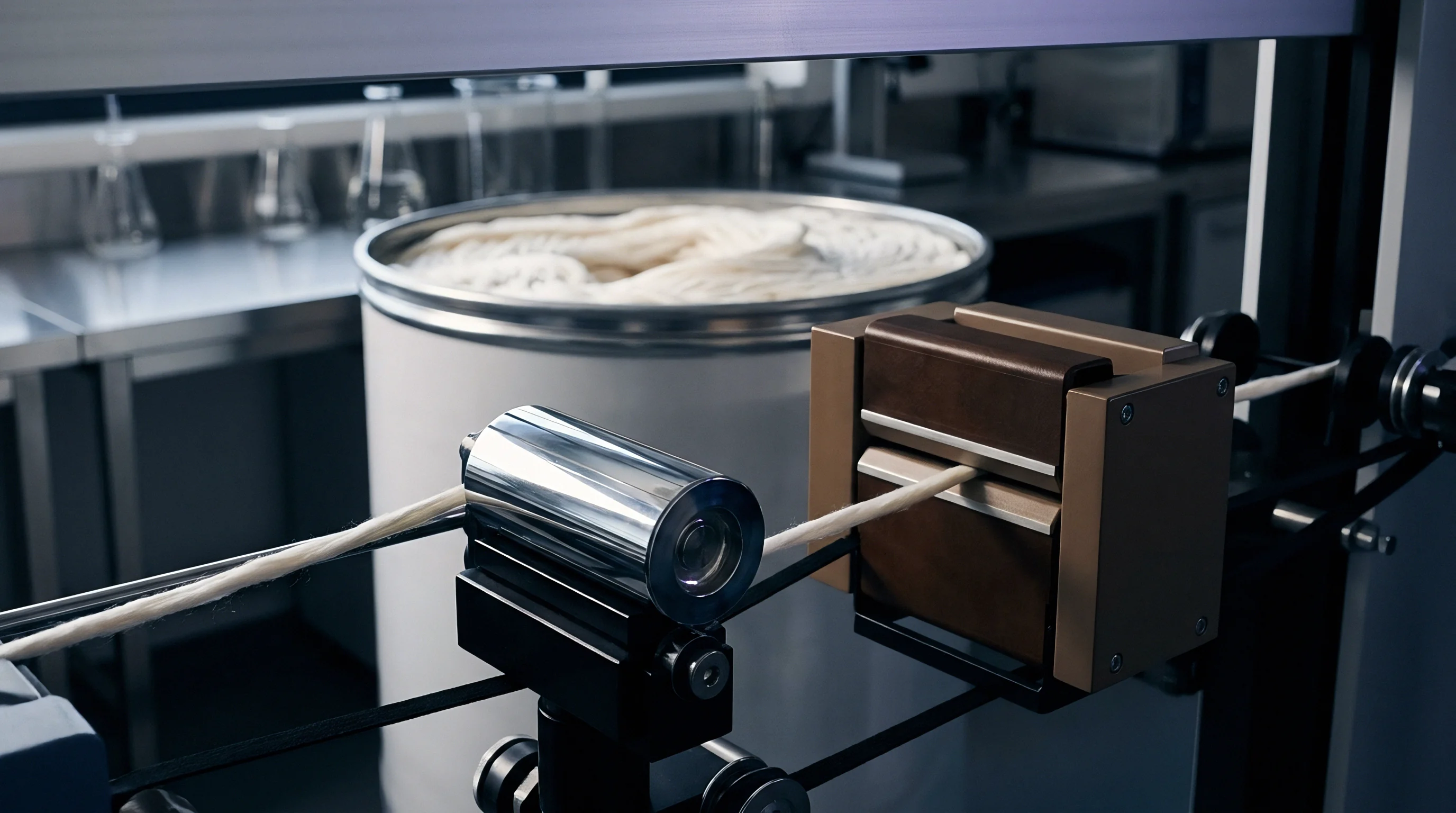
The single-end tenacity collapses by 28 percent as the blend transitions from virgin upland stock to a 50/50 comber noil composition. To prevent catastrophic yarn breakages inside the spinning box at high speeds, spinning managers increase the twist multiplier. Elevating the alpha metric twist parameter from 135 to 155 compensates for the deficit in individual fiber length by raising transverse radial pressure.
This compensation exacts a production penalty: higher twist insertions require lowering rotor takeoff speeds, which directly reduces hourly yarn output.
The economic impact manifests in the end-break metric. At 240 ends down per 1,000 rotor hours, operator patrol cycles become unsustainable, leading to spinning box stoppages and automated piecing failures that degrade total machine efficiency.
Drift
Spinning operations experience subtle shifts in fiber properties between delivered supply batches. Comber noil arrives compressed into high-density bales bearing wide structural variance. Because combing machines clear short fibers intermittently across varying operational cycles, noil taken from the commencement of a combing lap change carries different fiber length parameters than noil cleared midway through production.
Moisture regain variances complicate real-time blending ratios. Cotton fibers exhibit commercial moisture regain benchmarks near 8.5 percent under standard temperature and relative humidity environments defined by ISO 139. Comber noil bales stored under unregulated mill conditions fluctuate between 6.0 and 10.5 percent moisture content.
Feeding noil dry into the blowroom line without gravimetric moisture correction alters real fiber mass addition by several percentage points.
A blowroom line configured to blend 30 percent noil by gross weigh-pan drop delivers an actual dry cellulose mass of only 27.5 percent if the noil moisture reads two percent higher than the virgin stock. Such discrepancies disrupt sliver count consistency and generate random deviations in downstream tenacity.
Nep creation represents another operational failure mode linked to unstable noil quality. Comber noil contains dense entanglements of immature fibers. If carding flats fail to comb out these clusters, neps bypass the carding zone and land directly in the draw frame sliver.
Advanced testing systems distinguish between raw seed-coat fragments and fiber neps.
- Fiber nep accumulation expands rapidly when carding cylinder speeds exceed 480 revolutions per minute on high-ratio noil mixtures.
- Seed coat fragment debris embeds securely inside rotor grooves, producing periodic profile faults and repetitive thread breaks.
- Short fiber accumulation inside transportation conduits chokes air depression, dropping localized air velocity below operating limits.
- Trash particle retention inside the rotor track forces continuous mechanical piecing sequences that mar overall yarn package appearance.
Uncontrolled fiber property shifts force constant machinery recalibration. When draw frame sliver uniformity drifts past acceptable limits, technicians face the undesirable choice of slowing machine output or accepting downstream customer claims for fabric appearance defects.


Splice
Blending execution dictates yarn consistency across entire production runs. Direct sliver blending at the breaker draw frame yields tighter statistical control than blowroom weigh-pan mixing. When blending virgin cotton sliver with pure comber noil sliver at the draw frame, machine gearing fixes the exact volumetric ratio of the components.
Draw frame blending introduces specific mechanical restrictions. Comber noil fibers lack internal cohesion, causing pure noil card sliver to break easily under feed table tension. To run cleanly, pure comber noil requires gentle carding web collection, larger trumpet diameters, and reduced draft ratios across the drafting zone.
Most mills bypass pure noil carding by executing the blend inside the blowroom via automated bale opening carousels and multi-bin blenders.
Draw frame sliver blending isolates noil mass ratios within a dry tolerance band of 0.8 percent across long production sequences.
A multi-bin blender stacks layers of virgin stock and comber noil horizontally, slicing them down vertically with spiked lattices. This perpendicular cross-sampling averages out bale-to-bale length fluctuations before the material encounters the opening beaters. The blender prevents noil clustering, dispersing short fibers evenly through the virgin upland matrix.

Are Comber Noils Uniform across Supply Origins?
Variations across origin markets determine processing stability. Comber noil extracted from extra-long staple Egyptian or Pima combing runs displays upper half mean lengths between 18.0 and 21.0 millimetres, whereas upland cotton noil rarely exceeds 14.5 millimetres. Pima-derived noil delivers physical properties that rival lower-grade virgin upland cotton, allowing spinners to incorporate ratios up to 40 percent without degrading yarn tenacity below weaving thresholds.
Upland noil requires conservative blend limits. Mills buying comber noil without validating the original cotton growth program encounter severe processing failures. Incorporating noil sourced from coarse Asian short-staple cotton drops single-end breaking strength past acceptable commercial tolerances within single yarn lots.
Ledger
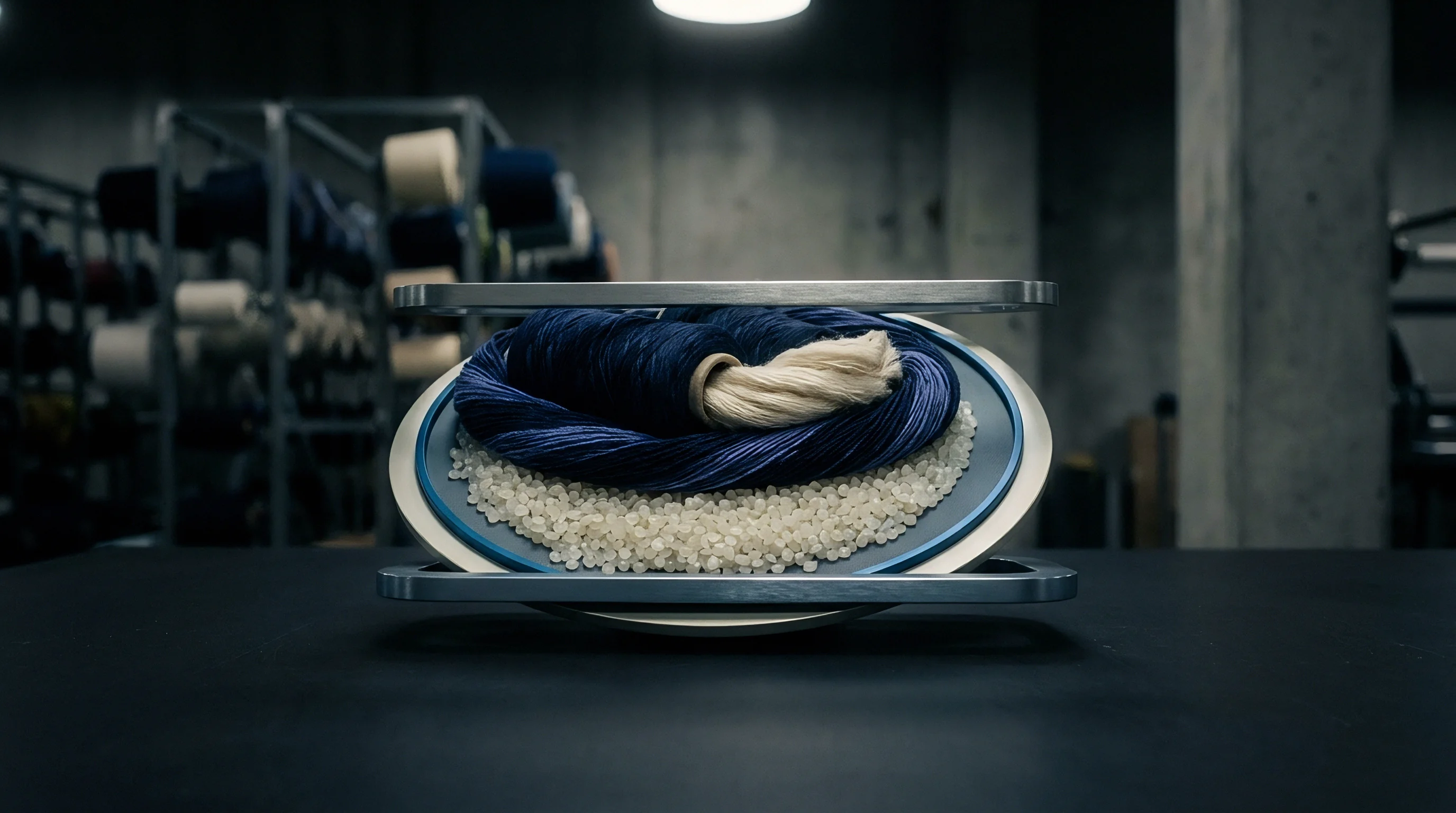
Commercial viability hinges upon real landed fiber costs compared against spinning conversion expenses. While comber noil lowers gross fiber costs per metric ton, downstream processing costs rise due to lower output speeds, higher electrical consumption per kilogram, and packaging waste.
To demonstrate this financial balance, a worked cost construction tracks production parameters for an English Cotton Count 16 (37 tex) rotor yarn destined for standard 12-ounce denim fabric weaving. The analysis contrasts three processing programs across a 100-metric-ton finished production lot, assuming a virgin upland cotton landed base price of 2.10 US dollars per kilogram and a comber noil cost of 1.45 US dollars per kilogram delivered to the opening floor.
| Cost Component | Program A (100% Virgin) | Program B (75% Virgin / 25% Noil) | Program C (50% Virgin / 50% Noil) |
|---|---|---|---|
| Raw Fiber Input Cost ($/kg) | 2.100 | 1.938 | 1.775 |
| Blowroom and Carding Waste Loss (%) | 5.5 | 7.2 | 9.8 |
| Effective Net Fiber Cost ($/kg) | 2.222 | 2.088 | 1.968 |
| Twist Factor Inserted (alpha metric) | 135 | 142 | 155 |
| Rotor Speed (RPM) | 110,000 | 102,000 | 85,000 |
| Yarn Output Rate (kg/rotor/hour) | 0.298 | 0.264 | 0.201 |
| Energy and Machine Direct Cost ($/kg) | 0.380 | 0.429 | 0.563 |
| Total Manufacturing Cost ($/kg) | 2.602 | 2.517 | 2.531 |
| Finished First-Quality Recovery (%) | 98.5 | 96.8 | 91.2 |
| True Landed Yarn Cost ($/kg finished) | 2.642 | 2.600 | 2.775 |
The manufacturing arithmetic exposes the operational tipping point. Moving from Program A to Program B captures a tangible net savings of 0.042 US dollars per kilogram of deliverable yarn. The raw material discount comfortably covers the minor energy penalty and production slowdown.
Program C demonstrates the operational penalty of over-diluting raw blends. Fiber costs decrease to 1.775 US dollars, but blowroom and carding waste climbs to 9.8 percent as short fibers are pulled into dust collection filters. Rotor speeds drop to 85,000 RPM to sustain minimal yarn tenacity, decreasing hourly output.
Energy consumption and machine run-time costs rise sharply to 0.563 US dollars per kilogram.
The final financial collapse happens at customer packaging and quality sorting. Elevating noil content to 50 percent drops first-quality finished package yields to 91.2 percent due to frequent slubs, thin spots, and package piecing defects. The true landed cost of deliverable yarn climbs to 2.775 US dollars per kilogram, exceeding the production cost of pure virgin fiber yarn.
A mill running Program C loses 0.133 US dollars per kilogram compared to pure virgin cotton while generating yarn that risks customer claims during weaving. Strategic engineering favors a calibrated blend ratio between 18 and 25 percent noil, which secures clear fiber cost savings without pushing spinning limits past stable productivity baselines.
Custom
International procurement adds regulatory, tariff, and shipping considerations to blend calculations. Cotton fiber and cotton by-products cross borders under defined Harmonized Tariff Schedule categorizations. Raw virgin cotton enters international shipping lanes under tariff code 5201.00, attracting specific customs scrutiny based on staple length, grade, and origin certification.
Comber noil falls strictly under Harmonized Tariff heading 5202.10, designating cotton yarn waste and thread waste, or heading 5202.99, covering general cotton waste. The duty differential between these classifications can significantly impact landed costs, depending on trade agreements and import jurisdictions.
- Tariff code misclassification exposure occurs when import authorities reclassify clean comber noil as raw carded cotton, imposing virgin commodity duty tariffs plus penal processing fees.
- Phytosanitary inspection delays at discharge ports arise if comber noil documentation lacks approved fumigation certificates confirming methyl bromide or phosphine quarantine treatments.
- Traceability verification audits require proof of origin to exclude raw fiber sourced from banned agricultural regions or forced labor regimes under global enforcement mandates.
Importing mills must review chemical contamination documentation before executing import purchase contracts. Comber noil concentrated from ring spinning operations can accumulate paraffin waxes, sizing residues, or lubrication oils used during combing preparation. These chemical residues build up in rotor grooves over time, changing the friction profile and requiring frequent machine stops for cleaning.
Delivery contracts must explicitly define maximum allowable non-lint content, moisture regain ceilings, and chemical purity limits. Relying on simple trading classifications exposes buyers to batches containing unusable sweeping waste that causes high end-break rates during rotor spinning.
Customs and shipping requirements dictate the overall landed cost of fiber. Production savings achieved through careful machine calibration disappear instantly if customs authorities detain shipments for fiber identification or quarantine testing.
Standard purchase contract terms enforce financial deductions if delivered moisture exceeds 8.5 percent or if non-lint trash content measured by Shirley Analyzer testing surpasses 4.0 percent by mass.