Dynamic Moisture Sorption Hysteresis in Blended Polymer Matrices under Variable Conditioning
Dynamic moisture sorption hysteresis shifts blended fabric commercial weights up to three percent depending on preconditioning history and transit humidity.


Phase
Moisture molecules entering a binary polymer matrix interact differently with hydrophilic amorphous domains than with crystalline synthetic cores. In a matrix blending cellulosic polymers like viscose or cotton with hydrophobic polymers like polyester or polyamide, water vapor sorption is governed by localized chemical affinity and polymer chain mobility. Cellulosic regions contain abundant free hydroxyl groups that form primary hydration shells through hydrogen bonding.
Synthetic domains lack these active binding sites, acting as passive barriers that force moisture vapor along convoluted diffusion paths through the amorphous structural matrix.
Thermodynamic equilibrium during moisture sorption is rarely achieved in dynamic operational environments. As atmospheric relative humidity changes, the rate of water absorption depends heavily on the diffusion coefficient of the matrix and the rate of polymer chain relaxation. Water molecules bind to hydroxyl sites.
This localized binding disrupts existing inter-chain hydrogen bonds within the amorphous cellulose, increasing free volume and facilitating further vapor penetration. At high vapor concentrations, absorbed water acts as a plasticizer, lowering the glass transition temperature of the hydrophilic polymer phase and accelerating structural reorganization.
| Polymer Matrix Ratio | Test RH Step (%) | Adsorption Regain (%) | Desorption Regain (%) | Hysteresis Delta (%) |
|---|---|---|---|---|
| 100% Viscose | 30 to 65 | 10.2 | 12.8 | 2.6 |
| 70/30 Viscose / Polyester | 30 to 65 | 7.4 | 9.3 | 1.9 |
| 50/50 Viscose / Polyester | 30 to 65 | 5.3 | 6.7 | 1.4 |
| 30/70 Viscose / Polyester | 30 to 65 | 3.2 | 4.1 | 0.9 |
| 100% Polyester | 30 to 65 | 0.4 | 0.5 | 0.1 |

Thermodynamic Equilibrium across Polymer Domains
Moisture uptake in blended matrices follows distinct thermodynamic pathways depending on localized hydroxyl density. During adsorption, water vapor penetrates the outer surface of the hydrophilic fiber domains first. Initial sorption occurs through localized site binding at high-affinity hydroxyl sites, characterized by high differential enthalpy of sorption.
As relative humidity increases beyond forty percent, multi-molecular layer formation begins, followed by capillary condensation inside micro-voids within the amorphous cellulosic structure.
Cellulosic polymers exhibit structural swelling during moisture adsorption that exposes previously inaccessible hydroxyl binding sites during the subsequent desorption cycle.
In hydrophobic synthetic phases, water sorption remains confined to microscopic interstitial voids and polymer chain ends. Polyester exhibits an equilibrium moisture regain below zero point five percent at standard atmosphere, while polyamide 6,6 reaches approximately four point five percent due to amide group hydrogen bonding. When these polymers are blended with cellulosic fibers, the overall sorption capacity of the composite matrix scales non-linearly.
The physical presence of synthetic fibers restricts the volumetric swelling of neighboring cellulosic fibers, altering the thermodynamic activity of water within the blended yarn structure.

Kinetic Sorption Rates and Hydrogen Bond Reorganization
Water molecules penetrating cellulose chains break existing inter-molecular hydrogen bonds while establishing transient hydration shells. Polymer chain segments gain segmental mobility as bound water increases. The hysteresis loop opens.
This plasticization depresses the glass transition temperature of amorphous cellulosic regions below ambient processing temperatures when relative humidity exceeds seventy percent. Dynamic vapor sorption kinetics slow down significantly near phase transitions, where polymer chain relaxation times match the time scale of water diffusion.
Desorption follows a thermodynamically distinct energy landscape. When atmospheric relative humidity drops, moisture desorbs from high-energy site-bound states with greater difficulty than it absorbed. Hydrogen bonds broken during swelling do not immediately reform in their original spatial configurations.
Cellulosic chains remain temporarily extended, trapping water molecules within newly created matrix cavities. Desorption leaves more water bound. This structural persistence creates the dynamic hysteresis gap observed between wetting and drying cycles in commercial fabric processing.
Prematurely stopping a moisture conditioning protocol before dynamic thermodynamic balance occurs introduces systematic mass errors that invalidate subsequent weight-based trade declarations.


Loop
Sorption hysteresis manifests as a non-coincident path between the adsorption and desorption isotherms across the relative humidity spectrum. When a dry polymer blend absorbs moisture from zero percent to ninety percent relative humidity, the measured regain follows the lower boundary curve. Conversely, desorbing moisture from a fully saturated state back to dry conditions forces the regain along the upper boundary curve.
The region enclosed between these two primary curves defines the envelope of thermodynamic hysteresis.
Intermediate environmental fluctuations generate primary and secondary scanning curves inside the boundary envelope. A fabric partially conditioned to fifty percent relative humidity during adsorption that experiences a sudden drop in ambient humidity desorbs along an intermediate scanning path. Scanning paths cross the internal area of the hysteresis envelope without touching either primary boundary until extreme relative humidity limits are re-established.
Understanding these internal paths is essential when predicting moisture content during transit through variable climate zones.

Mechanisms Driving Isotherm Boundary Divergence
Hydrogen bonding sites within the amorphous regions of viscose and wool remain locked during initial vapor exposure until localized plasticization lowers the polymer glass transition temperature. The uncoiling of cellulose and protein microfibrils requires mechanical work supplied by the swelling pressure of water. During desorption, the swollen polymer network retains its open conformation down to lower relative humidity levels, leaving polar groups accessible at vapor pressures where they were previously buried during adsorption.
- Uncoiling of amorphous polymer chains during high relative humidity exposure increases accessible internal free volume.
- Capillary condensation inside micro-voids retains moisture at lower relative humidity levels during desorption than required for capillary filling during adsorption.
- Differential relaxation times between synthetic hydrophobic fibers and hydrophilic natural fibers create localized mechanical stresses that alter moisture vapor permeability.
- Clustering of water molecules at high vapor concentrations reduces the thermodynamic activity of absorbed moisture relative to bulk water.
A sixty-forty viscose polyester blend conditioned at twenty degrees Celsius exhibits a three point two percent higher moisture regain along the desorption curve at sixty-five percent relative humidity than along the adsorption curve.
Polymer free volume shifts continuously along the hysteresis loop. Capillary pores that fill at high vapor pressures require a larger chemical potential drop to empty because the meniscus radius during desorption presents a smaller effective radius of curvature than during filling. This pore network effect operates alongside molecular-level site binding to widen the total hysteresis envelope.
In wool and cellulosic blends, matrix geometry shifts permanently if relative humidity cycles exceed eighty-five percent, shifting subsequent adsorption curves upward.
Whether rapid relative humidity cycling in transit prevents the inner core of high-twist blended yarns from ever reaching the boundary desorption path remains an open operational question.


Chamber
Laboratory evaluation of dynamic moisture behavior relies on automated gravimetric vapor sorption instruments capable of holding temperature within tight tolerances. Dynamic Vapor Sorption systems measure mass changes down to zero point one micrograms while controlling carrier gas humidity through precision mass flow controllers. Small sample masses, typically between five and fifty milligrams, eliminate bulk diffusion lags that mask intrinsic polymer sorption kinetics in standard oven-drying procedures.
This instrumentation isolates true thermodynamic hysteresis from transport-limited equilibrium delays.
Conditioning protocols in standard test chambers use stepwise relative humidity changes. Static balance readings drift. The automated balance records sample weight continually while carrier gas switches between target humidity steps.
Equilibrium is defined when the rate of mass change with respect to time falls below a predetermined numerical threshold. Setting this mass stability criterion too high truncates dynamic sorption curves, artificially narrowing the observed hysteresis loop and producing misleading moisture regain data.

Will Step-Change RH Protocols Understate Sorption Hysteresis?
Stepwise relative humidity changes measuring mass stability at predefined intervals often truncate kinetic sorption tails in slow-relaxing polymer structures. When an instrument increments relative humidity by ten percent as soon as mass change reaches zero point zero zero two percent per minute, the polymer matrix may still be undergoing slow structural relaxation. Cellulosic chains reorient over tens of hours following a humidity step.
Truncating the dwell time at each relative humidity step shifts the adsorption curve upward and the desorption curve downward, artificially compressing the measured hysteresis envelope.
Sample preparation introduces additional variance inside the testing enclosure. Fiber orientation, yarn twist density, and fabric surface density modify the convective mass transfer rate from the carrier gas to the polymer surface. Dense woven structures create a boundary layer of stagnant air that slows vapor exchange, requiring extended dwelling times at each relative humidity setpoint.
Cutting swatches into fine fiber fragments eliminates structural transport resistance, exposing intrinsic polymer sorption behavior at the expense of fabric structural representation.

Dynamic Vapor Sorption versus Static Equilibration
Traditional oven-drying and standard humidity conditioning rooms operate under static equilibrium assumptions defined in standard test methods like ISO 139 and ASTM D1776. These methods mandate conditioning at twenty degrees Celsius and sixty-five percent relative humidity for twenty-four hours. Static methods ignore moisture history.
A sample entering the conditioning room from a tropical port desorbs down to target weight, while a sample arriving from a dry desert warehouse desorbs up to target weight. The two samples differ in final moisture mass by up to three percent despite meeting identical standard conditioning criteria.
| Test Parameter | DVS Dynamic Protocol | ISO 139 Static Method | Impact on Hysteresis Resolution |
|---|---|---|---|
| Sample Mass | 10 mg to 50 mg | 10 g to 500 g | Micro-gram accuracy captures fast kinetic transitions |
| Equilibrium Criterion | dm/dt < 0.002% / min | Fixed 24-hour time dwell | Static dwell underestimates structural chain relaxation |
| Atmospheric Flow Rate | 200 mL / min active gas | Passive room convection | Active flow eliminates boundary layer vapor resistance |
| RH Control Precision | +/- 0.5% continuous step | +/- 4.0% ambient chamber | Precise control resolves minor scanning curve loops |
| Moisture History Control | In-situ pre-desiccation | Uncontrolled prior state | DVS establishes verified initial dry mass baseline |
Vapor transport takes time. Relying on single-point static conditioning fails to identify whether a fabric lot sits on the adsorption or desorption boundary. Laboratory technicians who record fabric weight without documenting the prior conditioning state introduce unquantified systematic error into commercial moisture regain declarations.
- Incomplete kinetic mass stabilization premature equilibrium determination truncates the observed hysteresis width by missing slow structural relaxation in cellulosic fibers.
- Inadequate sample dispersion tightly packed fabric swatches impede vapor diffusion, causing sample surface layers to desorb while inner fibers remain on the adsorption curve.
- Thermal fluctuations during balance readings micro-balance sensitivity degrades when internal instrument temperatures drift by more than zero point two degrees Celsius.
- Inconsistent preconditioning state starting test cycles without complete dry-state desiccation skews all subsequent adsorption points along intermediate scanning curves.
A sample conditioned from a wet state will consistently weigh more at standard atmospheric humidity than an identical sample conditioned from a bone-dry state.
Suppliers routinely argue that discrepancy in delivered fabric mass reflects unavoidable climate variation during shipping rather than incomplete laboratory equilibration prior to dispatch weighing.


Swell
Volumetric expansion of hydrophilic fibers inside a tight blend architecture exerts mechanical forces that alter fabric physical properties. Cellulosic fibers expand predominantly in diameter rather than length when absorbing water vapor, driving yarn diameter increases. In a blend containing non-swelling polyester fibers, this radial expansion compresses adjacent synthetic filaments, reducing inter-fiber pore space and modifying yarn air permeability.
Cellulose swells in moist air. Polyester absorbs virtually no water. This structural imbalance shifts fabric geometry.

Anisotropic Fiber Dimensional Shifts in Blended Yarns
Cellulosic fibers expand predominantly in diameter rather than length when absorbing water vapor, driving yarn diameter increases. Fiber radial swelling reaches fifteen to twenty percent at saturation, whereas longitudinal extension remains below two percent. In ring-spun blended yarns, this anisotropic expansion forces synthetic fibers situated on the yarn periphery to extend around the swollen cellulosic core, increasing structural yarn crimp.
The resulting structural stress resists further water penetration, contributing to sorption hysteresis.
- Specify conditioning origin explicitly state in purchase contracts whether target weights apply to adsorption or desorption equilibrium states.
- Determine dynamic glass transition thresholds test high-viscose blends across operational humidity ranges to prevent permanent fabric creasing during transit.
- Calibrate regional weight allowances set shipping weight tolerances based on destination port atmospheric relative humidity averages.
Applying standard ISO 6741 commercial moisture regain values without verifying actual moisture history leads to financial losses when billing high-regain cellulosic blends by weight.
Dynamic mechanical shifts accompany moisture cycling. As humidity rises, inter-fiber friction decreases due to surface water lubrication, lowering fabric bending rigidity and altering handfeel. When humidity drops, moisture desorbs but the fiber orientation remain locked in its expanded geometry until external mechanical work is applied.
Fabric thickness follows its own hysteresis loop relative to humidity, failing to return to its original dry gauge after high-humidity exposure.
Blends containing high proportions of hydrophilic staple fibers undergo permanent structural relaxation if exposed to cyclic moisture loads under mechanical tension.

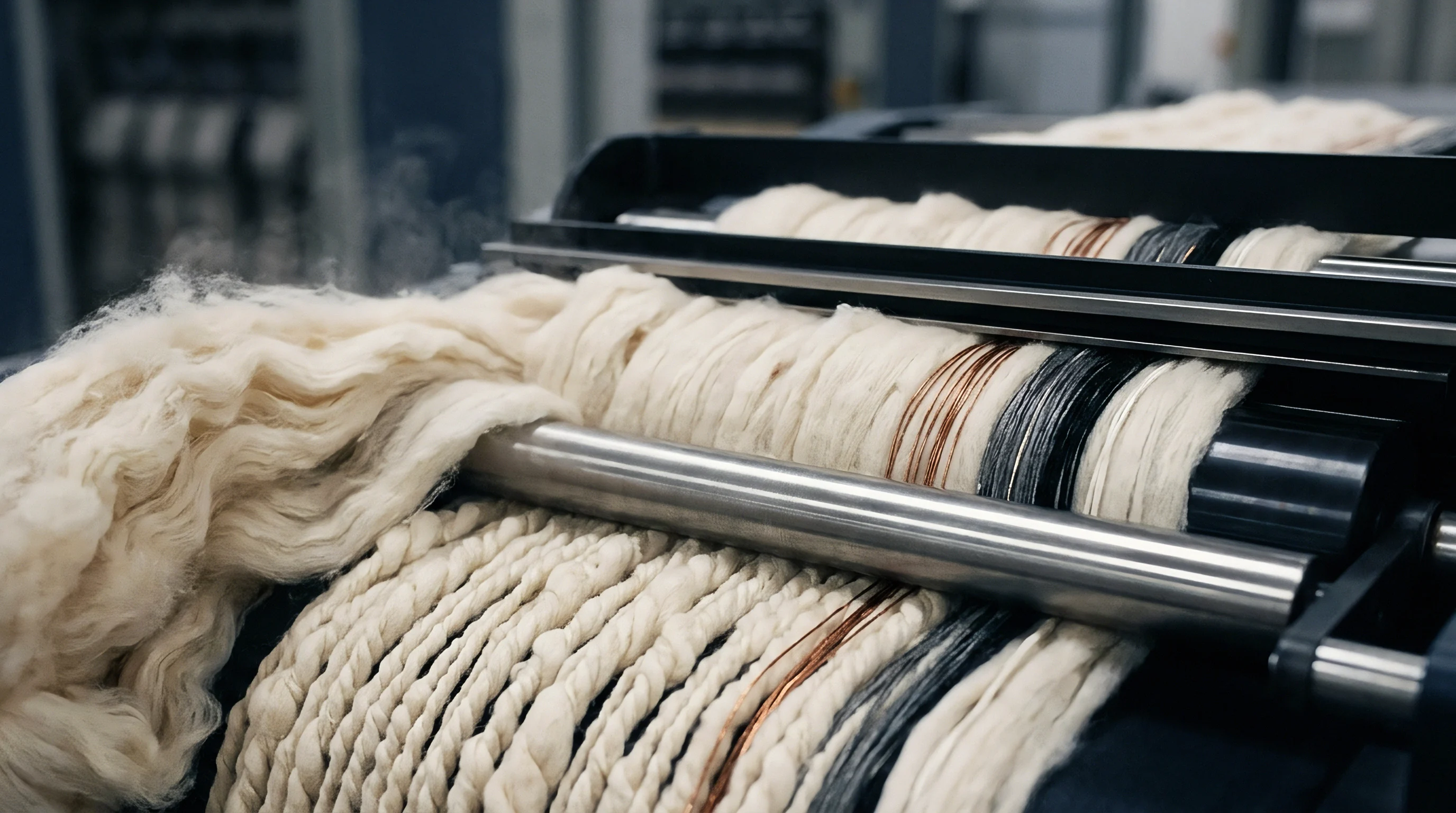
Margin
Commercial valuation and customs tariff determinations turn directly on the mass of dry fiber versus absorbed moisture at the time of official weighing. International trade contracts specify fabric transactions based on commercial mass, calculated by adding official standard moisture regain allowances to the oven-dry mass of the textile lot under ISO 6741. When shipments are weighed at destination ports without desiccation to absolute dry weight, absorbed environmental moisture is billed as commercial fiber weight, inflating invoice balances.
Customs checks the dry lot. This alters landed cost. Invoices rely on dry weight.
Fiber percentage declarations determine customs classification under Harmonized System chapters 54, 55, 60, and 62. Tariff lines turn sharply at fifty percent chief weight boundaries. A fabric declared as fifty-two percent viscose and forty-eight percent polyester based on ambient weighing may actually contain forty-nine percent viscose by dry mass if desorbed moisture weight is removed from the hydrophilic fraction.

Customs Classification Threshold Risks
Customs authorities classify blended textiles according to the fiber that predominates by weight under dry commercial conditions. Differential moisture regain skews uncorrected composition calculations. Viscose carries an official commercial regain allowance of thirteen percent under standard trade agreements, while polyester carries an allowance of zero point four percent.
If a laboratory analyzes a fabric swatch without pre-desiccation, the measured mass of the viscose fraction includes bound water from the desorption hysteresis loop, pushing the calculated weight percentage above tariff classification thresholds.
| Conditioning State | Measured Gross Weight (kg) | Apparent Viscose Share (%) | Apparent Polyester Share (%) | HS Tariff Classification Line | Customs Duty Rate Impact |
|---|---|---|---|---|---|
| Desorption Boundary (80% RH Transit) | 21,450 | 52.4% | 47.6% | 5516.12 (Cellulosic Predominant) | 12.0% preferential rate |
| Standard Atmosphere (65% RH Equilibrium) | 20,880 | 50.8% | 49.2% | 5516.12 (Cellulosic Predominant) | 12.0% preferential rate |
| Adsorption Boundary (30% RH Transit) | 20,320 | 49.1% | 50.9% | 5515.11 (Polyester Predominant) | 8.0% standard rate |
| Oven-Dry Core Mass (ISO 1833 Corrected) | 19,200 | 48.5% | 51.5% | 5515.11 (Polyester Predominant) | 8.0% base legal duty line |
Financial disputes arise when invoice masses calculated under destination ambient conditions clash with commercial mass calculated from dry mass plus standard allowance. Consider a twenty-tonne shipment of nominal 50/50 viscose/polyester fabric. Dry mass determines true duty.
If loaded in a high-humidity port, the physical lot retains desorbed water equivalent to six hundred kilograms of excess weight above dry baseline. Billing this lot without desiccation charges the buyer for excess moisture at fiber prices while triggering higher tariff rates under cellulosic chief weight classifications.
Contracts incorporating standard commercial regain adjustment clauses with explicit pre-test desiccation requirements per ISO 6741-1 eliminate billing disputes by establishing oven-dry mass as the sole binding baseline for invoice calculations and customs declarations.