Fluid Dynamics and Finish Shear inside Vortex Spinning Chambers
Aerodynamic shear inside vortex chambers strips spin finishes, causing spindle deposits, wrapper loss, and high yarn hairiness unless viscosity is maintained.
Torque
Air injected through tangential nozzle orifices at gauge pressures between 0.45 and 0.65 megapascal expands into the swirl chamber at speeds exceeding 350 meters per second. The resulting rotating airflow establishes a Rankine-like vortex profile within the nozzle body. Near the central axis, a forced vortex regime dominates, where tangential velocity scales proportionally with radial distance.
Beyond the central core, the fluid transitions into a free vortex profile, where tangential velocity increases inversely with the radius until fluid layers meet the viscous boundary layer along the chamber perimeter. Centrifugal pressure drives heavy particles outward. The axial velocity component simultaneously accelerates downward toward the hollow spindle entrance, pulling the drafted fiber bundle directly from the front delivery nip.
The drafted strand enters the nozzle tip through an eccentric fiber guide channel. Drafting roller nips maintain mechanical control over the strand until fiber leading ends pass into the hollow spindle bore. As trailing ends exit the front roller nip, the intense peripheral vortex flow overcomes the bending rigidity of individual staple lengths.
The tangential airflow peels these trailing fiber tails away from the entering yarn axis, deflecting them radially outward against the conical outer surface of the stationary spindle. The drafting apron delivers parallel strands. This geometric separation between the forward-moving core fibers and the radially deflected trailing tails creates the structural architecture of air-vortex spun yarns.
Spindle tip geometry governs wrapper formation long before package take-up tension exerts influence.
The twisting action in vortex spinning differs entirely from true mechanical ring twist or rotor-based false twist. False twist propagates upstream toward the front roller nip, stabilizing the fiber bundle inside the guide orifice. As the yarn strand is drawn into the hollow spindle bore by take-up rollers operating at speeds between 350 and 550 meters per minute, the trailing ends caught on the spindle cone rotate continuously around the advancing core.
The rotating tails wrap helically around the parallel, twistless core fibers, forming true fasciated yarn structures. The torque transferred from the swirling air to the trailing ends depends on fluid density, tangential velocity gradients, and the aerodynamic drag coefficient of the fiber cross-section.
| Zone Location | Mean Static Pressure (kPa) | Tangential Air Velocity (m/s) | Axial Velocity (m/s) | Wall Shear Stress (Pa) |
|---|---|---|---|---|
| Injector Nozzle Orifice | 480 | 385 | 45 | 142 |
| Swirl Chamber Annulus | 210 | 310 | 95 | 88 |
| Spindle Conical Tip | 145 | 265 | 180 | 116 |
| Spindle Internal Bore | -18 | 40 | 240 | 32 |
| Exhaust Vent Annulus | 5 | 120 | 110 | 45 |
Air velocity reaches supersonic levels locally. When the expanding air stream meets the sharp geometry of the spindle tip, micro-shock formations and turbulent eddies generate wall shear stresses exceeding 100 pascals. These turbulent fluctuations strip the boundary layer along the spindle edge.
Fiber wrapper density decreases when airflow vorticity decays prematurely along the spindle cone.


Shear
Boundary lubricants applied during staple synthetic fiber manufacturing experience destructive aerodynamic forces within the swirl chamber. A typical spin finish on 1.33 dtex polyester or regenerated modal staple consists of lubricating esters, antistatic ethoxylated surfactants, and polydimethylsiloxane friction modifiers applied at 0.10 to 0.18 percent by weight of dry fiber. The high relative velocity between the supersonic air jet and the fiber surface generates aerodynamic boundary layer shear rates surpassing 100,000 reciprocal seconds.
Viscosity drops as temperature rises. Boundary films fail under extreme shear.
Which Fluid Velocities Strip Fiber Boundary Lubricants?
Stripping initiates when the hydrodynamic shear stress exerted by the expanding gas exceeds the cohesive energy of the surfactant boundary film. As compressed air expands through the 0.4 to 0.6 millimeter nozzle orifices, static temperature drops across the expansion zone, followed by an immediate recovery spike due to aerodynamic stagnation on the spindle surface. The local friction heating raises fiber surface temperatures above 75 degrees Celsius within milliseconds.
This sudden thermal input thins the liquid lubricant film, dropping its dynamic viscosity from 45 centistokes to under 12 centistokes. The accelerated air stream tears the liquid film from the fiber surface, atomizing the chemistry into sub-micron aerosols that exhaust into the pneumatic waste channel.
Boundary lubricants desorb when local airflow velocities exceed 320 meters per second at 0.5 megapascal nozzle pressure.
Finish migration creates severe compositional drift across synthetic staple fibers. Unbalanced finishes lose volatile mineral oil carriers, leaving high-molecular-weight ethoxylated alcohols behind on the fiber exterior. These stripped residues alter the inter-fiber cohesive forces necessary for consistent draft zone control.
- Aerosol stripping of esters occurs when tangential flow velocities drag low-viscosity lubricating oils off synthetic staple perimeters into the central exhaust stream.
- Thermal desorption of surfactants follows the temperature recovery cycle across the spindle tip stagnation point, leaving naked polymer surfaces exposed to metallic contact.
- Triboelectric charge escalation emerges immediately after the conductive antistatic layer atomizes, inducing fiber flare that destabilizes the trailing ends.
- Polymer skin scuffing develops when stripped polyester fibers rub against the hardened nozzle surfaces without intervening boundary lubrication layers.
Natural cotton fibers present an alternative degradation route. Cotton wax contains long-chain fatty alcohols, free fatty acids, and triterpene esters with melting points ranging from 68 to 82 degrees Celsius. When raw or scoured cotton sliver enters the vortex chamber, friction heat liquefies these native waxes.
The rotating vortex shears the softened wax from the primary cell wall, depositing organic fats onto internal surfaces. Scoured cotton lacking adequate levels of supplementary spinning lubricants generates micro-dust fragments that peel away under aerodynamic vortex turbulence.
| Chemical Component | Primary Function | Viscosity at 20°C (cSt) | Stripping Threshold Velocity (m/s) | Desorption Temperature (°C) |
|---|---|---|---|---|
| Polyoxyethylene Lauryl Ether | Antistatic Carrier | 52 | 280 | 85 |
| Isobutyl Stearate | Boundary Lubricant | 18 | 230 | 68 |
| Polydimethylsiloxane | Friction Modifier | 100 | 340 | 145 |
| Alkyl Phosphate Potassium Salt | Anionic Antistat | 110 | 360 | 160 |
| Native Gossypium Wax | Natural Cotton Binder | Semi-solid | 245 | 72 |
Chemical suppliers attribute package density defects to irregular air dryer regeneration rather than low-temperature finish desorption within the chamber.
Deposit
Atomized finish components and liberated fiber fibrils do not vacate the nozzle body entirely. The radial pressure gradient in the swirl chamber forces dense aerodynamic aerosols toward stagnant flow zones. A low-pressure separation bubble anchors permanently behind the entrance lip of the stationary spindle.
Within this separation zone, atomized finish droplets collide with airborne fiber micro-dust, forming an adhesive paste that bakes onto the metallic surfaces of the nozzle cone. Residues bake onto the steel.
The accumulation builds through a progressive three-phase fouling cycle. Droplet impingement primes the micro-grooves of the tungsten carbide or ceramic spindle surface. Airborne lint and fractured fibrils then embed into the sticky hydrocarbon layer.
Under continuous exposure to hot, compressed air exhaust, the organic fraction oxidizes into a hardened lacquer. The resulting crust constricts the clearance between the spindle cone and the swirl chamber wall, distorting the intended Rankine vortex profile.
Polymer oligomers collect at the stagnation zone behind the spindle entry edge.
Fouled nozzles alter the drag force experienced by wrapper fibers. When build-up narrows the swirl annulus by 0.05 millimeters, local tangential air velocity increases, yet turbulence intensity spikes erratically. Wrapper fibers catch on the abrasive deposit edge instead of rotating freely around the spindle.
These disrupted wrapper fibers snap, causing long, unbound parallel core segments that register as thick places and hairiness spikes on capacitive yarn clearers.
- Optical inspection of spindle entry surfaces exposes amber varnish bands across the front bevel where high stagnation pressures bake stripped finishes onto the metal.
- Ultrasonic immersion in solvent degreasers strips organic waxes and baked surfactant complexes without abrading the precision-ground hollow spindle tip profile.
- Differential pressure qualification across injector ports confirms the clearance of sub-millimeter delivery holes before the spinning unit returns to production.
- Capacitive mass profiling of initial package builds flags residual flow imbalance across individual spindle positions prior to full lot start-up.
Ignoring deposit accumulation across spinning units destabilizes yarn structure, causing wrapper peel-back during high-speed warping, broken ends across knitting creels, and expensive fabric downgrades from structural barré patterns.
Friction
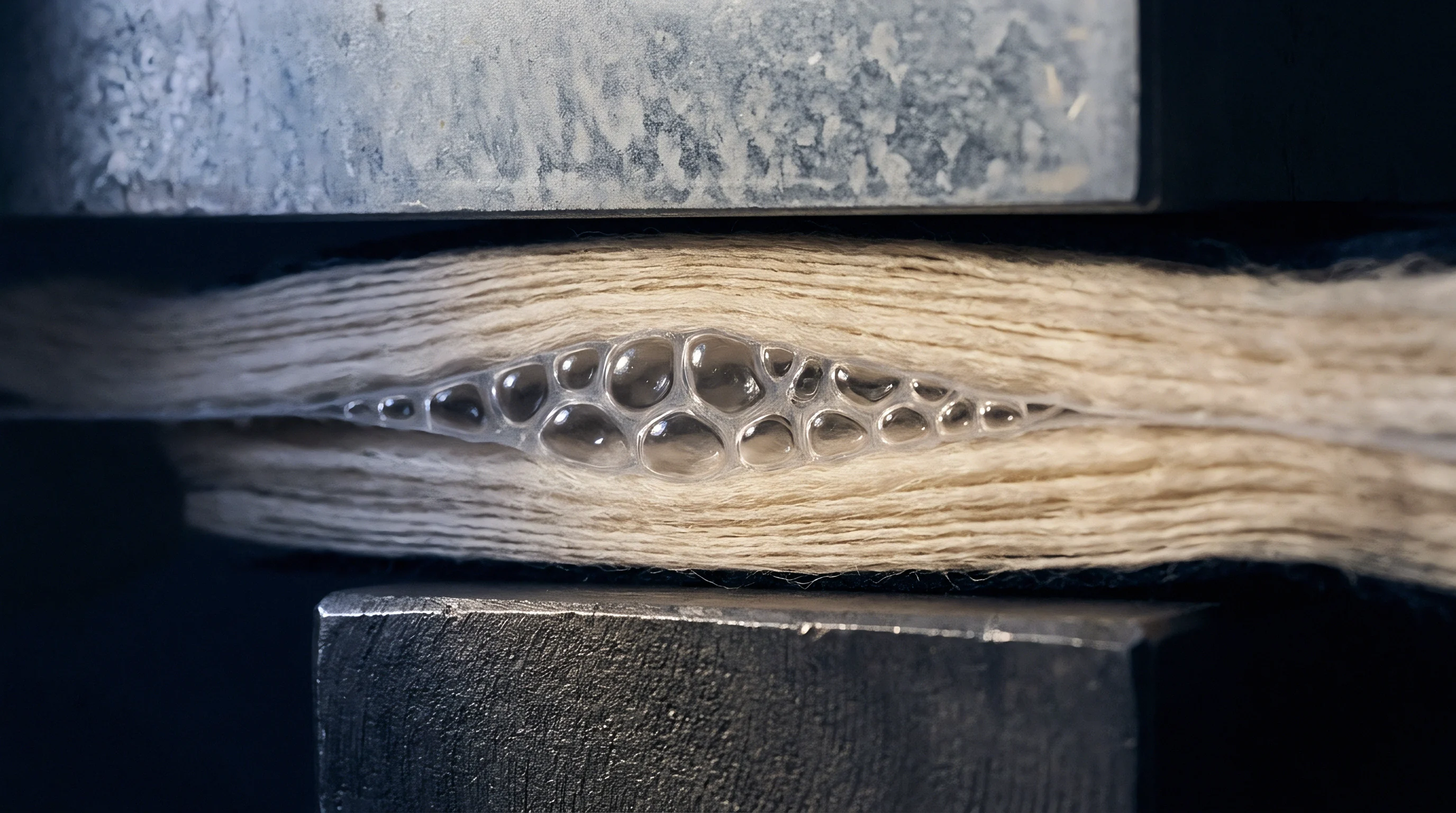
Stripping finish off the staple fiber alters the coefficient of friction inside the spinning chamber. Fiber processing requires balanced boundary friction parameters: fiber-to-fiber dynamic friction must support sufficient cohesion to hold the core together during drafting, while fiber-to-metal dynamic friction must remain low to permit rapid sliding over the spindle cone. When aerodynamic shear removes boundary lubricants, the fiber-to-metal friction coefficient on polyester staple surges from 0.22 to above 0.48.
Static friction spikes immediately.
What Aerodynamic Instability Generates Wrapper Fiber Sloughing?
The sudden increase in metal contact friction arrests the trailing ends rotating on the spindle face. The centrifugal force exerted by the vortex can no longer overcome the frictional drag of the dry fiber passing against the guide edge. Instead of wrapping smoothly at angles between 45 and 60 degrees around the advancing core, trailing ends bunch behind the contact zone.
The wrapper turns become irregular, yielding open, twistless yarn cores that pull apart under minor take-up tensions.
Pneumatic waste collection captures stripped oil. Yarn hairiness escalates without lubrication. Standard testing of vortex-spun yarns on capacitive systems reveals a direct correlation between finish stripping severity and the S3 hairiness value, which measures the number of protruding fiber ends exceeding 3 millimeters per 100 meters of yarn.
Synthetic yarns spun through clean nozzles with intact finish films yield S3 values under 150. When finishes shear away, S3 figures consistently exceed 600, signaling a failure of wrapper fiber retention.
- Kinematic viscosity minimums restrict lubricant thinning beneath 20 centistokes at 50 degrees Celsius to prevent aerodynamic boundary layer displacement.
- Thermal desorption thresholds dictate that finish formulations retain liquid phase integrity up to 130 degrees Celsius during high-velocity gas expansion.
- Conductive ionic balances preserve surface resistivity below 10 to the ninth ohms per square centimeter after fifty milliseconds of vortex exposure.
- Surface tension parity targets align lubricant surface tension with synthetic fiber surface energy to eliminate chemical droplet separation under rotational shear.
Sliver cohesion governs drafting evenness. Clean nozzles preserve wrapper consistency. The exact boundary layer thickness where aerodynamic shear balances surface tension forces across non-circular synthetic fiber profiles remains an unresolved subject across current spinning chamber research.

Invoice
The operational efficiency of vortex spinning operations dictates conversion costs per kilogram of finished yarn. Murata vortex machinery delivers strand at speeds five to twenty times faster than conventional ring frames, running up to 550 meters per minute per position. At these delivery velocities, any interruption from finish fouling compounds production losses immediately.
If finish stripping requires manual spindle wiping every 72 hours instead of standard 300-hour operational cycles, machine downtime increases by 4.2 percent across a 96-position frame.
Consider an operational yarn mill producing Ne 30 (19.7 tex) single yarns from a 65 percent polyester and 35 percent combed cotton intimate mixture. Take a 20,000-kilogram commercial production run operating at 450 meters per minute. When poorly formulated synthetic finish strips into the swirl chamber, pneumatic filter waste collection climbs from a baseline of 1.2 percent to 3.8 percent of sliver mass due to fiber fragments sheared off by fouled spindle surfaces.
This 2.6 percent yield loss consumes raw material value directly. The loss represents 520 kilograms of prepared sliver, equivalent to 1,144 dollars in discarded material cost under current market pricing for polyester-cotton sliver at 2.20 dollars per kilogram.
| Finish Add-on (wt %) | Spindle Fouling Interval (Hours) | Pneumatic Waste (%) | Tenacity (cN/tex) | Yarn S3 Hairiness Index | Landed Cost Surcharge ($/kg) |
|---|---|---|---|---|---|
| 0.08 (Sub-critical) | 48 | 4.1 | 15.2 | 720 | 0.14 |
| 0.14 (Optimal) | 310 | 1.1 | 19.8 | 110 | 0.00 |
| 0.24 (Excessive) | 36 | 2.4 | 17.1 | 340 | 0.11 |
| 0.32 (Flooded) | 12 | 5.8 | 13.4 | 890 | 0.28 |
Excess finish creates problems as severe as deficient finish. Over-lubricated fibers transfer wet oils directly to the swirl chamber walls without requiring aerodynamic stripping. Wet residues trap fly lint instantaneously, leading to choked nozzles and frequent automated piecing cycles.
Machine efficiency dictates final conversion margins. Each automated piecing sequence creates an optical defect that risks downstream rejection.
Mill contracts invoking ASTM D2257 require solvent-extractable finish levels between 0.12 and 0.18 percent by weight on incoming synthetic sliver.
Import classifications also ride on correct chemical application. Tariff classifications follow fiber mass ratios. Custom authorities classifying multi-component yarns under Chapter 55 of the Harmonized Tariff Schedule rely on precise quantitative chemical separation per ISO 1833 standards.
If erratic drafting or uncontrolled waste extraction inside the vortex chamber strips one fiber component at a higher rate than another, the delivered yarn composition drifts away from the declared sliver blend ratio. A nominal 50/50 polyester and viscose yarn that shifts to 48/52 due to selective fiber fragmentation incurs different preferential origin criteria under bilateral trade agreements. Fabric buyers incorporate yarn testing protocols directly into sales contracts to protect delivered margins.
Commercial agreements stipulate that deliveries exhibiting S3 hairiness values above 250 per 100 meters across three consecutive test packages incur a five percent price deduction across the entire invoiced weight.