Harmonized System Chief Weight Tariff Rules for Blended Textile Yarns
Tariff classification for blended yarns follows the single fibre component predominating by weight after applying ISO 6741 commercial moisture regain.
Precedence
Legal determination of yarn classification under international trade rules depends on the relative mass of each constituent fibre. Section XI Note 2 of the Harmonized Tariff Schedule specifies that textiles containing two or more materials fall under the heading corresponding to the component that predominates by weight over any other single fibre. This weight-majority rule applies prior to evaluating finishing properties, yarn construction, or intended end use.
Small variations in component weight ratios can alter applicable tariff duties immediately.

Section XI Note 2 Classification Hierarchy
Tariff schedules group textile products into distinct chapters by raw material origin. Chapter 52 governs cotton, Chapter 54 covers synthetic filaments, Chapter 55 governs synthetic staple fibres, and Chapter 51 controls wool and fine animal hair. When a spun yarn blends staple fibres from multiple chapters, customs classification does not require an absolute majority above fifty percent; it assigns classification to whichever single fibre component represents the largest individual weight fraction in the blend.
In a tri-component yarn containing 40 percent combed cotton, 35 percent polyester staple, and 25 percent viscose staple, cotton accounts for the highest single weight proportion. Customs authorities classify the entire consignment under Chapter 52, specifically heading 5206, even though synthetic components together make up 60 percent of the total physical mass. Evaluating the blend requires comparing each fibre individually rather than grouping synthetic against natural materials.
| Declared Composition Ratio | Dominant Component by Weight | Applicable HS Chapter | Harmonized System Heading | Tariff Classification Principle |
|---|---|---|---|---|
| 52% Combed Cotton / 48% Polyester Staple | Combed Cotton (52%) | Chapter 52 | Heading 5206 | Absolute majority single fibre predominance |
| 40% Cotton / 35% Polyester / 25% Viscose | Cotton (40%) | Chapter 52 | Heading 5206 | Plurality single fibre component dominance |
| 50% Polyester Staple / 50% Combed Cotton | Tie (50% / 50%) | Chapter 55 | Heading 5509 | Tie-breaker rule favoring highest numerical heading |
| 45% Wool / 35% Acrylic / 20% Nylon | Wool (45%) | Chapter 51 | Heading 5107 | Plurality animal fibre component dominance |
Tariff line assignment follows the single heaviest component in the blend.
Equal Weight Rule Mechanics for Multi Component Blends
Binary 50/50 blends and multi-component yarns frequently present equal top percentages between two different fibres. Section XI Legal Note 2(A) provides a mandatory tie-breaker for these scenarios: when no single textile material predominates by weight, the goods enter under the tariff heading that appears last in numerical order among those equally qualifying for consideration.
A 50/50 ring-spun yarn of carded cotton and polyester staple results in a direct tie. Cotton falls under Chapter 52, while polyester staple belongs to Chapter 55. Because 55 succeeds 52 in numerical order, customs classifies the yarn under Heading 5509 as a synthetic staple yarn.
This statutory sequence overrides commercial product descriptions that list natural fibres first in sales literature.
A 50/50 cotton-polyester yarn defaults to Chapter 55 because Heading 5509 occurs after Heading 5206 in numerical order.
- Extract individual percentages from the official quantitative chemical test report performed under standard atmospheric conditions.
- Rank each fibre type in descending order by commercial dry mass percentage without rounding preliminary laboratory numbers.
- Identify the single highest fraction to establish whether an absolute or relative weight majority exists.
- Apply the numerical sequence rule whenever two top-ranking fibre fractions return identical dry mass figures.
- Assign the final tariff line based on the selected Chapter heading prior to assessing secondary thread counts or finishing treatments.
Misidentifying the predominant fibre at entry results in immediate tariff reclassification, retroactive duty collection, interest assessments, and potential customs penalties against the importer of record.
Sliver
Maintaining exact fibre ratios during yarn production requires steady process control inside the spinning mill. Feed stock composition is set long before roving reaches the ring frame, but variations in staple length, crimp density, and blowroom mixing efficiency cause physical ratio fluctuations between nominal target specifications and delivered bulk shipments.
Blowroom Blending Mechanics and Intimate Fibre Drift
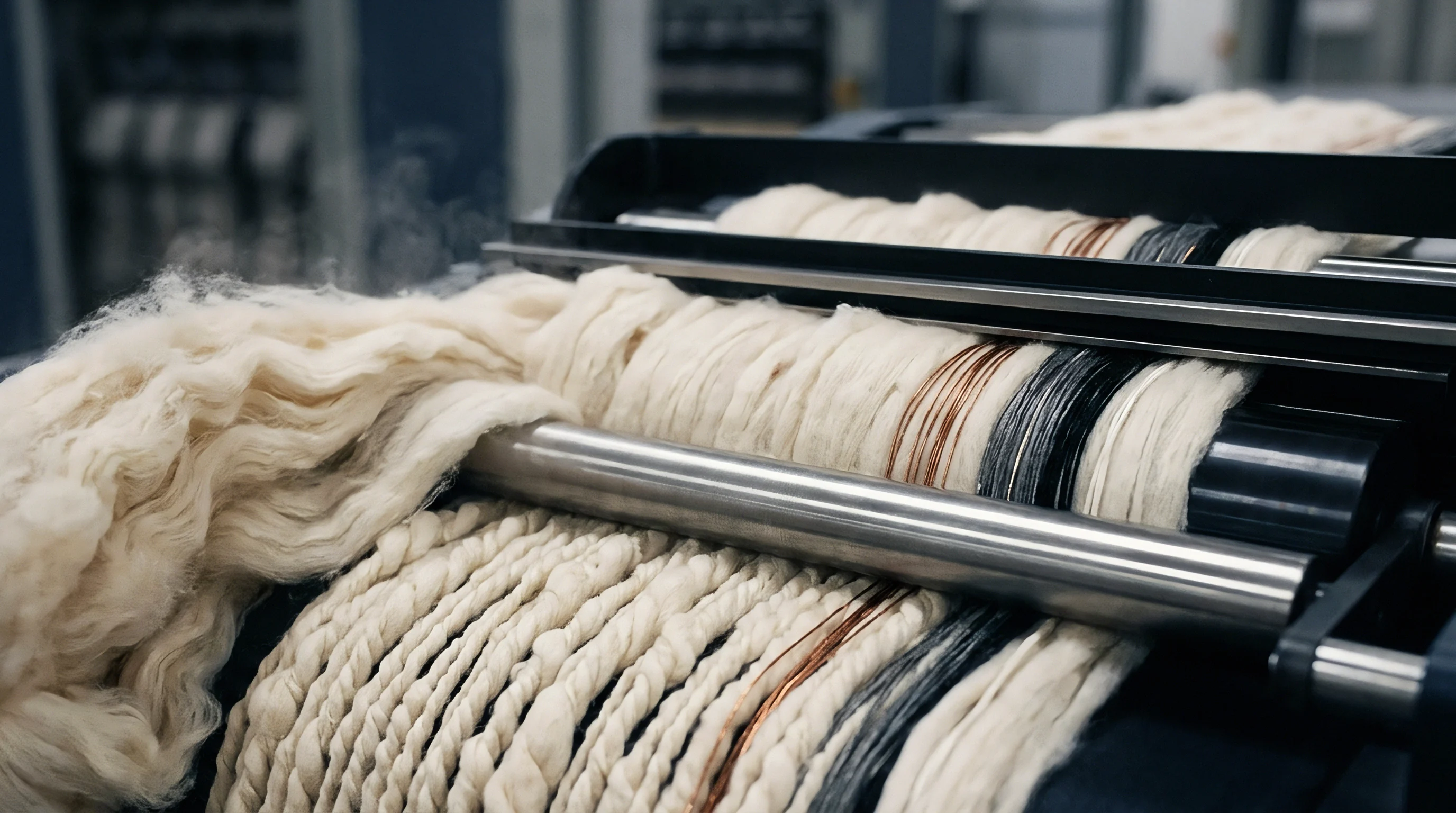
Carded and combed yarn manufacturing uses two primary methods to combine different fibre types. Bale-to-bale mixing in the blowroom produces intimate blends by laying down alternating tufts of synthetic and natural stock before carding. Draw frame blending feeds separate slivers of pure cotton and synthetic fibres into a single drafting zone, using repeated doubling passes to mix the components.
Raw fibre properties fluctuate across harvest seasons and production lots.
Blowroom blending yields a thorough distribution, but variations in tuft density can cause ratio shifts along the length of the sliver. Synthetic fibres exhibit different static charge characteristics and crimp profiles than natural cotton. During carding and combing, fiber waste extraction rates differ between components: carding action removes a higher fraction of short cotton fibres while retaining continuous synthetic staple lengths, raising the final synthetic proportion above the original weigh-hopper recipe.

Draw Frame Variance across Spinning Lots
Draw frame blending relies on precise linear density control of incoming pure slivers. If a cotton sliver fluctuates by three percent in grain weight due to relative humidity shifts in the card room, the resulting blended sliver drifts off its target composition ratio. Because high-speed drawing frames operate at delivery speeds exceeding 800 metres per minute, hundreds of kilograms of out-of-spec sliver can pass through prior to auto-leveler detection.
Standard carding processes alter final blend ratios by preferentially extracting short natural fibres as waste.
Uncorrected blend drift leads directly to tariff reclassification risks.
- Differential waste extraction occurs when card clothing extracts short natural fibres at higher rates than synthetic staple, skewing the final blend ratio toward synthetic predominance.
- Static charge accumulation on synthetic fibers causes machine cling during drafting, forcing local density variations along the strand.
- Humidity fluctuations alter the moisture mass of natural fibres during sliver preparation, feeding incorrect dry masses into auto-leveling draft heads.
- Roving twist variation permits unequal fiber migration during ring spinning, causing outer yarn layers to carry different blend percentages than the core strand.
Natural fibre moisture absorption during transit can alter the apparent weight percentages of the delivered blend relative to mill exit checks.

Regain
Fibre composition percentages declared for customs compliance cannot be calculated directly from ambient room-temperature weights. Different textile fibres absorb varying amounts of water vapor from surrounding air. This moisture regain alters the gross physical weight of raw fibre, sliver, yarn, and fabric.
Absorbed moisture content changes measured mass proportions.

Chemical Dissolution Testing via ISO 1833 Standard
Establishing true fiber proportions requires chemical separation techniques specified under ISO 1833 standards or AATCC Method 20A. Testing laboratories extract non-fibrous matter ~ such as oils, waxes, and spinning finishes ~ using petroleum ether or enzymatic scouring. The scoured sample then undergoes selective solvent dissolution to isolate the blend components.
In a cotton-polyester blend, concentrated sulfuric acid or zinc chloride dissolves the cotton fraction while leaving the polyester residue intact. The remaining insoluble component is washed, neutralized, and dried in an oven at 105 degrees Celsius until reaching a constant dry mass. Subtracting the dry residue weight from the initial dry sample weight yields the unadjusted dry mass ratio.
Are Commercial Moisture Allowance Rates Uniform across Customs Jurisdictions?
Customs authorities require calculating final composition based on commercial mass rather than ambient or oven-dry mass. Commercial mass equals the oven-dry mass of the clean fibre multiplied by one plus the official commercial moisture regain allowance factor. ISO 6741 defines these statutory regain rates for trade compliance.
Cotton carries an official commercial moisture regain rate of 8.50 percent, polyester carries 0.40 percent, viscose carries 13.00 percent, and scoured wool yarn carries 18.25 percent. Because cotton retains over twenty times more water weight than polyester under standard allowance rules, calculating ratios without applying regain factors artificially inflates the synthetic percentage.
| Textile Fibre Material | Standard Commercial Regain Rate (%) | Commercial Mass Multiplier Factor | Hydrophilic / Hydrophobic Classification |
|---|---|---|---|
| Polyester (PET) Staple / Filament | 0.40% | 1.0040 | Hydrophobic Synthetic |
| Polyamide (Nylon 6,6) | 5.75% | 1.0575 | Semi-Hydrophilic Synthetic |
| Acrylic Staple Fibre | 2.00% | 1.0200 | Hydrophobic Synthetic |
| Combed Cotton (Scoured) | 8.50% | 1.0850 | Hydrophilic Natural Cellulose |
| Viscose / Rayon Staple | 13.00% | 1.1300 | Regenerated Cellulose |
| Scoured Wool (Yarn Form) | 18.25% | 1.1825 | Hydrophilic Animal Protein |
Customs authorities adjust dry test masses using statutory regain multipliers.
Calculation of Corrected Mass Ratios
Converting oven-dry test masses to commercial mass percentages follows a standardized mathematical formula. A yarn sample that yields 50.00 grams of dry cotton residue and 50.00 grams of dry polyester residue after chemical dissolution has an unadjusted oven-dry composition of 50.00 percent cotton and 50.00 percent polyester.
To calculate the commercial mass of the cotton component, 50.00 grams is multiplied by 1.0850, yielding 54.25 grams. For the polyester component, 50.00 grams is multiplied by 1.0040, yielding 50.20 grams. The total commercial mass of the sample equals 104.45 grams.
Dividing 54.25 grams by 104.45 grams sets the official commercial cotton proportion at 51.94 percent. Dividing 50.20 grams by 104.45 grams sets the commercial polyester proportion at 48.06 percent. Applying statutory moisture regain shifts the predominant fibre classification from an equal tie into Chapter 52 under Heading 5206.
Oven-dry mass establishes baseline pure fibre weight prior to adjustment.
Applying ISO 6741 commercial moisture regain factors converts an apparent 50/50 oven-dry mass ratio into a 51.94/48.06 cotton-predominant blend for customs declaration.
- Dry the scoured test sample in a ventilated oven at 105 degrees Celsius to constant mass.
- Perform selective chemical dissolution to isolate individual fibre components.
- Weigh each separated residue component to obtain oven-dry mass figures.
- Multiply each dry component weight by its corresponding statutory commercial regain factor.
- Sum the individual commercial weights to calculate total commercial sample mass.
- Divide each component commercial mass by total commercial mass to establish official declaration percentages.
Sales contracts specifying composition must explicitly incorporate ISO 6741 commercial regain adjustments to bind both parties to customs-compliant calculations.


Dispute
Border inspections challenge declared yarn composition percentages when port laboratory tests return figures that differ from commercial invoices. Enforcement focuses heavily on threshold blends where minor analytical variations move product entries between high-duty and low-duty tariff lines.
Port laboratory results take precedence in entry determination.
Laboratory Tolerances and Statutory Composition Margins
Regulations in major import markets establish legal tolerances for textile labelling, but these commercial allowances do not automatically protect importers against tariff reclassification. European Union and United States labelling rules permit a three percent commercial allowance for multi-fibre blends to cover manufacturing variations.
Customs classification enforcement operates under strict statutory interpretation rather than labelling tolerance rules. If an importer declares a yarn as 52 percent cotton and 48 percent polyester under Heading 5206, and border chemical testing returns 49.5 percent cotton and 50.5 percent polyester, customs authorities will reclassify the goods under Heading 5509. The commercial labelling tolerance does not prevent tariff reclassification or duty adjustments.
Customs Reclassification Mechanics
Customs testing protocols require taking representative samples from imported consignments using random selection criteria. Samples undergo conditioning in standard laboratory atmospheres of 20 degrees Celsius and 65 percent relative humidity prior to testing under ISO standards.
Importers contesting customs laboratory test reports can request secondary referee testing on retained reserve samples. Dispute resolution requires proving that the port laboratory failed to follow standardized solvent procedures, misapplied commercial moisture regain factors, or omitted non-fibrous matter extraction prior to chemical separation.
Statutory labelling allowances of three percent do not override customs reclassification rules when laboratory tests show a shift in chief weight predominance.
Commercial labelling tolerances do not apply to tariff classification decisions.
- Verification of laboratory accreditation confirms the testing facility holds active ISO/IEC 17025 certification for ISO 1833 quantitative fibre methods.
- Audit of non-fibrous matter extraction ensures spinning lubricants, sizing agents, and wax finishes were completely removed prior to solvent treatment.
- Review of regain factor application checks whether laboratory analysts applied correct statutory commercial moisture regain multipliers to dry residue masses.
- Chain of custody validation tracks sample handling from port sampling to laboratory bench to eliminate contamination risks.
What specific margin of analytical error must an importer demonstrate to invalidate a port laboratory finding of fibre predominance?

Invoice
Commercial invoices carry legal weight in cross-border customs entries. Discrepancies between invoice descriptions, bills of lading, and physical lab tests expose importers to severe financial liabilities. Landed cost calculations depend directly on tariff lines established by chief weight classification rules.
Chemical test results dictate final duty rates.

Landed Cost Exposure under Borderline Blend Shifts
Tariff schedules often place different duty rates on natural versus synthetic yarns. A country may impose a 4.0 percent ad valorem duty rate on combed cotton yarns under Chapter 52 while applying a 12.0 percent rate on synthetic staple yarns under Chapter 55. On a bulk shipment valued at 250,000 dollars, this duty spread alters the import tax bill substantially.
Consider a contract specified at 51 percent cotton and 49 percent polyester staple yarn. The importer models landed costs based on the 4.0 percent cotton tariff rate, expecting a duty assessment of 10,000 dollars. If spinning mill variation causes the bulk shipment to deliver at 49 percent cotton and 51 percent polyester, customs reclassifies the cargo under Heading 5509 at the 12.0 percent synthetic rate.
Duty increases to 30,000 dollars, creating an unexpected 20,000 dollar cash loss on a single consignment.
| Declared vs Tested Composition | Declared Tariff Heading | Actual Tariff Heading | Applied Duty Rate (%) | Total Duty Payable ($) | Landed Cost Variance ($) |
|---|---|---|---|---|---|
| Declared: 51% Cotton / 49% PET Tested: 51% Cotton / 49% PET | Heading 5206 (Cotton) | Heading 5206 (Cotton) | 4.0% | $10,000 | Baseline expected cost |
| Declared: 51% Cotton / 49% PET Tested: 49% Cotton / 51% PET | Heading 5206 (Cotton) | Heading 5509 (Synthetic) | 12.0% | $30,000 | +$20,000 unexpected liability |
| Declared: 50% Cotton / 50% PET Tested: 50% Cotton / 50% PET | Heading 5509 (Tie-Breaker) | Heading 5509 (Tie-Breaker) | 12.0% | $30,000 | Evaluated at synthetic rate |
| Declared: 55% Viscose / 45% PET Tested: 45% Viscose / 55% PET | Heading 5510 (Viscose) | Heading 5509 (Synthetic) | 10.0% vs 12.0% | $30,000 | +$5,000 unexpected liability |
Contracted Composition Specifications
Mitigating customs financial risk requires writing precise technical specifications into purchase contracts. RFQ documents should mandate that spinning mills produce target ratios with strict internal tolerances, such as 53/47 target ratios for nominal 50/50 commercial lines, ensuring that production drift does not cross the 50 percent threshold under official moisture regain calculations.
Contracts must specify independent pre-shipment testing by accredited laboratories using ISO 1833 chemical separation methods. Requiring test certification prior to bill of lading issuance protects buyers against paying invoices for shipments that will fail customs entry checks.
Specifying safety margins well clear of binary fifty-percent thresholds protects commercial margins against natural mill drift.