Mathematical Correction Models for Customs Tariff Classification under Asymmetric Fiber Moisture Regain Allowances
Statutory moisture allowances convert dry mass into legal commercial mass, shifting chief weight and flipping tariff headings on tight fibre ratios.

Bolt
An entry manifest detailing fifty-two percent combed cotton and forty-eight percent filament polyester arrives at customs clearance carrying an immediate fiscal hazard. Customs tariff classification under Section XI of the Harmonized System assigns goods according to the single textile constituent that predominates by weight. When clearing officers draw an inspection sample, the physical weight of that piece of cloth does not determine the legal outcome.
Cotton absorbs water aggressively. Polyester repels ambient humidity. The physical ratio measured on an analytical balance in a conditioned room reflects ambient relative humidity rather than the legal commercial mass recognized by customs law.
International tariff codes separate chapters based on fibre origin. Chapter 52 governs cotton, while Chapter 54 and Chapter 55 govern man-made filaments and staple fibres. The customs duty payable on an imported textile shifts substantially across these chapters.
A difference of half a percentage point redistributes the entire consignment into a higher tariff category. Importers frequently face surprise duty demands because their technical specifications rested on dry polymer mass while border laboratories applied statutory commercial regain allowances.
Under standard test conditions of sixty-five percent relative humidity and twenty degrees Celsius, raw cotton holds eight and one-half percent water while polyester holds less than one-half percent.

Mechanical Moisture Equilibrium across Dual Substrates
Water molecules bind directly to hydroxyl groups on the amorphous regions of cellulose chains. Inside synthetic polyester, the crystalline structure provides virtually no hydrophilic bonding sites. This natural divergence creates asymmetric water absorption across any dual-fibre intimate mixture.
When an intimate yarn containing equal parts dry cotton and dry polyester enters an environment with sixty-five percent relative humidity, the cotton component gains mass rapidly while the polyester component remains almost unchanged.
The clean mass shifted overnight. A yarn formulated at exactly fifty percent cotton and fifty percent polyester by oven-dry weight tips into cotton predominance as soon as it reaches moisture equilibrium with standard air. The laboratory result governs the entry.
Border authorities do not classify textiles according to raw unconditioned intake at the spinning mill. They assess the goods either after complete oven drying followed by the addition of official moisture regains, or by measuring conditioned mass against statutory tables.
| Fibre Type | ISO 6741 Allowance Percentage | EU Regulation 1007/2011 Percentage | ASTM D1909 Commercial Regain Percentage | US Customs CBP Table Percentage |
|---|---|---|---|---|
| Combed Cotton | 8.50 | 8.50 | 8.50 | 8.50 |
| Carded Cotton | 8.50 | 8.50 | 8.50 | 8.50 |
| Polyester Staple | 1.50 | 1.50 | 1.50 | 3.00 |
| Polyester Filament | 1.50 | 1.50 | 0.40 | 1.50 |
| Viscose Rayon | 13.00 | 13.00 | 11.00 | 11.00 |
| Wool Worsted | 18.25 | 18.25 | 15.00 | 17.00 |
| Nylon 6.6 | 5.75 | 5.75 | 4.50 | 4.50 |

Gravimetric Drift across Container Shipments
Ocean freight conditions introduce significant humidity swings during multi-week ocean crossings. A sealed steel container moving through tropical waters experiences internal condensation and extreme hygrometric variation. Hydrophilic components absorb moisture from the trapped microclimate, whereas synthetic filaments show minimal gravimetric reaction.
If a customs officer weighs an incoming roll directly on the pier, the apparent weight ratio deviates substantially from the spinning floor recipe.
Testing personnel cannot rely on warehouse scale readings to settle legal tariff identity. The chief weight inverted. An uncorrected gravimetric measurement taken in an uncontrolled ocean freight terminal yields arbitrary classifications that collapse under formal dispute.
Customs procedures therefore bypass ambient moisture readings entirely by mandating specific mathematical correction formulas applied to the oven-dry weight of separated fibre components.
Mislabelling the dominant constituent exposes the entry to mandatory seizure, penalty rate adjustments, and back assessments across all past consignments.


Extraction
Quantitative analysis of dual-fibre textiles demands complete chemical separation under standardized testing methods. Laboratory technicians isolate each component by selectively dissolving one polymer while leaving the second constituent undamaged. ISO 1833 and ASTM D629 outline the definitive chemical mechanisms used to dissolve cellulose, polyamides, acrylics, or polyesters from intimate mixtures.
The chemical reagent dissolved the wool. In a mixture of sheep hair and synthetic filaments, cold alkaline solutions or warm sodium hypochlorite remove the animal fibre cleanly. What remains on the sintered glass crucible is the insoluble synthetic mass.
That residue undergoes thorough washing with deionized water, neutralisation with dilute acetic acid, and drying in a ventilated oven at one hundred and five degrees Celsius until reaching constant mass.

Selective Solvent Digestion under Standard Atmosphere
Laboratory chemists apply specific aggressive solvents calibrated to polymer vulnerability:
- Formic acid eighty-five percent dissolves nylon 6 and nylon 6.6 completely within two hours at room temperature, allowing the gravimetric recovery of intact cotton or polyester filaments without surface etching.
- Acetone reagent grade extracts acetate and triacetate fibres at room temperature, leaving non-derivatized plant cellulose and synthetic polymers intact on the filter plate.
- Sulfuric acid seventy-five percent breaks down cellulose chains in cotton and viscose during immersion at fifty degrees Celsius, leaving unattacked polyester residues for quantitative drying.
- Dimethylformamide pure grade strips acrylic copolymers from natural hairs and synthetics within thirty minutes at ninety-five degrees Celsius.
The insoluble residue settled cleanly. The analyst calculates the clean oven-dry mass of both dissolved and remaining components. However, chemical solvents routinely leach minute quantities of surface finishes, oligomers, and natural waxes.
ISO 1833 introduces specific correction factors, known as d-values, to compensate for slight mass loss suffered by the insoluble residue during chemical exposure. For clean polyester treated with seventy-five percent sulfuric acid, the standard d-factor is 1.00, indicating complete chemical inertness, whereas cotton exposed to mild hypochlorite carries a d-factor of 1.01 to offset minor cellulose degradation.
Chemical dissolution methods under ISO 1833 mandate application of empirical d-factors to adjust for solvent erosion on insoluble residue before any moisture allowance calculation begins.

Gravimetric Tare Isolation after Thermal Desiccation
Desiccation testing strips all moisture to arrive at absolute bone-dry mass. Technicians place the extracted components inside an oven maintained at one hundred and five degrees Celsius, plus or minus three degrees, until two consecutive weighings taken twenty minutes apart show less than 0.05 percent mass variation. Glass weighing bottles with ground-glass stoppers prevent the parched cellulose from pulling water out of the air during transport to the analytical scale.
This dry gravimetric tare forms the baseline for all statutory customs calculations. The customs debt crystallizes immediately. Border agencies do not classify cloth on bone-dry mass alone, because bone-dry conditions represent an artificial state never present in commercial use.
Instead, statutory authorities take this clean, solvent-extracted dry figure and load it with legal moisture regain allowances. The physical reality of the sample inside the testing oven is systematically converted into a legal fiction defined by statutory percentages.
Overseas spinning managers frequently claim that moisture uptake remains beyond factory control once the container leaves the loading dock.


Statute
Harmonized System General Rules of Interpretation govern tariff allocation. Note 2(A) to Section XI dictates that goods composed of two or more textile materials are classified as if consisting wholly of that one textile material which predominates by weight over every other single textile material. National customs codes implement this instruction through distinct regulatory texts that prescribe specific mathematical correction algorithms.
European Union customs law operates under Regulation (EU) No 1007/2011 on textile fibre names and related labelling. Annex VIII sets forth the exact mathematical sequence required to establish commercial composition. United States Customs and Border Protection operates under Customs Valuation and Classification standards, incorporating ASTM D629 and ASTM D1909 through Chapter 54 and Chapter 55 administrative rulings.
While both trading blocs acknowledge the need for moisture correction, their mathematical models handle commercial mass adjustments with subtle algorithmic differences that alter outcomes on borderline compositions.
Where Does Commercial Mass Overrule Oven Dry Ratios?
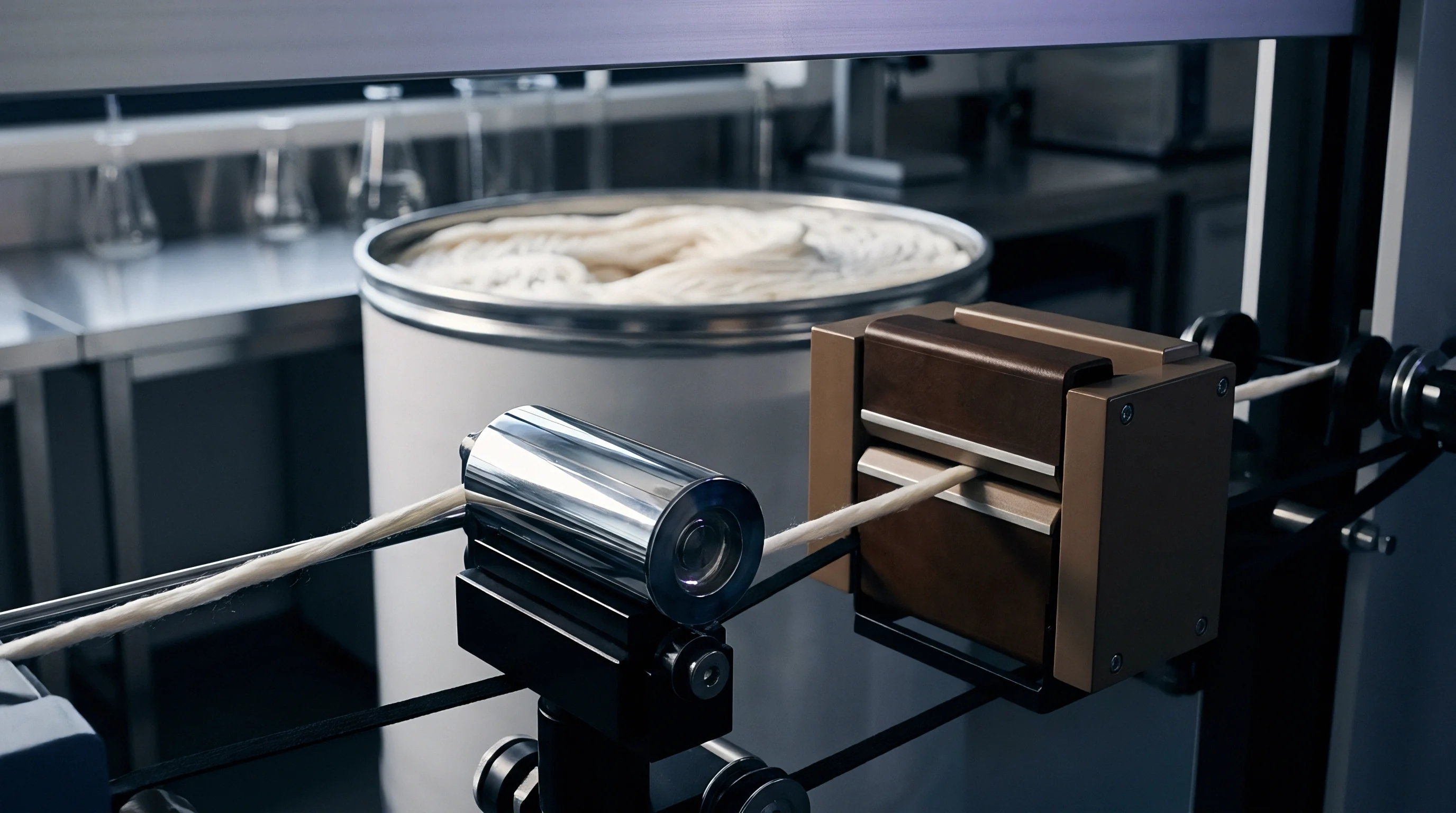
The transition between clean oven-dry mass and legal commercial mass reveals how tariff identity flips on close ratios. The statutory correction applies here. Under European Union rules, analysts determine the clean dry mass of fibre A, denoted as m1, and fibre B, denoted as m2.
Each mass is multiplied by its statutory commercial moisture regain allowance, denoted as a1 and a2, alongside any agreed allowance for manufacturing sizing or finish.
The legal commercial mass of each component is derived through a linear formula:
M1 equals m1 multiplied by the quantity one plus a1 divided by one hundred.
M2 equals m2 multiplied by the quantity one plus a2 divided by one hundred.
The corrected percentage of fibre A, which dictates tariff classification, is defined by the commercial ratio:
Percentage A equals M1 divided by the sum of M1 and M2, multiplied by one hundred.
If fifty grams of bone-dry combed cotton and fifty grams of bone-dry polyester staple are analyzed under EU Regulation 1007/2011, the cotton allowance is 8.50 percent and the polyester staple allowance is 1.50 percent. The commercial mass of the cotton becomes 54.25 grams. The commercial mass of the polyester becomes 50.75 grams.
The total commercial mass equals 105.00 grams. Cotton represents 51.67 percent of the legal weight. The piece of cloth is classified under Chapter 52 as cotton, despite having entered the laboratory as an exact fifty-fifty dry mixture.
| Mixture Description | Oven-Dry Mass Ratio | Applicable Regains (Fibre 1 / Fibre 2) | Calculated Commercial Mass (g) | Final Legal Tariff Percentage | Statutory Predominance |
|---|---|---|---|---|---|
| Cotton / Polyester Staple Case A | 49.00g / 51.00g | 8.50% / 1.50% | 53.165g / 51.765g | 50.67% Cotton / 49.33% Poly | Cotton Chapter 52 |
| Cotton / Polyester Staple Case B | 48.00g / 52.00g | 8.50% / 1.50% | 52.080g / 52.780g | 49.67% Cotton / 50.33% Poly | Polyester Chapter 55 |
| Worsted Wool / Polyester Filament | 44.00g / 56.00g | 18.25% / 1.50% | 52.030g / 56.840g | 47.79% Wool / 52.21% Poly | Polyester Chapter 54 |
| Worsted Wool / Polyester Filament | 46.00g / 54.00g | 18.25% / 1.50% | 54.395g / 54.810g | 49.81% Wool / 50.19% Poly | Polyester Chapter 54 |
| Viscose Rayon / Polyester Staple | 46.00g / 54.00g | 13.00% / 1.50% | 51.980g / 54.810g | 48.67% Viscose / 51.33% Poly | Polyester Chapter 55 |
| Viscose Rayon / Polyester Staple | 48.00g / 52.00g | 13.00% / 1.50% | 54.240g / 52.780g | 50.69% Viscose / 49.31% Poly | Viscose Chapter 55 |

Harmonized System Mathematical Corrections
United States Customs and Border Protection encounters significant classification disputes when dealing with polyester filament mixtures. The US Harmonized Tariff Schedule applies distinct moisture regain allowances depending on whether the synthetic material is continuous filament or cut staple. Under ASTM D1909, filament polyester carries a commercial regain allowance of only 0.40 percent, whereas staple polyester receives 1.50 percent.
In certain older CBP customs court precedents, officers applied a flat 3.00 percent allowance for man-made fibres when classification rules crossed into specialty woven categories.
An importer testing a 49/51 cotton-polyester filament cloth faces an aggressive shift. Applying 8.50 percent to cotton and 0.40 percent to filament polyester drives the cotton share from 49.00 percent dry weight to 50.93 percent commercial weight. Cotton becomes the chief weight.
The calculation overturns the bill. The tariff classification shifts from heading 5407 (woven fabrics of synthetic filament yarn, frequently taxed at twelve to fourteen percent duty) to heading 5210 (woven fabrics of cotton containing less than 85 percent by weight of cotton, mixed mainly with man-made fibres, carrying lower duty rates).
European Union Regulation 1007/2011 Annex VIII mandates the direct addition of statutory commercial regains to clean dry mass, establishing legal predominance regardless of physical warehouse weight.

Audit
Customs enforcement operations target borderline declarations using structured laboratory audits. Border agencies recognize that spinning mills cut costs by substituting cheap virgin or recycled polyester into natural fibre runs. When an import declaration asserts a 51/49 composition favoring a low-duty natural fibre, automated risk profiling systems flag the shipment for destructive laboratory verification.
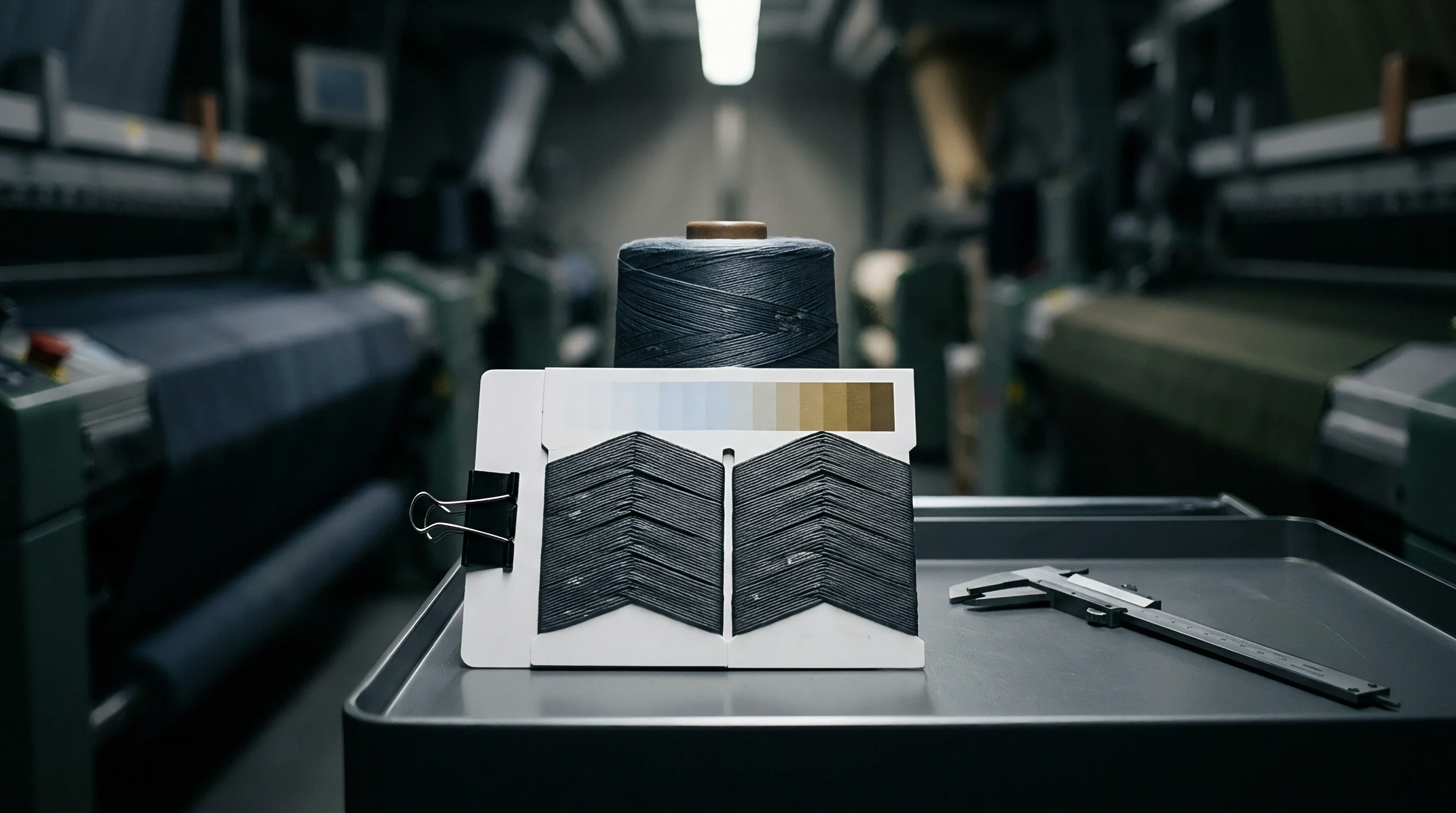
The container remains detained. Customs officers draw composite swatches according to strict sampling schedules. ISO 1130 and ASTM D2258 specify the extraction of random yardage taken from the deep core of selected rolls.
Border inspectors discard the outer two layers of the bolt to eliminate dust contamination, topical processing oil residue, and surface humidity anomalies.
Whose Regulatory Tolerance Governs Port Borderline Retests?
Textile testing laboratories operate under analytical margins of error. A quantitative chemical dissolution test under ISO 1833 carries an inherent inter-laboratory reproducibility variance between 0.5 and 1.2 percentage points. Commercial consumer labelling laws, such as FTC rules in the United States or Regulation 1007/2011 in Europe, allow a three percent manufacturing tolerance between declared composition and tested reality.
Customs tariff classification strictly rejects commercial labelling tolerances:
- Customs border re-testing measures exact mathematical predominance rather than consumer disclosure compliance, meaning a cloth testing at 50.1 percent polyester is classified as synthetic even if sold commercially as a cotton blend under a three percent labelling allowance.
- Secondary independent arbitration occurs only when an importer files a formal protest under 19 U.S.C. 1514 or EU Union Customs Code Article 44, submitting split samples to an accredited third-party laboratory using identical chemical reagents.
- Destructive oven desiccation eliminates sizing agents, topical softeners, and antistatic finishes through petroleum ether and water wash cycles before solvent separation to ensure that chemical additives do not skew the clean gravimetric tare.
The rate spread reaches nine percent. When retests occur, authorities demand proof of the exact analytical methods used by the origin mill. Discrepancies between testing facilities often trace back to the temperature at which the insoluble residue was desiccated, or whether the testing house applied the staple regain rather than the filament regain to a textured synthetic yarn.
Customs authorities reject retail consumer labelling tolerances during tariff disputes, enforcing legal classification strictly on calculated commercial predominance down to a tenth of a percent.

Core Sampling Integrity in High Humidity Docks
Inspection bays at marine ports frequently subject exposed cloth samples to extreme thermal and barometric swings. If port technicians take days to seal swatches into airtight moisture-proof canisters, moisture absorption begins immediately. A sample of dried cotton exposed to open sea air absorbs up to five percent moisture within ninety minutes.
The importer faces full classification reassessment. When sample packaging fails, the testing facility receives material that no longer matches the bulk shipment. Competent customs brokers insist on witnessing the sample extraction, verifying that the testing officers place swatches into heat-sealed aluminum laminate bags or vapor-tight polyethylene containers immediately upon cutting from the roll.
Whether customs laboratories will eventually calibrate correction formulas to real microplastic absorption coefficients inside recycled polymers remains an unanswered problem across border control authorities.

Margin
Landed cost calculations depend directly on tariff predictability. The financial variance caused by an inverted chief weight determination destabilizes supply chain profitability. An importer sourcing millions of metres of pocketing cloth or uniform twill operates on net commercial margins between four and eight percent.
A sudden reclassification by border authorities instantly consumes that margin through back-duty assessments and delayed clearance demurrage.
The differential settles the tariff heading. Consider a high-volume combed cotton and polyester twill engineered for workwear. Under United States Harmonized Tariff Schedule heading 5210, a twill containing under eighty-five percent cotton by weight, mixed mainly with polyester, enters at an ad valorem rate between 7.5 and 8.4 percent.
If chemical testing flips predominance to polyester staple under heading 5514, the duty rate jumps to 12.0 or 14.9 percent depending on weave structure and yarn construction.
| Declared Ratio | Clean Dry Tested Ratio | Corrected Legal Ratio | Assigned Tariff Heading | Ad Valorem Duty Rate | Total Duty Payable |
|---|---|---|---|---|---|
| 55% Cotton / 45% Poly | 53.2% Cotton / 46.8% Poly | 54.9% Cotton / 45.1% Poly | 5210.31.00 (Cotton Chief) | 7.5% | $26,250 |
| 51% Cotton / 49% Poly | 48.8% Cotton / 51.2% Poly | 50.5% Cotton / 49.5% Poly | 5210.31.00 (Cotton Chief) | 7.5% | $26,250 |
| 50% Cotton / 50% Poly | 47.5% Cotton / 52.5% Poly | 49.2% Cotton / 50.8% Poly | 5514.21.00 (Synthetic Chief) | 14.9% | $52,150 |
| 48% Cotton / 52% Poly | 45.5% Cotton / 54.5% Poly | 47.2% Cotton / 52.8% Poly | 5514.21.00 (Synthetic Chief) | 14.9% | $52,150 |

Tariff Schedule Spreads between Plant and Synthetic Chapters
Financial exposure increases exponentially when dealing with specialty wool combinations. Fine animal hair attracts distinct tariff provisions designed to protect domestic agriculture. In European trade under TARIC, worsted wool mixed with synthetic filaments falls into Chapter 51 or Chapter 54.
Worsted wool carries a massive statutory regain allowance of 18.25 percent. Synthetic filament carries a negligible 1.50 percent allowance.
This seventeen-point regain asymmetry creates an enormous legal lever. A weaver setting up a loom with forty-six percent dry wool and fifty-four percent dry polyester produces cloth that feels synthetic to a classer in the warehouse. Yet on the legal customs ledger, the wool commercial mass expands by almost one-fifth, driving the wool share to nearly fifty percent.
If the dry wool fraction reaches 46.5 percent, legal commercial wool mass hits 50.2 percent, throwing the entire consignment into Chapter 51 and triggering entirely different trade defense duties.
Purchasing Specifications for Strict Customs Clearance
Procurement teams must engineer safety buffers directly into mill contracts. Relying on nominal yarn counts or spinning floor target ratios invites customs disaster. When buying dual-fibre piece goods intended to clear under a natural-fibre heading, technical specifications must mandate minimum clean oven-dry natural fibre thresholds that account for all manufacturing tolerances and moisture corrections.
Clear contracts define testing parameters before yarn is spun:
- Target oven-dry composition must sit at least three percentage points above the legal tipping threshold to absorb normal roving mass drift across multi-spindle production lots.
- Solvent separation method validation under ISO 1833 or ASTM D629 must be certified by an ISO 17025 accredited laboratory prior to container loading at the port of origin.
- Statutory regain inclusion clauses must specify whether customs calculations for the target destination will utilize national staple allowances or filament allowances on synthetic components.
- Indemnity against classification shift must place financial liability for sudden duty rate increases directly onto the textile mill if post-entry chemical testing reveals unapproved synthetic substitution.
Specifying the synthetic component three full points below the statutory threshold protects landed goods against unexpected tariff reclassification.