Mathematical Modeling of Fiber Crimp Variations on Differential Waste Drop Rates in Blowroom Extraction
Higher fiber crimp increases tuft aerodynamic drag and inter-fiber cohesion, elevating blowroom lint loss unless grid slot gaps and transport air speeds are dynamically recalibrated.


Kinematics
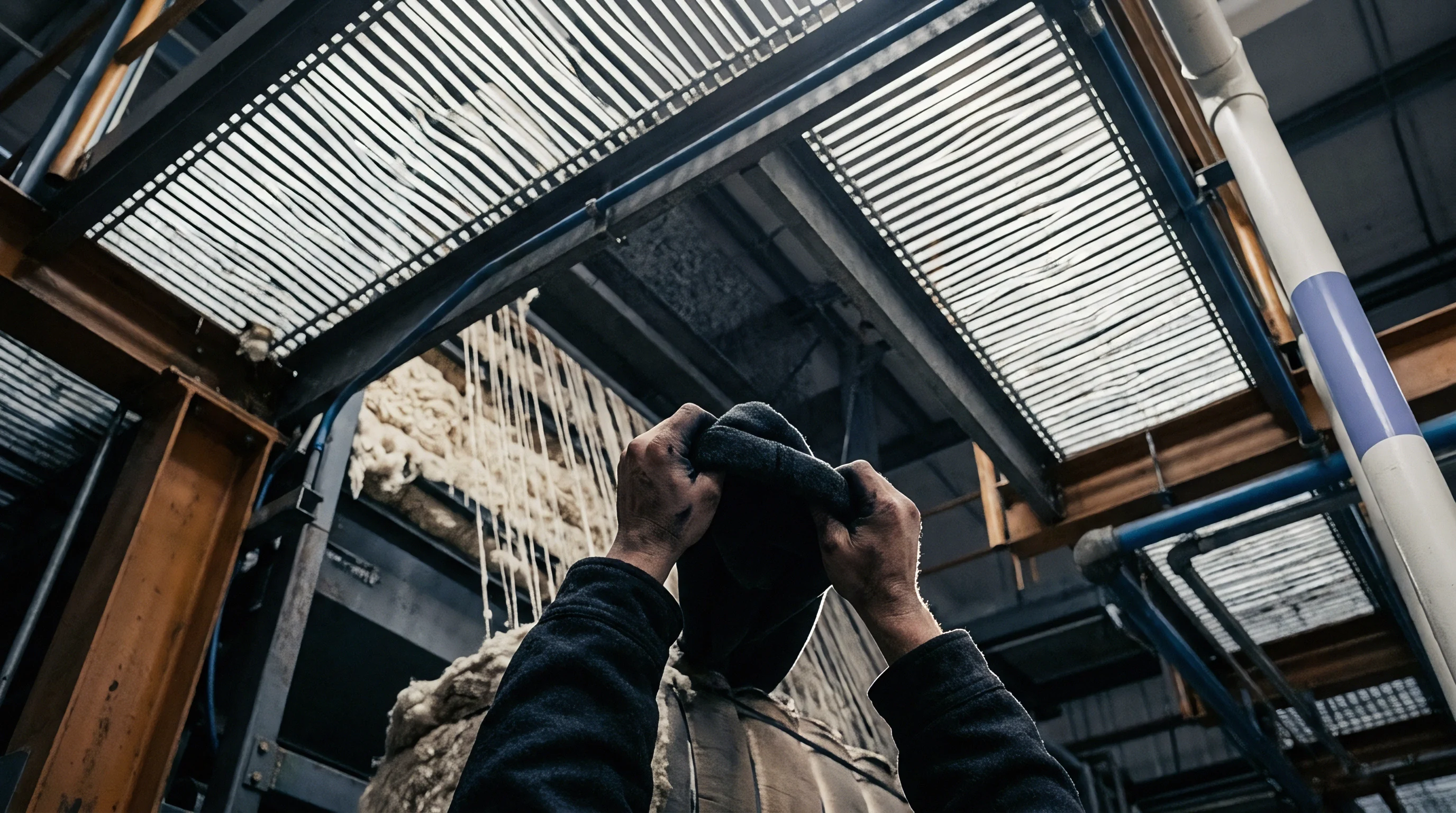
High-speed motion analysis inside mechanical opening zones reveals that fiber geometric deformation governs tuft trajectory across air currents. In blowroom extraction, raw cotton or synthetic staple fibers enter opening stages as compressed, cohesive tufts held together by inter-fiber friction and crimp engagement. Fiber crimp curvature creates a complex three-dimensional geometry that significantly alters both the effective projected surface area of individual tufts and their bulk density.
As air transport currents convey these tufts past revolving beaters and extraction openings, the aerodynamic force acting on a tuft is directly proportional to its effective cross-sectional area and fluid drag coefficient.
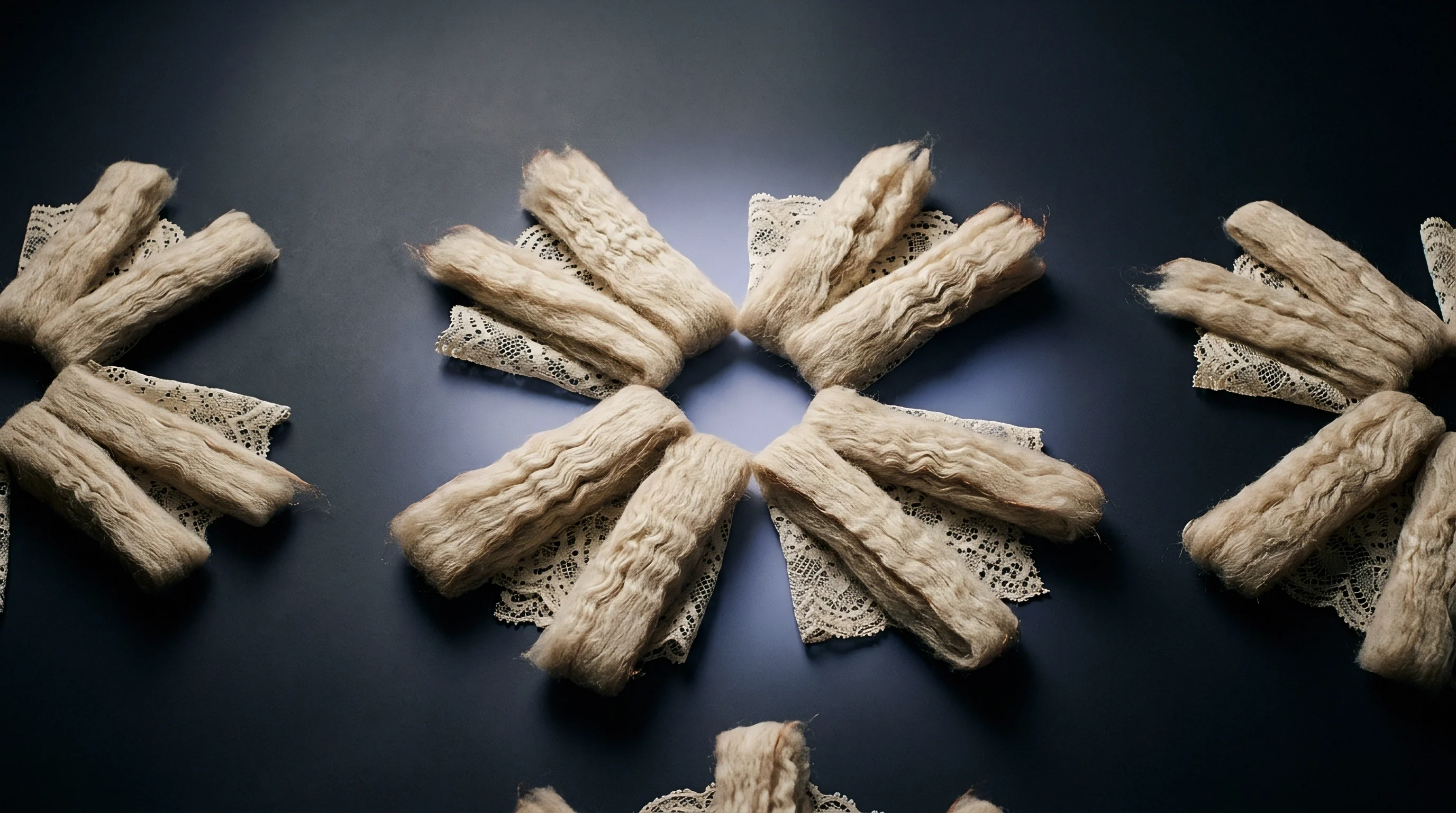
Crimp Curvature and Aerodynamic Drag Coefficients
Dimensional parameters of staple geometry define how moving air transfers momentum to suspended tuft masses. Helical geometry increases aerodynamic drag. A fiber with high crimp frequency (crimps per centimeter) and elevated crimp amplitude forms a bulky tuft structure with high internal void volume.
Fluid dynamics modeling shows that air currents penetrate low-density, high-crimp tufts differently than dense, low-crimp fiber bundles. The aerodynamic drag force exerted on a suspended tuft inside a blowroom duct is expressed by the standard hydrodynamic relationship:
F_d = 0.5 rho v_rel^2 C_d A_eff
where rho represents air fluid density (typically 1.204 kg/m³ at standard standard atmospheric conditions), v_rel is the relative velocity between the air stream and the tuft, C_d is the boundary-layer drag coefficient, and A_eff is the effective projected frontal area. Higher crimp amplitude increases A_eff by expanding tuft radius without increasing total fiber mass. Air velocity governs transport.
High-crimp tufts experience elevated drag forces at equivalent airflow velocities, causing rapid acceleration along transport air ducts.
Helical fiber curvature expands the effective hydrodynamic boundary layer of opening tufts, shifting suction velocity thresholds across extraction zones.
This increased acceleration modifies tuft transit kinetic velocity at the exact moment of engagement with opening elements such as pin beaters, step cleaner beaters, or carding rollers. Crimp alters tuft bulk. When a high-crimp tuft enters the strike zone of a revolving beater, the higher aerodynamic drag keeps the tuft suspended centrally within the air duct, altering its approach angle relative to grid bar apertures.
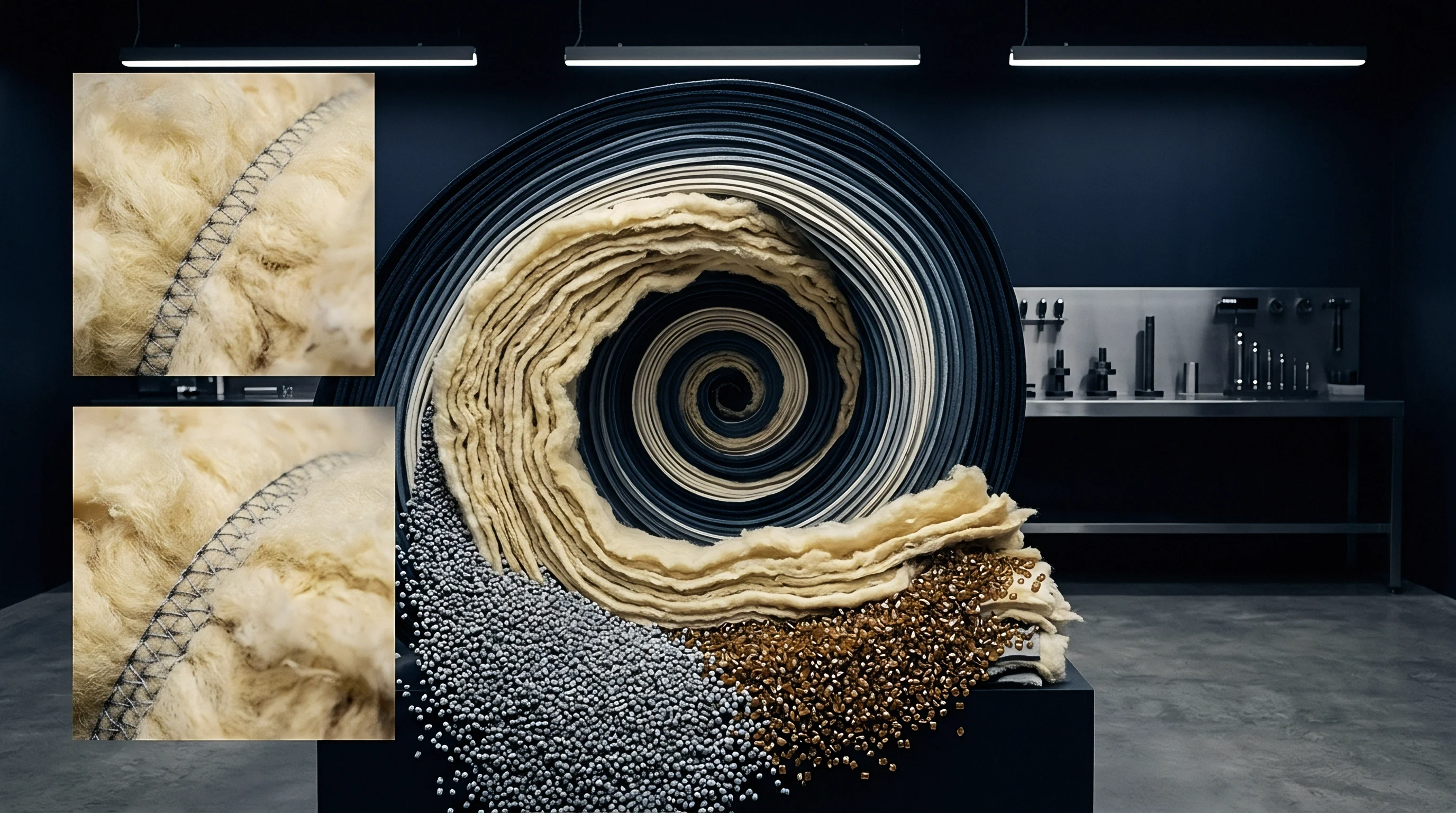
Mechanical Decrimping Energy in Tuft Opening
Stored flexural strain within bent polymer chains responds dynamically when striker pins strike incoming fiber bundles. As a beater pin strikes a tuft, part of the kinetic impact energy goes into breaking inter-fiber cohesion, while another fraction goes into transient tensile decrimping. The energy absorbed during decrimping is governed by the flexural rigidity of the fiber and the crimp stability index.
Crimp stability measures the resistance of crimped fibers to permanent extension under applied tensile stress, quantified according to ISO 5079 under specified loading rates.
When fibers possess high crimp energy, the tuft behaves like an elastic spring during mechanical impact. Rather than immediate disintegration into small, clean sub-tufts, the high-crimp fiber mass deforms elastically upon beater impact. Decrimping energy resists mechanical pull.
This elasticity reduces the effective mechanical force transferred to trash particles trapped within the fiber network, altering the differential rate at which heavy waste, motes, and leaf fragments separate from clean lint.
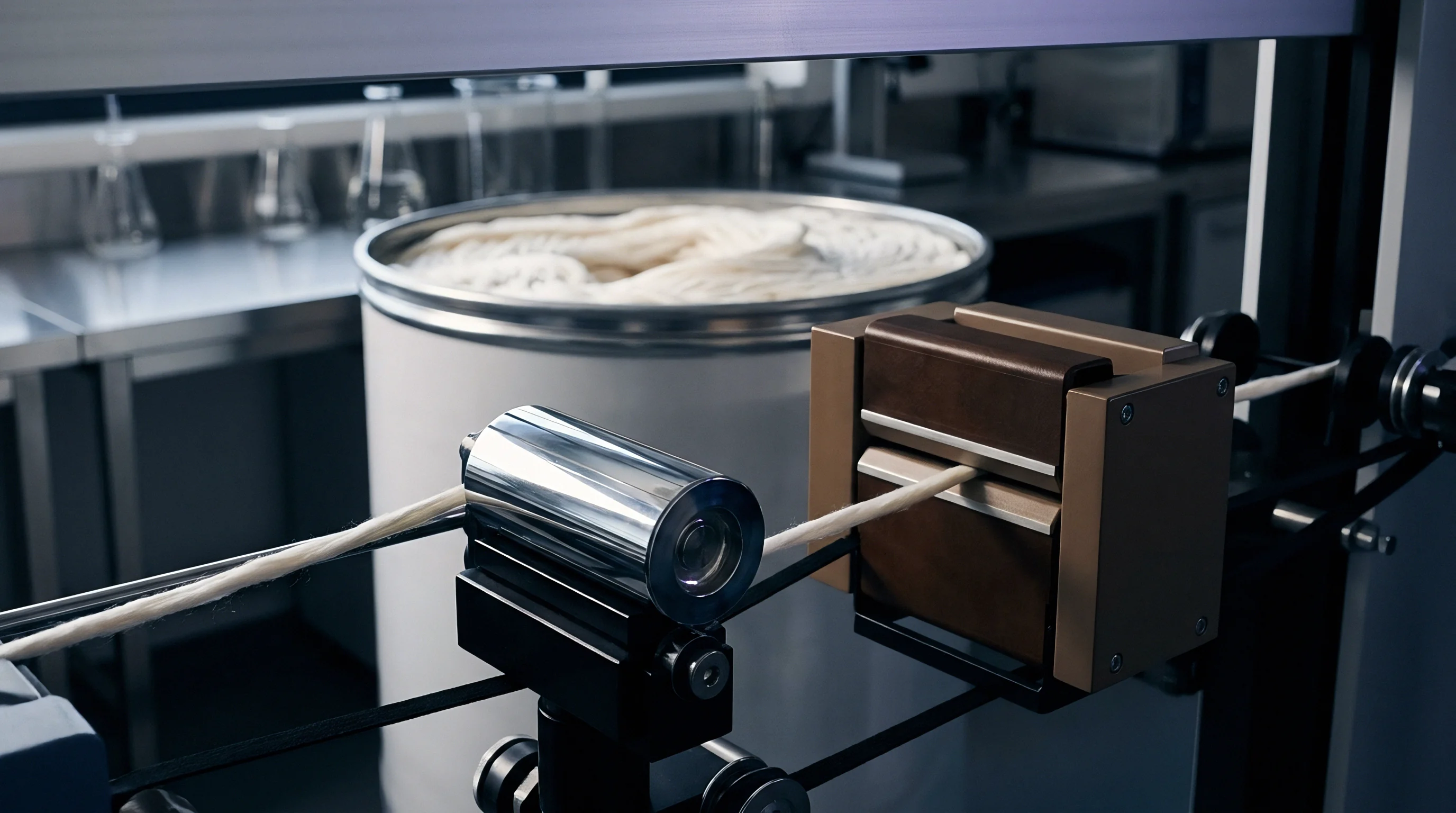

Slot
Waste extraction apertures depend on precise physical separation between solid debris and elastic staple bundles. Blowroom cleaning machinery utilizes grid bars separated by adjustable waste extraction openings, where air suction currents draw smaller, heavier trash particles out of the primary transport duct. The probability of waste drop versus lint loss across a grid aperture hinges on the kinetic trajectory of particles exiting the beater radius.
Striker speed alters kinetic impact.
Impact Geometry across Extraction Bars
Striking actions by revolving beaters accelerate tufts directly toward stationary steel profiles set along the air stream. When a tuft strikes a grid bar edge, trash particles detach due to differential inertia: dense sand, leaf, and seed coat fragments possess high mass-to-surface-area ratios and maintain a straight impact trajectory out through the extraction aperture. Fiber tufts, having low mass and high aerodynamic drag, are pulled along by boundary layer air currents that deflect over the grid bar profile.
Fiber crimp variation disrupts this classical inertial separation mechanism. High crimp frequency increases inter-fiber cohesion through mechanical interlocking of adjacent helical bends. Trash particles trapped inside high-crimp tufts remain mechanical prisoners within the cohesive fiber matrix.
Trash particles detach rapidly. If the force required to pull a trash particle out of an interlocked fiber matrix exceeds the inertial detachment force generated by beater velocity, the trash particle stays inside the tuft and bypasses extraction.
The operational failure modes associated with crimp-induced extraction inefficiencies follow distinct physical pathways across opening zones:
- Interlocking Tuft Pinning occurs when high crimp stability prevents tuft breakdown, causing large elastic fiber bundles to bridge across adjacent grid slots and obstruct trash removal paths.
- Vortex Trash Re-entrainment occurs when high surface area tufts create localized turbulent eddies behind grid bars, drawing previously separated motes back into the main fiber stream.
- Grid-Edge Shearing arises when rigid high-crimp synthetic fibers catch on sharp grid profile edges, resulting in fiber rupture and elevated short fiber content in accepted stock.
- Boundary Air Layer Choking happens when low-density bulky tufts expand into suction ducts, lowering local transport air velocity below the minimum trash settling threshold.
To quantify how crimp variations alter separation dynamics, laboratory trials measure trash detachment force, drag coefficient, and waste drop efficiency across varied opener speeds and crimp parameters.
| Fiber Crimp Frequency (crimps/cm) | Opener Speed (RPM) | Tuft Density (g/cm³) | Effective Drag Coeff (Cd) | Trash Detachment Force (cN) | Lint Loss Ratio (%) |
|---|---|---|---|---|---|
| 4.5 (Low Crimp) | 650 | 0.042 | 0.85 | 0.12 | 0.22 |
| 6.2 (Medium Crimp) | 650 | 0.028 | 1.15 | 0.28 | 0.45 |
| 8.5 (High Crimp) | 650 | 0.018 | 1.52 | 0.45 | 0.88 |
| 4.5 (Low Crimp) | 850 | 0.040 | 0.82 | 0.18 | 0.31 |
| 6.2 (Medium Crimp) | 850 | 0.026 | 1.10 | 0.39 | 0.62 |
| 8.5 (High Crimp) | 850 | 0.016 | 1.48 | 0.62 | 1.24 |
Data recorded across these test runs demonstrates that elevated crimp frequency increases effective drag coefficients and tuft bulk, while drastically increasing the force required to dislodge embedded trash particles. Centrifugal force drives separation. Higher opener speeds increase trash detachment force but concurrently increase lint loss, particularly for high-crimp lots where expanded tuft surface area exposes more good fiber to grid bar collision zones.
Machine vendors frequently attribute elevated waste fractions to excessive raw material crimp variance rather than improper bar angle calibration.
Variance
Statistical dispersion in staple waviness across raw material bales creates uneven mechanical resistance during mechanical processing. Raw cotton bales exhibit natural variations in convolution frequency and micro-crimp, influenced by boll growth conditions, seed strain, and mechanical ginning parameters. Synthetic staple fibers, such as polyester or viscose, receive engineered two-dimensional or three-dimensional crimp during texturing or stuffer-box operations; however, lot-to-lot and bale-to-bale crimp variation remains a persistent industrial reality.
Raw staple density varies. When bales with disparate crimp distributions enter the blowroom blend line, differential extraction rates occur across successive cleaning stages.
Does High Crimp Frequency Increase Good Fibre Carryover?
Elevated wave count per unit length strengthens cohesion between adjacent staple strands within processed tufts. Higher crimp increases internal tuft cohesion, making the fiber aggregate resistant to mechanical opening. As a result, beaters fail to reduce tuft size down to the target milligram mass required for precise cleaning.
Cohesion holds fibers together. Larger, bulky tufts present greater surface area to extraction air currents, causing good fibers to be swept out through waste apertures alongside heavy contaminants.
To control this phenomenon, classers and blowroom technicians implement rigorous lot testing and setting calibration sequences before processing high-crimp lots:
- Draw ten representative fiber subsamples from thirty opened bales across the target lot laydown.
- Condition samples at sixty-five percent relative humidity and twenty degrees Celsius according to ISO 139 standards.
- Measure wave frequency under two milligrams per decitex tension on an automated optical fiber analyzer.
- Calculate coefficient of variation for wave count across five hundred individual single filaments.
- Adjust beater grid settings based on calculated crimp standard deviation before running bulk production.
Higher crimp delays opening. When the coefficient of variation for crimp frequency across a bale mix exceeds twelve percent, standard fixed-grid blowroom settings fail to maintain constant cleanability ratios.
A three-point increase in fiber crimp frequency raises good fiber extraction by zero point four percent under standard grid setting angles.
Grid slot settings control drop. Bales exhibiting excessive crimp frequency require wider grid bar settings and reduced suction pressure to prevent high-value spinnable fiber from dropping into waste pits. Uncleaned trash damages downstream card wire.
Operating extraction zones without adjusting for lot-wide crimp changes results in severe lint loss that inflates total yarn production expenditures.


Equations
Mathematical formulation of differential drop rates combines centrifugal separation force with inter-fiber mechanical friction constants. To build a predictive mathematical model for blowroom extraction, the total waste drop rate (W_total) is divided into clean fiber extraction (W_lint) and non-lint content extraction (W_trash). The differential drop ratio (DDR) defines the efficiency of cleaning:
DDR = W_trash / W_lint
An optimized blowroom extraction system maximizes DDR, extracting high trash quantities while minimizing lint loss. Fiber crimp enters the equation primarily through its governing impact on inter-fiber cohesion force (F_coh) and aerodynamic tuft volume (V_tuft).
Differential Drag and Centrifugal Drop Modeling
Balance between force vectors dictates whether an individual particle clears the grid threshold or continues into downstream transport channels. Consider a fiber tuft of mass m_t moving at velocity v_t along a curved duct profile of radius R above a grid aperture of width S. The centrifugal force pushing particles toward the grid slot is:
F_c = (m_t v_t^2) / R
Simultaneously, suction airflow through the grid slot exerts a radial drag force F_s. Countering these outward forces is the aerodynamic lift force F_L created by the main air stream moving parallel to the grid bars at velocity v_air:
F_L = 0.5 rho (v_air – v_t)^2 C_L A_eff
Fiber crimp directly dictates A_eff and the internal interlocking force F_int that binds trash particles to neighboring fibers. Modeling A_eff as a function of crimp parameters yields:
A_eff = A_0 (1 + alpha CF C_amp)
where A_0 is the un crimped baseline tuft area, CF is crimp frequency (crimps/cm), C_amp is crimp amplitude (mm), and alpha is an empirical expansion factor (typically 0.15 to 0.28 for staple synthetics). The trash detachment condition requires that centrifugal and suction forces overcome internal mechanical crimp locking:
F_c + F_s > F_int = k_c CF^2 (E_c / dtex)
where k_c is the inter-fiber frictional constant, E_c is single-fiber decrimping energy (cN/tex), and dtex is linear density. When high crimp increases F_int beyond the combined centrifugal and suction forces, the trash particle remains locked inside the tuft. The entire tuft then either passes forward into downstream machinery or, if its expanded area A_eff generates excess aerodynamic drag across the aperture boundary, gets pulled into the waste chute as lint loss.
Failure to meet contractually specified crimp energy tolerances within raw staple deliveries voids supplier waste rate guarantees across the blowroom line.
Numerical modeling of differential waste drop rates across varied crimp frequency bands establishes precise operational boundaries for blowroom tuning.
| Crimp Frequency (crimps/cm) | Decrimping Energy (cN/tex) | Calculated F_int (cN) | Predicted Lint Loss (%) | Predicted Trash Drop (%) | Model Differential Ratio (DDR) |
|---|---|---|---|---|---|
| 3.0 | 0.08 | 0.072 | 0.18 | 8.40 | 46.67 |
| 4.5 | 0.12 | 0.243 | 0.29 | 8.10 | 27.93 |
| 6.0 | 0.18 | 0.648 | 0.52 | 7.60 | 14.62 |
| 7.5 | 0.25 | 1.406 | 0.94 | 6.80 | 7.23 |
| 9.0 | 0.34 | 2.754 | 1.58 | 5.70 | 3.61 |
The mathematical output demonstrates a critical non-linear decay in the Differential Drop Ratio as crimp frequency and decrimping energy increase. As CF increases from 3.0 to 9.0 crimps/cm, F_int grows by a factor of thirty-eight, driving lint loss up by nearly nine hundred percent while reducing trash cleaning efficiency by thirty-two percent. Blowroom managers must evaluate incoming lot parameters against technical guidelines before adjusting mechanical settings:
- Crimp Energy Matching requires adjusting beater pin angles whenever raw material decrimping energy exceeds 0.20 cN/tex to maintain baseline DDR.
- Air Velocity Adjustment dictates increasing primary transport duct suction by five percent per unit increase in crimp frequency above 6.0 crimps/cm.
- Grid Slot Clearance Calibration demands reducing individual waste slot gap width when processing elevated crimp lots to restrict clean tuft entry into waste hoppers.
Whether non-linear crimp recovery under microsecond impact times can be modeled strictly using static tensile decrimping curves remains unresolved in current industrial research.

Accounting
Financial evaluation of blowroom waste requires tracking clean fiber yield against raw bale purchase costs. Every kilogram of fiber rejected in blowroom extraction represents lost raw material capital and added disposal overhead. When crimp variations cause excessive lint loss, the true landed cost of spinnable fiber rises exponentially.
Lint loss costs money. Raw material accounts for fifty to seventy percent of total yarn manufacturing expenditure, making waste rate control a paramount financial requirement in short-staple and long-staple spinning mills.
Landed Cost Shifts in Blowroom Waste Ratios
Commercial calculations convert extraction percentage changes directly into landed price per clean kilogram of spun yarn. Assume a spinning plant purchases 10,000 kilograms of raw synthetic staple fiber at a raw material cost of $2.20 per kilogram, yielding a base consignment purchase value of $22,000. Base target blowroom waste is set at 1.50 percent trash with a baseline lint loss of 0.30 percent, establishing a total target waste rate of 1.80 percent.
If incoming fiber delivered by a supplier exhibits an unannounced increase in crimp frequency from 5.0 to 8.0 crimps/cm, the mathematical drop model proves that lint loss expands from 0.30 percent to 1.10 percent, while trash extraction decreases due to tuft interlocking. Waste ratios shift daily.
| Lot Parameter Scenario | Total Waste Rate (%) | Lint Loss Fraction (%) | Clean Fiber Yield (kg) | Effective Raw Cost ($/clean kg) | Net Financial Loss per Lot ($) |
|---|---|---|---|---|---|
| Base Target Calibration | 1.80 | 0.30 | 9,820 | 2.2403 | 0.00 |
| Moderate Crimp Elevation (+1.5 cpi) | 2.25 | 0.65 | 9,775 | 2.2506 | 100.82 |
| High Crimp Elevation (+3.0 cpi) | 2.90 | 1.10 | 9,710 | 2.2657 | 247.38 |
| Severe Unadjusted Crimp Drift | 3.80 | 1.85 | 9,620 | 2.2869 | 455.09 |
Analysis of this commercial financial model reveals that an uncorrected 1.55 percent increase in lint loss elevates the effective clean fiber price from $2.2403 per kilogram to $2.2869 per kilogram. Across a modest monthly production volume of 500 metric tonnes, unadjusted crimp variance increases raw material operating expenditure by more than $22,700.
Every half percent increase in lint loss at blowroom extraction bars increases clean sliver manufacturing cost by twice the raw material waste percentage shift.
Managing this landed cost exposure requires strict intake quality controls, clear raw material specifications, and dynamic machinery re-calibration. Matching grid slot geometry to raw staple crimp energy yields higher economic returns than attempting to correct lint loss at carding beaters downstream.