Mercerized Cotton Twill Dyeing Mechanics and Dye Penetration Fundamentals
Mercerization converts cotton to Cellulose II, expanding mesopores to boost dye absorption and requiring controlled salt and alkali dosing to prevent twill core ring dyeing.

Pore

Cellulose Microstructure Alterations under Caustic Tension
Sodium hydroxide treatment converts native cotton from the natural Cellulose I crystal structure into the denser, thermodynamically stable Cellulose II lattice. Processing greige or scoured twill substrate through a caustic bath containing 24 to 28 weight-percent sodium hydroxide at temperatures between 15 and 20 degrees Celsius initiates deep intracrystalline swelling. Hydroxide ions penetrate the tightly packed crystalline regions, breaking inter-molecular hydrogen bonds and forcing the parallel polysaccharide chains to realign into an antiparallel orientation.
Unconstrained swelling allows the fiber length to shrink significantly while increasing the cross-sectional area. Applying longitudinal tension during caustic impregnation and washing restricts this lengthwise shrinkage, forcing the internal swelling pressure outward to permanently alter the fiber morphology.
Flat, twisted ribbon structures typical of raw cotton transform into smooth, uniform cylinders with circular cross-sections. Central lumen cavities collapse inward, while the outer primary wall loses its deep longitudinal convolutions. Fiber surface smoothing reduces diffuse light scattering, raising specular reflectance and producing the characteristic luster of mercerized cloth.
Concurrent structural changes take place within the amorphous matrix, expanding total internal pore volume and widening individual pore dimensions.
Impregnating cotton twill with 26 percent sodium hydroxide under warp tension elevates the accessible internal surface area from 42 to 88 square metres per gram.
Mercury intrusion porosimetry and solute exclusion measurements track this structural shift across the fiber volume. Mercerization reduces the volume of small micropores under 1.5 nanometres in diameter while expanding the population of mesopores measuring between 3.0 and 10.0 nanometres. Internal pore volume expansion directly alters how large reactive dye molecules migrate through the wet fiber substrate.
Dye molecules with high molecular weights that remain excluded from native cotton capillaries move freely through these expanded mesopores.

Capillary Porosity Distribution and Barium Activity
Internal accessibility improvements dictate both the rate of dye uptake and the maximum equilibrium dye saturation. Native cellulose contains an amorphous fraction around 30 to 35 percent, limiting hydroxyl group availability for dye bonding. Caustic swelling permanently disrupts crystalline lattice ordering, increasing the amorphous fraction to roughly 45 to 50 percent.
Reorganized amorphous domains present accessible primary and secondary hydroxyl groups at C-2, C-3, and C-6 positions, lowering the chemical potential barrier for dye adsorption.
Quantitative assessment of structural modification relies on standardized chemical reactivity tests. Absolute absorption capacity scales with the degree of lattice conversion, which mill quality labs verify through chemical titrations.
| Processing State | Barium Activity Number | Crystallinity Index Percentage | Mean Mesopore Diameter | Water Retention Value Percentage |
|---|---|---|---|---|
| Unmercerized Greige Twill | 100 | 68.5 | 2.1 nm | 48.2 |
| Slack Mercerized Twill | 152 | 54.1 | 6.8 nm | 82.4 |
| Tension Mercerized Twill | 138 | 57.3 | 5.4 nm | 71.6 |
| Caustic Semi-Mercerized Twill | 118 | 62.0 | 3.8 nm | 59.0 |
| Test conditions: Barium activity measured per AATCC Test Method 89; Crystallinity calculated via X-ray diffraction peak intensity ratio; Pore sizes derived from nitrogen adsorption isotherms. | ||||
Uneven caustic penetration creates localized variations in crystal transformation across the warp and weft yarns. Thick twill weaves generate significant internal mechanical resistance to liquid transport during short dwell times in the caustic padder. Processing sequence steps establish the physical boundary conditions for subsequent wet operations.
- Dry greige twill enters the saturator box containing 260 grams per litre sodium hydroxide and 5 grams per litre non-foaming wetting agent.
- Heavy squeegee rolls compress the wet fabric at 0.4 megapascals pressure to force caustic liquor into yarn core capillaries.
- Timing rolls maintain fabric immersion for 30 seconds while chainless expanders apply transverse tension.
- Stabilizing spray boxes reduce caustic concentration below 100 grams per litre while maintaining longitudinal tension above 250 Newtons per metre width.
- Counter-current wash boxes remove residual alkali until fabric pH falls below 8.0 prior to neutralization acid baths.
Contracts governing high-fastness uniform fabrics specify a minimum Barium Activity Number of 135 per AATCC Test Method 89 to prevent shade depth variations during production runs.

Drill
Geometrical Barriers to Fluid Transport in Diagonal Weaves
Woven twill fabrics present severe physical obstacles to rapid liquid penetration due to their high structural compactness and asymmetric yarn floats. Interlocking warp and weft systems create diagonal ribs or wale lines on the fabric surface. A 3/1 right-hand twill construction contains long warp floats over three weft yarns before passing under one.
Long warp floats pack tightly against adjacent yarns under weaving tension, forming a dense shield of parallel fibers. Fiber packing density inside these floating ridges reaches values between 0.65 and 0.72 grams per cubic centimetre, compared to 0.45 grams per cubic centimetre in balanced plain weaves.
Cross-sectional transport depends heavily on spaces between adjacent yarns and micro-channels inside the yarn bodies. Inter-yarn pores between dense warp threads feature irregular, non-circular geometry with high tortuosity factors. Wetting liquid front propagation slows drastically when traversing these contorted pathways.
Capillary pressure driving liquid movement along yarn lengths operates rapidly, whereas liquid movement across fabric thickness faces mechanical flow restriction at every yarn crossover point.
Yarn Twist Factors and Float Tightness
Warp yarn twist multipliers dictate internal fiber arrangement and capillary channel diameters. High twist factors elevate yarn density, locking internal fibers into rigid helical paths that resist liquid displacement. Ring-spun warp yarns produced with a twist factor of 3.8 to 4.2 exhibit narrow inter-fiber voids under 1.0 micrometre.
Caustic liquors and aqueous dye baths fail to displace trapped air from these microscopic spaces within standard padding dwell times.
Twisting direction relative to twill diagonal orientation alters liquid transport dynamics. Aligning warp twist direction with the twill wale line accentuates ridge height, narrowing the channel grooves between adjacent ridges. Diagonal channel constriction forces padding liquors to flow over high ridges rather than penetrating into the weave structure.
Lowering warp twist to a 3.2 twist factor relaxes internal fiber packing, enlarging internal yarn void space without destroying fabric tensile strength.
- Cover Factor Concentration Warp cover factors exceeding 75 percent combined with weft cover factors above 55 percent create mechanical barriers that block vertical dye liquor flow under low padding pressures.
- Float Length Asymmetry Unbalanced floats in 2/1 and 3/1 constructions create disparate fluid absorption rates between face and back fabric surfaces during continuous pad operations.
- Yarn Spin System Mechanics Open-end rotor yarns retain higher internal void ratios than compact ring-spun yarns, allowing rapid core liquor absorption despite tight weave constructions.
- Crimp Balance Imbalance High warp crimp values force weft yarns into flat linear paths, restricting fluid transport along transverse fabric axes during pad-batch dwell periods.
High weave tightness factors require elevated nip pressures on continuous dyeing ranges to mechanically force liquid into dense inter-yarn voids.

Kinetics

Thermodynamics of Dye Adsorption on Hydroxide-Treated Fibers
Mercerization alters both equilibrium sorption isotherms and mass transfer coefficients during aqueous dyeing. Native cellulose fibers present restricted accessible surface area, producing low partition coefficients for reactive, direct, and vat dye classes. Expanded mesopore populations in caustic-treated cotton reduce activation energy barriers for dye diffusion through fiber pore networks.
Apparent diffusion coefficients for monochlorotriazine and vinyl sulfone reactive dyes increase by a factor of 1.8 to 2.5 following tension mercerization.
Affinity parameters derived from Langmuir and Freundlich adsorption models reveal elevated chemical potential differences between dye in solution and dye adsorbed onto fiber substrate. Higher hydroxyl group density in amorphous Cellulose II domains increases weak hydrogen bonding and van der Waals interactions with dye chromophores. Rapid initial exhaustion creates shade levelness risks during batch dyeing operations.
Exhaustion rates during the salt-addition phase accelerate rapidly, demanding precise temperature control profiles to avoid surface ring-dyeing failures.

How Does Salt Concentration Alter Penetration Dynamics?
Electrolyte additions suppress negative electrical surface potentials generated by carboxyl and hydroxyl groups on cotton in water. Inorganic salts increase dye substantivity by lowering electrostatic repulsion between anionic dye molecules and fiber surfaces. Excessive salt additions early in the dyeing cycle promote fast surface aggregation, causing dye molecules to bind onto outer yarn sheaths before migrating into yarn cores.
Lowering initial salt dosing by 40 percent during the migration phase prevents premature dye aggregation on outer fiber perimeters.
Optimizing electrolyte profiles involves step-wise additions or progressive linear dosing schedules. Controlled ionic strength allows dye molecules to diffuse freely through water-filled yarn capillaries toward inner fibers. Thermosol and cold pad-batch application methods rely on precise electrolyte-to-dye ratios to control strike rates inside heavy twill structures.
| Substrate State | Electrolyte Dosage | Half-Dyeing Time t1/2 | Diffusion Coefficient Deff | Final Fixation Yield |
|---|---|---|---|---|
| Unmercerized Control | 60 g/L Na2SO4 | 14.2 min | 1.8 x 10^-11 cm2/s | 62.4% |
| Slack Mercerized | 60 g/L Na2SO4 | 5.1 min | 4.2 x 10^-11 cm2/s | 78.1% |
| Tension Mercerized | 60 g/L Na2SO4 | 7.8 min | 3.5 x 10^-11 cm2/s | 81.6% |
| Tension Mercerized | 40 g/L Na2SO4 | 11.4 min | 3.2 x 10^-11 cm2/s | 83.2% |
Fixation kinetics accelerate sharply upon alkali addition during reactive dyeing runs. Sodium carbonate or sodium hydroxide dosing raises bath pH from 6.5 to 11.2, converting accessible cellulose hydroxyl groups into cellulosate anions. Cellulosate nucleophiles attack reactive dye functional groups, forming covalent ether or ester linkages with the fiber structure.
Rapid covalent bond formation locks dye molecules in place. If dye molecules have not fully penetrated to the center of heavy twill yarns before alkali injection, the finished fabric displays core ring-dyeing defects.
Suppliers frequently attribute unlevel shades and light core regions to variations in raw cotton micronaire rather than uncalibrated alkali dosing curves on the dyehouse floor.
Bath

Surfactant Chemistry and Interfacial Tension Reduction
Dye bath formulation determines whether liquid spreads instantly across hydrophobic greige fibers or sits on fabric surfaces. Scoured and mercerized twill retains residual natural waxes and sizing agents within dense thread intersections. Aqueous dye liquors present high surface tension around 72 millinewtons per metre, preventing spontaneous entry into narrow yarn capillaries.
Penetrating agents and wetting auxiliaries must drop bath surface tension below 28 millinewtons per metre without generating foam under turbulent jet flow or pad-mangle nip pressures.
Anionic sulfosuccinate ester surfactants deliver rapid interfacial tension reduction, facilitating instant capillary suction inside dry yarn bundles. Non-ionic alcohol ethoxylates maintain wetting efficiency across elevated temperature ranges and high electrolyte concentrations. Mixed surfactant systems optimize dynamic wetting performance, lowering contact angles at liquid-solid interfaces to zero degrees within 200 milliseconds of contact.

Liquor Displacement Mechanics in Jet and Pad Application
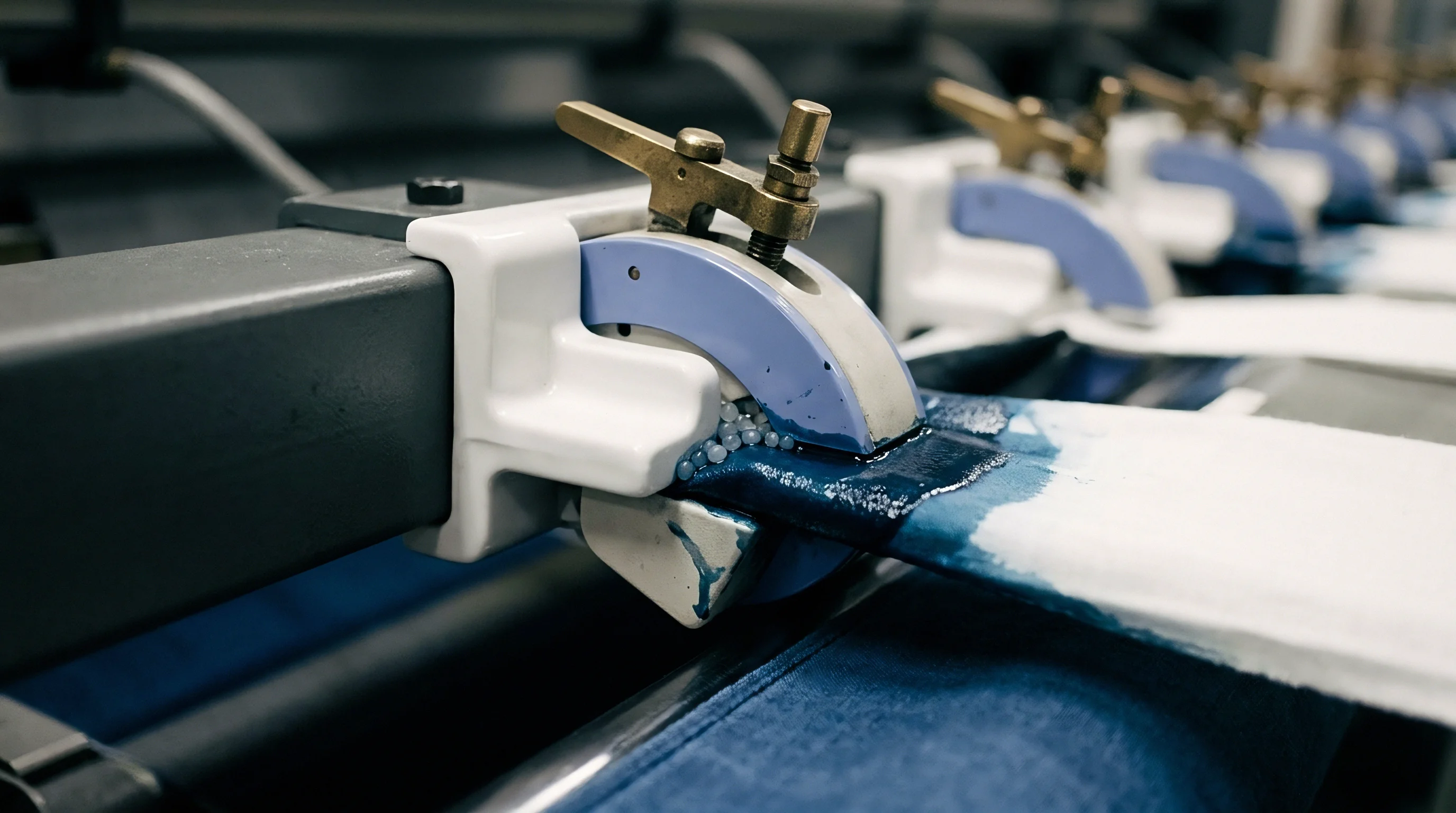
Continuous pad application relies on mechanical squeeze rolls to force dye bath liquid into tight twill structures. Mangle bowl hardness, dip trough volume, and line speed dictate fluid transfer rates. Expressing air from internal voids requires sufficient immersion time inside the dip trough.
Line speeds exceeding 40 metres per minute cut trough dwell times below 0.8 seconds, leaving center cores of heavy 300 gram per square metre twills dry upon exiting the nip.
Fabric passing through high-pressure pad nips requires a minimum wet pickup of 65 percent to guarantee complete internal void displacement.
Jet dyeing equipment relies on dynamic liquor interchange driven by venturi nozzles and mechanical liquor circulation. High liquor flow rates generate pressure differentials across the fabric rope, forcing bath solution through yarn structures. Low liquor ratio machines operating at 5:1 ratios reduce chemical consumption but increase mechanical friction.
Maintaining rope speed and nozzle differential pressure prevents streaking along twill diagonal lines.
Alkali Dosing Profiles for Level Fixation
Precise control of bath pH prevents rapid surface fixation of reactive dyes during liquor circulation. Linear alkali dosing injects sodium carbonate at constant rates, causing sudden pH jumps that trigger instant dye fixation on outer fiber layers. Progressive or quadratic dosing schedules inject alkali slowly during initial phases, raising bath pH from 7.0 to 10.5 over 20 minutes before accelerating injection for final fixation at pH 11.5.
Progressive pH elevation permits dye molecules to migrate inward from outer yarn perimeters before covalent bonding takes place. Temperature control profiles work alongside pH dosing curves. Maintaining a 10-minute migration hold at 60 degrees Celsius prior to alkali injection ensures uniform dye distribution throughout heavy twill thread cross-sections.
What combination of de-aerating agent chemistry and mangle nip pressure yields complete core penetration on 350 GSM cotton drill at production speeds above 50 metres per minute?


Core
Microscopic Assessment of Cross-Sectional Penetration
Evaluating dye penetration efficiency requires precise cross-sectional examination of individual yarn structures taken from finished cloth. Optical microscopy of yarn slices embedded in synthetic resin reveals spatial distribution maps of fixed dye molecules. Ring dyeing manifests as an intense dark band along outer fiber perimeters surrounding a pale or colorless yarn core.
Core penetration index calculations quantify the radial depth of dye transport from the outer yarn perimeter to its center axis.
Image analysis software measures grey-scale intensity across yarn cross-sections to generate quantitative penetration curves. Uniform penetration profiles yield flat intensity curves from edge to center. Ring-dyed profiles drop sharply to baseline white levels within 15 to 20 micrometres of the outer yarn boundary.
Fabric exhibiting low core penetration index values under 0.45 suffers severe color loss when subjected to surface abrasion during garment wear and laundering.

Abrasion Resistance and Frosted Appearance Defect Modes
Twill fabrics feature raised surface diagonal ridges that bear the brunt of mechanical friction during abrasive wear. When abrasive forces remove outer ring-dyed fibers, un-dyed white fiber cores become exposed on the fabric surface. This physical breakdown generates localized color fading known in the trade as frosting or white line marking along twill ribs.
Abrasion failure modes appear rapidly in heavy cotton twill garments subjected to industrial washing or heavy domestic laundering cycles.
Martindale abrasion testing per ISO 12947 paired with spectrophotometric shade measurement quantifies frosting susceptibility. Fabrics suffering from severe ring dyeing demonstrate major color space shifts exceeding 2.5 Delta E units after 5,000 abrasion cycles, whereas fully penetrated fabrics hold color variance below 0.8 Delta E units under identical mechanical loading.
- Ring-Dyed Core Exposure Mechanical rub forces abrade dark outer fibers, revealing white inner filaments that alter visual shade depth.
- Seam Whitening Failure High pressure along needle paths during sewing fractures ring-dyed yarns, creating bright light-colored lines along garment structural seams.
- Frosting Along Twill Ribs Abrasion concentrated on elevated twill diagonals selectively wears away outer surface fibers, generating pale parallel stripes along the weave angle.
- Differential Wet Crock Fastness Poor internal dye distribution concentrates unfixed dye on fiber surfaces, dropping wet rubbing fastness ratings to ISO 105-X12 Grade 2 or lower.
Ignoring cross-sectional penetration depth during dye recipe approval results in bulk garment shipments failing retail wash-and-wear durability inspections after minimal consumer use.

Yield

Color Strength Enhancements and Spectrophotometric Metrics
Mercerization increases total color yield, permitting dyehouses to achieve target shade depths using significantly lower dye mass concentrations. Kubelka-Munk optical strength values, calculated as K/S from reflectance data at peak absorption wavelengths, increase by 25 to 40 percent on tension-mercerized twill relative to unmercerized controls. Circular fiber cross-sections shorten internal optical light path reflections, increasing light absorption efficiency per unit mass of fixed dye chromophore.
Yield gains vary across specific shade categories and dye molecule structures. High-molecular-weight direct dyes display large K/S increases due to expanded accessible mesopore volumes within Cellulose II structures. Bifunctional reactive dyes demonstrate superior fixation efficiencies, reaching 85 to 90 percent total fixation on mercerized twill compared to 68 to 72 percent on unmercerized greige cloth.
| Shade Depth Class | Standard Unmercerized Recipe Cost per 100 kg | Mercerized Fabric Recipe Cost per 100 kg | Color Strength K/S Gain | Net Recipe Cost Reduction Percentage |
|---|---|---|---|---|
| Pale Shade (0.5% Depth) | 38.20 USD | 29.40 USD | + 28.5% | 23.0% |
| Medium Shade (2.0% Depth) | 112.50 USD | 81.00 USD | + 34.2% | 28.0% |
| Deep Navy (4.5% Depth) | 245.00 USD | 168.00 USD | + 38.0% | 31.4% |
| Triple Black (6.0% Depth) | 310.00 USD | 212.00 USD | + 39.5% | 31.6% |
Cost calculations must balance dye recipe savings against chemical, water, and energy expenditures incurred during the mercerization process. Running a dedicated continuous mercerizing frame adds approximately 0.12 to 0.18 USD per linear metre in operating costs, including caustic soda recovery system overheads. High-volume production of medium and dark shades recovers this mercerization processing cost through reduced dye consumption and shorter wash-off cycles.
Technical Sourcing Dossier Specifications
Verification protocols for high-grade mercerized twill sourcing require mandatory documentation covering chemical and structural parameters. Mills must submit comprehensive test dossiers prior to bulk dye run approval to prove substrate consistency across batch lots.
Evaluating shade depth using spectrophotometric K/S values confirms that tension mercerization yields a 30 percent reduction in raw dye mass requirements.
- Barium Activity Number test report per AATCC 89 confirming value equal to or exceeding 135 across left, center, and right fabric width samples.
- Cross-sectional microscopic fastness assessment verifying a minimum Core Penetration Index of 0.70 on 3/1 warp-face twill constructions.
- Dimensional stability wash test per ISO 5077 demonstrating warp and weft shrinkage below 2.0 percent after five domestic wash cycles.
- Color fastness test dossier per ISO 105-X12 showing dry rubbing fastness at Grade 4-5 and wet rubbing fastness at Grade 3-4 minimum.
Landed cost calculations for mercerized twill must incorporate savings from lower dye usage, diminished effluent salt loads, and shortened wash-off cycle times. A comprehensive wet-processing specification binds the converter to exact mercerization standards, protecting the buyer against surface ring-dyeing failures and shade fastness degradation in bulk production runs.