Nonlinear Viscoelastic Yarn Stress Relaxation under Stenter Tension
Nonlinear viscoelastic yarn stress relaxation during stenter finishing requires precise dwell time and overfeed control to prevent latent post-wash fabric shrinkage.
Kinetics
Polymer Chain Mobility under Mechanical Load
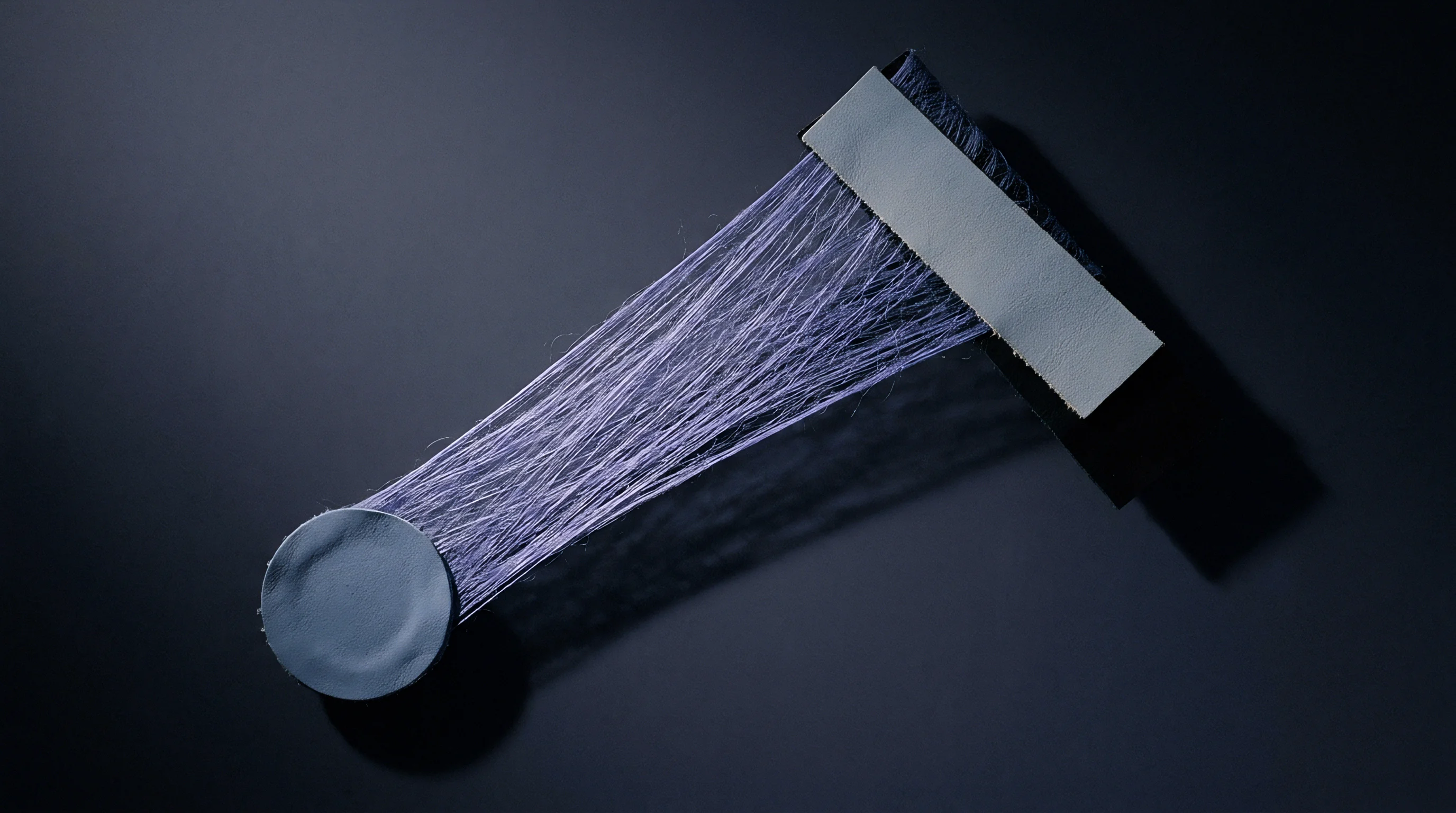
When polymers undergo continuous drawing, immediate elastic deformation gives way to time-dependent rearrangement. Internal stress in continuous filament yarns subject to heavy tension during finishing does not remain static; microstructural relaxation sets in as macromolecular chains slide past one another, breaking temporary secondary bonds to reach lower-energy conformational states. This viscoelastic decay follows an exponential path.
The yarn initially resists stretching through covalent bond extension along its polymer backbone, but amorphous regions in the synthetic filaments start to yield within milliseconds.
The rate at which stress decays hinges on whether the yarn is above or below its glass transition temperature. Below glass transition, segmental rotation along the polymer backbone remains restricted. Thermal activation opens free volume in the amorphous domains, accelerating chain mobility so that elastic strain quickly converts to viscous flow.
Chain slip then permanently lowers internal yarn tension. When synthetic yarns like polyethylene terephthalate or polyamide 6,6 enter a heat-setting environment under draft, the rate of stress relaxation jumps by several orders of magnitude compared to ambient conditions.
Thermal energy above the glass transition temperature unlocks amorphous polymer chain segments, converting elastic tension into permanent viscous orientation within seconds.
Semi-crystalline polymer filaments undergo a dual-phase relaxation process. Crystalline lamellae serve as physical crosslinks constraining the amorphous inter-lamellar ties, which stretch and transfer load to the crystalline blocks under tension. At elevated temperatures, smaller crystallites undergo partial melting and recrystallization alongside amorphous relaxation.
This structural reorganization lowers internal yarn stress while resetting thermal memory. Should the fabric leave the heating field before stress relaxation reaches equilibrium, frozen-in strain stays trapped within the yarn.
Glass Transition and Temperature Interaction
Thermal energy above one hundred eighty degrees Celsius breaks secondary intermolecular hydrogen bonds in synthetic filaments. While the glass transition of polyethylene terephthalate occurs at eighty degrees, dry air shifts this transition; inside a hot-air stenter box, polymer chain mobility peaks rapidly between one hundred ninety and two hundred ten degrees Celsius. At these temperatures, the relaxation half-life of internal stress drops from hours down to fractions of a second.
The exact activation energy for stress relaxation can be modeled using an Arrhenius relationship modified for mechanical stress fields.
Applied mechanical stress lowers the energy barrier for molecular segment jumps. Higher initial tension accelerates the relaxation rate itself ~ a defining trait of non-linear viscoelastic behavior, unlike linear viscoelasticity where the relaxation modulus is independent of strain amplitude. Because strain levels in stenter operations frequently exceed five percent, yarns are driven deep into the non-linear regime.
High thermal energy combined with mechanical strain causes rapid stress dissipation, altering yarn crimp, linear density, and residual contraction potential in a non-linear fashion.
- Instantaneous Elastic Response represents the immediate Hookean elongation caused by bond angle deformation along the crystalline polymer backbone under initial mechanical load.
- Primary Viscoelastic Decay involves short-range segmental movements of polymer chains within the amorphous regions occurring within two seconds of entering the heating zone.
- Secondary Viscoelastic Decay encompasses long-range chain reptation and crystalline domain rotation that requires sustained thermal dwell times to achieve stress equilibrium.
- Permanent Viscous Flow defines the irreversible molecular slippage that permanently alters yarn length and removes residual shrinkage potential from the finished fabric.
The final structural equilibrium of the cloth depends on the interplay between heat transfer rate and mechanical tension. High-velocity air jets impinging on the fabric bring yarns to target temperature within three to five seconds. Maintaining stenter pin-chain tension past thermal equilibrium lets the yarn relax continuously down to a low plateau stress.
Conversely, chilling the fabric under high tension freezes polymer chains in an extended, high-energy state. This locked-in tension inevitably releases during wet processing or laundering, distorting the fabric.
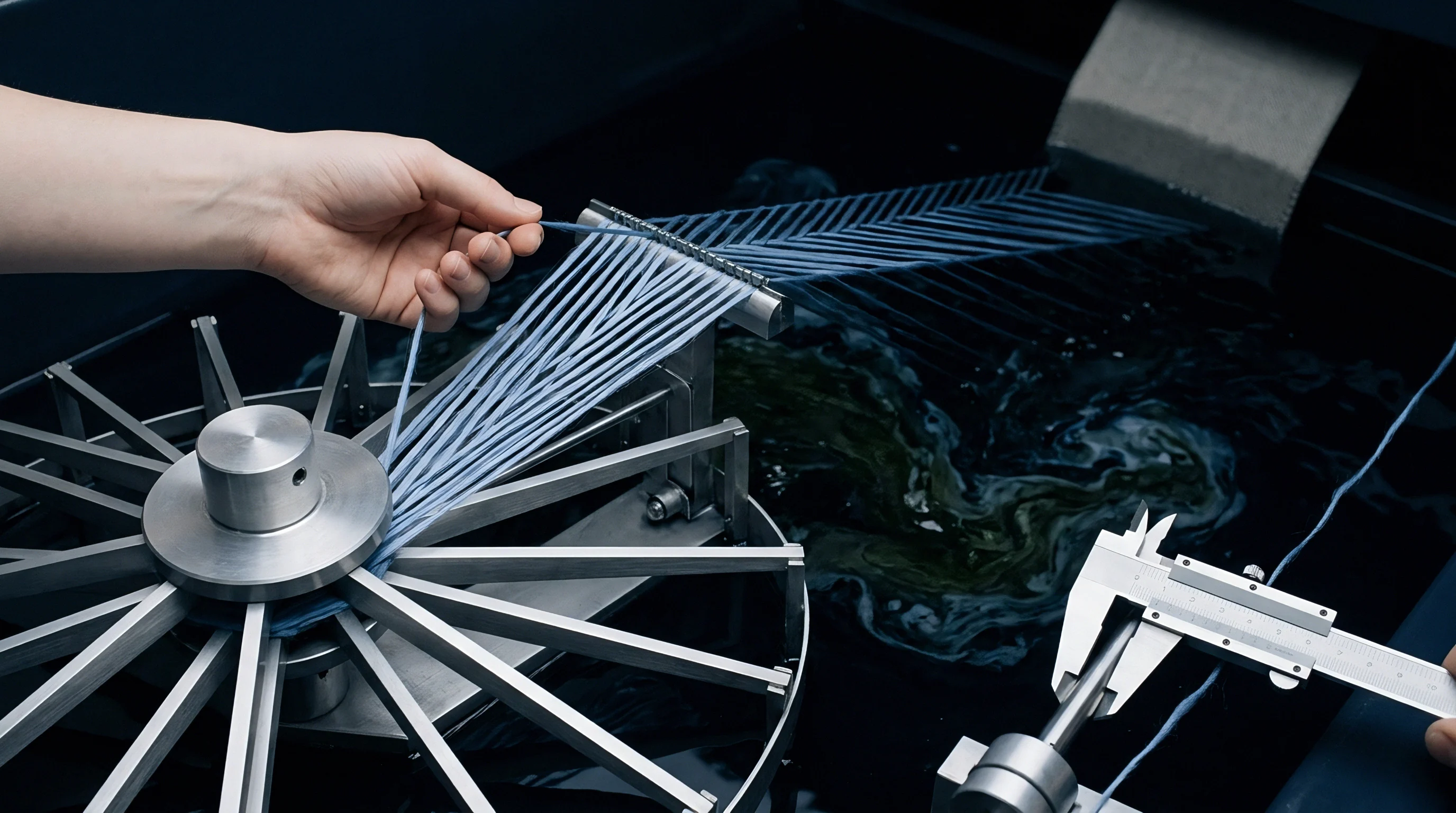
Frame
Pin Chain Velocity and Overfeed Mechanics
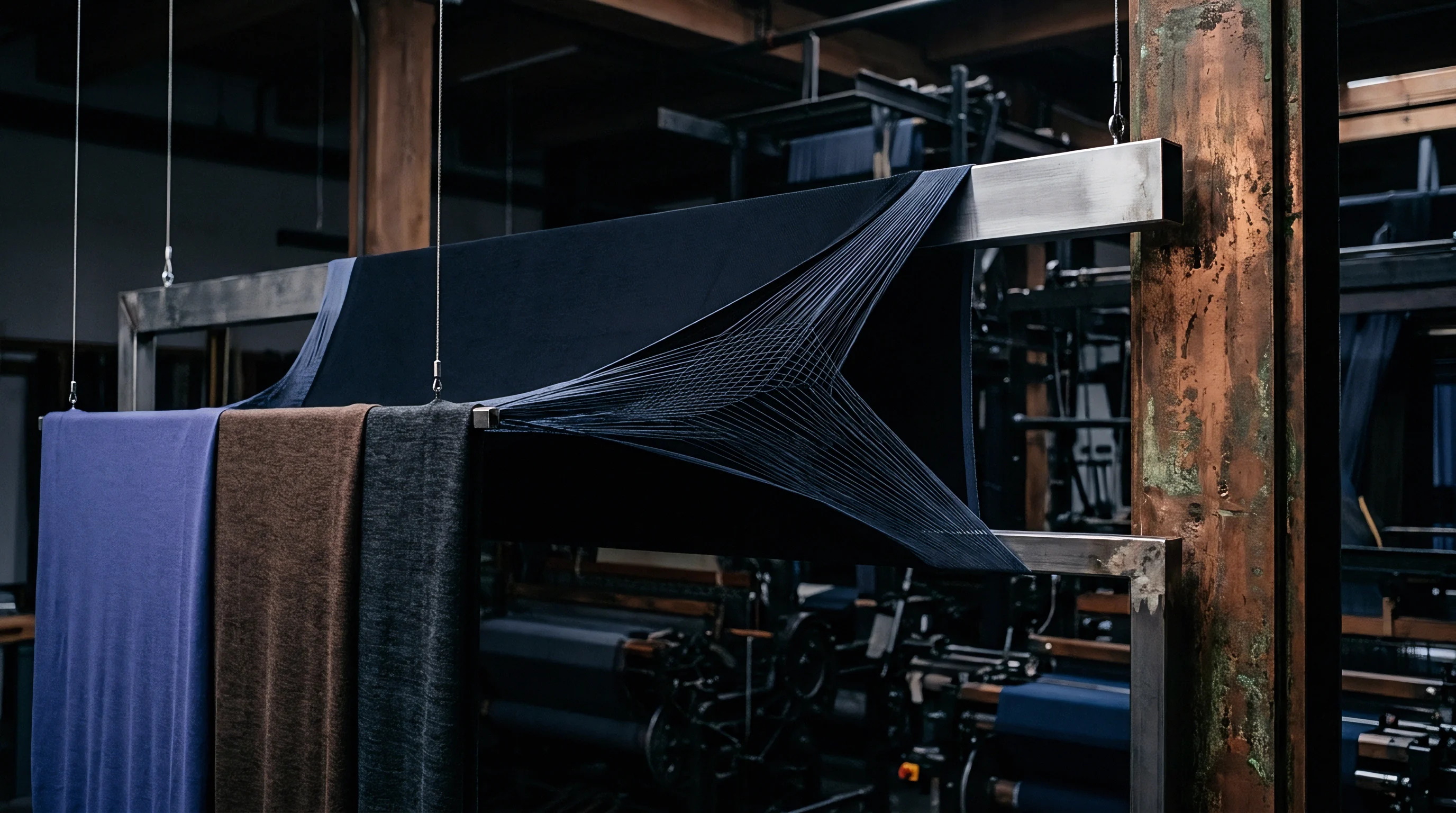
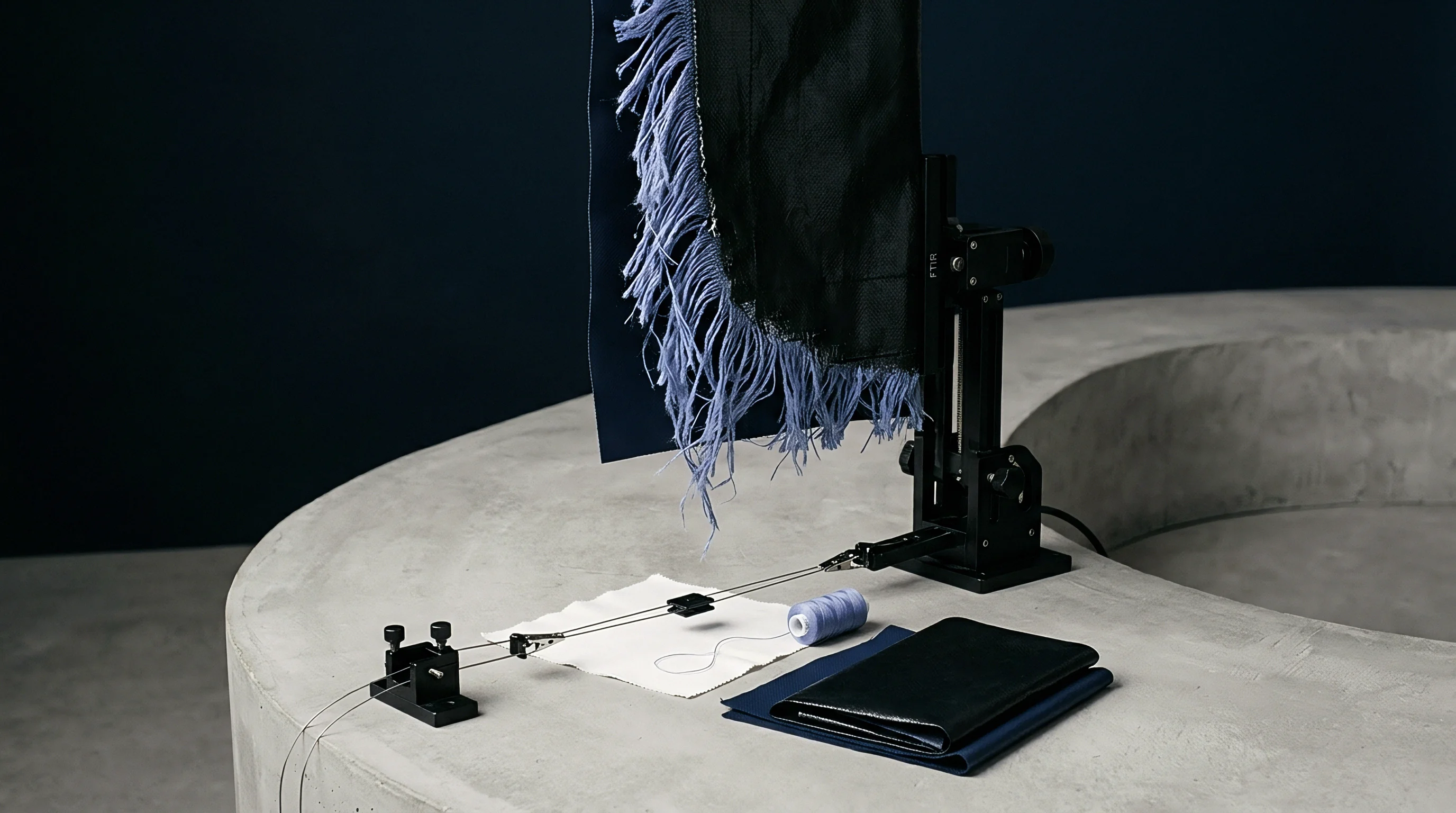
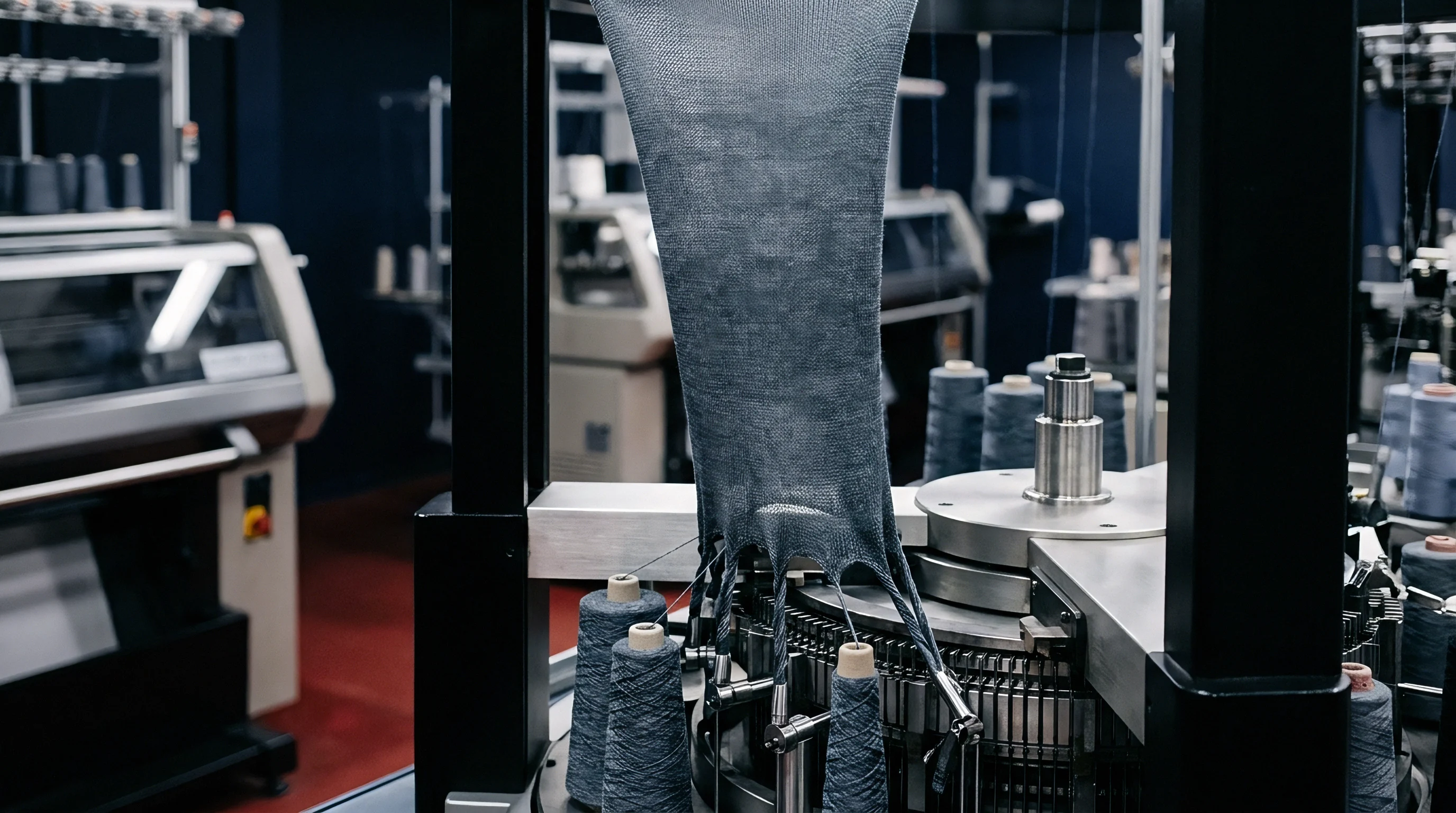
Dyehouse stenters transport fabric through heated zones while regulating both width and length. Longitudinal tension is applied by setting a speed differential between entry feed rollers and the main pin or clip chain, while transverse tension is set by adjusting rail widths across successive heating fields. Overfeed settings dictate warp-direction relaxation allowances: feeding fabric onto the pin chain faster than the chain velocity creates positive warp overfeed.
This extra length allows warp yarns to contract and absorb thermal stress relaxation without staying under heavy longitudinal tension.
With positive overfeed properly set, warp yarns shrink longitudinally as heat disrupts their molecular orientation, and the introduced mechanical slack absorbs that contraction. If the overfeed percentage falls below the yarn’s natural thermal shrinkage, warp yarns remain under severe longitudinal stress across the heating zone. Meanwhile, the pin chain holds lateral width constant.
Operating longitudinal overfeed alongside lateral tentering ultimately sets fabric mass per unit area and thread density.
| Yarn Composition | Stenter Zone Temp (Celsius) | Overfeed Range (Percent) | Dwell Time (Seconds) | Relaxation Modulus Loss (Percent) |
|---|---|---|---|---|
| 100% Textured Polyester (PET) | 195 – 205 | +3.5 to +6.0 | 30 – 45 | 78 – 85 |
| Polyamide 6,6 Filament | 185 – 195 | +2.0 to +4.5 | 25 – 35 | 72 – 80 |
| PET / Elastane Core-Spun | 180 – 190 | +8.0 to +12.0 | 40 – 50 | 88 – 94 |
| Cotton / PET Blend (65/35) | 175 – 185 | +1.5 to +3.0 | 20 – 30 | 60 – 68 |
Dwell time inside the stenter chamber determines whether yarn reaches its stress relaxation plateau. A standard stenter running at sixty meters per minute through a five-chamber housing fifteen meters long gives a dwell time of fifteen seconds. For heavy wovens or high-twist filaments, fifteen seconds is not enough to achieve full viscoelastic decay at one hundred eighty degrees Celsius.
Increasing line speed to push factory throughput cuts dwell time below what stress equilibrium requires.
Width Expansion Profile in Multi-Zone Dwell
Dividing drying chambers into distinct temperature zones permits targeted heat setting: initial fields bring fabric and moisture to the evaporation point, middle zones raise dry polymer to heat-setting temperature, and final fields cool the web before unpinning. Rail width profiles across these zones are rarely uniform. Entry rails start narrow to receive wet fabric, widen through heating fields to pull weft yarns to target width, and narrow slightly in the cooling zone to allow for thermal contraction.
- Verify raw fabric width and incoming warp tension at the stenter feeding frame using inline load cells.
- Calibrate positive overfeed relative to the measured wet contraction of the warp yarn to prevent mechanical tension spikes.
- Set the rail width expansion gradient across zones two and three to not exceed two percent width increase per meter of track length.
- Adjust cooling zone exhaust fans to drop fabric temperature below sixty degrees Celsius before unpinning from the chain.
Poor rail width profiling creates localized stress peaks in weft yarns. Stretching fabric laterally in the final heating zone ~ where chain mobility peaks ~ induces non-linear viscoelastic strain. If unpinning happens immediately after intense lateral stretching without adequate cooling, weft yarns snap back rapidly upon release, pulling finished width below target.
Edge-to-center shading or width variation often stems from incoming yarn non-uniformity rather than incorrect rail expansion profiles.
Proper overfeed settings allow warp yarns to achieve thermal contraction equilibrium without retaining high internal tension.
The unpinning zone is a crucial transition point for tension control. As fabric leaves the pins, lateral restraint vanishes. If internal weft stress has not relaxed during thermal dwell, the cloth immediately recovers transversely, losing width in direct proportion to residual unrelaxed stress.
Controlling this requires tuning line speed, rail profiles, and zone temperatures so that viscoelastic decay completes inside the machine enclosure.
Decay
Nonlinear Viscoelastic Constitutive Relations
Stress relaxation curves measured at low strains fail to predict fabric behavior under strong biaxial extension. Within the linear viscoelastic range ~ governed by Boltzmann superposition ~ the relaxation modulus depends strictly on time and temperature. Under actual stenter tension, which pulls yarns past their yield point, the modulus becomes strongly dependent on strain amplitude.
This shifts response into the non-linear regime, requiring Eyring rate process theory or Schapery non-linear viscoelastic models to chart stress dissipation.
The Eyring model treats non-linear relaxation as a stress-assisted thermal process in which applied load lowers the energy barrier for molecular segment jumps. Mathematically, the decay rate follows a non-linear differential equation where the stress rate is proportional to the hyperbolic sine of current stress multiplied by a temperature-dependent factor. At high stress, this hyperbolic sine approaches an exponential function, triggering rapid early stress loss followed by a long, slow asymptotic tail.
| Yarn Specimen | Applied Strain (Percent) | Test Temp (Celsius) | Activation Volume (nm cubic) | Initial Stress (MPa) | Relaxed Stress at 30s (MPa) |
|---|---|---|---|---|---|
| Polyester 167dtex / 48f | 3.0 | 190 | 1.45 | 42.5 | 11.2 |
| Polyester 167dtex / 48f | 6.0 | 190 | 2.10 | 78.0 | 14.8 |
| Polyamide 6,6 78dtex / 24f | 3.0 | 185 | 1.82 | 38.0 | 8.5 |
| Polyamide 6,6 78dtex / 24f | 6.0 | 185 | 2.65 | 69.5 | 10.1 |
Increasing initial strain from three percent to six percent expands the polymer’s effective activation volume. Because higher activation volume accelerates bond breakage under stress, early relaxation proceeds quickly. Dwell time governs final thermal set, yet residual stress at thirty seconds does not scale linearly with initial load: while high strain accelerates initial structural breakdown, final plateau stress remains bounded by the thermodynamic equilibrium of the polymer network at processing temperature.
How Strain Amplitude Alters Synthetic Decay Rates?
Once strain surpasses three percent, the relaxation modulus depends directly on deformation amplitude, requiring multi-integral constitutive equations or strain-dependent Prony series parameters to model. Physically, high strain stretches amorphous polymer chains near maximum elongation, reducing entropic capacity. Under this tension, mechanical force ruptures weak van der Waals bonds and hydrogen crosslinks directly, accelerating the transition from stored elastic energy to viscous flow.
Consider a 100% textured polyester woven cloth entering a high-temperature stenter process at forty-five meters per minute over an eighteen-meter heat-setting zone, giving a dwell time of twenty-four seconds. If entry draft imposes a constant six percent longitudinal warp strain at two hundred degrees Celsius, initial warp stress reaches seventy-eight megapascals. Under non-linear Eyring kinetics with an activation volume of 2.10 cubic nanometers, internal stress falls from seventy-eight to twenty-five megapascals in the first three seconds.
Over the next nine seconds ~ as yarn temperature reaches cross-sectional equilibrium ~ stress decays from twenty-five down to sixteen megapascals. During the final twelve seconds in the heating zone, relaxation slows, with stress creeping down from sixteen megapascals to an asymptotic limit of 14.8 megapascals. Increasing line speed by fifty percent to sixty-seven meters per minute cuts total dwell time to sixteen seconds, causing the yarn to exit while still in secondary decay at 18.2 megapascals.
Standard ISO 5077 measures post-wash dimensional change.
That extra 3.4 megapascals of unrelaxed stress stays trapped in amorphous domains as the web enters the cooling zone. Upon release from the stenter clips, residual stress drives immediate elastic recovery, shrinking the fabric longitudinally by roughly 1.8 percent over twenty-four hours at ambient conditions. This post-finishing movement shifts cut width, warp end density, and garment cutting yields.
Because decay is non-linear, small cuts in dwell time yield disproportionately high residual stress.
Calculating residual stress accurately requires numerical integration of the non-linear relaxation modulus across the machine’s dynamic temperature profile. As fabric progresses from entry to exit, temperature varies continuously while strain remains fixed by the mechanical clips. Shift factors for temperature ~ typically modeled through Williams-Landel-Ferry (WLF) or Arrhenius equations ~ change continuously down the line.
Coupling non-linear strain dependence with transient thermal profiles produces complex stress histories in both warp and weft yarns.
A key uncertainty in commercial finishing is how local variations in yarn packing and spin-finish application affect strain within individual filaments. While continuum viscoelastic models predict average fabric stress decay with reasonable accuracy, microscopic stress concentrations inside fiber bundles often cause localized under-relaxation, leaving hidden pockets of instability that routine lab testing misses.
Distortion
Bowing and Skewing from Asymmetric Stress Loss
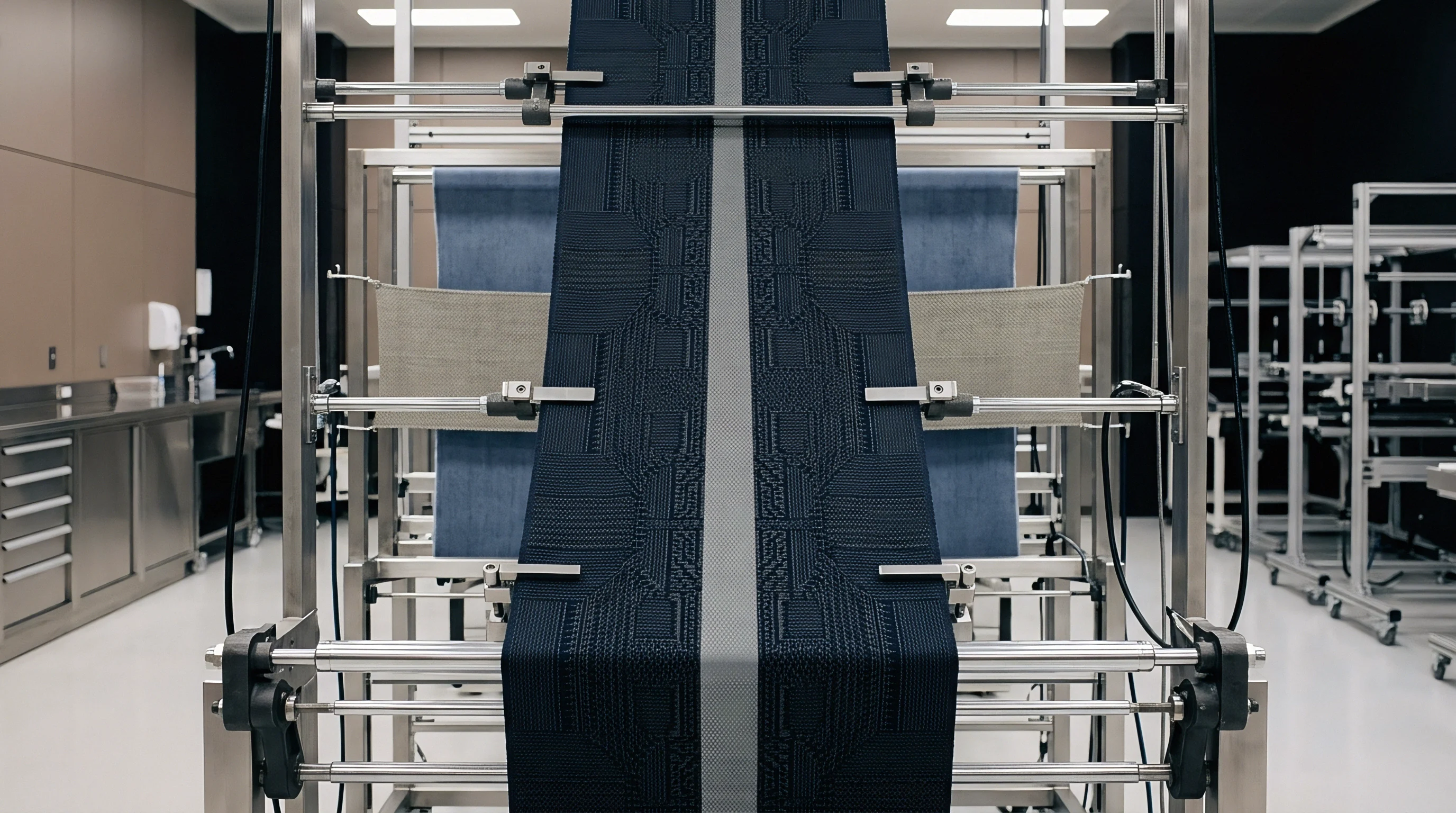
Uneven relaxation rates across the left, center, and right sections of the web distort weft lines into curves. Stenter drying boxes often suffer from uneven airflow or transverse thermal gradients; a spread of just five degrees Celsius across the bed creates a sharp gradient in weft stress relaxation. Yarns in hotter regions relax faster and shrink more, pulling cooler, less-relaxed sections into the parabolic curve known as bowing.
Skewing happens when left and right drive chains drift out of phase or develop minor speed differences. A alignment mismatch of less than a millimeter between pin chains pulls weft yarns off-square under tension. If heat-setting occurs while yarns are skewed, non-linear stress relaxation fixes them in that diagonal alignment.
Once cooled, this structural skew cannot be corrected without re-wetting and re-stentering under opposing bias.
- Weft Bowing Distortion emerges when center-to-edge thermal gradients inside the drying chamber cause non-uniform lateral stress relaxation across the fabric web.
- Diagonal Structural Skew results from mechanical pin-chain speed imbalances that heat-set weft yarns at non-perpendicular angles relative to the warp selvedge.
- Edge Wave Defect occurs when clip-mark edge tension prevents total stress relaxation along selvedges while the fabric body relaxes freely in the center.
- Latent Wash Shrinkage develops when unrelaxed internal yarn stresses locked in during rapid cooling release during subsequent laundering cycles.
These distortions cause issues well beyond appearance. Setting fabric under asymmetric stress creates uneven torque that twists garment panels after laundering. When washed, areas retaining higher residual stress recover dimensionally more than fully relaxed zones, distorting side seams, twisting collars, and causing quality rejections.
Dimensional Stability Testing under Wash Cycles
Standardized washing under ISO 5077 measures residual fabric movement. Specimen benchmarks are marked, washed and dried under controlled conditions, and measured after conditioning. Fabric heat-set under excessive draft exhibits strong warp shrinkage when warm water releases trapped elastic strain.
Target stability for commercial apparel wovens generally permits no more than two percent change in warp or weft after three wash cycles.
| Physical Defect | Primary Root Cause | Evaluation Method | Industry Threshold |
|---|---|---|---|
| High Warp Shrinkage | Insufficient positive overfeed during stenter setting | ISO 5077 / ISO 6330 | Max -2.0% (Warp) |
| High Weft Shrinkage | Excessive lateral rail expansion in final heating zone | ISO 5077 / ISO 6330 | Max -2.0% (Weft) |
| Seam Twist / Spirality | Asymmetric stress relaxation causing fabric web skew | ISO 16322-3 | Max 2.5% Angle Shift |
| Differential Width Snapback | Incomplete cooling before unpinning from chain | Width gauge across roll | Max 10 mm vs Spec |
Failing to control non-linear stress relaxation during stenter finishing directly compromises commercial performance. Running a frame too fast to hit yardage targets leaves high residual stress in finished goods. When a garment maker cuts and washes the cloth, dimensional movement exceeds specs, prompting bulk shipment rejections and forcing the mill to absorb remake costs or commercial claims.

Margin
Machine Line Speed versus Thermal Equilibrium
Running stenter lines faster boosts daily plant output at the expense of stress relaxation quality. Management constantly weighs machine throughput against technical performance: every extra meter per minute reduces unit finishing costs by spreading capital amortization and burner energy over higher volume. Yet pushing speed without expanding stenter housing cuts thermal dwell below what viscoelastic equilibrium requires.
The trade-off between throughput and quality can be quantified directly. A seven-chamber stenter costing two million dollars carries significant hourly overhead. Running a synthetic blend at fifty meters per minute yields three thousand meters per hour; pushing speed to seventy meters per minute raises yield to four thousand two hundred meters per hour, cutting finishing costs per meter by nearly thirty percent.
But if that speed prevents complete stress relaxation, post-wash shrinkage jumps from 1.5 percent to 4.2 percent, exceeding brand tolerances.
Fast line speeds compromise internal yarn relaxation.
Finishing mills on tight margins sometimes mask incomplete thermal setting with chemical crosslinking resins or temporary stiffeners. These finishes hold dimensions temporarily, masking unrelaxed stresses during initial inspection. Once the consumer washes the garment, the chemical finish strips off, releasing underlying viscoelastic stress.
The resulting shrinkage leads to returns and damages brand reputation.
Financial Impact of Yield Optimization
Excessive lateral tentering artificially expands fabric area at the expense of stability. Converters paid by the meter have an incentive to pull fabric as wide as possible: stretching a 140-centimeter gray cloth to a finished width of 150 centimeters increases area yield by over seven percent. But aggressive lateral stretching forces weft yarns deep into the non-linear viscoelastic regime, building severe internal stresses that demand extended dwell times and high heat to relax.
Without sufficient thermal dwell to relax these lateral strains, the fabric remains in a meta-stable state, making area gains on the finishing floor illusory. Unrolling the fabric, laying it on a cutting table, or exposing it to ambient humidity triggers natural elastic recovery, drawing the cloth back toward equilibrium width. Cutters then find that lay planning markers no longer fit the contracted width, generating heavy scrap losses.
Contracts between buyers and finishing mills should specify clear processing parameters ~ such as maximum pin-chain tension and minimum dwell times ~ alongside target weight, width, and shrinkage limits. Without contractual limits on speed and overfeed, converters tend to prioritize throughput over viscoelastic stress equilibrium. As a rule of thumb in technical procurement, washing stability improves in direct proportion to positive warp overfeed applied during heat setting.