Polyurethane Core Spun Stretch Woven Fabric Construction
Polyurethane core spun stretch wovens achieve stable elastic recovery when yarn draft ratios remain below 3.8 to 1 and stenter temperatures do not exceed 192C.

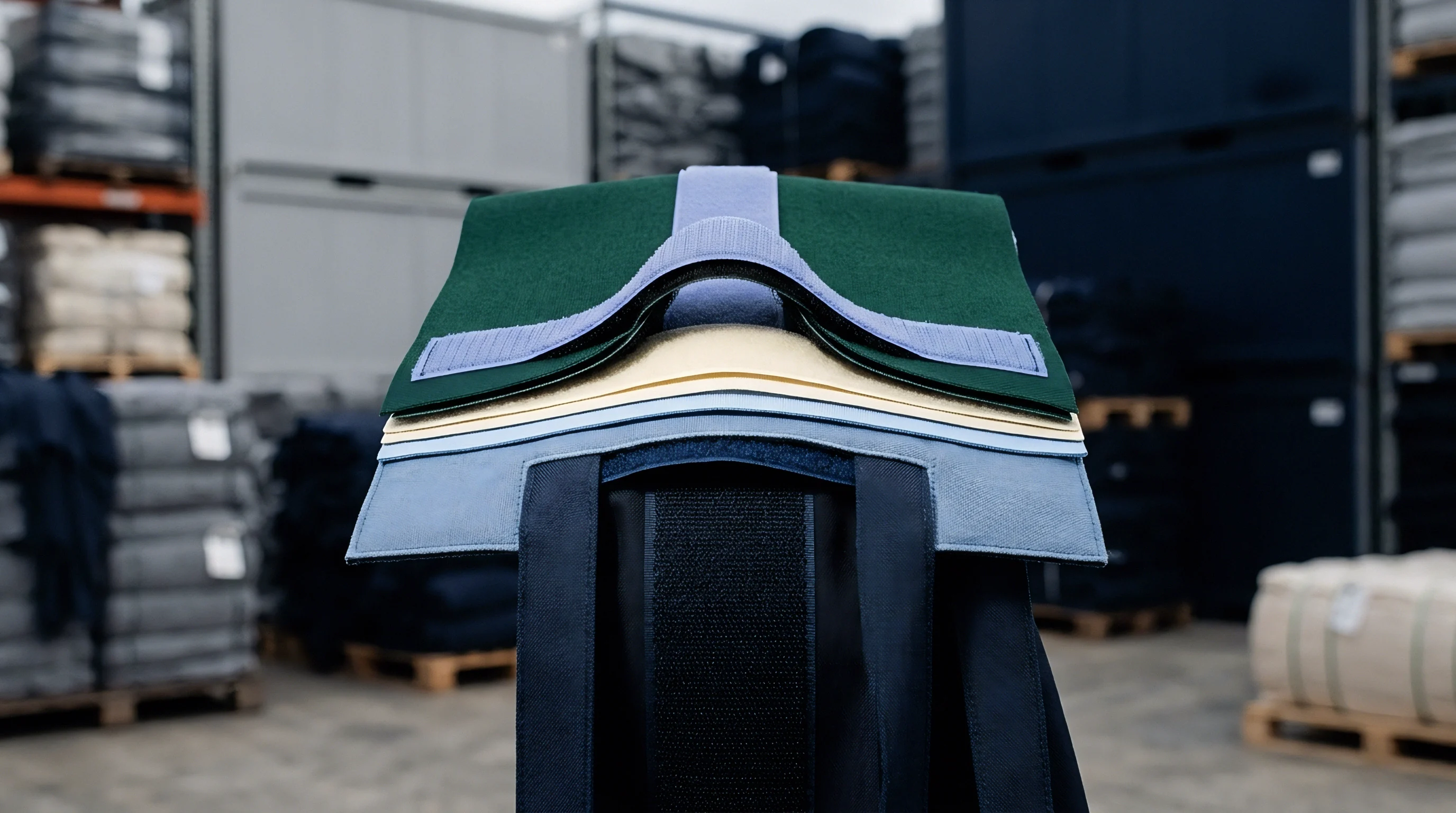
Core
Polyester or cotton staple fibers wrapped around a central elastomeric filament create a composite strand with high elastic strain and a natural surface hand. Production of this structural strand occurs on modified ring spinning frames or air-jet spinning equipment fitted with specialized elastomeric feeding attachments. The elastomeric core, typically composed of continuous monofilament polyurethane ranging from 20 to 140 denier, passes through a dedicated tensioning roll system positioned directly behind the main drafting zone.
Control over the tension applied to the polyurethane monofilament during yarn formation fixes the prospective elasticity of the woven gray fabric.

Draft Ratios and Sheath Coverage
Feeding a 40 denier or 70 denier polyurethane monofilament into the spinning triangle under mechanical tension determines the stretch capability of the resulting yarn. The draft ratio represents the mechanical extension applied to the elastomeric core before the staple roving encapsulates it. Standard production parameters utilize draft ratios between 2.8 to 1 and 4.2 to 1.
Higher draft ratios reduce the final denier of the core inside the yarn, lowering raw material mass while elevating the risk of elastomeric breakage during weaving. Lower draft ratios leave higher residual mass, generating dense elastic power with reduced maximum extension.
Spindle speed dictates yarn twist. Adequate twist insertion binds the outer staple sheath securely around the elastomeric filament. Insufficient twist insertion allows the sheath fibers to slide along the core filament during dynamic tensioning, exposing the inner polyurethane thread to abrasive contact with loom drop wires and reed wires.
Ring spinning yields superior cohesion. The mechanical wrapping efficiency of ring spinning creates a tighter lock around the core than air-jet methods, making ring-spun stretch yarns the standard choice for heavy denim and rugged uniform wovens.
A draft ratio of 3.5 to 1 applied to a 70 denier polyurethane core yields 28 percent finished fabric elongation under ISO 20932 testing.
Spinning Machinery and Filament Centering
Ring spinning frames equipped with modified roving guides deliver continuous elastomeric strands precisely into the center of the drafted staple roving. Off-center placement forces the synthetic filament to the exterior surface of the yarn. Exposing the polyurethane monofilament on the yarn exterior creates immediate surface defects known as core exposure or grinning.
Exposed cores melt when exposed to high-temperature singeing equipment or break down under chemical scouring baths in wet processing.
The mechanical integrity of the core-spun strand requires rigorous monitoring of yarn friction coefficients and roving twist factors. Standard cotton count equivalents for stretch wovens range from 10s Ne for heavy bottom-weight twills to 60s Ne for light poplin shirtings. Higher yarn counts require finer core deniers, typically 20 or 30 denier, to maintain adequate outer sheath thickness without creating irregular yarn slubs.
- Core slip occurs when the staple sheath slides along the inner polyurethane strand during high-tension weaving.
- Filament rupture stems from excessive mechanical draft ratios exceeding four to one inside the spinning zone.
- Sheath stripping arises when insufficient roving twist allows cotton fibers to peel away under friction.
Spinning mill technicians frequently claim that core slippage during weaving stems from ambient humidity fluctuations in the shed rather than uneven tension on the elastomeric creel.
Geometry
Woven fabric specifications for elastic textiles balance warp density against reed width expansion to accommodate finishing contraction. When weft stretch yarns exit the loom under high mechanical tension, the relaxation of the elastomeric core pulls the selvedges inward. Fabric designers compensate for this dimensional reduction by calculating the structural contraction ratio between the grey off-loom width and the final heat-set width on the stenter frame.
Reed Width and Contraction
On-loom warp tension stretches elastomeric weft yarns by fifteen to thirty percent during pick insertion. Once the cloth clears the loom take-up roller, weft contraction reduces the total width rapidly. A loom weaving a target finished width of 148 centimeters often requires a reed width of 190 to 210 centimeters, depending on the yarn count, pick count, and elastomeric draft ratio.
Greige sett governs final density. If the off-loom pick count measures 20 picks per centimeter, post-finishing relaxation may consolidate that structure to 26 picks per centimeter as the length and width shrink into equilibrium.
Heavy picks reduce weft stretch. Higher pick densities increase yarn-to-yarn mechanical friction inside the weave matrix, restricting the freedom of the core-spun yarn to contract. Consequently, achieving high stretch performance in high-density constructions requires lower pick counts or higher elastomeric core deniers.
- Calculate expected finishing contraction based on target elastomeric draft and total weft density.
- Select reed width allowing twenty to thirty-five percent width allowance over finished fabric specs.
- Adjust loom warp tension to prevent pick distortion during high-speed insertion.
- Verify off-loom grey pick count against wet processing target dimensions prior to heat setting.
Weave Pattern and Cover Factor
Plain weave patterns restrict filament movement more severely than twill or satin constructions. The frequent interlacing points in a 1/1 plain weave lock the core-spun yarns into tight crimp geometry, limiting structural elongation to roughly fifteen to twenty percent even with high-draft cores. A 3/1 twill or 4/1 satin pattern features longer yarn floats, reducing structural friction and allowing the elastomeric yarns to extend up to thirty-five percent under equivalent loads.
| Fabric Type | Weave Structure | Reed Width (cm) | Finished Width (cm) | Grey Sett (warp x weft / cm) | Finished Sett (warp x weft / cm) |
|---|---|---|---|---|---|
| 3/1 Right Hand Twill | 198 | 148 | 24 x 16 | 31 x 22 | |
| 2/1 Left Hand Twill | 188 | 150 | 36 x 20 | 44 x 26 | |
| 1/1 Plain Weave | 175 | 142 | 42 x 28 | 48 x 33 |
Off-loom contraction shifts fabric weight. A greige fabric woven at 180 grams per square meter can reach 240 grams per square meter after scouring and thermal relaxation consolidate the yarn grid.
Specifying a maximum finished width tolerance of plus or minus two centimeters under ISO 3932 prevents garment panel distortion during automated cutting room operations.
Selecting an excessively tight reed width without accounting for elastomeric retraction buckles the selvedges and renders the full finished fabric roll unusable for garment manufacturing.

Thermofixation
Dimensional stabilization in a stenter frame subjects elastomeric woven grey goods to temperatures between 185 and 195 degrees Celsius. Heat setting alters the crystalline structure of the polyurethane core, freezing the elastomeric network into a stable equilibrium state. Without thermal fixation, core-spun stretch wovens display extreme dimensional instability, shrinking uncontrollably during wet dyeing processes and domestic laundering cycles.
Stenter Parameters and Heat Setting
Processing fabric through a five-chamber pin chain at twenty-five meters per minute establishes the permanent width and elastic modulus. Exposure time in the peak temperature zones ranges from 30 to 45 seconds. Overfeeding prevents width loss.
Mill operators set the entry overfeed rate between ten and twenty-five percent, allowing the warp yarns to relax ahead of the drying pins while the width chain opens the cloth to its targeted dimension.
Stenter speed controls heat transfer. Running the stenter too fast prevents the inner core from reaching its softening point, leaving residual stress in the polyurethane filament. This residual stress triggers unmanaged relaxation during dyeing.
High heat degrades elastomeric cores. Exceeding 198 degrees Celsius breaks the soft polymer segments of the polyurethane core, permanently destroying elastic recovery and turning white yarns yellow.
| Fiber Blend | Polyurethane Type | Target Temp (C) | Dwell Time (s) | Overfeed Rate (%) | Width Retain (%) |
|---|---|---|---|---|---|
| Cotton / Polyurethane | Standard Polyether | 190 | 35 | +18 | 98.5 |
| Polyester / Cotton / Polyurethane | Polyester-based PU | 195 | 40 | +15 | 99.0 |
| Nylon / Polyurethane | Low-temp Polyether | 182 | 30 | +22 | 97.8 |
Wet Processing and Dyeing Chemistry
Alkaline scouring baths remove lubricants applied during yarn spinning while avoiding chemical hydrolysis of the polyurethane backbone. Dyehouse wet processing utilizes jet dyeing machines or continuous pad-steam lines operated under low tension. Continuous mechanical tension in rope dyeing equipment stretches the hot, wet fabric along the warp axis, causing irreversible warp elongation and total loss of weft stretch capacity.
Scouring removes core spinning oils. Silicone or mineral oils applied during core spinning must be thoroughly washed out at 70 to 80 degrees Celsius using non-ionic surfactants. Residual spinning oils exposed to heat setting temperatures polymerize on the fabric face, causing dark spots and preventing dye molecule migration into the outer cotton or polyester sheath.
Acid dyes stain polyamides rapidly. When dyeing nylon or polyurethane blends, selector chemistry prevents acid dye molecules from over-saturating the polyurethane core, which would cause severe shade bleeding and poor wet fastness under ISO 105-C06 testing. Reactive dyeing of cotton sheaths requires careful pH control to avoid acid hydrolysis of ester-type polyurethanes in acidic bath conditions.
Increasing overfeed on the stenter pin chain reduces residual garment shrinkage after domestic laundering.
Thermal dwelling locks the elastomeric network. Precision temperature controls across all stenter heating zones maintain uniform cross-web stretch characteristics, preventing width variations from edge to center across bulk dye lots.
Incorporating standard ISO 6330 4N wash compliance into the commercial purchase agreement obligates the mill to absorb the cost of re-finishing any lot displaying residual shrinkage above three percent.
Recovery
Tensile strain applied to stretch fabrics induces viscoelastic extension followed by rapid elastic recoil. Structural performance metrics rely on two distinct factors: extension percentage under a fixed load and the ability of the material to return to its original length after the load relaxes. Fabric failure manifests as growth or permanent set, where the material retains a percentage of the applied extension, causing garment bagging at knees, elbows, and pocket seams.
Which Draft Ratio Prevents Core Filament Slippage?
Mechanical draft multipliers exceeding 3.8 to 1 overstretch the inner polyurethane filament, inducing physical detachment from the outer staple sheath. When the sheath loses mechanical grip, elastic recovery forces pull the core filament inward while the outer staple fibers remain extended. This physical breakdown, known as core pull-out or core structural detachment, leaves localized patches of dead, non-stretch fabric along the weft line.
Core pull-out destroys elasticity completely. Maintaining draft ratios between 3.2 to 1 and 3.5 to 1 preserves interfacial friction between the elastomeric core and the surrounding cotton fibers, suppressing core slippage even after repeated elongation cycles.
Testing Methods and Permanent Set
Standardized cyclic loading per ISO 20932-1 evaluates tension decay over specified extension intervals. Testing protocol places a 100-millimeter fabric strip under a 30-Newton force, holding the extension for one minute before releasing tension. Elastic growth calculations measure the unrecovered length remaining after thirty minutes of relaxation.
- Target strain level dictates whether a 40 denier or 70 denier elastomeric core provides sufficient elastic power.
- Weave structure selection balances structural stability against maximum elongation along the weft axis.
- Heat setting dwell time determines the equilibrium point between elastic recovery and permanent growth.
Elastic growth creates baggy knees. Acceptable commercial thresholds for premium casual bottom-weights require weft stretch between 20 and 30 percent, with elastic growth remaining strictly under 4.0 percent after three hours of static relaxation under standard ISO conditions.
Unstabilized polyurethane filaments lose up to forty percent of their retractive force when exposed to repeated high-temperature washing cycles.
Whether synthetic polyurethane cores can maintain elastic memory after fifty commercial laundry cycles without structural elastomeric degradation remains an open technical challenge.
Qualification
Commercial fabric acceptance relies on rigorous verification of physical performance metrics across every production roll. Technical specifications define explicit boundary conditions for fabric mass, usable cuttable width, elongation percentage, permanent set, and tear strength. Inspection procedures intercept sub-standard material before roll goods enter automated garment cutting lines.
Roll Inspection and Tolerances
Four-point inspection systems assign penalty points based on defect size and frequency along the fabric bolt. Elastic core failures, such as core exposure, missing elastomeric picks, or puckered selvedges, earn maximum four-point penalties. A commercial lot fails qualification if total penalty points exceed 28 points per one hundred square meters.
Lab dips fail under D65. Shade matching protocols demand spectrophotometric verification across multiple light sources, including D65 daylight, TL84 store lighting, and A tungsten filament illumination. Polyurethane core yellowing during thermal setting causes metameric shifts, forcing shade discrepancies between grey goods and finished bulk dyeings.

Landed Cost and Audit Controls
Defect rates above four points per one hundred square meters trigger financial reclaims against the textile mill. Sourcing teams quantify risk by auditing the mill’s internal quality control dossier, focusing on heat setting logs, greige yarn draft certificates, and batch-to-batch weight variation reports. Residual shrinkage values exceeding 3.0 percent along either warp or weft axes force recalibration of garment production patterns, adding unbudgeted labor costs to the finished product.
A fabric buyer rejects any stretch bulk lot where the finished weight variance exceeds the greige weight variance.