Psychrometric Mass Transfer Rate Stabilization in Heated Pad Trough Operations
Maintaining constant liquor concentration in heated pad troughs demands minimal bath volume, rapid turnover, tight thermal control, and ambient vapor management.
Boundary
Thermal energy delivered to an open pad liquor vessel sets up a steep partial pressure gradient against the surrounding air. Surface liquid molecules absorb kinetic energy and cross the interface as vapor. This evaporation rate depends on bath temperature, ambient room conditions, and the air movement created by the passing web.
When continuous ranges run heated troughs between 40°C and 80°C, unmanaged surface loss continuously shifts the solute balance: water leaves as vapor while dyes, auxiliaries, alkalis, and salts stay behind. The resulting change in bath molarity leads directly to shade variation over long production runs.
Mass transfer across the exposed bath follows standard vapor pressure differentials. Water saturation vapor pressure increases exponentially with temperature, climbing to 47.4 kPa at 80°C versus 2.34 kPa in a 20°C room. As dry ambient air moves over the liquid, vapor travels down this concentration gradient.
Lower relative humidity or cooler surrounding air speeds up mass transfer per unit area, while fast-moving fabric strips away the saturated boundary layer directly above the bath, preserving the pressure gap and maintaining steady solvent loss.
Liquid Interface Mass Transfer Mechanics
Evaporative flux at the liquid surface rapidly alters bath chemistry. Heat enters through submerged steam coils or external jackets while vaporization continuously pulls latent heat out. This thermal gradient sets up micro-convection currents in the surface film: as surface water evaporates, the top layer cools and concentrates, growing denser until it sinks into the active dipping zone where it mixes with fresh feed.
Air flow over the trough speeds up this exchange. Running fabric at 40 to 120 meters per minute acts like a pump, drawing room air across the liquor and replacing saturated vapor with drier air. As ambient relative humidity in the dyehouse shifts between morning and afternoon, the mass transfer coefficient changes with it, leaving unmanaged heated pad operations prone to continuous drift.
Evaporative Flux Profiles across Exposed Trough Geometry
Enclosing the trough and controlling boundary layer humidity restricts vapor transport. Reducing open surface area relative to liquor volume lowers overall evaporative flux by shrinking the interface where transfer takes place. The table summarizes mass transfer rates, vapor pressure differentials, and solvent losses across typical operating conditions in a standard dyehouse.
| Liquor Temp (°C) | Ambient Temp (°C) | Ambient RH (%) | Vapor Pressure Delta (kPa) | Mass Transfer Coeff (m/s) | Evaporative Water Loss (L/m²·h) |
|---|---|---|---|---|---|
| 40 | 22 | 65 | 5.65 | 0.012 | 4.15 |
| 50 | 22 | 65 | 10.61 | 0.015 | 8.42 |
| 60 | 24 | 50 | 18.42 | 0.018 | 16.20 |
| 70 | 24 | 50 | 29.74 | 0.022 | 28.95 |
| 80 | 25 | 40 | 46.03 | 0.026 | 48.10 |
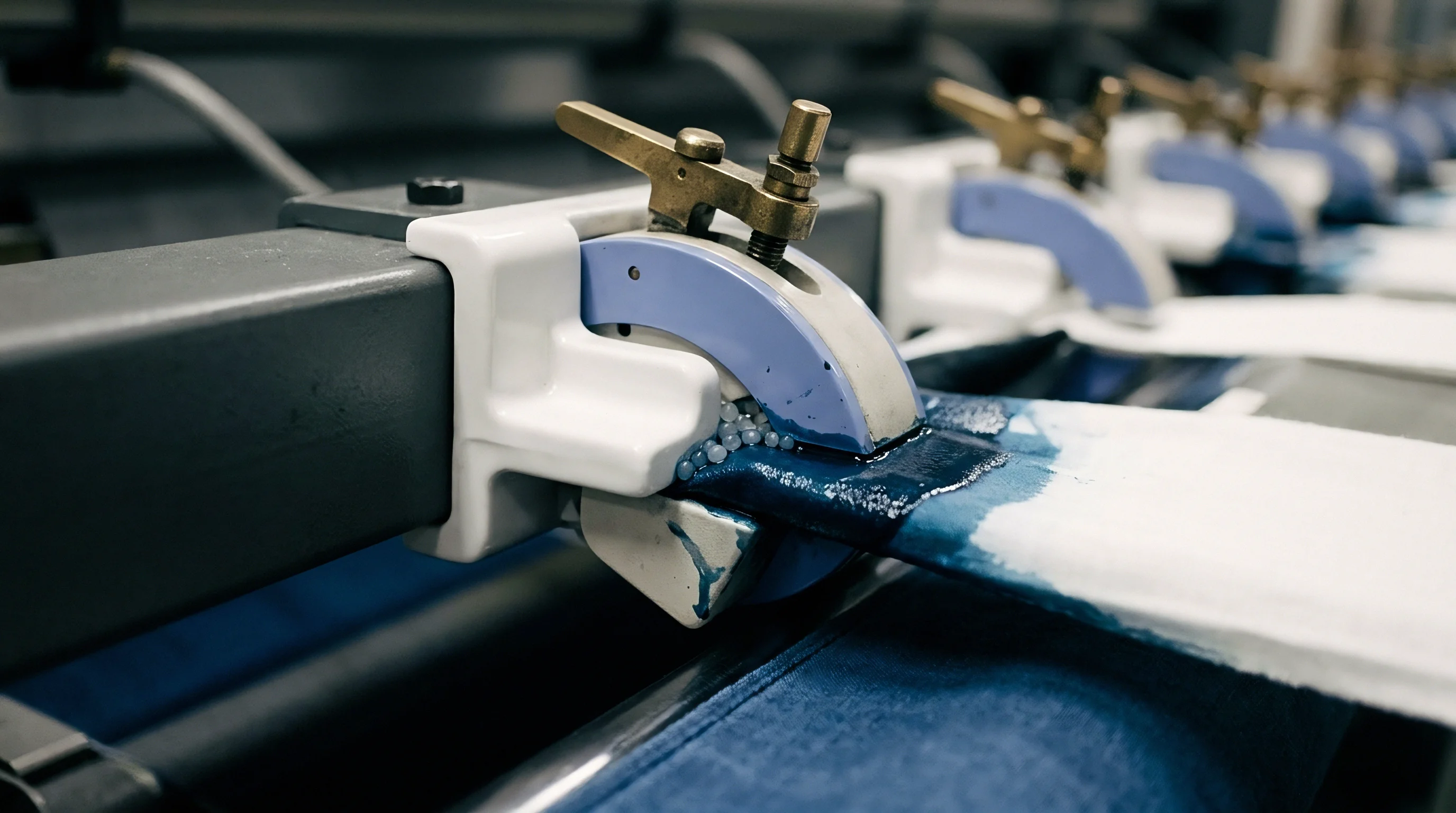
Stagnant boundary layers over hot liquor surfaces cause localized solute enrichment right at the entry squeegee.
Vapor
Calculating moisture loss depends on the partial pressure difference between hot liquor and room air. Vapor escaping from the trough is essentially an unmetered loss of solvent from what should be a balanced chemical system. Continuous pad dyeing assumes fixed concentration ratios when calculating liquor pickup; when solvent evaporates, fabric passing through the bath absorbs a higher mass of dye per unit weight of fiber.
This leads to tailing, where the start of a 5,000-meter roll meets target shade while later yardage grows steadily darker as solutes accumulate in the bath.
Uncontrolled evaporation causes several distinct problems in continuous pad ranges, affecting both fabric performance and shade consistency:
- Tailing and Color Drift drives a progressive shade change from the start to the end of a run as dye concentrates in the trough.
- Chemical Instability speeds up reactive dye hydrolysis and breaks down alkali-sensitive fixatives under continuous heat.
- Viscosity Elevation alters wet pickup percentages and promotes surface migration during intermediate drying.
- Precipitation and Agglomeration pushes dissolved dyes or finishing auxiliaries past their solubility limits, leaving spots on rollers and cloth.
Mass Balance Equations in Continuous Dye Operations
Water loss directly changes the molarity of dissolved active solutes. A steady-state mass balance around the pad trough tracks incoming fresh feed, fabric substrate throughput, wet pickup rate, and evaporative solvent loss:
Mass In equals Mass Out plus Evaporative Loss. Expressed as an operational balance: F_in C_in = (F_fabric Wet_Pickup C_trough) + (A_surface E_flux) where F_in is the fresh feed flow rate in liters per minute, C_in is feed concentration, F_fabric is dry fabric throughput in kilograms per minute, Wet_Pickup is fractional pickup, C_trough is instantaneous bath concentration, A_surface is exposed trough area in square meters, and E_flux is the evaporative transfer rate in kilograms per square meter per minute.
Take a reactive dyeing run on 240 grams per square meter woven cotton twill running at 50 meters per minute across a 1.6-meter web. Dry fabric throughput is 19.2 kilograms per minute. At a target wet pickup of 65 percent, liquor demand is 12.48 liters per minute.
The trough presents an open surface area of 0.85 square meters, operating at 70°C in room air at 24°C and 50 percent relative humidity. Under these conditions, the evaporative water loss rate reaches 28.95 liters per square meter per hour, or 0.41 liters per minute across the exposed bath.
Without automated makeup water, evaporation strips 0.41 liters of pure water every minute while feed concentration stays unchanged. Over a 60-minute run, 24.6 liters of water evaporate from a trough holding just 15 liters of working volume. Even with rapid turnover, concentration climbs steadily: within 30 minutes, instantaneous bath concentration sits 3.2 percent above target feed, driving shade variance past commercial limits.
Concentration Factors and Pick-Up Dynamics
Fabric moving through the trough removes both solutes and solvent. When evaporative water loss exceeds two percent of total liquor delivery, the working liquor ratio changes. Higher chemical concentration increases absolute dye uptake without altering wet pickup percentage, forcing the fiber to absorb more active dye per gram than specified in the formulation.
Unbalanced vapor losses push the entire run out of color tolerance, leading to rejected yardage and unpaid finishing invoices.


Sump
Trough volume determines how fast fluid turnover can dilute evaporative concentration spikes. Older rectangular pad troughs holding 40 to 80 liters have long residence times, allowing evaporative losses to build up and creating distinct concentration gradients between the feed inlet and the nip. Modern high-efficiency ranges use U-shaped or wedge-shaped geometries holding only 5 to 15 liters, replacing the entire bath volume every 20 to 40 seconds.
Trough Geometry and Displacement Bodies
Standard rectangular vessels hold excess volume that slows liquor turnover. Inserting shaped displacement bodies into the trough cavity restricts liquid volume while preserving the necessary immersion path. Fabric travels through a narrow channel between the wall and the displacement block, where higher fluid velocity promotes rapid convective mixing and prevents stagnant pockets where concentrated solutes would otherwise gather.
Internal circulation systems further stabilize the concentration profile across the bath. High-capacity pumps draw liquor from the bottom sump, pass it through heat exchangers, and re-inject it through multi-point headers along the fabric entry zone. This continuous recirculation eliminates thermal layering and solute buildup across the working width.

Is Automated Refractometric Dosing Capable of Countering Evaporative Concentration?
Inline optical sensors track refractive index shifts to trigger real-time solvent dosing. As water evaporates, rising dissolved solids alter the liquor’s refractive index. Digital refractometers in the recirculation loop detect shifts as small as 0.0001 Brix, prompting automated dosing pumps to inject micro-pulses of deionized water and keep bath concentration within a 0.5 percent tolerance band.
- Position the inline digital refractometer sensor head in the primary recirculation loop immediately downstream of the exit drain.
- Calibrate the sensor baseline using fresh target dye liquor prepared at operating temperature.
- Set optical threshold alarms at plus or minus 0.3 percent dissolved solids.
- Connect the controller output directly to a high-precision micro-metering water injection valve on the fresh feed manifold.
- Trigger automated pulse dosing whenever the measured refractive index exceeds the target threshold for longer than five seconds.
Keeping trough fluid volume below 10 liters at a fabric speed of 60 meters per minute turns over the bath every 28 seconds.
High circulation pump flow rates are often assumed to eliminate thermal and concentration gradients within standard deep troughs.
Equilibrium
Thermal stability in pad troughs governs both reactant hydrolysis and shade consistency. Heating the liquor swells fibers, speeds chemical penetration, and lowers viscosity for uniform pickup on tight weaves. However, elevated temperatures accelerate reaction kinetics.
Reactive dyes in warm alkaline liquor face two competing pathways: bonding with cellulose hydroxyl groups or hydrolyzing with water hydroxyl ions. Hydrolyzed dye molecules cannot bind to fiber, lowering tinctorial yield and fastness.
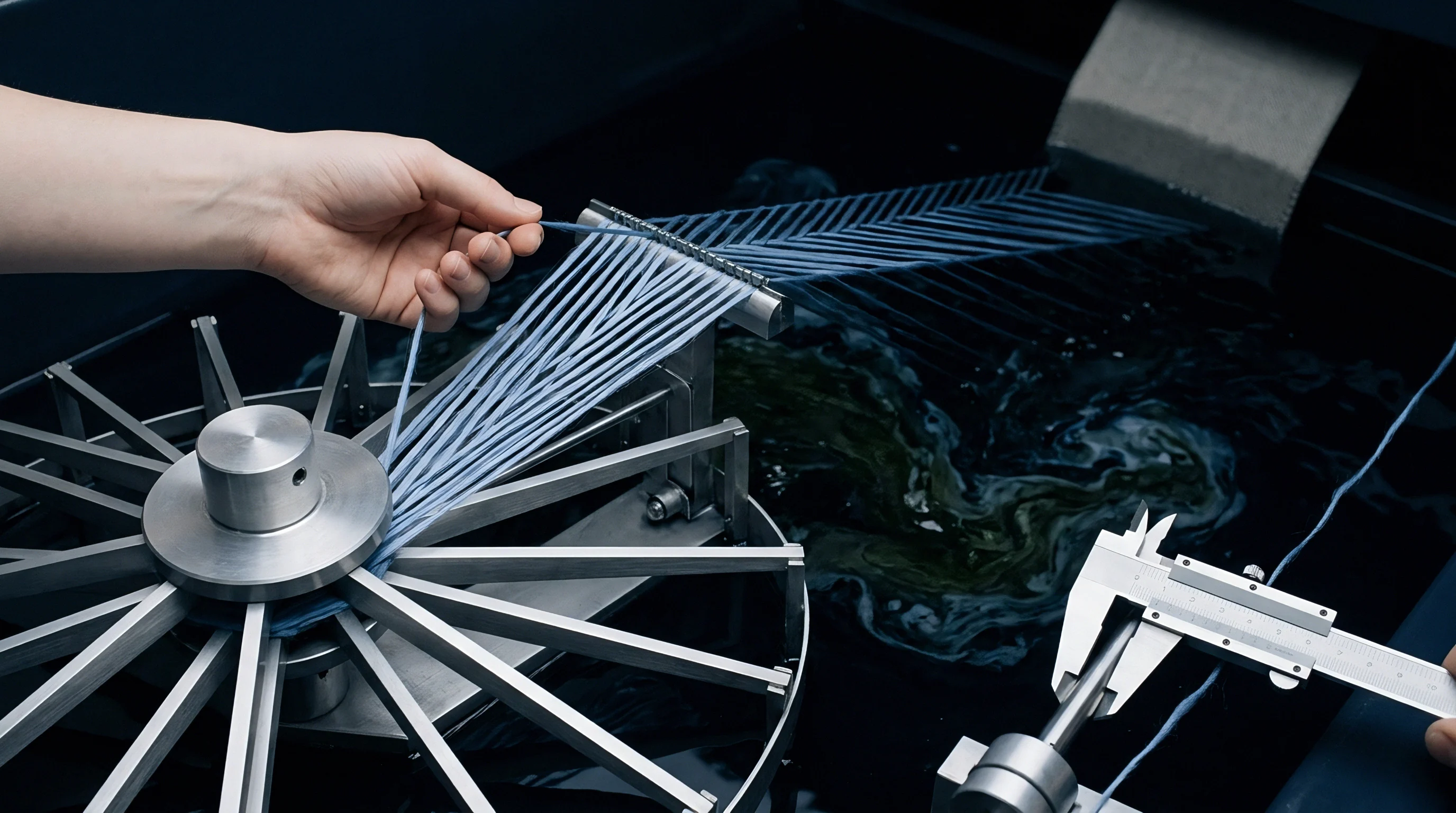
Latent Heat Balance and Temperature Regulation
Surface vaporization extracts thermal energy, cooling the upper liquid film at a rate equal to the mass transfer flux multiplied by the latent heat of vaporization (2,333 kJ/kg at 60°C). Heating jackets must continuously replace these lost calories to prevent surface cooling. Uneven temperatures across the bath create variable hydrolysis rates, causing shade streaks and side-to-center variation across the web.
| Dye Reactive Group Type | Trough Temp (°C) | Hydrolysis Rate Constant k (min⁻¹) | Dye Half-Life in Bath (min) | Fixation Yield Loss per 10 min (%) |
|---|---|---|---|---|
| Cold-Dyeing Dichlorotriazine | 30 | 0.012 | 57.7 | 11.3 |
| Cold-Dyeing Dichlorotriazine | 50 | 0.068 | 10.2 | 49.3 |
| Warm-Dyeing Vinylsulfone | 40 | 0.005 | 138.6 | 4.9 |
| Warm-Dyeing Vinylsulfone | 60 | 0.032 | 21.6 | 27.5 |
| Hot-Dyeing Monochlorotriazine | 60 | 0.008 | 86.6 | 7.7 |
| Hot-Dyeing Monochlorotriazine | 80 | 0.045 | 15.4 | 36.2 |
Reactant Hydrolysis Rates under Thermal Stress
Elevated bath temperatures double the decomposition rate of reactive bonds, making residence time control critical. A vinylsulfone reactive dye bath at 60°C in a 50-liter trough gives an average fluid dwell time of six minutes. As shown in the table, 60°C operation yields a dye half-life of 21.6 minutes, causing steady yield loss during run time.
Dropping trough volume to 10 liters cuts residence time below 1.2 minutes, suppressing hydrolytic loss before the liquor reaches the fabric.
Sustained evaporative cooling drops surface liquid temperature below bulk tank temperature, setting up convection currents that pull concentrated solute back into the active dipping zone.
Whether real-time acoustic velocity sensors can track dye concentration independently of temperature fluctuations in turbulent troughs remains unproven over extended commercial runs.

Audit
Verifying continuous pad bath stability requires inline instrumentation paired with strict laboratory dip matching. Quality systems evaluate bath parameters at fixed intervals, comparing sensor logs against physical swatch cuts. Spectrophotometric readings of swatches taken from the head, middle, and tail of bulk runs identify concentration drift before fabric leaves the line, using ISO 105-J03 color space metrics to set pass-fail limits for shade uniformity.
Inline Measurement and Refractometric Controls
Sensors in the recirculation loop give real-time feedback on dissolved solids. Optical refractometers, ultrasonic density meters, and conductivity sensors monitor bath conditions continuously, feeding signals to automated dosing units that remove operator error and hold tight tolerances. Qualifying inline hardware requires verifying temperature compensation algorithms under rapid thermal cycling.
Operational audits assess specific technical parameters when qualifying heated pad trough installations for bulk continuous runs:
- Thermal Profile Uniformity confirms temperature variation across the trough width remains within plus or minus 0.5°C at maximum line speed.
- Automated Concentration Compensation measures sensor response time and dosing accuracy under simulated evaporative water loss.
- Dwell Time Distribution tracks liquor turnover velocity using tracer dye injections to confirm the absence of dead zones.
- Enclosure Integrity Verification measures air velocity above the trough opening to ensure containment hoods suppress cross-draft evaporation.
Spectrophotometric Shade Tolerances across Bulk Runs
Color consistency across a 50,000-meter run depends on holding batch variation within tight tolerances. Spectrophotometric evaluations under illuminants D65, TL84, and A detect metamerism and shade drift, using total color difference Delta E CMC (2:1) to track uniformity and prevent panel-to-panel shade variation during garment assembly.
| Sensor Technology | Measured Parameter | Operational Precision | Response Time | Calibration Interval |
|---|---|---|---|---|
| Critical Angle Refractometer | Total Dissolved Solids (Brix) | ± 0.05 Brix | < 1.0 s | 7 days |
| Ultrasonic Density Transducer | Liquid Mass Density (g/cm³) | ± 0.0005 g/cm³ | < 2.0 s | 14 days |
| Four-Electrode Conductivity | Ionic Concentration (mS/cm) | ± 0.5 mS/cm | < 0.5 s | 7 days |
| Pt100 Resistance Thermometer | Bulk Temperature (°C) | ± 0.1 °C | < 0.3 s | 30 days |
Color difference evaluations exceeding 0.8 Delta E CMC under illuminant D65 under ISO 105-J03 justify immediate shipment rejection at the receiving dock.
Purchasing specifications that require continuous refractometric logs turn potential shade disputes into objective chemical compliance reviews.
Contract
Commercial purchasing agreements for continuous dyed goods set explicit boundaries for shade variation and re-run liabilities. Contracts establish maximum allowable color differences across bulk rolls. When unmanaged mass transfer causes bath concentration to drift, the resulting shade variation leads to rejections, financial claims, and schedule delays.
Converter orders place technical responsibility for bath control directly on the mill, mandating documented logs for temperature, level, and concentration stability.
Reject Risk Allocation and Downtime Liabilities
Converters and dyehouses manage risk by specifying precise operational limits in master supply agreements. Standard terms classify lots as non-compliant if head-to-tail shade variance exceeds 0.8 Delta E CMC under primary illuminants. If non-compliance traces back to poor trough management, the finisher bears the cost of redyeing, replacement fabric, and schedule penalties.
Outlining automated trough control standards in original supply contracts prevents commercial disputes when quality issues arise.
Uncompensated water loss during pad-batch dyeing shifts shade depth darker toward the trailing end of the roll.
Setting clear technical parameters for trough mass transfer stabilization protects operating margins and ensures reliable shade consistency.