Determining Chemical Separation Fiber Blend Composition Percentages
Chemical separation determines blend percentages by gravimetrically weighing insoluble residue after selective dissolution, requiring correction factors and moisture regains to match customs rules.


Reagent
Quantitative chemical separation measures fiber blend percentages by dissolving one component while leaving the second intact as a solid gravimetric residue. The laboratory weighs an oven-dry specimen, subjects it to a selective chemical solvent under defined temperature and agitation parameters, collects the insoluble residue in a sintered glass crucible, washes, dries, and reweighs the remaining mass. Standard method ISO 1833-1 sets the baseline protocol across multi-component textiles, while ISO 1833-11 and AATCC 20A govern the common polyester-cellulose binary blend using 75 percent sulfuric acid.
A technician circles 65/35 on the raw invoice, runs the dissolution, and watches the gravimetric calculation return 62.4 percent polyester and 37.6 percent cotton on clean dry weight. That gap defines the customs classification line.
Different fiber polymers respond to specific solvent systems based on differences in molecular polarity, hydrogen bonding, and chemical cleavage resistance. Cellulose dissolves in cold concentrated sulfuric acid or warm cuprammonium solutions through the rapid hydrolysis of beta-1,4-glycosidic bonds. Wool and specialty animal hair hydrolyze inside warm alkaline hypochlorite via the disruption of disulfide crosslinks in cystine.
Polyamide 6 and polyamide 6,6 dissolve cleanly in room-temperature 80 percent formic acid or hot 20 percent hydrochloric acid, leaving polyester, acrylic, or cellulosic polymers unattacked. Acetate dissolves selectively in acetone at room temperature, while elastane isolates via hot dimethylformamide or boiling cyclohexanone depending on the polyurethane composition.
Each dissolution step carries a chemical correction factor designated as d in ISO 1833. This d-factor compensates for the slight dissolution or mass loss of the non-soluble fiber during exposure to the aggressive reagent. The laboratory applies a factor of 1.02 for scoured cotton residues exposed to 75 percent sulfuric acid to account for surface polysaccharide stripping.
Polyester exposed to formic acid carries a d-factor of 1.00, exhibiting zero measurable weight loss under standard analytical conditions. Omitting these factors skews the mass calculation, systematically inflating the dissolved component’s percentage at the expense of the residue.
The solvent action requires strict temperature regulation to avoid degrading the target residue. During the separation of cellulose from polyester in 75 percent sulfuric acid, the temperature must stay between 15 and 25 degrees Celsius for 60 minutes. Exceeding 30 degrees Celsius causes the sulfuric acid to hydrolyze and cleave the ester linkages in polyethylene terephthalate, converting polymer segments into soluble oligomers.
The technician washes the collected residue with cold water, neutralizes the remaining acid with dilute ammonium hydroxide solution, rinses again to neutral pH, and dries the crucible at 105 degrees Celsius until mass equilibrium arrives.
A temperature spike above 30 degrees Celsius during sulfuric acid digestion dissolves polyester residue alongside cellulose, corrupting the gravimetric ratio.
A supplier often claims that finishing chemistry does not alter laboratory separation results. That assertion ignores how durable press resins, silicone softeners, fluorochemical repellents, and polyurethane coatings deposit solid non-fibrous mass. Standard test procedures require complete solvent pre-extraction in a Soxhlet apparatus using petroleum ether followed by warm water extraction before any quantitative dissolution takes place.
Pre-extraction removes up to four percent of non-fibrous finishing mass that would otherwise calculate erroneously as dissolved cellulose or wool. The gravimetric residue registers clean dry weight only when yarn auxiliaries, sizes, and chemical binders are stripped from the test specimen completely.

Calc
Gravimetric yields convert to commercial percentages only after applying standard moisture regains to dry oven mass. The analytical balance registers clean oven-dry residue mass and dissolved mass. Raw dry numbers cannot populate a commercial invoice, a customs manifest, or a retail garment label without mathematical adjustment.
Textile trade regulations mandate calculating blend percentages using official agreed moisture allowances, known across commerce as commercial moisture regains. ISO 1833-1 incorporates these allowances to reflect the mass of the fabric under normal ambient atmospheric conditions.
The calculation sequence begins with the clean oven-dry mass of the total specimen designated as m0. The clean oven-dry mass of the insoluble residue is m1. The corrected dry residue mass r equals m1 multiplied by the chemical correction factor d.
The dry mass of the dissolved component equals m0 minus r. Commercial blend proportions use dry percentages alongside commercial allowances. The mathematical equation derives the percentage of the first, dissolved component P1 as follows:
P1 = / 100
Here, a1 represents the agreed commercial moisture regain percentage for the dissolved fiber, and a2 represents the commercial moisture regain percentage for the residue fiber. The second component’s percentage P2 equals 100 minus P1. The commercial allowance assigns water weight back to the fibers according to their standard hygroscopic properties.
| Fiber Type | Commercial Regain ISO 6741 Percent | Commercial Regain ASTM D1909 Percent | Chemical Correction Factor d |
|---|---|---|---|
| Polyester Staple | 1.50 | 1.50 | 1.00 |
| Carded Cotton | 8.50 | 7.00 | 1.02 |
| Combed Cotton | 8.50 | 7.00 | 1.01 |
| Viscose Rayon | 13.00 | 11.00 | 1.02 |
| Wool Pure Scoured | 17.00 | 13.60 | 1.01 |
| Polyamide 6 / 6.6 | 6.25 | 4.50 | 1.00 |
| Acrylic | 2.00 | 1.50 | 1.00 |
Examine the mathematical shift in a real blend analysis. Take a woven fabric specimen with a clean dry starting mass m0 of 2.0000 grams. After 75 percent sulfuric acid dissolution, the insoluble polyester residue m1 weighs 1.3000 grams.
The polyester factor d is 1.00, yielding a corrected polyester residue r of 1.3000 grams. The dry mass of dissolved cotton is 0.7000 grams. Based purely on dry mass without moisture allowances, polyester represents 65.00 percent and cotton represents 35.00 percent of the yarn.
Applying the standard ISO commercial regains of 8.50 percent for cotton and 1.50 percent for polyester alters the values. The commercial mass of the cotton component equals 0.7000 multiplied by 1.085, yielding 0.7595 grams. The commercial mass of the polyester component equals 1.3000 multiplied by 1.015, yielding 1.3195 grams.
Total commercial mass reaches 2.0790 grams. The true commercial percentage of cotton becomes 36.53 percent, while the commercial percentage of polyester falls to 63.47 percent. The inclusion of commercial regain shifts the analytical balance 1.53 percent in favor of the hydrophilic cellulose fiber.
If the customs classification threshold for chief weight sits at 65 percent synthetic fiber, this exact calculation moves the shipment into a totally different tariff category.
Uncertainty enters the arithmetic through variability in the baseline lint. Cotton grown in upland regions shows variable non-cellulosic wax and pectin fractions between 4 and 8 percent by raw mass. Scouring removes most non-cellulosics, but residual pectin alters the real dissolution loss during sulfuric acid wash stages.
The laboratory technician cannot confirm whether the removed fraction was entirely cellulose or partially non-fibrous gum. For this reason, repeat determinations must run in parallel; standard ASTM D629 and ISO 1833 guidelines require the difference between two duplicate runs on the same laboratory sample to stay below 1.0 percentage point. When duplicates diverge by more than one percent, the entire analytical sequence repeats from original specimen preparation.
Disputes in customs laboratories center on whether the chemist applied ASTM D1909 or ISO 6741 moisture regain standards. The difference between 7.00 percent ASTM cotton regain and 8.50 percent ISO cotton regain represents 0.50 percent of the declared blend on finished cloth. European Union customs enforcement operates strictly under ISO regain schedules, while United States Customs and Border Protection references ASTM schedules unless contract documentation specifies otherwise.
Filter
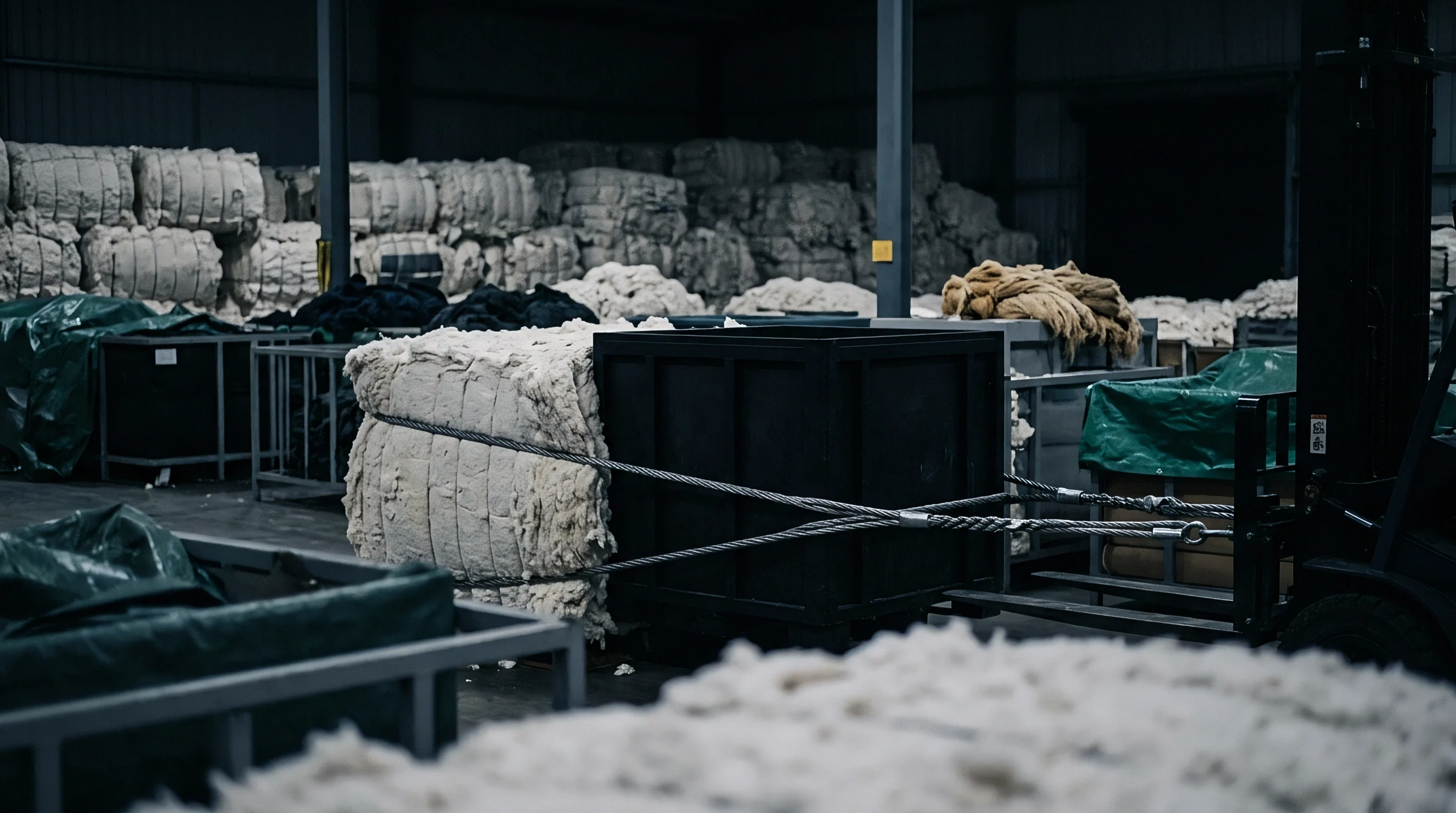
Separation chemistry relies upon physical barriers to capture gravimetric residues without losing fine fiber fibrils. Sintered glass crucibles serve as the standard filtering vessel across international textile laboratories. Crucibles with porosity grade 3, featuring a pore index between 16 and 40 microns, retain dissolved fiber fragments while permitting rapid solvent evacuation under vacuum filtration.
A compromised filter allows broken staple fragments to pass into the filtrate, artificially reducing the recorded residue weight.
Mechanical preparation determines how evenly the solvent penetrates the yarn structure. Yarns spun on vortex or rotor systems pack fibers tightly, resisting reagent penetration toward the core. Ring spun yarns, particularly with high twist multipliers above 4.2 Ne, prevent sulfuric acid or formic acid from reaching internal fibers within prescribed contact windows.
Technicians tease open tightly twisted yarns and woven structures into individual single ends cut into 5 to 10 millimeter segments before weighing. Denser woven constructions require manual unraveling to expose yarn cross sections to uniform liquid contact.
Crucible handling introduces micro-scale gravimetric errors that multiply into whole percentage points across batch runs. Borosilicate glass adsorbs atmospheric moisture rapidly when cooling from drying temperatures. A 30-milliliter sintered crucible exposed to 65 percent relative humidity gains 0.0008 grams of water weight in 90 seconds.
To eliminate ambient moisture pickup, all crucibles transfer directly from the 105-degree drying oven into an airtight desiccator loaded with fresh, activated silica gel or phosphorus pentoxide. Specimens cool for precisely 40 minutes inside the desiccator before analytical weighing on balances sensitive to 0.0001 grams.
Suction levels during vacuum filtration demand constant calibration. Excessive negative pressure pulls microscopic fiber particles directly through the glass filter disc, fracturing partially swollen fibers. Insufficient vacuum prolongs filtration times, allowing the solvent to remain in contact with the residue longer than the standard method permits.
Extended chemical exposure strips additional polymer chains from the insoluble fiber, driving the empirical recovery factor below the standard d-factor table. Vacuum lines run at an operating pressure between 10 and 20 kilopascals, ensuring rapid fluid drainage without mechanical disruption of the filter cake.
A sintered glass crucible cooling outside a desiccator collects enough atmospheric water within two minutes to distort the gravimetric yield by half a percentage point.
A supplier often argues that small weight losses during filtration reflect laboratory technician error rather than irregular material behavior. That defense fails to consider the structural heterogeneity of regenerated cellulosic fibers like modal and lyocell. High wet modulus fibers resist alkaline degradation better than standard viscose, but show distinct swelling properties during acid separations that blind the filter disc pores.
When pores clog, filtration slows, chemical contact stretches from 60 minutes to 90 minutes, and the acid attacks the polyester or polyamide residue through prolonged exposure.

Protocol
Accurate chemical determination of fiber blend percentages proceeds along a fixed analytical sequence. Deviation from the sequence introduces cumulative experimental errors that compound during final commercial calculations. Analytical teams follow a six-stage laboratory protocol to ensure repeatable quantitative results across disputed yarn and fabric lots.
- Specimen Conditioning sets equilibrium moisture mass across the test swatches in an atmosphere maintained at 20 degrees Celsius and 65 percent relative humidity for a minimum of 24 hours prior to initial handling.
- Solvent Pre-Extraction strips non-fibrous process oils, sizing compounds, finishing resins, and surface waxes inside a Soxhlet extraction apparatus using petroleum ether for one hour followed by distilled water extraction at 100 degrees Celsius for one hour.
- Oven Desiccation drives off all absorbed moisture by drying the pre-extracted specimen at 105 to 110 degrees Celsius inside a ventilated drying oven until successive weighings taken at 15-minute intervals show less than 0.0002 grams mass variance.
- Chemical Dissolution immerses the oven-dry sample in the specified selective reagent inside an Erlenmeyer flask, applying regulated mechanical agitation and temperature control for the exact duration specified by the standard method.
- Vacuum Filtration transfers the chemical slurry into a tared sintered glass crucible under vacuum, pulling the solvent away from the solid residue before rinsing the residue repeatedly with neutralizing solutions and distilled water to achieve neutral pH.
- Gravimetric Reweighing dries the crucible containing the insoluble fiber residue at 105 degrees Celsius to constant mass, cools the vessel inside an airtight desiccator for 40 minutes, and records the dry residue weight on an analytical balance calibrated to 0.0001 grams.
Sloppy sample gathering at the fabric roll ruins the accuracy of the six-step sequence before extraction starts. Taking swatches near the selvedge yields unrepresentative ratios due to uneven yarn tensions and yarn count variations introduced by weaving looms. Test specimens must come from fabric areas at least 150 millimeters away from both selvedge edges, cut across the warp and weft directions at staggered points along the roll length.
For yarn cones, outer wraps equal to 100 meters must be discarded to bypass surface contamination and oxidation.
A testing house standard operating procedure mandates that every batch of five production tests run alongside one blank control specimen. The control blank uses a known reference fiber to confirm reagent purity and d-factor calibration. If the control blank shows an uncorrected recovery factor outside the acceptable 0.99 to 1.03 boundary, the technician discards the reagents and recalibrates the analytical run.
The contract clause specifying ISO 17025 accredited testing establishes that unverified runs cannot substantiate customs origin claims.

Drift
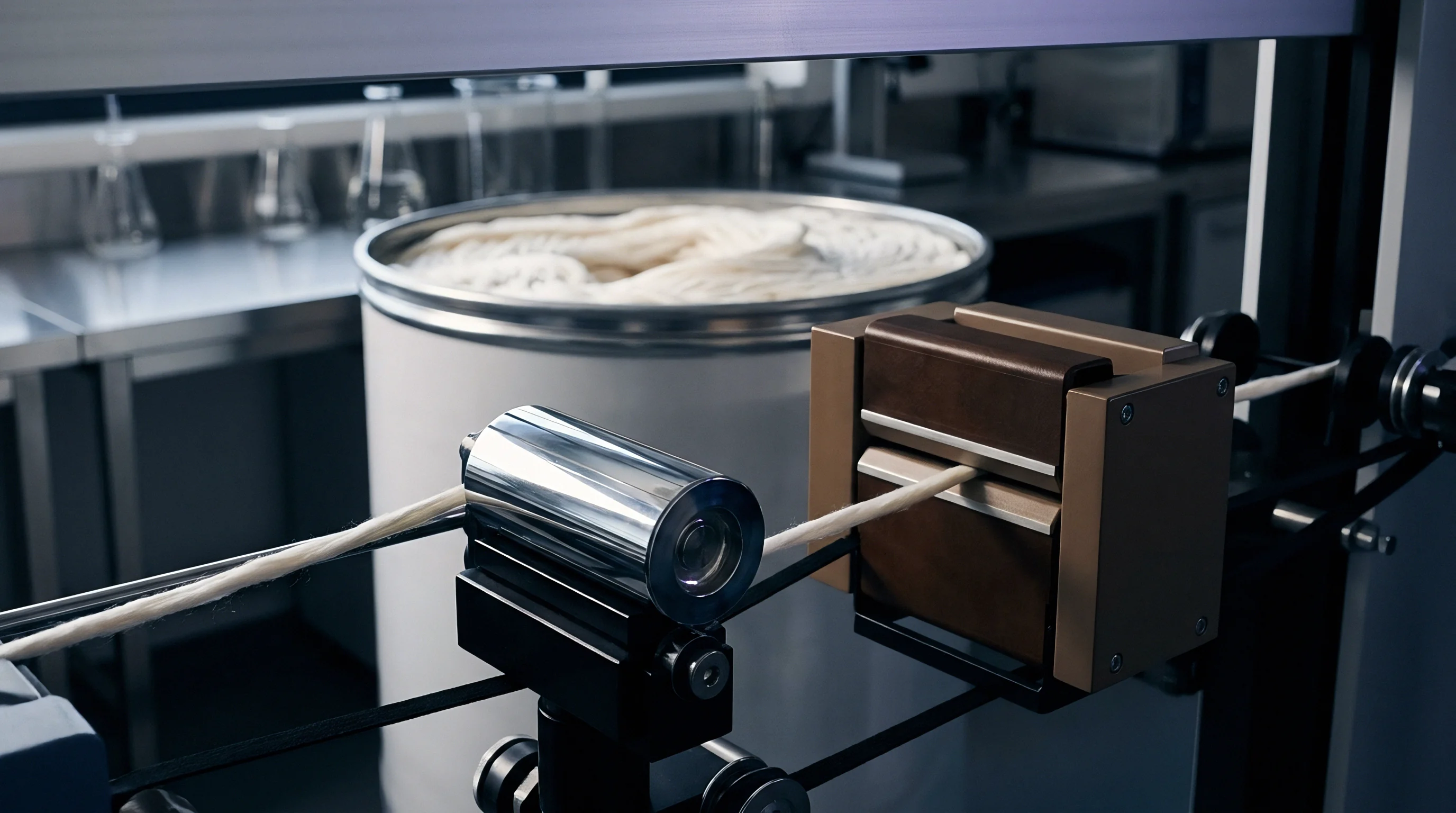
Commercial fibers do not match the pure polymer references cited in analytical standards. Production fiber streams contain delustrants, internal lubricants, pigment masterbatches, and variable crystalline ratios that change how the fiber dissolves. Titanium dioxide delustrant incorporated into semi-dull and full-dull polyester yarn accounts for 0.30 to 2.50 percent of total dry fiber mass.
This inorganic pigment does not dissolve in organic solvents or concentrated acids, remaining behind inside the crucible as part of the polyester residue. When analyzing bright polyester against dull polyester, the pigment mass creates an artificial positive error in calculated polyester content if left unaccounted for.
Recycled polyester, particularly post-consumer polyethylene terephthalate derived from recycled bottle flake, displays broad molecular weight distributions and variable intrinsic viscosity. Flake-derived polyester contains isophthalic acid co-monomers and diethylene glycol residues that lower crystalline melting temperatures and increase solvent susceptibility. When exposed to 75 percent sulfuric acid, low-molecular-weight fractions of recycled polyester degrade faster than virgin fiber, producing chemical mass losses up to 1.8 percent compared to the standard 0.0 percent assumption.
The residue drops, showing a lower synthetic ratio on the test report than the mill actually blended into the yarn.

Which Processing Variables Alter Chemical Resistance?
Heat setting temperatures applied during fabric stentering directly control polymer morphology. Exposing polyester to dry heat setting at 195 degrees Celsius for 45 seconds raises fiber crystallinity from 40 percent to 55 percent, tightening the crystalline domains and slowing chemical reagent penetration. Conversely, thermal degradation from excessive heat exposure shears polymer chains, generating amorphous defects that dissolve rapidly during standard chemical separations.
Cotton mercerization shifts the crystal lattice from cellulose I to cellulose II, accelerating dissolution speed inside 75 percent sulfuric acid and increasing cotton sensitivity to stray acidic washings.
Microfibers present distinct dissolution challenges due to elevated specific surface area. A 0.8 dtex polyester microfiber exposes significantly more surface contact area per gram than a standard 3.3 dtex apparel staple fiber. Reagents attack surface defects exponentially faster on fine microfibers, driving mechanical fragmentation and chemical degradation beyond published correction values.
When running separations on micro-denier fibers, the standard ISO 1833-11 d-factor of 1.00 for polyester proves insufficient; empirical evaluations demonstrate that microfibers require a real-world d-factor between 1.015 and 1.025 to balance dissolution-induced surface degradation.
Blending intimate fibers at the draw frame versus the blowroom creates distinct dispersion patterns that influence chemical exposure. In blowroom intimate blends, individual fibers intermingle thoroughly, distributing solvent contact evenly across the dissolving matrix. Draw-frame blends can leave alternating fiber clusters inside the yarn cross section.
These clustered structures trap the solvent, preventing thorough washing during the neutralization step and causing localized ongoing degradation of the supposedly insoluble residue while sitting on the filter bed.
Post-consumer recycled polyester with depressed intrinsic viscosity loses mass in concentrated acid that virgin synthetic polymer survives intact.
Dyeing chemistry also modulates the behavior of the fiber matrix under solvent attack. Deep black sulfur dyeing on cotton yarn degrades cellulose polymer chains through acid generation during steaming and aging, rendering the cotton partially soluble in mild alkalis that normally leave untreated cotton unharmed. Heavy reactive dyeings attach bulky chromophores covalently to cellulose hydroxyl groups, marginally reducing the accessibility of sulfuric acid to beta-1,4-glycosidic bonds and extending the dissolution time needed for clear separation.
The table below summarizes common chemical separation methods along with their active agents and standard correction allowances under commercial testing conditions.
| Fiber Blend System | Selective Reagent | Soluble Component | Insoluble Residue | Standard d-Factor |
|---|---|---|---|---|
| Polyester / Cotton | 75% Sulfuric Acid (H2SO4) | Cotton | Polyester | 1.02 (Cotton) |
| Wool / Polyester | Alkaline Sodium Hypochlorite | Wool | Polyester | 1.01 (Polyester) |
| Polyamide / Polyester | 80% Formic Acid (HCOOH) | Polyamide | Polyester | 1.00 (Polyester) |
| Acetate / Viscose | Acetone (CH3COCH3) | Acetate | Viscose | 1.00 (Viscose) |
| Elastane / Cotton | Dimethylformamide (DMF) | Elastane | Cotton | 1.01 (Cotton) |
| Acrylic / Wool | Dimethylacetamide (DMAc) | Acrylic | Wool | 1.01 (Wool) |
A mill’s technical representative typically claims that fiber blend variations reflect natural lot variability rather than uneven manufacturing inputs. That explanation crumbles when cross-sectional chemical analysis shows draw-frame sliver weights drifting across spinning shifts. If the blowroom scales misfeed by two percent on the polyester line, the resulting intimate yarn locks that error into every meter of cloth.
Chemical separation reveals precisely where the mill’s mass metering failed.

Tariff
Composition testing governs customs classification under Chapter 52 through Chapter 55 of the Harmonized System. Border customs authorities operate on a strict legal criterion known as chief weight. Under Section XI of the Harmonized Tariff Schedule, goods composed of two or more textile materials classify as if consisting wholly of that one textile material which predominates by weight over every other single textile material.
A single percentage point determines whether a woven shipment imports as cotton fabric carrying an 8.4 percent ad valorem duty or as synthetic polyester fabric carrying a 14.9 percent ad valorem duty.
Consider the commercial exposure of a 40,000-kilogram lot of disputed woven shirting imported into the United States. The invoice declares the goods as 52 percent combed cotton and 48 percent polyester, classifying the cloth under HTS 5208.52 with an applicable duty rate of 7.5 percent. The imported fabric value stands at 12.00 dollars per kilogram, establishing a total customs declared value of 480,000 dollars.
The projected duty burden under the declared cotton-dominant classification equals 36,000 dollars.
Customs and Border Protection draws random verification swatches from three containers at the port of entry and submits them to an accredited customs laboratory for quantitative chemical analysis under ASTM D629. The laboratory removes finishing starches, conditions the specimens to ASTM standards, dissolves the cotton in 75 percent sulfuric acid, applies standard 7.0 percent commercial moisture regain to cotton and 1.5 percent to polyester, and issues a certified test report. The laboratory finds 49.2 percent cotton and 50.8 percent polyester by commercial mass.
The polyester now predominates by weight. Customs rejects the declared classification under Chapter 52 and reclassifies the entire consignment under HTS 5514.12 as woven fabric of synthetic staple fibers containing less than 85 percent by weight of such fibers, mixed mainly or solely with cotton. The applicable duty rate under HTS 5514.12 is 14.9 percent ad valorem.
- Revised Duty Liability climbs to 71,520 dollars upon reclassification, creating an immediate customs underpayment assessment of 35,520 dollars on the entry docket.
- Merchandise Processing Penalties apply under Title 19 U.S. Code Section 1592 for commercial negligence, running up to two times the duty loss unless the importer proves prior due diligence.
- Port Demurrage Charges accumulate at rates between 180 and 350 dollars per container day while the shipment sits on customs hold awaiting laboratory re-testing and formal petition reviews.
- Commercial Delivery Defaults trigger liquidated damages under retail sales contracts when cutting schedules fail, costing up to five percent of finished garment value per week of delay.
A buyer cannot hedge against this risk with standard contractual boilerplate. Mill purchase orders frequently specify a blend ratio tolerance of plus or minus three percent, aligning with general textile industry manufacturing allowances. Customs compliance rules recognize no commercial manufacturing tolerances.
The customs tariff schedule operates on binary lines: an article contains 50.1 percent synthetic fiber or it does not. A plus-or-minus three percent mill tolerance guarantees that a nominally 52/48 blend can legally leave the factory as a 49/51 blend, throwing the entire customs classification into non-compliance.
When the laboratory finds that a blend crosses the 50 percent threshold, the importer faces an unresolvable trade dispute. Re-testing the identical lot at an independent commercial laboratory often returns 50.2 percent cotton due to minor differences in drying ovens, handling speeds, or atmospheric control. The customs administration maintains its own laboratory results over private test reports unless the importer demonstrates clear methodological error by the government chemist.
Proving such error requires detailed examination of the customs bench sheets, raw crucible weights, desiccator cooling logs, and applied moisture regain calculations.
The standard procurement contract clause establishing quality acceptance based on factory-floor certification leaves the buyer fully vulnerable to customs reassessment. Sourcing contracts must explicitly state that blend guarantees apply strictly to oven-dry chemical separation values adjusted for destination-country legal moisture regains. If the mill will not warrant compliance at the destination port’s statutory standards, the buyer must price the higher duty rate directly into the initial landed-cost model.
Dispatch
Protecting commercial operations against composition failures requires enforceable sampling before the mill releases the shipment. Retesting cutting swatches after goods arrive at the destination distribution center arrives too late to prevent port seizures or duty penalties. Sourcing teams deploy systematic lot sampling protocols at the spinning and weaving mill before authorizing export dispatch.
Random sampling based on ANSI/ASQ Z1.4 General Inspection Level II governs specimen collection across production runs. For a finished yarn lot of 500 cases, the inspection team selects 32 individual yarn packages from across outer, middle, and inner pallet positions. A composite test sample created by blending yardage from across these packages provides an accurate baseline for bulk yarn composition.
For fabric rolls, inspectors cut full-width 500-millimeter swatches from the tail and head of five separate rolls per dye lot, sealing each specimen inside vapor-impermeable plastic bags to lock in ambient conditions during transport to the testing laboratory.
The testing mandate must specify quantitative chemical separation over visual, optical, or burning identification methods. Microscopic examination under ISO 137 provides qualitative identification of fiber structures, but cannot resolve exact commercial weight percentages in intimate blends where cross sections vary along the fiber axis. Fourier transform infrared spectroscopy verifies the presence of synthetic polymers, but surface coatings and pigment additives distort quantitative peak-ratio calibrations.
Wet chemical dissolution according to ISO 1833 or ASTM D629 remains the sole legally defensible proof of fiber composition in cross-border trade.
A supplier often suggests that fiber blend deviations balance out across large volume contracts. That commercial framing overlooks how customs penalties and customer labeling claims target specific individual production lots. If three shipping containers out of twenty test below the cotton threshold, customs holds those specific containers regardless of the average composition across the annual contract.
Operational safety requires every distinct dye lot and spinning lot to clear independent chemical validation prior to cargo release.
Purchase specifications must tighten blend tolerances far beyond conventional commercial standards for any goods engineered within five percentage points of a tariff boundary. When sourcing a nominal 55 percent cotton and 45 percent polyester yarn, the technical specification must restrict acceptable lot delivery to 54.0 percent to 57.0 percent cotton under destination regain schedules. Any production run testing below 54.0 percent cotton must face immediate rejection or price renegotiation before bills of lading issue, keeping regulatory compliance anchored firmly to verifiable chemistry.