Polypropylene Defect Detection Limits in Combed Cotton Yarns
Polarized and short-wave infrared yarn clearers detect white polypropylene splinters down to 0.02 mg in combed cotton yarn, preventing un-dyeable fabric specks.


Comb
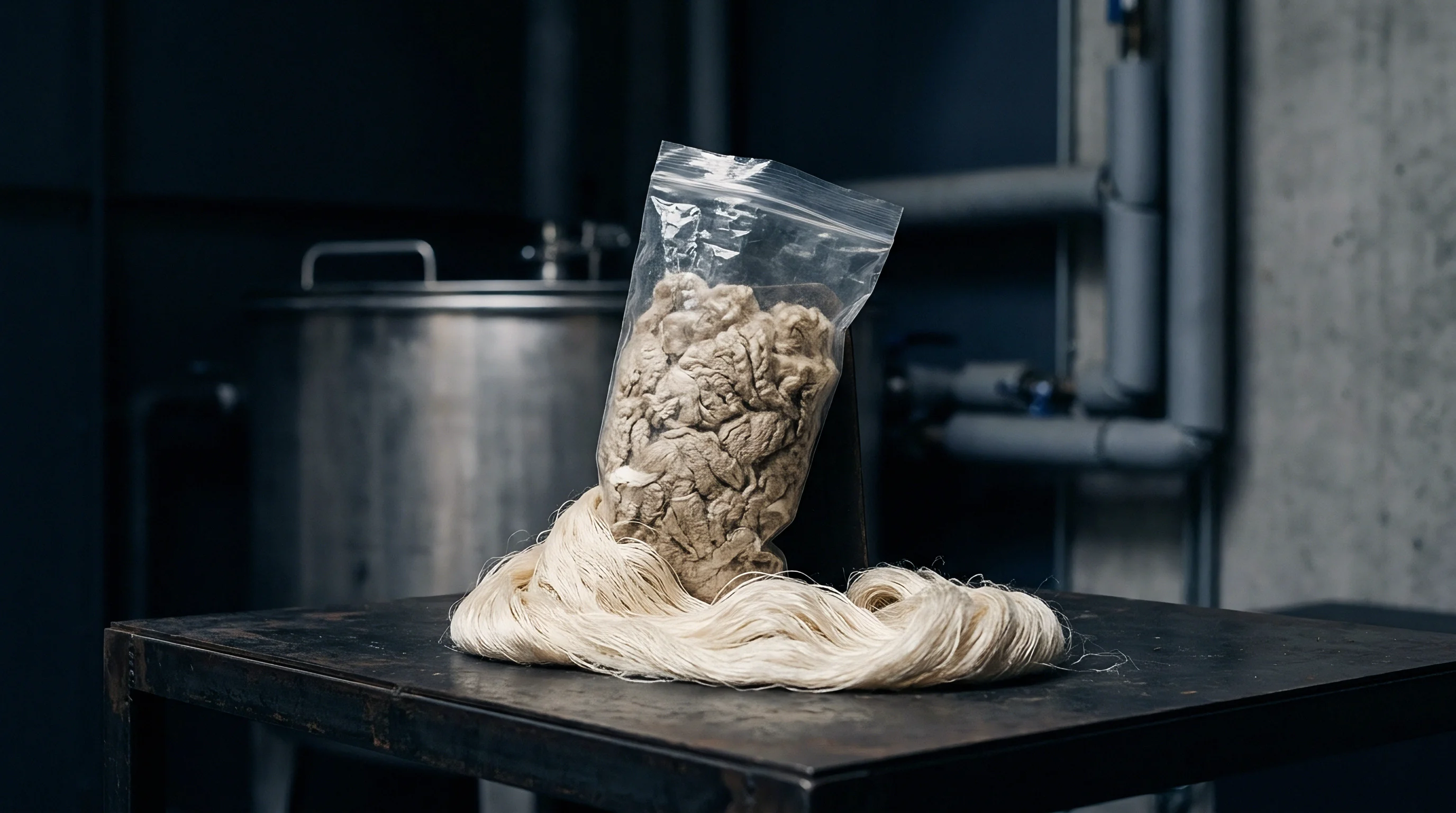
Raw cotton lots arriving at spinning mills frequently carry synthetic contaminants from agricultural baling materials. Polypropylene twine, woven bale packaging, and field tarpaulins split into thin ribbon-like splinters during mechanical picking and ginning. These polyolefin contaminants present a distinct challenge in fine combed cotton production because polypropylene density ranges from 0.90 to 0.91 grams per cubic centimeter, placing it close to the effective buoyancy of loose cotton fiber flocs during pneumatic opening.
Polypropylene remains non-polar.

Polyolefin Entrapment in High-Grade Cotton
Synthetic packaging film splinters entering the blowroom survive early cleaning machinery. Beaters, grid bars, and saw-tooth rolls fail to eject flexible polypropylene strips because flat film fragments lack the mass-to-surface-area ratio of heavy botanical trash like seed coat fragments or stem bark. The material moves alongside cotton tufts into carding.
Carding fails to remove film splinters. Cylinder and flat wires card the cotton fibers while flattening the polypropylene tape along the main orientation axis of the sliver, converting coarse film shreds into thin fibrillated ribbons.
Mechanical combing aims to extract short fibers, neps, and residual trash to produce high-tenacity yarns ranging from Ne 30s to Ne 80s. Combing needles bend under pressure. Circular comb top wires, arranged at densities between 26 and 34 needles per centimeter, pass through the fiber lap to remove short staple lengths.
Thin polypropylene splinters possess high flexural flexibility in their thin transverse axis. When the comb nip engages, flat synthetic splinters bend around the needle tips rather than getting caught in the needle gaps. The needles slice through loose cotton web without impaling the smooth, low-friction surface of oriented polyolefin film.
Consequently, polyolefin contaminants pass directly into the combed sliver drafting zone.
Synthetic polyolefin splinters survive mechanical combing because thin film geometries flex past circular comb needle gaps without impaling.
Fibrillated tape splinters that survive combing undergo drafting across multiple draw frame passages. Drafting rolls attenuate the fiber bundle, aligning the synthetic ribbons parallel to the cotton fibers. Direct dyes ignore polyolefins.
During ring spinning, twist insertion buries portion of these synthetic ribbons within the yarn core while leaving thin fibrillated whiskers extending from the yarn surface. Twisted yarn retains these flat film inclusions tightly, preventing passive shedding during winding.

Mechanics of Sliver Passage and Neps
Processing raw fiber through card cylinder wires reduces large trash aggregates to fine particles. Synthetic contaminants behave differently than brittle botanical matter. Polypropylene film shreds flex under impact rather than shattering.
As drawing rollers exert drafting force, flat synthetic shreds shear into elongated micro-fibrils with widths below 50 micrometers. These micro-fibrils wrap around neighboring cotton staples, forming synthetic core neps that lack chemical dye binding sites.
Unordered structural forms of foreign synthetic material persist in combed cotton sliver after mechanical preparation:
- Extruded Film Splinters Flat ribbon shreds originating from woven bale covers that flatten under card cylinder rolls and align parallel to drafted staple fibers.
- Fibrillated Twine Bundles Multi-filament clusters derived from agricultural tying strings that disintegrate into flexible, hair-like polyolefin strands during blowroom opening.
- Micro-Pellet Shreds Dense, molded container fragments crushed during ginning into sharp particulates that embed directly inside high-twist yarn cores.
Spinning mills frequently maintain that foreign polyolefin particles remaining below ten millimeters in length represent unavoidable agricultural background noise beyond the mechanical extraction envelope of standard combing equipment.


Spectrum
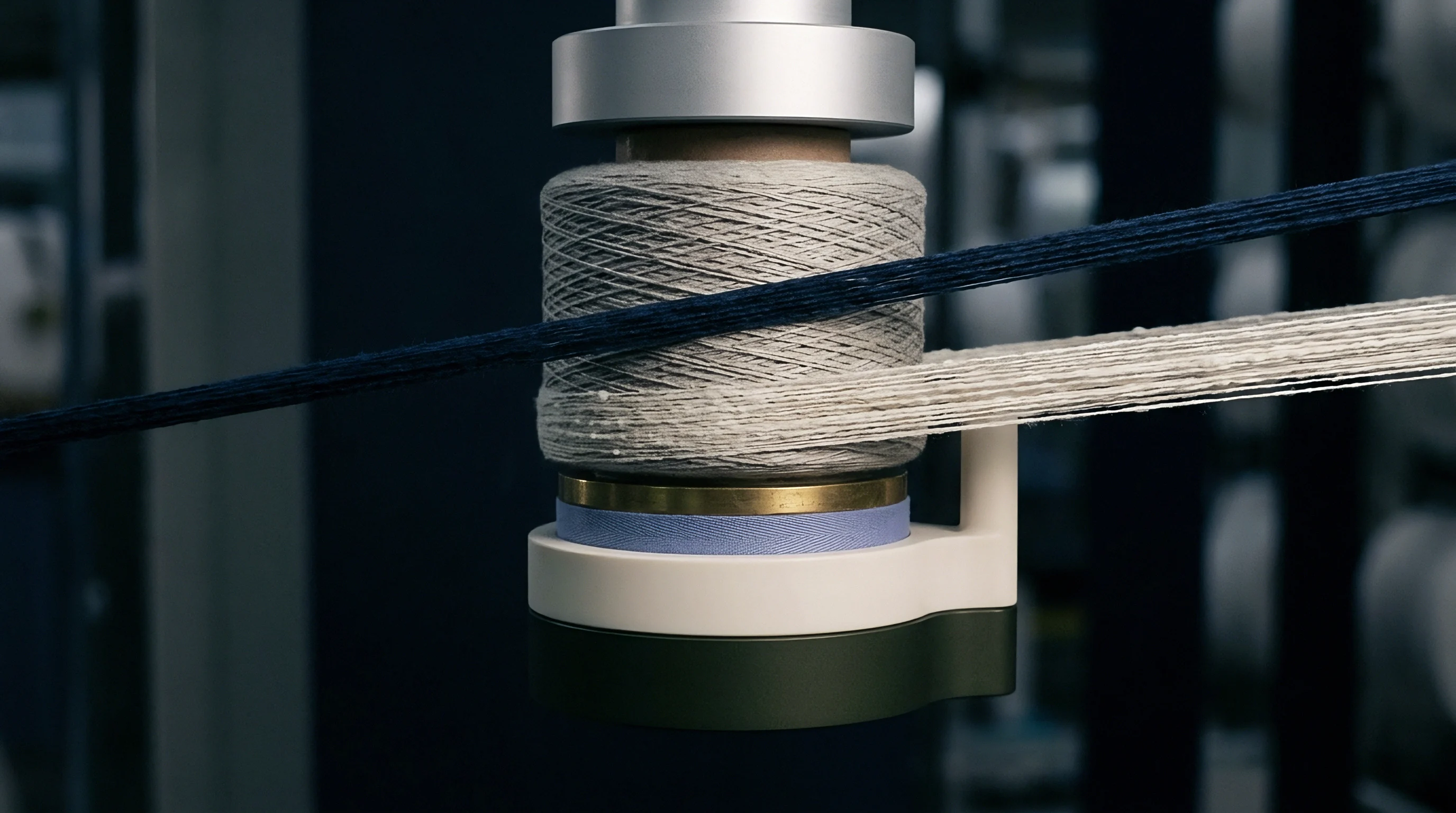
Winding machinery utilizes specialized optical array sensors to monitor yarn uniformity. Automatic cone winders pass yarn through yarn clearer channels at speeds ranging from 1200 to 1800 meters per minute. Standard optical clearing relies on transmitted light shade absorption to detect dark foreign matter like jute, leaf, or colored polypropylene.
White tape resists conventional illumination. Transparent, natural white, or pale yellow polypropylene tape matches the light transmission profile of bleached or unbleached combed cotton fiber, creating zero shade contrast under standard broad-spectrum light emitting diodes.

Polarized and Near-Infrared Signal Differentials
Conventional shade sensors struggle to register transparent plastic ribbons against white cotton. Specialized clearers incorporate dual detection systems operating on optical polarization shift and short-wave infrared spectroscopy. Birefringence reveals polymer alignment.
Highly oriented polypropylene film possesses significant anisotropic optical properties due to molecular chain alignment achieved during film extrusion. Polarized light passing through oriented polypropylene undergoes a phase retardance shift, altering the polarization plane. Cellulosic cotton fibers exhibit distinct, lower birefringence profiles under tension.
Polarization sensors detect this differential rotation angle, identifying white polyolefin splinters regardless of visual color match.
Near-infrared absorbance sensors exploit chemical bond resonances. Cellulose contains abundant hydroxyl groups exhibiting heavy absorption bands at wavelengths of 1450 nanometers and 1940 nanometers. Polypropylene consists entirely of hydrocarbon chains with saturated carbon-hydrogen bonds.
Hydrocarbon C-H overtones generate sharp, distinct infrared absorption peaks near 1195 nanometers, 1390 nanometers, and 1690 nanometers. As yarn passes the sensor slit, a high-speed short-wave infrared spectrographic module measures the baseline intensity ratio between 1450 nanometers and 1690 nanometers. A rapid drop in the O-H to C-H absorbance ratio triggers an immediate foreign matter defect signal.
| Technology Type | Operating Wavelength Range | Minimum Mass Sensitivity | Minimum Length Sensitivity | Clear Film Detection Reliability |
|---|---|---|---|---|
Dual polarization and short-wave infrared yarn clearers detect un-dyed polypropylene down to 0.02 milligrams at winding speeds of 1500 meters per minute.
Sensor Calibration and Baseline Noise
Setting detection thresholds on automated winding frames involves balancing foreign fiber removal against yarn cut frequency. Increasing sensor amplifier gain allows the detection of sub-milligram synthetic particles. White tape reflects ambient light.
Excessive sensitivity settings cause optical sensor arrays to mistake natural cotton thick places, seeds, or fiber bunching for synthetic contaminants. High false-positive cut rates create frequent winder stops, increasing yarn splices per 100 kilometers and diminishing overall yarn tenacity.
Film width alters optical scatter. Polypropylene tape passing edge-on through an optical sensor slit presents a optical frontal cross-section under 10 micrometers wide. Under edge-on orientation, optical scattering drops below sensor trigger limits.
Core inclusions hide from cameras. When cotton fibers completely envelope a polypropylene splinter inside the yarn axis, polarization light scattering is damped by the surrounding opaque cellulosic sheath, preventing accurate phase retardance measurement.
Whether ultra-high-speed short-wave infrared array sensors can distinguish micro-denier polyolefin splinters embedded deep inside the core of Ne 80s yarn without triggering excessive false-positive cuts remains open to industrial field verification.

Sieve
Particle geometry governs whether a foreign inclusion trips an optical cut signal. Sensor detection limits define the lower physical threshold of foreign matter removed during high-speed winding. Synthetic tape splinters present irregular aspect ratios, varying from short blocky particles to paper-thin elongated ribbons.
A polypropylene particle measuring 5 millimeters in length, 0.1 millimeter in width, and 25 micrometers in thickness yields a total mass of approximately 0.011 milligrams. Physical size thresholds determine clearing effectiveness.

Can Optical Sensors Catch Submillimeter Tape Splinters?
Detection capabilities drop significantly when synthetic particle length falls below five millimeters. Submillimeter polypropylene splinters pass through sensory detection windows in less than 35 microseconds at standard winding speeds. High-speed optical array processors require minimum signal dwell times to differentiate random background optical noise from authentic polyolefin absorption peaks.
When particle length shrinks below two millimeters, optical signal modulation fails to breach the preset cut threshold, allowing micro-splinters to remain embedded within the yarn.
Yarn linear density directly impacts signal contrast. In coarse yarns such as Ne 20s, the mass of surrounding cotton per unit length is high, dampening optical signal shifts caused by tiny synthetic inclusions. In fine combed cotton yarns such as Ne 60s or Ne 80s, the yarn diameter is significantly reduced.
In fine yarns, even tiny synthetic film splinters occupy a substantial fraction of the yarn cross-sectional area, generating sharper, easily distinguishable optical shifts.
Standardized sequence of clearing parameter calibration on modern winding frames:
- Calibrate baseline optical sensors using uncontaminated combed cotton reference yarn running at 1200 meters per minute.
- Set short-wave infrared absorbance thresholds to trigger cuts when C-H bond reflection signals exceed three standard deviations above baseline noise.
- Adjust polarization channel sensitivity until synthetic film fragments down to 0.02 milligrams register consistent signal spikes.
- Run a 500-kilogram test lot to track cuts per hundred kilometers against knot strength degradation.
- Balance cut channel matrix settings to cap overall winding efficiency loss below two point five percent.

Linear Density and Mass Extraction Thresholds
Finer yarns present smaller cross-sectional dimensions that alter the signal-to-noise ratio of physical defects. Fine combed yarns run at elevated spinning tension on ring frames. Increased tension causes flat polyolefin ribbons to stretch along the yarn axis, reducing their effective transverse thickness down to less than 10 micrometers.
Clearer thresholds dictate cut frequency. Setting high sensitivities on fine counts leads to excessive winder cuts per 100 kilometers, directly compromising package build and mill production efficiency.
| Yarn Count (Ne) | Synthetic Cut Threshold (mg) | Cut Frequency (cuts / 100 km) | Residual Synthetic Faults (faults / 100 km) | Package Yield Loss (%) |
|---|---|---|---|---|
Calibrating yarn clearer cut channels to extract polyolefin splinters under 0.03 milligrams in Ne 60s combed yarn increases cutting frequency above four stops per hundred kilometers.
Setting clearing sensitivities too low leaves synthetic splinters in the yarn that create un-dyeable white defects across thousands of meters of finished knit fabric, forcing total fabric rejection at the dyehouse table.

Assay
Accurate quantification of synthetic contamination depends on analytical testing in accredited laboratories. Physical inspection of spun yarn packages by human visual auditing catches only large, surface-exposed colored contaminants. Internal core contaminants and transparent white polyolefin splinters remain completely invisible to unassisted visual inspection.
Advanced quantitative testing combines thermo-analytical separation, density differential flotation, and spectroscopic identity verification.

Laboratory Verification and Thermal Spectroscopy
Confirmatory testing isolates synthetic contaminants from cellulosic plant fibers through physical and chemical pathways. Differential Scanning Calorimetry measures thermal phase transitions. Polypropylene possesses a crystalline melting point range between 158 degrees Celsius and 165 degrees Celsius.
Cotton cellulose exhibits no melting phase transition, decomposing thermally above 250 degrees Celsius without melting. Placing isolated foreign fiber fragments into a Differential Scanning Calorimeter cell heated at 10 degrees Celsius per minute reveals a sharp endothermic melting peak at 162 degrees Celsius, confirming polyolefin polymer presence.
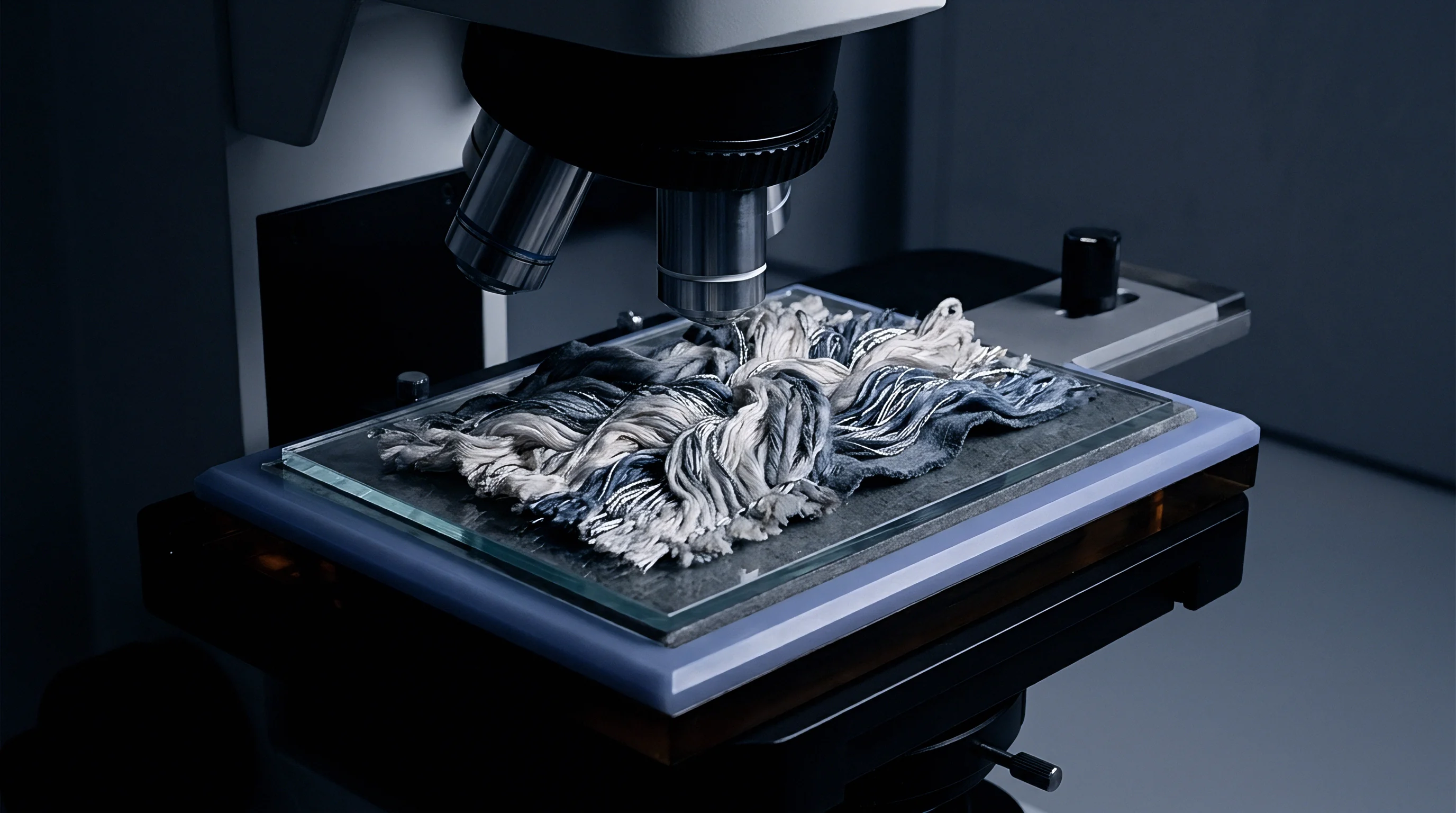
Infrared spectrographic verification uses Attenuated Total Reflectance Fourier-Transform Infrared spectroscopy. Sampling technicians clip suspect yarn segments containing optical thick places and press them onto a diamond crystal element. Polypropylene produces distinct infrared absorption bands at 2950, 2917, 1456, and 1376 wave numbers, corresponding to asymmetric and symmetric stretching and bending vibrations of methyl groups.
Cotton cellulose displays broad O-H absorption between 3300 and 3400 wave numbers alongside C-O-C pyranose ring peaks at 1030 wave numbers.
Laboratory techniques for quantitative isolation and identification of foreign polyolefin fragments:
- Hot-Stage Optical Microscopy Thermal stage heating permits direct visual observation of polyolefin softening and melting transitions between 158 and 165 degrees Celsius under cross-polarized light.
- Attenuated Total Reflectance FTIR Infrared spectroscopy measures characteristic methyl C-H bending doublets at 1376 and 1456 wave numbers to confirm polypropylene polymer chemistry.
- Selective Acid Dissolution Analysis Concentrated seventy-two percent sulfuric acid digests cellulosic cotton matrix while leaving synthetic polyolefin filaments undamaged for gravimetric filtration.

Solvent Extraction and Density Separation Protocols
Differential solubility allows full separation of organic plant material from polyolefin polymer fragments. Cotton dissolves completely in concentrated 72 percent cold sulfuric acid, cupriethylenediamine, or cold zinc chloride-formic acid solvent mixtures. Polypropylene remains chemically inert to ambient sulfuric acid digestions.
A 100-gram specimen of combed cotton yarn is chopped into five-millimeter lengths and immersed in cold concentrated sulfuric acid for two hours under magnetic stirring. The cellulosic matrix hydrolyzes completely into soluble glucose units. Filtration through a sintered glass crucible isolates insoluble polyolefin splinters for gravimetric determination.
Quantitative chemical digestion in seventy-two percent sulfuric acid completely dissolves cotton cellulose while recovering intact polypropylene splinters for gravimetric balance weighing.
Density separation exploits float differentials. Zinc chloride aqueous solutions adjusted to a specific gravity of 1.10 grams per cubic centimeter provide a rapid physical sorting medium. Polypropylene floats instantly due to its lower density of 0.90 grams per cubic centimeter.
Cotton fibers, possessing a true density of 1.52 to 1.54 grams per cubic centimeter, sink rapidly to the container bottom. Floating residue is skimmed, rinsed with distilled water, dried, and analyzed via micro-analytical balances sensitive down to 0.001 milligrams.
When laboratory staining yields translucent un-dyed specks in finished yarn, heating the sample on a hot stage offers faster polymer confirmation than chemical extraction.


Clause
Yarn specifications establish maximum permissible defect levels to protect downstream knitting and weaving operations. Raw material purchase contracts specify foreign fiber limits based on International Textile Manufacturers Federation contamination benchmarks. Unmitigated polyolefin splinters generate non-dyeable streaks in finished cloth, leading to commercial disputes between yarn spinners, fabric knitters, and dyehouses.
Clear contractual definitions assign financial liability based on quantitative detection limits.

Commercial Contamination Thresholds and Contract Guarantees
International trading guidelines define acceptable contamination counts across standardized yarn weights. Spinners supply yarn tested against International Textile Manufacturers Federation standards. Classifying foreign matter levels involves counting polyolefin defects per 100 kilograms of spun yarn.
Premium combed cotton yarn contracts for high-end apparel typically stipulate a maximum threshold of less than 1.5 polyolefin defects per 100 kilometers of yarn running through optical clearers.
| Contamination Grade | Polyolefin Fault Count (per 100 km) | Winder Cut Rate Impact | Standard Commercial Claim Allowance |
|---|---|---|---|
Contract terms specify standardized testing methods for claim resolution. When dyehouse returns expose un-dyed white specks in finished fabric, representative yarn retain samples undergo independent testing in accredited laboratories. Landed costs reflect yarn yield.
Excessive foreign matter content elevates effective yarn costs by forcing garment cutters to panel-inspect, mending specks with solvent pens or rejecting completed fabric rolls.

Worked Calculation of Claims and Fabric Yield Deficits
Evaluating financial risk involves converting cut frequencies per hundred kilometers into finished fabric repair costs. Consider a commercial procurement lot of 20,000 kilograms of Ne 40s combed cotton yarn intended for single jersey circular knitting. Single jersey fabric knitted at 120 grams per square meter yields approximately 166,600 meters of finished fabric.
Contamination penalizes mill margins.
Assume an un-cleared foreign polyolefin defect density of 2.8 faults per 100 kilometers of yarn. At Ne 40s linear density (14.77 meters per gram), 20,000 kilograms contains 295,400 kilometers of yarn. A fault density of 2.8 per 100 kilometers translates to 8,271 discrete polyolefin tape splinters distributed across the shipment.
In single jersey knits, each synthetic splinter creates a visible horizontal white streak spanning between 2 and 15 millimeters across the fabric face.
If manual fabric inspection and spot mending cost 0.45 USD per defective fabric meter, and each defect damages an average of 0.5 meters of fabric roll before operator intervention, total fabric repair costs reach 1,860.98 USD. Adding a 3.0 percent fabric scrap allowance for un-fixable specks yields an additional loss of 2,160.00 USD on a 120,000.00 USD yarn order. Total financial exposure amounts to 4,020.98 USD, representing a 3.35 percent landed cost penalty.
Contractual risk matrix for commercial yarn purchasing agreements:
- Maximum Fault Density Stipulation Contracts set explicit numerical limits for foreign synthetic fiber faults per hundred kilometers of yarn verified on calibrated winding clearers.
- Joint Sampling Laboratory Designation Agreements specify an independent accredited laboratory to run thermal and spectrographic tests on disputed yarn lots.
- Commercial Rejection Threshold Clause Purchase orders define the percentage of un-dyeable fabric specks that entitles the buyer to return entire yarn shipments for full credit.
Commercial claims for foreign polyolefin contamination rely on verified defect counts per hundred kilometers measured by calibrated optical yarn clearers.
Incorporating the standard ITMF synthetic contamination clause into yarn purchasing agreements shifts the financial liability for un-dyeable fabric faults back to the spinner whenever foreign particle counts exceed three per hundred kilometers.