Quantitative Analysis of Surface Cyclic Trimer Migration in Dyed Polyester
Surface cyclic trimer yields above 0.05% of polyester yarn weight generate yarn friction spikes, requiring solvent extraction and high-temperature reduction scour.


Dust
Fine white deposits on dark polyester yarn packages signal cyclic oligomer accumulation. Polymerization of polyethylene terephthalate generates an equilibrium mixture containing linear chains alongside low molecular weight cyclic species. Oligomers migrate during dry heat fixation.
Bulk polyester chips hold between one and two percent total oligomers by weight, distributed throughout the matrix. Cyclic trimer constitutes the dominant fraction. This cyclic tri-ester of terephthalic acid and ethylene glycol accounts for roughly eighty-five percent of total extractable oligomers.
The remaining portion consists of cyclic tetramers, pentamers, and linear short-chain fragments. Hexagonal and rhombic crystals form when migrating trimer reaches the filament boundary and meets cooler ambient air.
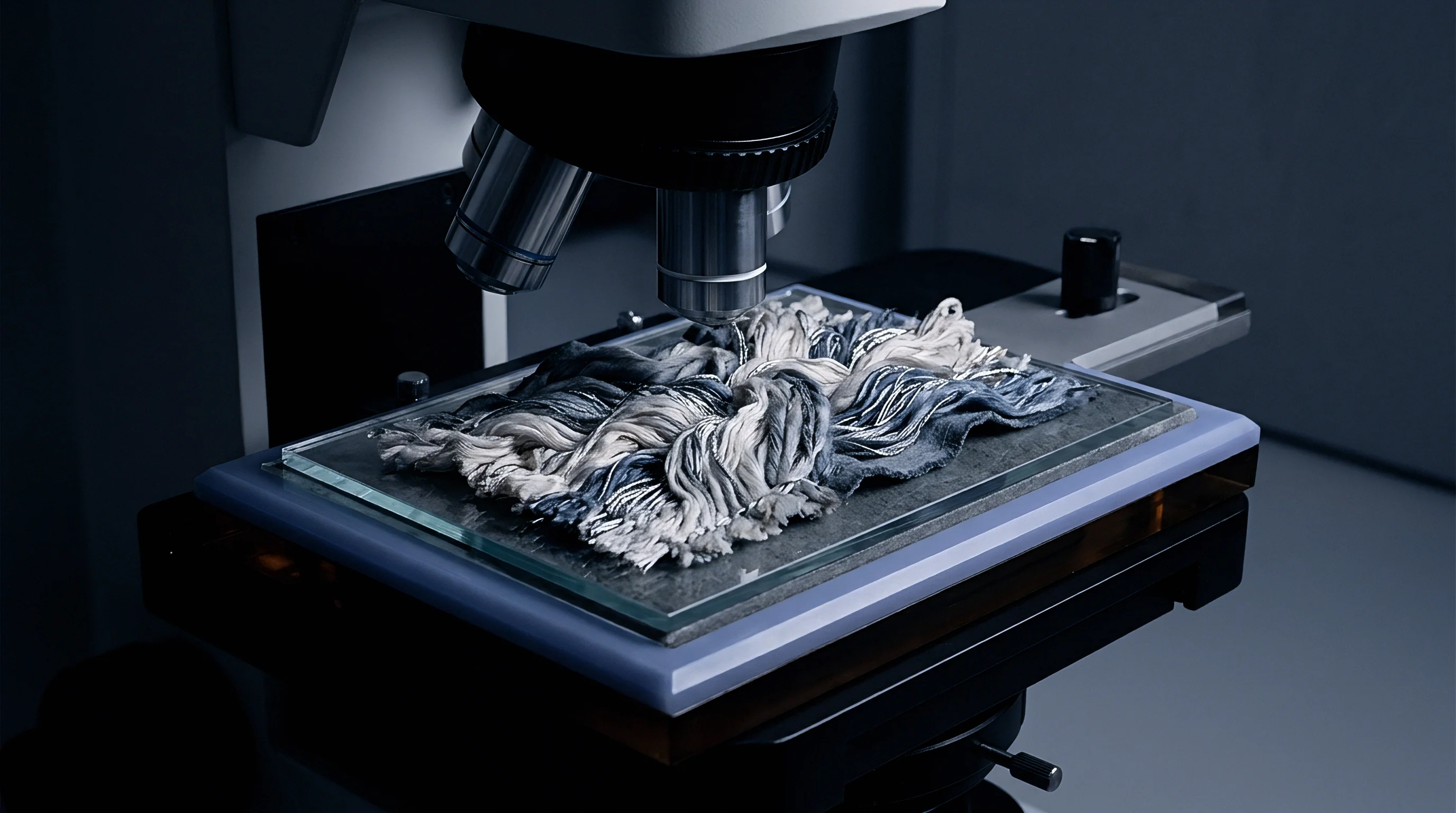
Surface crystals scatter incident illumination. Microscopic examinations reveal discrete rhombic platelets ranging from one to five micrometres in diameter adhering tenaciously to individual filament perimeters. These crystalline deposits alter light refraction across the textile structure, imparting an undesirable milky cast over saturated navy, burgundy, and jet black disperse shades.
Bulk dyers frequently misdiagnose this phenomenon as dye precipitation or poor bath dispersion stability. The chemical structure of cyclo-tris(ethylene terephthalate) features a compact ring structure without terminal hydroxyl or carboxyl functional groups, rendering the compound hydrophobic and water-insoluble. Crystalline melting occurs between 315 and 320 degrees Celsius, well above the 255 to 260 degree melting point of the parent polyester filament.
Dark disperse dyeings exhibit chalky surface dulling whenever cyclic trimer crystals nucleate across filament boundaries.
Boundary friction climbs abruptly when yarn passes over stationary contact points. The mineral-like hardness of cyclic trimer crystals transforms smooth filament surfaces into micro-abrasive rasps. Texturing units, warping creels, and high-speed circular knitting machines experience severe mechanical interference as dislodged crystals pack into guide slots, tension discs, and needle gates.
Downstream processors face yarn breaks and uneven tension profiles across continuous feed operations.
- Chalky surface bloom dulls dark disperse dyeings by scattering reflected light across dyed filament surfaces.
- Ceramic guide grooving occurs when hard oligomer crystals abrade yarn contact points on circular knitting machines, raising replacement costs.
- Package filtration rings develop inside yarn packages where dense crystal clusters lodge between inner filament layers during inside-out dye liquor circulation.
- Needle hook shearing happens under severe trimer accumulation, creating dropped stitches and persistent running lines along knitted webs.
Laboratory assessment distinguishes between bulk internal oligomer content and external surface deposits. While total internal oligomer levels dictate fundamental polymer synthesis equilibrium, surface concentration governs spinning, texturing, and knitting performance. Unchecked deposits on texturing mandrels compound into uneven crimp recovery, producing irreversible barrel distortion across finished apparel panels.

Wash
Accurate quantification requires isolating surface deposits without leaching the polymer core. Immersion techniques exploiting solvent solubility differentials separate external crystals from internal matrix trimer. Cold dioxane dissolves only surface deposits.
Analytical methods specifying room-temperature solvent exposure prevent swelling of amorphous polyester regions, avoiding artificial inflation of surface trimer values. Dichloromethane and 1,4-dioxane serve as primary extraction media under strictly controlled thermal conditions.
Solvent contact duration establishes analytical specificity. Exposing polyester filaments to boiling 1,4-dioxane for extended periods dissolves the entire substrate, releasing the complete bulk oligomer inventory. Surface-specific assays restrict solvent contact to rapid rinses under ambient conditions.
Dichloromethane dissolves external cyclic trimer within seconds while exhibiting negligible swelling of semi-crystalline polyethylene terephthalate below thirty degrees Celsius. The extract dries under nitrogen. Evaporation leaves a crystalline film ready for chromatographic reconstitution and quantitative spectrophotometric evaluation.
Dichloromethane extractions exceeding two minutes at twenty degrees Celsius inflate measured trimer values by thirty percent through core polymer dissolution.
Chromatographic separation resolves each cyclic oligomer. High-performance liquid chromatography coupled with ultraviolet absorbance detection at 242 nanometres quantifies cyclic trimer concentrations down to single-digit parts per million. Reverse-phase C18 columns running water and acetonitrile gradients elute linear oligomers first, followed sequentially by cyclic trimer, tetramer, and pentamer.
Calibration curves show strict linear response. Analytical runs match peak areas against certified cyclic trimer standards isolated via preparative chromatography.
- Specimen mass conditioning stabilizes the yarn sample at standard atmosphere for twenty-four hours to fix baseline dry weights within tight analytical tolerances.
- Non-swelling solvent immersion strips external oligomer crystals through mild mechanical agitation in analytical grade dichloromethane at twenty degrees Celsius for exactly ninety seconds.
- Membrane microfiltration removes loose insoluble lint via a fluoropolymer syringe disc before any liquor enters the evaporation apparatus.
- Residue nitrogen reconstitution dries the washed liquor under inert gas flow before dissolving the dried crystals into spectrophotometric grade acetonitrile.
Alternative gravimetric approaches fail at low contamination thresholds. Weighing dried solvent residues introduces severe bias from spin finishes, coning oils, and residual knitting lubricants present on filament exteriors. Chromatographic assays bypass lubricant interference by resolving finish components away from the cyclic trimer retention window.
Ultraviolet absorbance at 242 nanometres isolates the terephthaloyl chromophore, ensuring non-aromatic paraffin oils and polyglycol surfactants remain undetected during peak integration.
| Extraction Medium | Bath Temperature | Exposure Time | PET Core Swelling | Trimer Recovery | Surface Selectivity |
|---|---|---|---|---|---|
| Dichloromethane | 20 °C | 90 seconds | Negligible | 98.4% | High |
| 1,4-Dioxane (Cold) | 22 °C | 120 seconds | Low | 95.1% | High |
| 1,4-Dioxane (Boiling) | 101 °C | 120 minutes | Severe | 100.0% | Zero (Bulk Extraction) |
| Tetrahydrofuran | 25 °C | 180 seconds | Moderate | 91.2% | Moderate |
| Acetone (Cold) | 20 °C | 300 seconds | Zero | 62.7% | Poor (Low Solubility) |
| Data gathered using drawn textured yarn samples tested under ASTM D3418 conditioning baselines. | |||||
Standardizing test volumes ensures reproducible liquor-to-goods ratios across comparative trials. Laboratories utilizing fifty millilitres of dichloromethane per five grams of yarn achieve rapid, unhindered crystal dissolution without approaching solvent saturation limits. Commercial arbitration clauses invoking ISO 1833 solvent extraction parameters penalize sellers when surface cyclic trimer exceeds zero point zero five percent by dried filament weight.
Heat
Thermal processing mobilizes oligomers held within the core. At ambient conditions, rigid crystalline domains and tightly constrained amorphous regions immobilize low molecular weight species. Stenter heat accelerates outward oligomer diffusion.
When process temperatures rise above the polyester glass transition point of seventy-five degrees Celsius, amorphous segments undergo cooperative relaxation. Free volume expands, creating physical pathways through which low molecular weight cyclic rings migrate toward regions of lower chemical potential.
Amorphous segments relax at elevated temperatures. High-temperature aqueous dyeing between 130 and 135 degrees Celsius plastically plasticizes polyester filaments, speeding oligomer migration into the pressurized aqueous bath. Cyclic trimer dissolves marginally in pressurized water at 130 degrees Celsius up to approximately eighteen milligrams per litre.
Dry stenter heat-setting operations conducted between 180 and 215 degrees Celsius induce even more violent migration gradients. Volatilization of surface moisture and boundary air movement drive rapid diffusion from the core to the perimeter.
Where Does Trimer Segregate during Rapid Cooling?
Thermal drawdown regimes dictate precipitation patterns. Upon leaving the high-temperature stenter chamber or exiting pressurized dyeing autoclaves, filament temperatures drop rapidly below 100 degrees Celsius. Cooling triggers rapid crystal nucleation.
Because cyclic trimer possesses minimal solubility in cold water and cooled polymer matrices, dissolved molecules rapidly supersaturate. Trimer dissolved in dye liquor precipitates as suspended micro-crystals, while trimer arriving at filament surfaces crystallizes into hard platelets adhered directly to the outer polymer skin.
| Stenter Set Point | Dwell Duration | Drawing Tension | Bulk Trimer Loss | Surface Trimer Mass |
|---|---|---|---|---|
| 160 °C | 30 seconds | 0.08 cN/dtex | 0.02% w/w | 180 mg/kg |
| 175 °C | 45 seconds | 0.10 cN/dtex | 0.05% w/w | 310 mg/kg |
| 190 °C | 45 seconds | 0.12 cN/dtex | 0.11% w/w | 620 mg/kg |
| 205 °C | 45 seconds | 0.12 cN/dtex | 0.19% w/w | 980 mg/kg |
| 215 °C | 60 seconds | 0.15 cN/dtex | 0.28% w/w | 1420 mg/kg |
Thermosol continuous dyeing lines exacerbate surface accumulation. Fabric running through infrared pre-dryers and contact hot-flues experiences prolonged thermal residence times, creating steady-state diffusion pumps. Tension applied to the running web aligns amorphous polymer chains, lowering diffusion barriers along filament longitudinal axes.
Technologists still debate whether rapid liquid quench rates suppress trimer migration more effectively than high velocity chilled air impingement.

Yarn
Processing issues concentrate heavily around packaging formats. Yarn packages wound onto perforated dye tubes present severe filtration geometry. Package tension spikes across the spool.
During inside-out liquor circulation cycles, the wound yarn bed functions as an efficient depth filter. Suspended trimer crystals nucleating in the cooling liquor cannot pass through dense package layers, accumulating heavily along inner yarn layers situated adjacent to the dye spindle.
Ceramic guides sustain rapid abrasive wear. When dried packages feed into circular knitting machines at four hundred metres per minute, surface trimer deposits dislodge under friction. Needle friction climbs beyond acceptable thresholds.
Loose powder falls into needle tracks, mixing with lubricating oils to form an abrasive slurry that accelerates latch wear and increases running tension. Dynamic yarn tension monitors register erratic spikes as yarn snags across clogged porcelain eyelets.
DIN 54300 delivery specifications reject textured polyester package lots whenever surface oligomer concentrations surpass five hundred milligrams per kilogram.
Knitting defects track surface trimer concentrations directly. Low levels remain undetectable during visual inspection, but mechanical knitting performance deteriorates predictably as surface trimer concentrations exceed three hundred milligrams per kilogram. Machine downtime climbs exponentially when needles fail from crystal packing within the hook throat.
| Surface Trimer Level | Friction Coefficient (f) | Guide Tension at 400 m/min | Needle Failure Rate | Knitting Fault Index |
|---|---|---|---|---|
| 120 mg/kg | 0.185 | 14 cN | 0.02 / 100 hours | 0.1 faults / 1000 m |
| 280 mg/kg | 0.210 | 19 cN | 0.08 / 100 hours | 0.4 faults / 1000 m |
| 520 mg/kg | 0.275 | 32 cN | 0.65 / 100 hours | 2.8 faults / 1000 m |
| 850 mg/kg | 0.340 | 48 cN | 2.10 / 100 hours | 8.6 faults / 1000 m |
| 1350 mg/kg | 0.425 | 68 cN | 5.80 / 100 hours | 22.4 faults / 1000 m |
- Dynamic boundary friction governs yarn tension through ceramic eyelets, where surface oligomers induce rapid micro-stick events and thread breaks.
- Solvent extractable threshold establishes the permissible mass percentage of cyclic trimer on finished cones before knitting yarn lots receive shipping clearance.
- Package density gradient measures firmness variance between core and perimeter layers to detect internal filtration traps formed during high-pressure liquor cycles.
Textile mills monitor package density profiles to mitigate localized trimer buildup. Adjusting winding angle and back-pressure softens package shoulders, allowing more uniform liquor flow velocity throughout the cross-section. Spinners routinely argue that powdery package exteriors merely reflect normal antistatic oil evaporation during warehouse storage rather than excessive oligomer exudation.
Scour
Chemical remediation removes surface deposits prior to final winding. Standard aqueous rinses fail because cyclic trimer exhibits zero solubility in plain neutral water. Alkaline scours hydrolyse external cyclic rings.
Combining strong sodium hydroxide with powerful reducing agents at elevated temperatures cleaves the cyclic ester linkage, converting water-insoluble trimer into water-soluble disodium terephthalate and ethylene glycol.
Sodium dithionite reduces residual dye stains. Formulations blending three grams per litre of caustic soda flakes with two grams per litre of sodium hydrosulphite clear surface deposits when run at eighty degrees Celsius for twenty minutes. Specialized trimer clearing auxiliaries containing ethoxylated fatty amines or quaternary ammonium salts emulsify detached crystals, holding them in stable suspension until the bath drains.
Clean rinse liquor removes dislodged residues. Overflow washing prevents redeposition of suspended crystals back onto outer yarn wraps.
Caustic soda saponifies surface cyclic rings into soluble monomers while leaving the bulk crystalline core intact.
Is High Temperature Caustic Clearing Sufficient for Packaging?
Atmospheric clearing treatments often prove inadequate for dense yarn packages. While surface trimer on loose woven piece goods hydrolyses readily under atmospheric jig or winch conditions, the core of a dense package stays insulated from mechanical liquor agitation. Raising reduction clearing temperatures to 120 degrees Celsius under pressure accelerates saponification kinetics, destroying trimer crystals lodged within tight inter-filament gaps.
Machine cleanliness prevents ongoing cross-contamination. Stenters, jet dyeing autoclaves, and continuous dryers accumulate condensed trimer on internal heat exchangers and exhaust ducts. Condensed crystals periodically flake off and re-enter circulation, spotting clean goods.
Dyehouses execute mandatory machine boil-outs using ten grams per litre caustic soda and five grams per litre auxiliary dispersant at 130 degrees Celsius every two weeks. Thorough reduction clears eliminate needle buildup when caustic concentration matches bath temperature throughout the cooling cycle.