Raw Cotton Foreign Matter Optical Sensor Line Operations
Optical blowroom sorters combine multi-wavelength sensors and millisecond pneumatic valves to eject foreign synthetics before carding shreds them into yarn.


Duct
In modern blowroom cleaning lines, raw cotton tufts travel through sheet metal ducts at speeds between twelve and eighteen metres per second. Pneumatic transport maintains a continuous flow of fibre from coarse openers to fine cleaners, sweeping loose tuft clumps past the scanning plane of optical sensor modules. If transport speed drops below twelve metres per second, heavy cotton tufts drag along the floor plate, creating uneven mass clumps that blind optical detectors.
Above twenty metres per second, transit windows compress beyond the response cycle of pneumatic ejection valves, letting targeted contaminants pass down the blow line unhindered.
Pneumatic Velocity and Tuft Aerodynamics
Separation machinery relies on an even layer of opened lint moving continuously through the inspection zone. Blowroom fans generate static pressure to draw stock across coarse cleaners, where round condenser drums strip conveying air before introducing stock into rectangular scanning channels. Feed rollers meter tuft bundles into an accelerating air stream, separating dense locks into open, individual tufts weighing between two and ten milligrams.
Maintaining moisture regain between 6.5 percent and 8.0 percent preserves tuft suppleness, preventing electrostatic charges from causing thin cotton veils to cling to metal duct walls or transparent viewing panels.
Heavier trash settles along the bottom channel wall when air velocity falls below the suspension limit of raw cotton tufts.
Divergent air currents create localized eddies that twist thin plastic packaging strips behind dense cotton tufts. Aerodynamic drag coefficients differ substantially between round, dense leaf fragments and flat, low-density polyethylene sheet fragments. While compact botanical particles travel straight down the center line of the air channel, plastic packaging films flutter laterally toward channel walls, altering their arrival time at the downstream ejection manifold.
Because stock movement varies, precise separation demands constant static pressure monitoring across the scanning hood, holding velocity tolerances within plus or minus 0.5 metres per second across the entire duct cross-section.
Air Channel Geometry and Sensor Enclosures
Inspection enclosures maintain a uniform rectangular passage thickness of roughly one hundred millimetres to keep cotton bundles within focal depth. Wide channels spanning twelve hundred to sixteen hundred millimetres spread the tuft mass thinly across optical camera fields, establishing mass throughput rates between six hundred and one thousand kilograms per hour. Glass scanning windows must stay pristine under abrasive lint friction.
Optical inspection modules employ positive-pressure air curtains that sweep clean, micro-filtered air over internal glass surfaces, preventing sticky honeydew deposits and fine cotton dust from obscuring high-resolution camera lenses.
| Parameter | Coarse Cleaning Zone | Optical Inspection Zone | Separation Chamber Exit |
|---|---|---|---|
| Air Velocity (m/s) | 10.5 to 12.0 | 14.0 to 16.5 | 12.5 to 14.0 |
| Tuft Mass Range (mg) | 50.0 to 150.0 | 2.0 to 10.0 | 1.5 to 8.0 |
| Static Pressure (Pa) | -250 to -350 | -120 to -180 | -200 to -280 |
| Duct Width (mm) | 800 to 1000 | 1200 to 1600 | 1000 to 1200 |
The cleaner the opening of the tuft before the glass window, the cleaner the separation of the trash.

Spectra
Optical sensing units deploy multiple illumination wavelengths across the inspection zone to expose contrasting foreign matter. High-speed line-scan camera arrays mounted on opposing sides of the glass channel scan the passing raw cotton stream from two faces, eliminating blind shadows behind dense locks. To isolate foreign matter, reflected light architectures identify dark botanical matter like dried bracts, grass, and jute cordage, while transmission backlights silhouette opaque objects embedded inside thick tuft layers.

Multi-Wavelength Sensing Arrays in Opening Lines
Silicon line-scan cameras capture visible colour variations across RGB colour space at line scan frequencies exceeding twenty kilohertz. White, grey, and yellowed seed-coat fragments stand out against the white baseline of virgin cotton lint under broad-spectrum halogen or high-CRI white light-emitting diode arrays. In the red and blue channels, colored polypropylene packaging twine, oily wool locks, feathers, and dyed rags display stark chromatic separation, allowing image signal processors to classify foreign objects down to two millimetres in length.
Operating at twenty thousand lines per second, pixel resolution reaches 0.5 millimetres per pixel at standard transport speeds of fifteen metres per second.
- Dust accumulation on optical windows attenuates transmitted luminous flux, producing artificial grey level shifts that mimic dirty cotton tufts.
- Translucent white polypropylene tape matches raw cotton reflectance across visible wavelengths, evading RGB line-scan cameras completely.
- Oiled machine tufts absorb shortwave radiation similarly to organic leaf particles, triggering false ejection cycles across high-speed nozzles.
- Immature fiber bundles exhibit diffuse scattering resembling synthetic foil fragments, causing clean spinnable lint rejections under poorly calibrated illumination thresholds.

Polymer Distinction under Polarized and Infrared Illumination
Transparent packaging films present identical coloration to bleached or combed cotton under visible daylight sources. Optical sorters overcome this hurdle through polarized illumination and specialized ultraviolet excitation. Ultraviolet tubes emitting at three hundred sixty-five nanometres induce fluorescence in optical brightening agents present on recycled plastic packaging, agricultural mulch films, and synthetic stitch yarns.
The synthetic additives absorb ultraviolet radiation and re-emit visible blue light, producing bright signals on monochromatic sensors calibrated to ignore non-fluorescent cellulosic cotton.
Polypropylene detection efficiency falls below sixty percent under visible light sensors when contaminant thickness drops below twenty-five micrometres.
Transparent and white polypropylene packaging strips present the most hazardous contamination in spinning mills. Linear polarized light arrays solve this detection barrier by exploiting the optical birefringence of stretched synthetic polymers. While natural cotton cellulose scatters polarized light randomly without uniform phase shifts, oriented polypropylene molecules alter the polarization angle of transmitted light.
Polarizing filters positioned before line-scan lenses reveal transparent polypropylene tapes as glowing iridescent strips against a darkened cotton background. Under short-wave infrared, sensors operating between fourteen hundred and sixteen hundred nanometres leverage unique polymer molecular absorption bands, registering distinct dips in reflected light where polypropylene hydrocarbon chains absorb energy, whereas natural cellulosic fibres reflect short-wave infrared energy at high rates.
| Sensor Modality | Wavelength Range (nm) | Target Contaminants | Typical Resolution (mm) |
|---|---|---|---|
| RGB Line-Scan CMOS | 400 to 700 | Jute strings, colored plastics, cloth fragments, leaf | 0.5 x 0.5 |
| Ultraviolet Induced Fluorescence | 365 (UV-A) to 450 | Bleached twines, brightened synthetic wrappings, paper | 1.0 x 1.0 |
| Cross-Polarized Transmission | 520 to 580 | Clear polyethylene foils, unpigmented polypropylene strips | 0.8 x 0.8 |
| Short-Wave Infrared (SWIR) | 1400 to 1650 | White polypropylene, synthetic strapping, rubber bands | 1.5 x 1.5 |
Sensor integration combines signals from RGB, polarized, and infrared sensors onto a single spatial coordination grid. The line processor compares pixel coordinates across all arrays within fifty microseconds, mapping contaminant boundaries before outputting trigger instructions to downstream actuators.


Blast
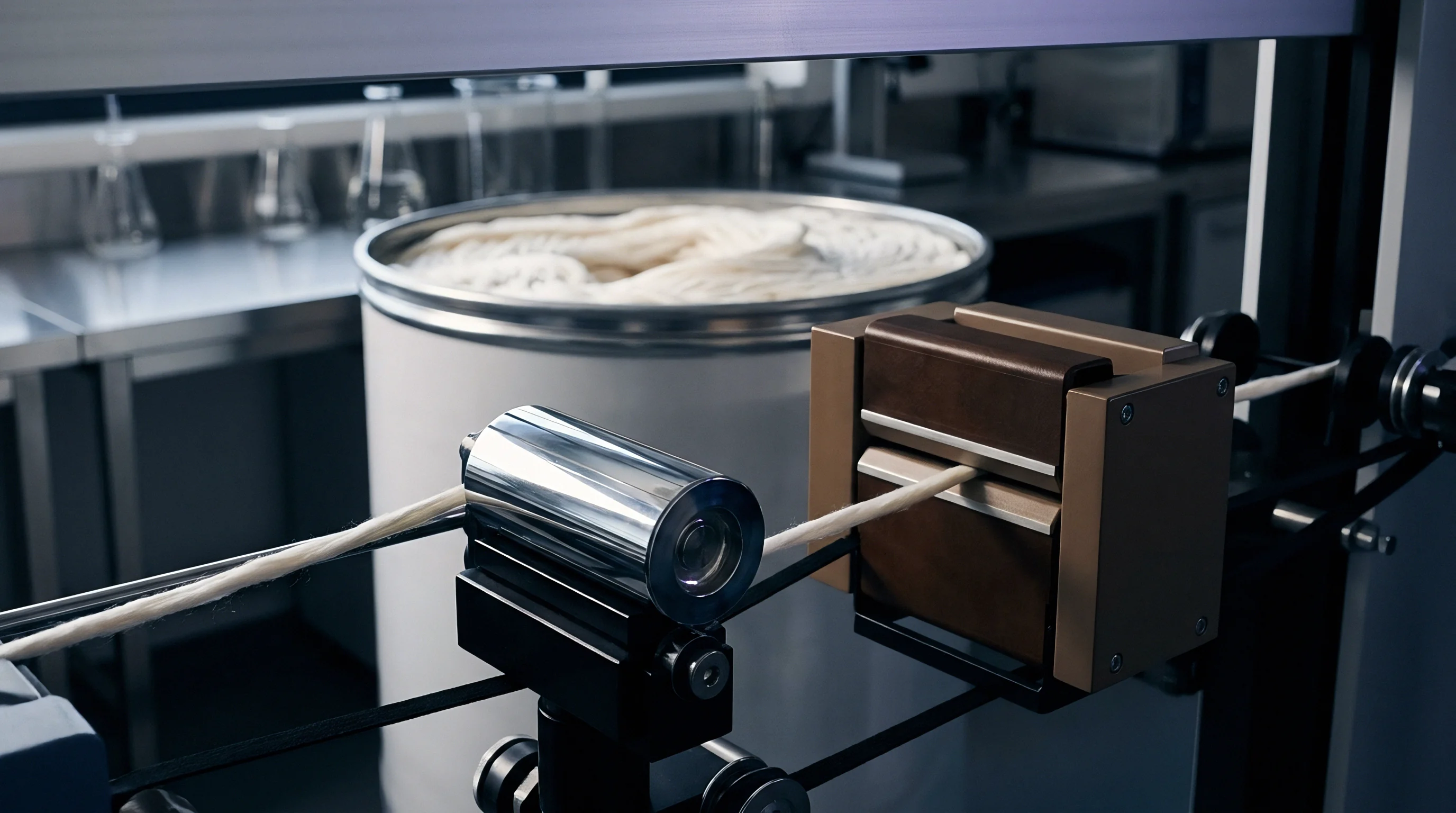
Pneumatic ejection systems deploy high-speed solenoid valves mounted on a transverse manifold across the transport line. Valve modules sit thirty to fifty centimetres downstream from the optical scanning line, maintaining absolute spatial alignment with camera pixel grids. When sensors register a contaminant, control electronics compute the arrival time of the defect at the nozzle plane and trigger a millisecond blast of compressed air, blowing the impurity into a waste collection hood.
Valve Actuation Timing and Pneumatic Dynamics
Optical processors calculate the transit delay between sensor detection lines and the nozzle discharge plane. At a line speed of fifteen metres per second, a distance of three hundred millimetres translates to an exact transit duration of twenty milliseconds. Accounting for mechanical delay in the valve plunger and air expansion through the nozzle tube, the system opens the targeted pneumatic valve after nineteen milliseconds.
Valves operate with opening response times between 1.2 and 2.0 milliseconds, discharging pressurized air pulses for durations of eight to fourteen milliseconds.
- Pressure regulation verification locks the compressed air receiver at seven bar before line initialization to prevent delayed valve seating.
- Optical calibration zeroing maps clean duct baseline values across each pixel channel under dark and illuminated states.
- Encoder synchronization checks measure fan motor rotational variations to update transport delay millisecond offsets continuously.
- Waste collection box differential logging records extraction mass every four hours to alert technicians to stuck pneumatic valves.

Compressed Air Supply and Waste Control
Blowroom operators connect dedicated dry air compressors capable of sustaining continuous seven-bar line pressure. Pressure drops below 6.5 bar diminish ejection force, allowing heavy contaminants like rubber bands, metal wires, and wooden twigs to escape the extraction duct. When processing heavily contaminated cotton, high valve actuation frequencies consume up to five cubic metres of compressed air per minute across a ninety-six-valve array.
Pneumatic ejection valves operating with wet supply air deposit oil mist directly onto downstream optical receiver lenses.
Each compressed air pulse extracts not only the target impurity but also surrounding spinnable white cotton lint. High ejection sensitivity settings remove thirty to fifty grams of good cotton for every single gram of foreign matter ejected. Mill technicians balance extraction sensitivity against blowroom raw material yield loss, targeting waste ratios below 0.5 percent of total line throughput.
Incorrect millisecond timing leads to missed foreign objects and dumps kilograms of spinnable white cotton into the opening room waste cyclone.


Sorting
Machine control processors execute classification algorithms to evaluate detected impurities by size, coloration, and material origin. Software filters calculate particle perimeter, surface area, and colour saturation values in real time. Control systems classify targets into harmless botanical leaf particles, acceptable dark seed specks, or catastrophic synthetic packaging polymers, deciding whether to fire an ejection nozzle based on programmed threshold settings.

Which Defects Escape Optical Pneumatic Extraction?
Thin transparent plastic wrappers wrapped tightly inside dense cotton clumps evade transmission and reflection optical pathways. If opening room beaters fail to open raw cotton locks down to individual tuft structures, internal contaminants remain hidden from surface-scanning cameras. Heavy twine fragments wrapped around cotton clumps travel at different velocities than surrounding free-floating lint, arriving out of sync with valve discharge timings.
Extremely fine, single white polypropylene filaments measuring under thirty micrometres in diameter reflect insufficient luminous energy to exceed optical sensor activation noise thresholds, slipping past inspection hoods into downstream carding machines.
| Defect Classification | Minimum Area Threshold (mm²) | Trigger Modality | Lint Loss Ratio (Good:Trash) | Downstream Spinning Risk |
|---|---|---|---|---|
| Colored Polypropylene Twine | 2.0 to 4.0 | RGB Color Contrast | 25:1 | Extreme (Knitted Fabric Seconds) |
| Clear Polyethylene Sheeting | 4.0 to 6.0 | Polarized Transmission | 35:1 | Severe (Winder Clearer Cuts) |
| White Polypropylene Tape | 3.0 to 5.0 | SWIR Absorption | 45:1 | Extreme (Dye Resist Spots) |
| Large Organic Leaf / Bark | 8.0 to 12.0 | RGB Grayscale Contrast | 15:1 | Moderate (Removable by Card) |
| Oily Cotton Clump | 5.0 to 8.0 | UV Fluorescence / RGB | 30:1 | High (Yarn Breakage / Streaks) |
| Values reflect standard industrial blowroom installations operating at 800 kg/hr throughput with 7.0 bar compressed air supply. | ||||
Organic Trash Discrimination and Carding Interaction
Botanical matter like broken leaves, bark slivers, and seed hulls presents dark visual profiles during optical inspection. While optical sorters can trigger on every dark speck down to one square millimetre, doing so exhausts compressed air receivers and ejects excessive amounts of clean fibre. Carding machines downstream mechanically crush and extract up to ninety-five percent of brittle botanical trash through carding wire flats and revolving licker-in screens.
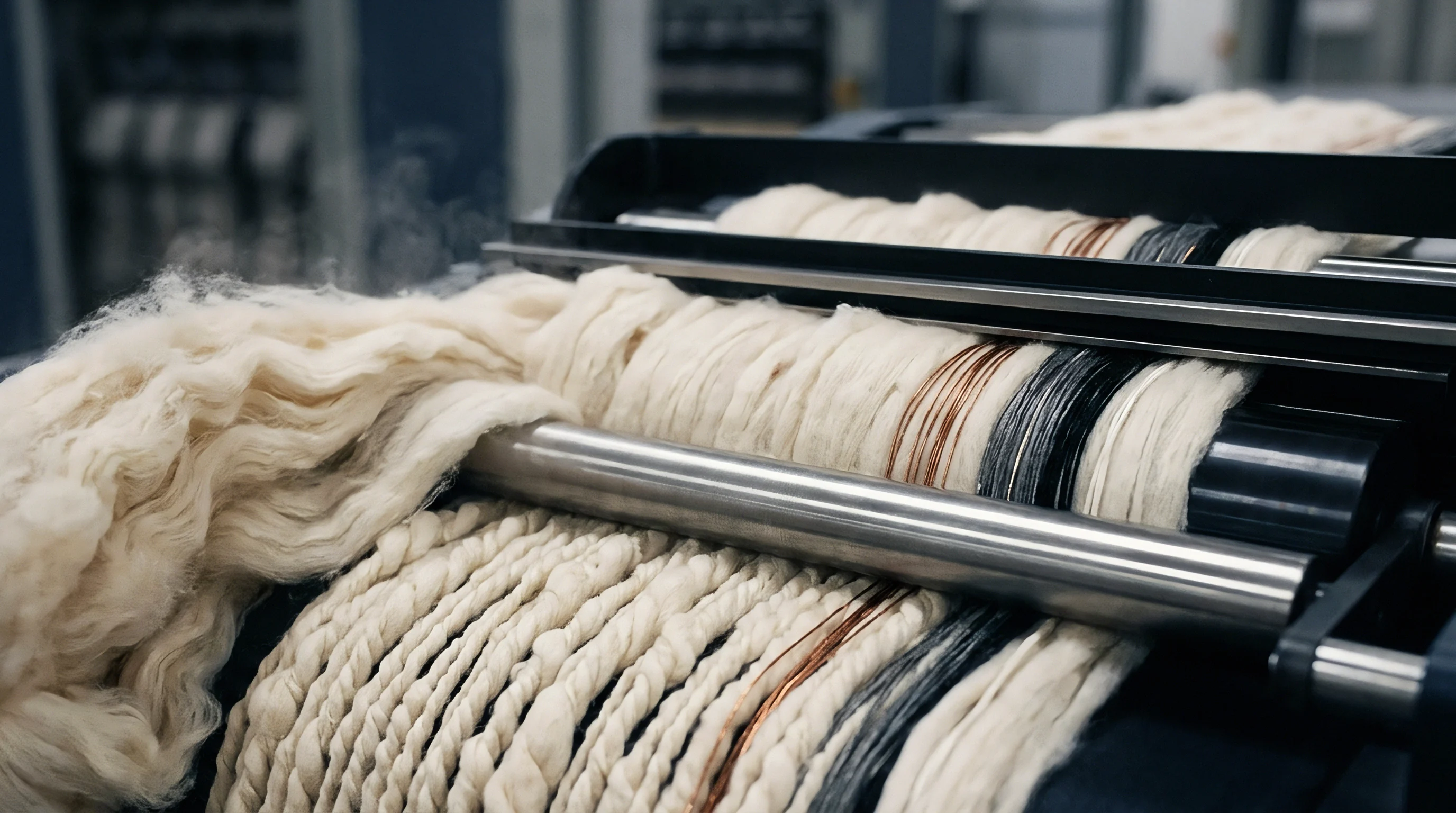
To prevent pressure loss and fiber waste, high-speed blowroom sorters bypass small organic trash, focusing ejection energy exclusively on flexible, synthetic polymers that carding machines cannot pulverize. When flexible plastic twines pass into revolving cards, aggressive metallic clothing wire shreds single plastic strips into thousands of microscopic synthetic fibrils, dispersing contamination across kilometers of drawn sliver.
- Minimum defect area setting determines whether particles under four square millimetres trigger nozzle activation during high throughput runs.
- Color contrast threshold balances the detection of dark jute cords against normal botanical cotton leaf flakes.
- Fluorescence excitation gain calibrates UV sensor response to separate bleached synthetic twines from naturally fluorescent yellow seed matter.
- Polypropylene NIR sensitivity band isolates non-absorptive synthetic polymers from moisture-retaining cellulosic base fibre.
Unextracted transparent polypropylene wraps tightly around seed hulls, allowing it to evade line-scan detection angles.


Claim
Yarn buyers evaluate foreign matter contamination by monitoring winding clearer cuts on automatic cone winders. In spinning plants, ring frames and open-end rotor boxes convert drawn cotton sliver into spun yarn at delivery speeds reaching eighteen hundred metres per minute. Any synthetic particle surviving blowroom sorting and carding creates weak points, leading to instant ends-down yarn breaks on ring spindles or forming visible blemishes inside finished yarns.
Winder Clearing Cuts and Yarn Downgrades
Undetected polypropylene slivers disintegrate into thousands of microfibres when carding wire teeth comb raw cotton clumps. As spun yarn passes through winding clearers, optical and capacitive sensor channels inspect yarn profiles for diameter variations, foreign matter, and synthetic plastics. Winder clearers programmed to cut polypropylene halt winding heads, splice out the contaminated length, and resume production.
When blowroom optical sorters operate below eighty percent cleaning efficiency on white polypropylene, winding cuts surge from thirty cuts per one hundred kilometres to over two hundred cuts per one hundred kilometres, crippling winding room productivity and increasing yarn splice frequency.
International Cotton Association Bylaw 232 restricts contamination arbitration awards unless the buyer isolates and preserves intact foreign matter samples along with spinning winding test logs.
High splice counts reduce single-yarn tensile strength by ten to fifteen percent across cut zones, triggering fabric breaks on high-speed knitting and weaving looms. In finished knitted goods, residual polypropylene pieces produce catastrophic defects during wet dyeing and finishing. Cotton cellulose bonds readily with reactive and direct dyestuffs in alkaline aqueous baths.
Polypropylene possesses zero dye sites for reactive dyestuffs, remaining completely white and undyed. In dark-dyed circular knits, a single two-millimetre white polypropylene speck devalues entire rolls from first-choice merchandise to discounted remnants, creating financial losses exceeding fifty dollars per contaminated fabric piece.

Commercial Settlement and Finished Goods Devaluation
Knitted and woven fabrics exhibit pale streaks or uncoloured specks whenever synthetic packing twine escapes blowroom sorting machines. Garment buyers reject finished consignments when inspection reveals more than one foreign fibre fault per one hundred square metres of apparel cloth. Spinning mills purchase raw cotton under rigid purchase specifications prohibiting plastic bale wraps, polypropylene ties, and woven synthetic bale covers.
When contamination strikes, spinning managers file claims against raw cotton merchants, demanding indemnification for lost spinning production, discarded yarn packages, and commercial customer claims.
Standard cotton trade contracts shift the entire expense of testing, clearing documentation, and devalued yarn lots to the spinning mill unless physical foreign polymer samples match the specific bale packaging used by the ginner.