Reconciling Moisture Regain Variations between Commercial Invoice Mass and Oven Dry Customs Analysis
Customs duties and commercial invoice settlements reconcile by multiplying oven dry sample mass by standard statutory regain allowances rather than raw landed weight.
Absorption
Hygroscopic materials pull vapor directly from surrounding air based on ambient relative humidity and temperature. In commercial trade, raw textile shipments rarely travel at their standard moisture equilibrium. Bales, yarns, and woven fabrics lose or gain atmospheric water depending on ambient transit conditions, storage duration, and packaging permeability.
When buyers receive bulk goods, physical scale readings reflecting actual landed mass diverge from commercial invoice mass. Commercial invoice mass relies on standardized, agreed regain allowances established by international bodies. Customs inspection laboratories ignore commercial contract allowances during initial physical testing.
Customs analysts strip total moisture down to absolute zero using ventilated thermal drying chambers. Reconciling commercial invoice values with customs laboratory findings demands converting physical landed weights back to standard dry mass baselines.

Standard Regain Figures across Commercial Fibre Categories
Official commercial trade rules define fixed moisture percentages that buyers and sellers add to oven dry weight when billing shipments. Standard commercial moisture regain allowances differ significantly from natural equilibrium regain levels observed under standard laboratory conditions of 20 degrees Celsius and 65 percent relative humidity. Synthetic polymers like polyester and acrylic resist vapor uptake, maintaining low regain allowances.
Natural fibers and regenerated cellulosics exhibit high moisture capacity due to abundant hydroxyl groups in their molecular chains. Raw cotton absorbs ambient vapor rapidly. Wool holds substantial regain capacity.
When commercial contracts specify mass, sellers compute invoiced weight by taking the bone-dry fiber mass and adding the official statutory regain allowance specified in standards such as ISO 6741 or ASTM D1909.
Discrepancies arise because actual moisture regain during transit fluctuates. A cotton shipment packed in high ambient humidity carries physical water weight exceeding its commercial allowance. The seller invoices the buyer based on commercial mass calculations.
The customs authority weighs the physical shipment upon arrival at the port of entry. If customs agents find elevated physical mass, they may suspect over-invoicing or misdeclaration of net weight. Conversely, goods dried out during desert transit or heated container transport show a physical weight deficit.
Bales absorb air humidity slowly.
Commercially traded wool yarn tested under standard atmospheric conditions of 20 degrees Celsius and 65 percent relative humidity retains an official regain allowance of 18.25 percent under ISO 6741 rules.
| Fiber Type | ISO 6741 Commercial Regain Allowance (%) | ASTM D1909 Commercial Regain Allowance (%) | Equilibrium Regain at 65% RH / 20°C (%) |
|---|---|---|---|
| Scoured Wool (Yarn) | 18.25 | 13.60 | 15.00 – 16.00 |
| Viscose Rayon | 13.00 | 11.00 | 12.50 – 13.50 |
| Cotton (Combed Yarn) | 8.50 | 7.00 | 7.50 – 8.50 |
| Linen (Flax) | 12.00 | 12.00 | 10.00 – 11.50 |
| Nylon 6,6 | 5.75 | 4.50 | 4.00 – 4.50 |
| Polyester (Staple) | 1.50 | 0.40 | 0.40 – 0.50 |

Atmospheric Equilibrium Shifts during Marine Transit
Baled textile fibers inside unventilated ocean containers absorb moisture or dry out until internal fiber water pressure equals ambient air vapor pressure. Ocean shipping containers trap ambient heat. A container loaded in a humid tropical port experiences temperature swings during marine transit.
Internal container air heats up during daylight hours, driving liquid water out of outer bale layers into container air volume. Direct cold night temperatures cool container walls, condensing water vapor back onto upper cargo surfaces. This vapor cycle redistributes water throughout cargo mass, creating localized pockets of extreme moisture regain.
When goods arrive at import terminals, outer core samples yield radically different regain percentages compared to inner bale core samples. A customs sampling core taken exclusively from outer bale layers returns inaccurate moisture figures. Misrepresenting total shipment water content skews both commercial settlement calculations and customs duty determinations.
Reconciling these variations demands standardized sampling procedures that account for moisture migration patterns within baled raw materials.
- Core Moisture Gradients occur when outer bale surfaces lose or absorb atmospheric vapor faster than dense internal fiber cores during maritime transit.
- Container Sweat Condensation drips water directly onto cargo top layers, causing localized high-moisture anomalies in sample lots.
- Commercial Regain Mismatch happens when contractual billing rules apply static regain percentages to shipments carrying non-equilibrium water levels.
- Volatile Finish Evaporation distorts gross weight loss readings during thermal drying analysis by driving off spin finishes along with water.
Overseas mills frequently claim that weight discrepancies arise entirely from natural humidity variations during ocean transport rather than incorrect initial bale conditioning.


Steam
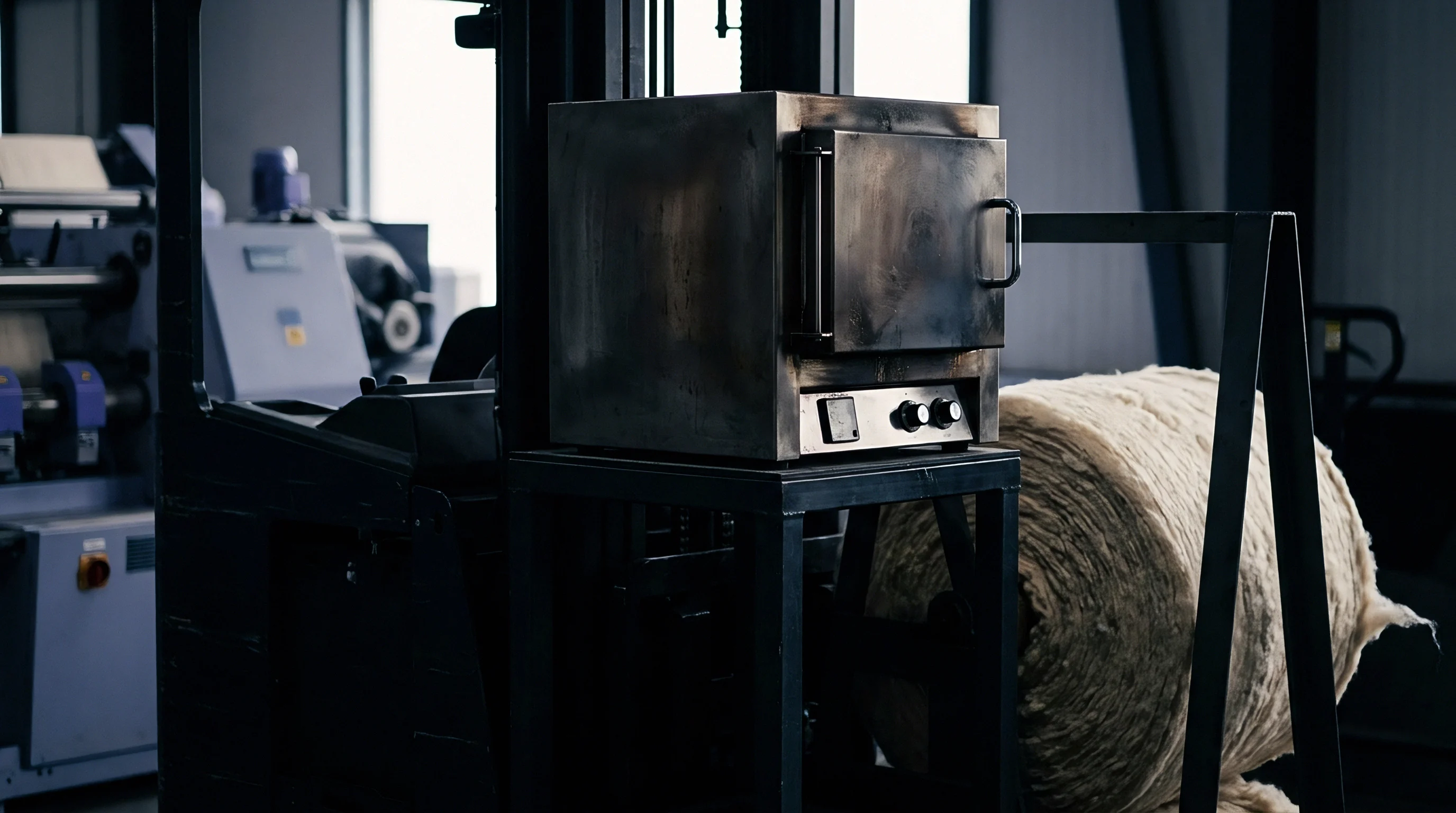
Desiccation of test specimens inside laboratory drying ovens requires precise temperature control to remove free water without scorching organic polymers. Oven dry testing forms the baseline for both customs classification analysis and commercial weight reconciliation. International standard procedures, including ISO 6741, ASTM D2118, and EN ISO 1833-1, specify heating fiber samples to constant mass inside ventilated drying ovens maintained at 105 degrees Celsius plus or minus 2 degrees.
Thermal drying removes capillary water and surface moisture. Laboratory ovens extract free water. Chemical scales record dry weight.
Thermal Drying Mechanics and Specimen Degradation
Exposing hygroscopic yarns to elevated temperatures above 105 degrees Celsius drives off uncombined liquid moisture. Prolonged thermal exposure risks driving off non-water volatile compounds or causing thermal degradation in heat-sensitive synthetic polymers. Wool fibers lose constitutional water and volatile oils if heated beyond prescribed duration limits.
Synthetics like polypropylene suffer structural changes or soft polymer vaporization under excessive heat. Thermal degradation alters specimen weight.
Quantitative testing protocols require pre-cleansing specimens when heavy lubricants, sizing agents, or spin finishes are present. If non-aqueous lubricants evaporate during oven drying, the scale registers their loss as water regain. Customs laboratories that skip solvent extraction prior to thermal drying produce inflated moisture regain calculations.
Inflated regain findings artificially suppress calculated dry fiber mass, leading customs officials to claim that commercial invoices understate actual dry fiber content.
Executing ISO 6741 conditioning protocols without accounting for non-aqueous volatile lubricants leads to overestimating total dry fiber loss.
Oven Dry Mass Determination under ISO Standard Conditions
Laboratory technicians weigh sealed weighing bottles after cooling dried fiber lots inside desiccators containing active silica gel. Desiccators prevent rapid moisture uptake. Unsealed dry fibers absorb ambient air moisture within seconds of exposure to atmospheric air.
Weighing must occur in air-tight containers or inside specialized oven balances where air circulation stops during mass determination.
Constant mass is achieved when consecutive weighings, taken at fifteen-minute drying intervals, show less than 0.05 percent variation. Reaching absolute dry weight provides the exact denominator needed to calculate actual moisture regain and commercial corrected mass. The mathematical formula for actual moisture regain expresses absorbed water mass as a percentage of bone-dry mass:
R_actual = ((W_initial – W_dry) / W_dry) 100
Where W_initial represents physical landed sample weight before drying, W_dry represents specimen weight after complete thermal desiccation, and R_actual represents percentage regain. Distinguishing actual regain from standard commercial regain resolves the core conflict between invoice declarations and import laboratory assessments.
Failure to isolate volatile spin finishes prior to oven drying inflates calculated moisture regain, triggering artificial import value adjustments and customs valuation audits.

Weight
Commercial transactions calculate invoice figures by multiplying measured dry fiber mass by official commercial regain allowances. Invoice pricing does not rely on landed net scale mass alone. When a spinner buys raw fiber, the contract stipulates payment based on commercial mass, also termed invoice mass or legal mass.
The seller calculates commercial mass by drying representative core samples, determining total shipment dry fiber mass, and adding statutory regain allowances. Invoices list commercial mass values. Dry scales demand precise calibration.

Mathematical Conversion between Dry Mass and Invoiced Tonnage
Calculating official billing mass involves taking pure desiccated material mass and scaling it upwards according to international trade allowances. The standard equation converting physical weight to invoice mass follows clear rules:
W_commercial = W_dry (1 + R_commercial / 100) (1 + C_allowance / 100)
In this equation, W_dry represents total dry mass, R_commercial represents standard commercial regain percentage, and C_allowance represents extra allowances for commercial finishes or sizing where permitted by trade rules. If a ten-tonne shipment of combed cotton yarn arrives with an actual moisture content of 10 percent, the physical scale reads 10,000 kilograms. Oven drying determines that actual dry mass equals 9,090.91 kilograms.
Applying the ISO commercial regain allowance for combed cotton (8.5 percent) yields an invoiced commercial mass of 9,863.64 kilograms. The buyer pays for 9,863.64 kilograms, despite physical scale indicators showing 10,000 kilograms at the dock.
Customs agents inspecting the shipment at entry ports frequently weigh gross package mass and subtract tare weight to establish physical landed net mass. If customs officials apply tariff rates directly to physical landed mass, they tax imported water. If customs agents run oven-dry tests without re-applying commercial regain allowances, they calculate an unadjusted dry mass that undercounts total legitimate invoice valuation.
Reconciling import declarations requires aligning customs entry documentation with standardized commercial dry mass conversions.
- Draw representative core samples across multiple container bales using ISO 6741 randomized sampling patterns.
- Weigh initial raw sample masses immediately upon extraction to capture landed physical moisture levels.
- Place test specimens into forced-draft drying ovens at 105 degrees Celsius until mass readings stabilize.
- Transfer specimens into desiccator chambers to cool without absorbing atmospheric moisture.
- Record final bone-dry masses on calibrated analytical balances to four decimal places.
- Calculate actual moisture regain percentages relative to absolute dry specimen weights.
- Apply statutory commercial regain factors to establish total invoice mass for duty clearance.

Blend Ratio Distortions Induced by Moisture Differentials
Binary fiber mixtures containing polymers with contrasting moisture uptake characteristics present shifting mass percentages under varying humidity environments. A 50/50 intimate blend of cotton and polyester exhibits different physical component weight ratios depending on relative humidity. Hydrophobic synthetics resist atmospheric water.
Polyester retains roughly 0.4 percent moisture regain at standard conditions, while cotton holds 8.5 percent commercial regain.
When customs laboratories analyze unconditioned intimate fiber blends, selective water absorption alters apparent weight ratios. A laboratory executing solvent separation or quantitative chemical dissolving on wet fiber calculates composition percentages based on wet component weights. Fiber component ratios shift beyond legal tolerance thresholds, exposing importers to misclassification penalties.
Standard regulations mandate converting all fiber components back to dry mass baselines before applying statutory regain allowances to establish official import composition percentages.
| Parameter | Cotton Component | Polyester Component | Total Shipment Lot |
|---|---|---|---|
| Target Dry Mass (kg) | 4,587.16 | 4,980.08 | 9,567.24 |
| Commercial Regain Allowance (%) | 8.50 | 0.40 | N/A |
| Invoiced Commercial Mass (kg) | 4,977.06 | 5,000.00 | 9,977.06 |
| High-Humidity Landed Mass (11% / 0.5% Regain) (kg) | 5,091.75 | 5,005.00 | 10,096.75 |
| Landed Physical Mass Ratio (%) | 50.43 | 49.57 | 100.00 |
| Oven Dry Corrected Commercial Ratio (%) | 49.88 | 50.12 | 100.00 |
Higher statutory moisture regain allowances favour natural fibers over synthetic polymers when assessing clean invoice dry mass.


Duty
Border control officials assess tariff line eligibility and statutory import valuation by applying standardized national laboratory testing rules. Customs administrations do not accept commercial invoice weights at face value when physical spot-check weighings reveal material variances. Custom agents audit physical mass.
Duty liabilities shift when moisture variations push multi-component fiber blends across Harmonized System classification thresholds.

Tariff Heading Threshold Spans and Weight Reclassification
Customs valuation schedules set explicit percentage thresholds for fiber content that determine applicable tariff rates. A fabric containing 84 percent cotton and 16 percent polyester by dry mass falls under a different tariff heading than a fabric containing 86 percent cotton and 14 percent polyester. Under Harmonized System rules, Chapter 52 classifies woven fabrics containing 85 percent or more by weight of cotton.
If moisture uptake during transit causes the cotton component to absorb excessive water, unconditioned lab testing may yield an apparent cotton content of 85.3 percent. This shift reclassifies the fabric from a mixed synthetic tariff line carrying low duty rates to a chief-weight cotton heading carrying elevated tariff rates.
Reconciling tariff classifications requires enforcing quantitative chemical analysis on an absolute dry mass basis. Standard testing protocols under EN ISO 1833 dictate removing moisture, finishes, and non-fibrous matter before executing chemical dissolution. Once pure dry masses of constituent fibers are isolated, technicians add statutory commercial regain allowances back to each isolated fiber mass.
The ratio of these commercial masses determines legal chief weight classification. Tariff thresholds drive import duty.
How Do Customs Laboratories Handle Unconditioned Fiber Samples?
State inspection agencies strip moisture completely using forced hot air ventilated drying chambers before calculating composition percentages. Problems occur when customs laboratories report results strictly on an oven-dry basis without reinstating statutory commercial regain allowances. Omitting regain additions penalizes fibers with higher natural moisture allowances.
Viscose wool blends suffer significant calculated component shifts when evaluated on pure dry mass versus commercial corrected mass.
Importers facing tariff reclassification must submit formal administrative appeals backed by certified laboratory test dossier records. These dossiers demonstrate that apparent threshold breaches result entirely from differential water uptake rather than physical fiber ratio misrepresentation during manufacturing. Standard regains set trade limits.
- Sampling Certificate documenting initial core extraction conditions, container seal numbers, and immediate gross sample weights.
- Oven Dry Test Reports detailing dry sample weights, desiccation temperatures, and calculated actual moisture percentages.
- Quantitative Separation Protocol establishing pure dry component masses following standard chemical dissolution routes.
- Commercial Regain Calculation Sheet demonstrating component percentage determinations after adding statutory regain factors.
- Commercial Invoice Cross-Reference matching declared billing weights against calculated dry mass plus legal regain allowances.
Incorporating ISO 6741 Clause 4 into international sales contracts establishes oven-dry mass testing as the exclusive binding referee method for commercial weight disputes.

Adjustment
Resolving financial claims between buyers and sellers demands converting physical weight test differences into clear price calculations. When customs authorities adjust declared import weights or when incoming lot weighings show deficits against invoiced quantities, commercial parties execute financial clawbacks. Settlement calculations convert raw mass differences into net dry mass adjustments, applying agreed unit pricing to verified commercial weights.
Contractual Reconciliation Frameworks for Import Valuation
Importers reduce financial vulnerability by specifying precise testing standards and moisture regain values in original purchase agreements. Standard purchase contracts incorporate moisture adjustment clauses that define acceptable variance bands. Typical contracts allow a neutral tolerance zone of plus or minus 0.5 percent between actual landed moisture regain and contract regain allowances.
If actual moisture regain falls within this band, billing stands unchanged.
When moisture variations exceed agreed tolerance bands, the contract mandates adjusting total invoiced weight. The buyer calculates adjusted billable weight by re-scaling landed physical mass according to certified dry mass laboratory findings. This mechanism prevents buyers from paying raw material prices for excess environmental water, while protecting sellers from unjust weight claims caused by dry atmospheric transit routes.

Worked Financial Settlement on a Mixed Blend Shipment
Evaluating a twenty-metric-ton container of polyester viscose yarn illustrates how dry mass lab results alter final landed costs. Assume an importer contracts 20,000 kilograms of 65/35 polyester/viscose yarn at 3.50 USD per kilogram invoiced mass. The contract specifies ISO standard regain values of 1.5 percent for polyester and 13.0 percent for viscose, yielding a combined weighted commercial regain factor of 5.525 percent.
Upon arrival, physical weighing records a landed net shipment weight of 20,400 kilograms. The customs authority draws samples and executes ISO 6741 oven-dry testing, revealing an actual moisture regain of 8.20 percent. Absolute dry mass of the shipment equals 18,853.97 kilograms (20,400 kilograms divided by 1.0820).
Re-applying the contractual weighted commercial regain allowance of 5.525 percent yields a true commercial mass of 19,895.65 kilograms.
The importer declared 20,000 kilograms based on original invoice documents. True commercial mass calculations show the shipment contains a deficit of 104.35 kilograms of billable fiber. At 3.50 USD per kilogram, the financial adjustment equals 365.23 USD in over-invoiced material cost.
Simultaneously, customs authorities adjust import duty valuation from the physical landed weight baseline down to the verified commercial mass baseline, preventing excess duty payments on 504.35 kilograms of ambient transit water.
| Financial & Weight Parameter | Commercial Invoice Baseline | Customs Landed Physical Finding | Reconciled Settlement Value |
|---|---|---|---|
| Gross Physical Mass (kg) | 20,000.00 | 20,400.00 | 20,400.00 |
| Tested Regain Rate (%) | 5.525 (Contract Default) | 8.20 (Actual Moisture) | 5.525 (Statutory Allowance) |
| Calculated Dry Mass (kg) | 18,952.85 | 18,853.97 | 18,853.97 |
| True Commercial Mass (kg) | 20,000.00 | 20,457.99 (Unadjusted) | 19,895.65 |
| Unit Price (USD/kg) | 3.50 | 3.50 | 3.50 |
| Total Material Valuation (USD) | 70,000.00 | 71,602.97 | 69,634.77 |
| Financial Adjustment Claim (USD) | 0.00 | +1,602.97 (Customs Duty Base Overcharge) | -365.23 (Supplier Refund Due) |
Documenting precise oven-dry mass determinations alongside standard statutory regain calculations eliminates ambiguity during import customs audits. Importers who align physical receipt sampling with international standard conversion rules protect operating margins from moisture fluctuations during international transit.