Stratified Variables Acceptance Sampling Protocols for Chemical Compliance in Textiles
Stratified variables acceptance sampling quantifies within-lot chemical variance under ISO 3951-1, preventing border detentions from trace contaminants.


Assortment
Every commercial textile consignment arriving at an import terminal conceals micro-level chemical gradients across its physical units. Sourcing managers frequently treat forty thousand meters of finished cotton poplin as a uniform chemical mass, relying on a single passing test certificate issued on pre-production yardage. That practice overlooks how industrial chemistry interacts with continuous processing.
Dyes, crosslinking resins, wetting agents, and water repellents undergo continuous thermal and mechanical variation during factory operations. When a customs authority or brand surveillance audit samples that delivery, a composite swatch pulled from one accessible container can fail a restricted substance threshold even when ninety percent of the production run conforms.
Acceptance sampling by variables measures the actual continuous concentration of a restricted compound across production units rather than cataloging lots into binary pass or fail categories. Under ISO 3951-1, testing technicians quantify the continuous distribution of a chemical, calculating the sample mean and standard deviation against an upper specification limit. This calculation yields a statistical quality index.
Comparing that index against an acceptance constant reveals whether the entire consignment meets the required confidence threshold. Attribute sampling under ISO 2859-1 demands enormous specimen counts when dealing with trace chemical contaminants at low acceptable quality limits. Variables plans achieve equal statistical confidence with far fewer destructive laboratory extractions.

Composite Slips and Chemical Camouflage
Standard commercial laboratory reports frequently merge twelve swatches into one homogenized extraction jar. Composite testing depresses the observed peak values of restricted substances through mechanical dilution. If ten specimens contain zero parts per million of free formaldehyde while two specimens contain two hundred parts per million, the homogenized test solution shows roughly thirty-three parts per million.
That averaged figure sails beneath an eighty parts per million limit. The consignment clears the test bench while harboring localized pockets that violate market regulations. The lab rejects composite swatches.
When regulatory enforcement officers excise an individual specimen from an outlying roll, that single roll triggers an immediate border detention for the entire bill of lading.
A variables plan achieves ninety-five percent confidence with eight test specimens under verified normal distribution.
Under standard international supply agreements, Incorporation of Section 8.4 of the Sourcing Master Terms binds the dyehouse to lot-level variables verification and shifts all border inspection liability to the manufacturing mill.


Strata
Wet processing equipment introduces non-random chemical variances throughout textile finishing operations. A continuous production lot rarely represents a single steady-state chemical environment. Variations emerge between separate dye exhaust cycles, across continuous pad baths experiencing replenishment drift, and along drying stenter frames subject to thermal gradient fluctuations.
Treating the resulting rolls as an undifferentiated population invalidates normal distribution assumptions and skews sampling estimators. Stratification segregates the master lot into distinct, chemically homogeneous subpopulations prior to sample selection.

Thermal Fixation and Padding Discrepancies
Stenter frames running at twenty-five meters per minute generate localized heat variations along the drying chamber. Heating nozzles foul over long production runs, creating temperature drops across the width of the moving web. Resin crosslinking requires precise temperature control.
When the stenter temperature drops below one hundred and sixty degrees Celsius during dimethyloldihydroxyethyleneurea curing, unreacted resin precursors remain trapped inside the cellulose matrix. These unreacted monomers release free formaldehyde during storage. Samples pulled exclusively from the beginning of a run miss the thermal degradation that accumulates as air filters clog during an eight-hour shift.
| Process Stage | Target Chemical Agent | Stratum Boundary Criterion | Variance Driver |
|---|---|---|---|
| Exhaust Dyeing | Arylamines from Azo Dyes | Individual dye vat cycle | Incomplete reduction clearing between distinct dye liquor batches |
| Pad-Dry-Cure | Free Formaldehyde | Chemical trough replenishment shift | Hydrolysis of methylol groups during bath concentration buildup |
| Water Repellent Finish | Perfluoroalkyl Substances | Tenter frame dwell time transition | Fluctuating curing temperatures across three distinct chamber zones |
| Softening Application | Alkylphenol Ethoxylates | Auxiliary emulsion drum change | Inconsistent surfactant dispersion in secondary finishing tanks |
| Rotary Screen Print | Ortho-phthalates | Plastisol ink formulation batch | Plasticizer migration during uneven infrared drying passes |

Exhaust Bath Depletion Cycles
Batch dye vessels witness continuous shifts in auxiliary chemical concentrations as liquor ratios shift during production. Levelling agents, dispersing salts, and pH buffers do not exhaust onto fibers at identical rates. In a high-temperature jet dyeing machine running polyester yarn, carrier chemicals and oligomer dispersants concentrate in the liquor as water evaporates or drains.
Rolls dyed in the final twenty percent of the cycle carry higher auxiliary chemical loads than early-run rolls. Stratifying sampling lots by specific vat dumps isolates these bath depletion effects.
Subdividing a consignment into strata allows quality teams to deploy proportional allocation or Neyman allocation. Proportional allocation distributes sample units according to the physical yardage in each production sub-lot. Neyman allocation directs higher sampling intensity toward strata displaying wider chemical variances, minimizing the overall variance of the estimated grand lot mean.
Ten parts per million governs. Applying stratified selection eliminates the sampling bias that occurs when warehouse selectors pull specimens solely from accessible pallets near the loading bay.
Industry researchers still debate whether thermal migration of disperse dye auxiliaries during maritime transit alters surface chemical concentrations beyond the initial factory dispatch measurements.


Bolt
Physical rolls of finished cloth exhibit substantial chemical variation between the outer protective layers and the inner cardboard core. Chemical finishes migrate along moisture gradients as a wound roll cools on the factory floor. Outer wraps cool rapidly while internal layers retain heat for hours, driving volatile auxiliaries inward or allowing residual crosslinkers to continue curing.
The position of an excision cut determines the analytical outcome of an extraction test.

Can Sub-Lot Variance Exceed Inter-Lot Limits?
Tension differentials during pad-mangle extraction force unbound dyestuffs and finishing agents toward the outer selvages. When pad rollers deflect under hydraulic pressure, the squeeze pressure at the center of the roll width drops relative to the edges. This mechanical deflection deposits excess chemical liquor across the middle of the running web.
Formaldehyde-based anti-crease agents and organotin catalysts accumulate in these heavy zones. A test specimen excised three inches from the selvage will reveal passing concentrations, whereas a specimen pulled from the center of the same roll breaches statutory limits. The quality statistic falls short.
Color intensity shifts along the selvedge signal chemical migration across the drying cylinder.

Excise Mechanics and Sample Preservation
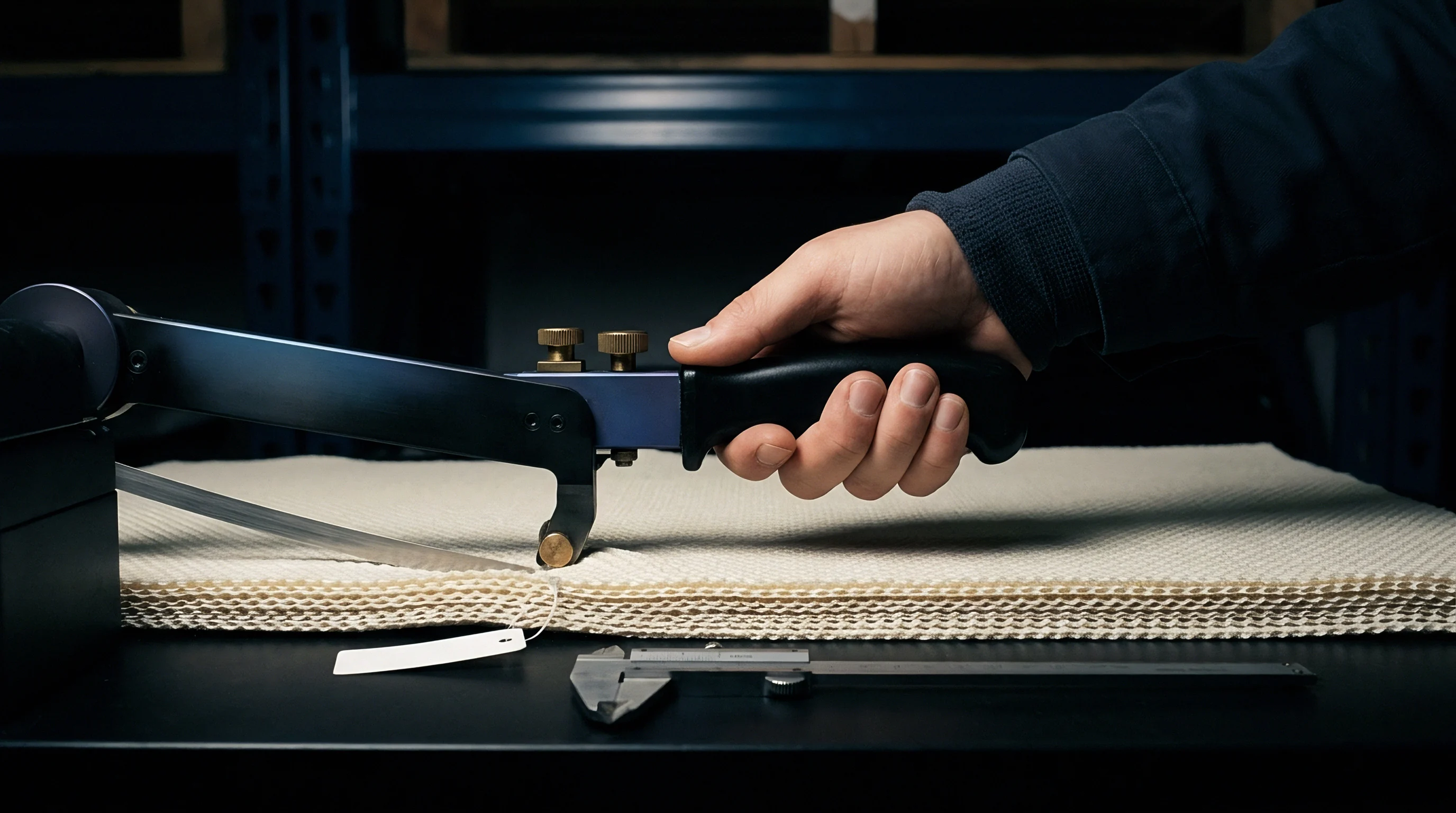
Cut technicians at production mills regularly commit procedural errors when removing test specimens from production rolls. Exposing newly cut specimens to ambient workshop air allows atmospheric moisture to initiate formaldehyde liberation or volatile solvent evaporation. Technicians must excise clean, full-width swatches while observing rigorous handling controls to prevent cross-contamination from handling benches, packaging tapes, or transport wrapping.
- Stripping the outer three layers of the selected roll removes surface contamination, atmospheric particulate deposition, and localized photolytic degradation.
- Cutting a full-width strip measuring one linear meter yields sufficient surface area for duplicate extractions across selvage, quarter-point, and center positions.
- Hermetically sealing the excised specimen inside an aluminum foil barrier bag stops the escape of volatile organic compounds and blocks ambient moisture ingress.
- Affixing an indelible tracking label to the exterior barrier bag records the precise roll identifier, batch run sequence, and cutting coordinate without introducing adhesive solvents to the textile fibers.
- Dispatching the sealed parcel to an ISO 17025 accredited laboratory within forty-eight hours preserves chemical stability prior to solvent extraction.
Excising specimens from contaminated roll packaging transfers external plasticizers onto virgin fiber, producing false-positive phthalate failures that trigger unnecessary customs quarantines and commercial cancellations.

Estimator
Mathematical evaluation of chemical concentration yields decisive acceptance criteria without requiring destructive testing on every textile roll. Variables acceptance sampling relies on the sample mean and the sample standard deviation calculated from measured continuous values. Under the ISO 3951-1 s-method, the testing technician evaluates conformity against an Upper Specification Limit (USL).
The distance between the mean chemical concentration and the statutory ceiling, expressed in standard deviation units, defines the quality index.
The upper quality index calculation follows a straightforward linear formulation: Q_U = (USL – x_bar) / s. In this expression, x_bar denotes the arithmetic mean of the chemical concentration across the sampled units, s denotes the sample standard deviation, and USL denotes the maximum allowable concentration prescribed by regulations such as REACH Annex XVII or consumer product safety standards. If the calculated quality index Q_U equals or exceeds the acceptability constant k specified for the agreed Acceptable Quality Limit (AQL), the inspector accepts the lot.
If Q_U falls below k, the lot fails acceptance criteria.
Is Normal Distribution Validated across Run Data?
Logarithmic transformations convert right-skewed contamination figures into symmetric bells suitable for classical Gaussian acceptance equations. Chemical trace contaminants often follow log-normal distributions because concentrations cannot drop below zero, clustering tightly near the limit of detection with occasional extended tail spikes. Subjecting raw, skewed parts-per-million values to linear standard deviation estimators inflates the sample variance, artificially depressing the quality index Q_U.
The buyer cancels the order. Taking the natural logarithm of each individual concentration measurement stabilizes variance across orders of magnitude, allowing standard ISO 3951-1 tables to apply with full mathematical validity.
| Lot Size Band | Code Letter | Sample Size n | Acceptability Constant k (AQL 0.40%) | Acceptability Constant k (AQL 1.50%) |
|---|---|---|---|---|
| 501 to 1,200 | F | 4 | 1.97 | 1.34 |
| 1,201 to 3,200 | G | 5 | 2.00 | 1.40 |
| 3,201 to 10,000 | H | 7 | 2.07 | 1.49 |
| 10,001 to 35,000 | J | 10 | 2.14 | 1.58 |
| 35,001 to 150,000 | K | 15 | 2.20 | 1.65 |

Worked Formaldehyde Lot Acceptance Calculation
Take a twelve-thousand-meter production order of resin-finished cotton woven twill split across three distinct heat-setting runs. The consignment comprises one hundred and twenty rolls of one hundred meters each. The buyer specifies compliance with OEKO-TEX Standard 100 Class II for direct skin contact, establishing an Upper Specification Limit of seventy-five milligrams per kilogram (USL = 75 mg/kg) for free and hydrolyzable formaldehyde measured via EN ISO 14184-1 water extraction.
The purchase agreement fixes Inspection Level II under normal single sampling with an AQL of 1.50 percent.
Table reference establishes Code Letter J for a lot size of one hundred and twenty rolls, requiring a sample size of ten rolls (n = 10) and an acceptability constant k equal to 1.58 (k = 1.58). The quality technician divides the lot into three strata representing morning, afternoon, and evening curing runs, pulling three rolls from Stratum 1, four rolls from Stratum 2, and three rolls from Stratum 3. The sample size index drops.
Destructive testing produces the following individual formaldehyde concentration readings in milligrams per kilogram: 42.1, 48.5, 39.2, 54.0, 58.2, 45.6, 61.1, 51.3, 44.8, and 49.2.
Summing the ten observations yields 494.0 milligrams per kilogram, producing a sample mean x_bar of 49.40 mg/kg. Calculating the squared deviations from this mean generates a sum of squared differences equal to 376.64. Dividing by n – 1 (nine degrees of freedom) yields a sample variance of 41.85, giving a sample standard deviation s of 6.47 mg/kg.
The acceptability constant equals 1.88. The technician calculates the upper quality index:
Q_U = (75.00 – 49.40) / 6.47 = 25.60 / 6.47 = 3.96
Because the calculated quality statistic Q_U (3.96) substantially exceeds the required acceptability constant k (1.58), the consignment passes chemical compliance verification. If two outlying rolls had registered ninety-five milligrams per kilogram due to resin accumulation, the mean would shift upward to 58.40 mg/kg and the standard deviation would widen to 18.20 mg/kg. Under that altered variance scenario, Q_U drops to (75.00 – 58.40) / 18.20 = 0.91.
That result falls far below the 1.58 threshold, mandating immediate lot rejection despite eight of the ten swatches sitting safely below the seventy-five parts per million ceiling.
Failure to satisfy the acceptability index under ISO 3951-1 permits the buyer to demand an immediate full-lot quarantine.
When process stability across dye runs wavers, tighter sampling intervals protect the buyer against sudden shifts in auxiliary bath chemistry.


Screen
Spectrometric instruments establish actual trace residue quantities within prepared fiber extractions. Analytical testing facilities operate under ISO 17025 accreditation, but individual equipment limits of detection (LOD) and limits of quantification (LOQ) differ markedly between laboratories. When measuring regulated toxins such as short-chain chlorinated paraffins, banned aromatic amines, or heavy metal ions, analytical uncertainty increases as sample concentrations approach the equipment baseline.
Sourcing teams must distinguish between an absolute chemical zero and an instrument reporting limit.

Censored Datasets below Reporting Thresholds
Values falling beneath the limit of quantification complicate numerical mean calculations during lot evaluation. When four swatches yield discrete numeric values while six return non-detect results, simple arithmetic cannot proceed without standard substitution rules. Azo dyes release banned amines.
Inappropriate handling of left-censored data introduces significant bias into variables acceptance equations, distorting both the mean and the calculated standard deviation.
- Complete non-detect substitution with zero artificially depresses the sample mean, underestimating contamination risks in marginal lots.
- Half-detection threshold insertion assigns fifty percent of the reporting limit to all non-detect specimens to maintain mathematical conservatism.
- Cohen maximum likelihood estimation fits a normal distribution curve to the visible upper tail, estimating the true population parameters despite missing lower values.
- Sample stratification re-clustering pools non-detect sub-lots separately, isolating them from strata displaying confirmed positive chemical hits.

Instrument Precision and Limit Calibration
Gas chromatography coupled with mass spectrometry isolates volatile organic compounds from complex textile matrices. For non-volatile heavy metals, inductively coupled plasma optical emission spectrometry (ICP-OES) quantifies acid-extractable ions down to fractional parts per million. Solvent extraction strips the finish.
If the laboratory calibrates instruments using inappropriate solvent blanks or matrix-mismatched calibration standards, matrix suppression artificially lowers the detected signal, disguising non-compliant chemical additions.
| Regulated Agent | Test Method | Statutory Limit | Reporting Limit | Unit Bench Cost |
|---|---|---|---|---|
| Cleavable Arylamines | EN ISO 14362-1 | 30 mg/kg | 5 mg/kg | 120 USD |
| Free Formaldehyde | EN ISO 14184-1 | 75 mg/kg | 16 mg/kg | 45 USD |
| Extractable Heavy Metals | EN 16711-2 | 1.0 mg/kg (Lead) | 0.1 mg/kg | 85 USD |
| Perfluorooctanoic Acid | CEN/TS 15968 | 0.025 mg/kg | 0.010 mg/kg | 240 USD |
| Alkylphenol Ethoxylates | EN ISO 18254-1 | 100 mg/kg | 20 mg/kg | 150 USD |
| Analytical bench costs reflect commercial ISO 17025 accredited laboratory rates for standard five-day turnaround times. | ||||
The mill manager maintained that because the chemical barrel showed an accredited supplier seal, finished cloth testing represented an unnecessary duplication of commercial costs.


Arbiter
Customs authorities and commercial audit teams enforce restricted chemical standards through decisive lot detentions. When a border surveillance agency intercepts a shipping container, field inspectors excise swatches without consulting the manufacturer’s internal quality records. The port holds the goods.
The importer of record carries strict liability for chemical violations under European Union REACH regulations, United States CPSIA enforcement, and Chinese GB 18401 national standards. Commercial survival demands contractual mechanisms that link mill-floor variables sampling directly to border release guarantees.
Border Interception and Retest Liability
Regulatory agencies in major destination markets pull random imports for confirmatory chromatography. If a governmental laboratory identifies thirty-eight milligrams per kilogram of 4-aminobiphenyl in a dyed lining textile, authorities seize the entire consignment under mandatory recall provisions. Formaldehyde release spikes under humid storage.
Commercial buyers facing inventory confiscation incur substantial financial losses encompassing cargo destruction fees, regulatory fines, and lost retail revenues.
Container holds at customs terminals generate compounding detention fees that exceed the invoice price of the cloth.
Establishing clear contractual recourse shields the purchasing brand from bearing the cost of hidden chemical non-compliance. Textile purchase orders should embed explicit testing regimes, identifying the governing sampling standard, the accredited laboratory panel, and the financial liability triggered by statistical non-conformance.
- Mismatched article descriptions between test certificates and commercial shipping invoices void regulatory safe harbor protections during customs inspections.
- Expired laboratory scope accreditation invalidates submitted technical dossiers, exposing shipments to immediate mandatory port quarantines.
- Uncontrolled composite roll swatching masks within-lot chemical variances, increasing vulnerability to random governmental single-point enforcement audits.
- Missing dry lot traceability numbers prevent selective quarantine of non-conforming strata, forcing total destruction of multi-container shipments.

Contractual Allocation of Sampling Expense
Purchase orders assign laboratory testing expenditures before production machines begin their initial cycle. Testing ten specimens per twelve-thousand-meter consignment adds roughly eight hundred dollars to landed production expenses. The carrier charges demurrage daily.
The test report clears customs. The importer forfeits the bond. When contracts stipulate that suppliers reimburse testing expenses upon lot failure alongside all associated demurrage penalties, dyehouse managers implement stringent chemical checks on incoming raw dyestuffs.
Dispute arbitration panels accept ISO 17025 accredited chromatography data backed by unbroken chain-of-custody documentation as definitive proof of consignment conformity.