Correlating Wet Processing Length Contraction with Finished Weft Pick Densities
Wet processing length contraction compresses warp geometry, driving up finished weft pick density relative to loom take-up settings in direct ratio to contraction percentage.

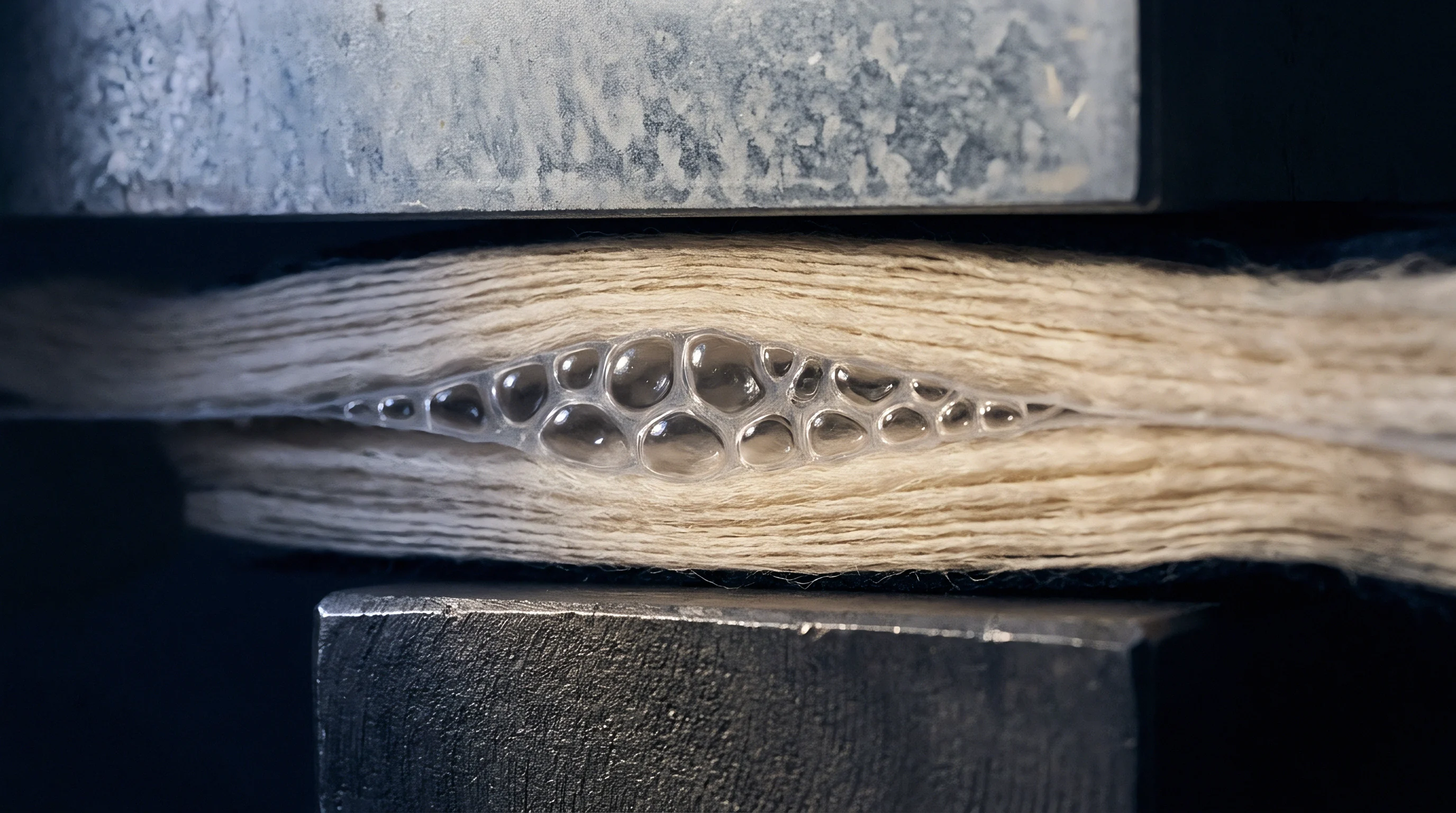
Swell
A grey 3/1 warp-faced cotton twill removed from an air-jet loom under 180 grams per end warp tension expands its yarn diameters immediately upon immersion in an aqueous desizing bath. Loom tension maintains warp threads in an unnatural, elongated state. When water enters the cellulosic structure, hydrogen bonds between adjacent cellulose chains break and reform, allowing amorphous zones to absorb liquor and swell transversely.
This cross-sectional enlargement increases yarn diameter, forcing the warp threads to bend more sharply around the perpendicular weft picks. Tension dictates crimp. The physical rearrangement of warp threads around inserted picks forces adjacent weft yarns closer together along the longitudinal fabric axis. Length contraction occurs during this initial wet phase without any mechanical compression applied by finishing machinery.
Hydraulic Relaxation Mechanics in Cellulosic Grey Goods
Woven cotton threads held straight by weaving tension store mechanical potential energy inside their twisted staple structures. Aqueous scouring releases this stored tension as the liquor lubricates fibre surfaces and dissolves protective sizing agents. Fibre swelling alters yarn spacing. As warp threads increase in cross-sectional area, the geometrical path required to traverse over and under weft picks lengthens significantly.
Because the overall fabric sheet remains free of longitudinal restraint in jet machines or tensionless washers, the warp path shortens along the fabric plane. This spatial realignment shifts the ratio of warp crimp to weft crimp, driving up the number of weft picks per unit length.
Mill technicians measuring off-loom pick density frequently fail to anticipate this hydraulic contraction. Greige specifications recording 60 picks per inch on the loom take-up roll regularly transition to 64 or 65 picks per inch following grey washing. Off-loom figures yield false weights. The degree of length contraction depends heavily on yarn twist factors, fibre origin, and size formulation.
Hydrophilic size materials like polyvinyl alcohol restrict initial wet relaxation until fully dissolved, whereas starch-based sizes permit progressive relaxation as temperature increases inside the scouring range.
An uncorrected 5 percent variance in structural contraction alters finished pick counts beyond standard ISO 3801 mass tolerances, triggering mandatory lot rejections under European buyer specification frameworks.

Warp Crimp Redistribution during Size Removal
Enzymatic liquor dissolves starch film coatings applied during warping, freeing constituent fibres to adjust their spatial packing. Without the rigid binder matrix, yarn flexural rigidity drops by up to 40 percent, permitting instantaneous crimp interchange. Wet processing shifts yarn spacing. The warp threads assume a higher amplitude sine wave profile around the relatively straight weft yarns.
This geometric conversion directly reduces the physical length of the fabric roll while maintaining the total count of inserted weft yarns, thereby compressing pick spacing.
Mistaking length contraction for mere machine relaxation creates severe errors in grey fabric planning. Weaving mills that target a finished pick density of 68 picks per inch must calculate the exact contraction percentage generated by their customer’s specific finishing sequence. If the wet processing plant uses high-temperature causticization, length contraction can reach 8.5 percent.
Underestimating this contraction leads to over-picking on the loom, wasting yarn mass and inflating greige manufacturing costs.
- Off-spec finished fabric weight results when unexpected warp contraction compresses picks too closely, driving total GSM above the target tolerance upper boundary.
- Distorted garment panel geometry appears downstream when unequal longitudinal contraction across roll edges generates skewing and bow during wet processing.
- Elevated thread consumption during sewing occurs because denser pick spacing increases needle penetration resistance and requires finer machine needles.
- Shifted air permeability ratings develop as compacted weft pick counts reduce open pore area between warp and weft intersections.
Failing to compensate for structural warp contraction in the loom reed calculation yields lightweight, over-dense finished goods that breach commercial weight specifications at the receiving port.
Transit
Continuous open-width scouring lines drag grey cloth across dozens of driven stainless steel rollers under constant axial pull. Mechanical tension applied by continuous finishing equipment opposes natural wet relaxation, creating a direct conflict between machine speed and fabric contraction. When longitudinal tension exceeds the internal restorative force of the swollen warp threads, length contraction drops to near zero.
Excess tension elongates the warp. Under these conditions, finished weft pick density remains locked near off-loom values, producing a finished cloth with high residual laundering shrinkage under ISO 5077 testing.
Mechanical Tension Controls across Wet Ranges
Load cells installed on pad-batch entry frames log longitudinal pull forces that resist structural relaxation. Dyehouse machinery operators frequently boost line speed to optimize daily throughput, inadvertently applying 350 to 500 Newtons of web tension across open-width ranges. This axial stretching pulls warp crimp flat, expanding fabric length and spreading inserted weft picks further apart.
The resulting fabric meets off-loom pick targets temporarily but collapses in length during home laundering.
| Process Stage | Physical Action | Longitudinal Contraction Range (%) | Net Weft Pick Density Shift (Picks/Inch) |
|---|---|---|---|
| Loom take-up roll tension | 0.0 (Baseline) | 60.0 (Baseline) | |
| Size solubilization and swelling | 3.0 to 4.5 | +1.8 to +2.8 | |
| Tensionless bath relaxation | 6.5 to 8.5 | +4.2 to +5.6 | |
| Overfeed drying and heat setting | -2.0 to +4.0 (Modulated) | -1.2 to +2.6 |
Jet dyeing vessels present the opposite operational dynamic. In jet machines, fabric ropes circulate freely through liquor nozzles driven by hydraulic pump pressure without mechanical draw rollers pulling the length. Jet dyeing permits full relaxation. Warp threads contract without restraint, allowing full crimp interchange to occur.
Finished pick counts measured from jet-dyed lots routinely exhibit the highest density increases relative to their loom state.
Continuous tension on open-width washing ranges suppresses structural crimp development, transferring dimensional instability downstream to the garment cutting table.

Stenter Overfeed Impact on Pick Frequency
Drying chambers equipped with pin chains drive wet cloth through thermal zones while differential speed settings regulate length tension. The stenter overfeed mechanism feeds fabric onto the pin chain at a velocity higher than the chain’s forward motion, creating localized slack. An overfeed setting of plus 5 percent delivers 105 metres of wet fabric onto 100 metres of pin chain.
This engineered slack allows heat-driven longitudinal contraction to take place during water evaporation.
Overfeed controls finished pick density. By manipulating stenter overfeed percentages, finishing engineers fine-tune the final pick count per inch to match client dossiers. If a mill receives grey fabric with 62 picks per inch and requires a finished density of 66 picks per inch, overfeeding the wet cloth by 6.5 percent on the stenter chain achieves the target density while setting dimensional stability. Insufficient overfeed leaves the fabric stretched, yielding a low pick count and guaranteed garment-level shrinkage failures.
Finishers routinely attribute unexpected pick count increases to excessive yarn moisture variation across grey goods rather than miscalibrated stenter tension rails.
Arithmetic
Calculating the transformation from off-loom pick density to finished state demands a clear formula for longitudinal dimension change. Off-loom pick density, denoted as P0, represents the number of inserted picks per unit length set by the weaving machine take-up gear. As the fabric undergoes wet processing, longitudinal length contraction SL occurs, expressed as a decimal fraction of the original grey length.
Warp crimp stores kinetic energy. The relationship governing finished weft pick density, P1, follows a strict geometric inverse function:
P1 = P0 / (1 – SL)
When length contraction equals 0.08 (representing an 8 percent reduction in length), a grey fabric with an off-loom density of 60.0 picks per inch converts to 60.0 / (1 – 0.08) = 65.22 picks per inch upon final drying. This mathematical increase in pick density direct impacts finished fabric mass per unit area, altering landed cost per linear metre.
Where Does off Loom Pick Density Diverge from Specification?
Discrepancies appear when mill technicians measure grey cloth directly behind the weaver’s take-up roller rather than after stress relaxation. On active air-jet or rapier looms, warp tension artificially extends the grey cloth, depressing the true off-loom pick count. Once released from loom beam tension, off-loom relaxation contraction (typically 1.5 to 2.5 percent) occurs immediately on the batching roll.
Incorrect pick counts alter yield. Calculating downstream wet processing contraction from active loom settings without accounting for off-loom relaxation skews the finished density prediction.
Consider a practical dyehouse worked calculation. A buyer orders a 100 percent cotton plain weave specification requiring a finished mass of 150 grams per square metre and a finished pick density of 66.0 picks per inch. The converter must determine the correct off-loom grey pick count to order from the weaving shedding mill.
The dyehouse utilizes a jet dyeing pathway known to generate an 7.5 percent length contraction (SL = 0.075) alongside a 3.0 percent width contraction.
- Determine the target finished weft pick density P1 required by the buyer dossier (66.0 picks per inch).
- Identify the verified wet processing length contraction factor SL for the intended jet finishing route (0.075).
- Calculate the required grey off-loom pick density P0 using the inverted formula: P0 = P1 (1 – SL).
- Execute the arithmetic: P0 = 66.0 (1 – 0.075) = 66.0 0.925 = 61.05 picks per inch off-loom target.
If the weaving mill erroneously sets the loom take-up gear to 64.0 picks per inch, the subsequent 7.5 percent wet contraction pushes the finished pick density to 64.0 / 0.925 = 69.19 picks per inch. Tensionless drying maximizes pick density. This excess density consumes 4.8 percent more weft yarn per finished metre than budgeted, destroying the converter’s operating margin on bulk production runs.
| Parameter | Greige Off-Loom | Continuous Range (High Tension) | Jet Dyeing (Low Tension) |
|---|---|---|---|
| 0.000 | 0.025 (2.5%) | 0.080 (8.0%) | |
| 60.0 | 61.54 | 65.22 | |
| 110.0 | 113.40 | 118.28 | |
| 135.0 | 141.2 | 152.8 | |
| N/A | -5.2% (Fails ISO 5077) | -1.8% (Passes ISO 5077) | |
| Assumes 30s Ne combed cotton warp and weft; greige size add-on of 8.0% fully removed during scouring; zero finishing chemical resin add-on. | |||
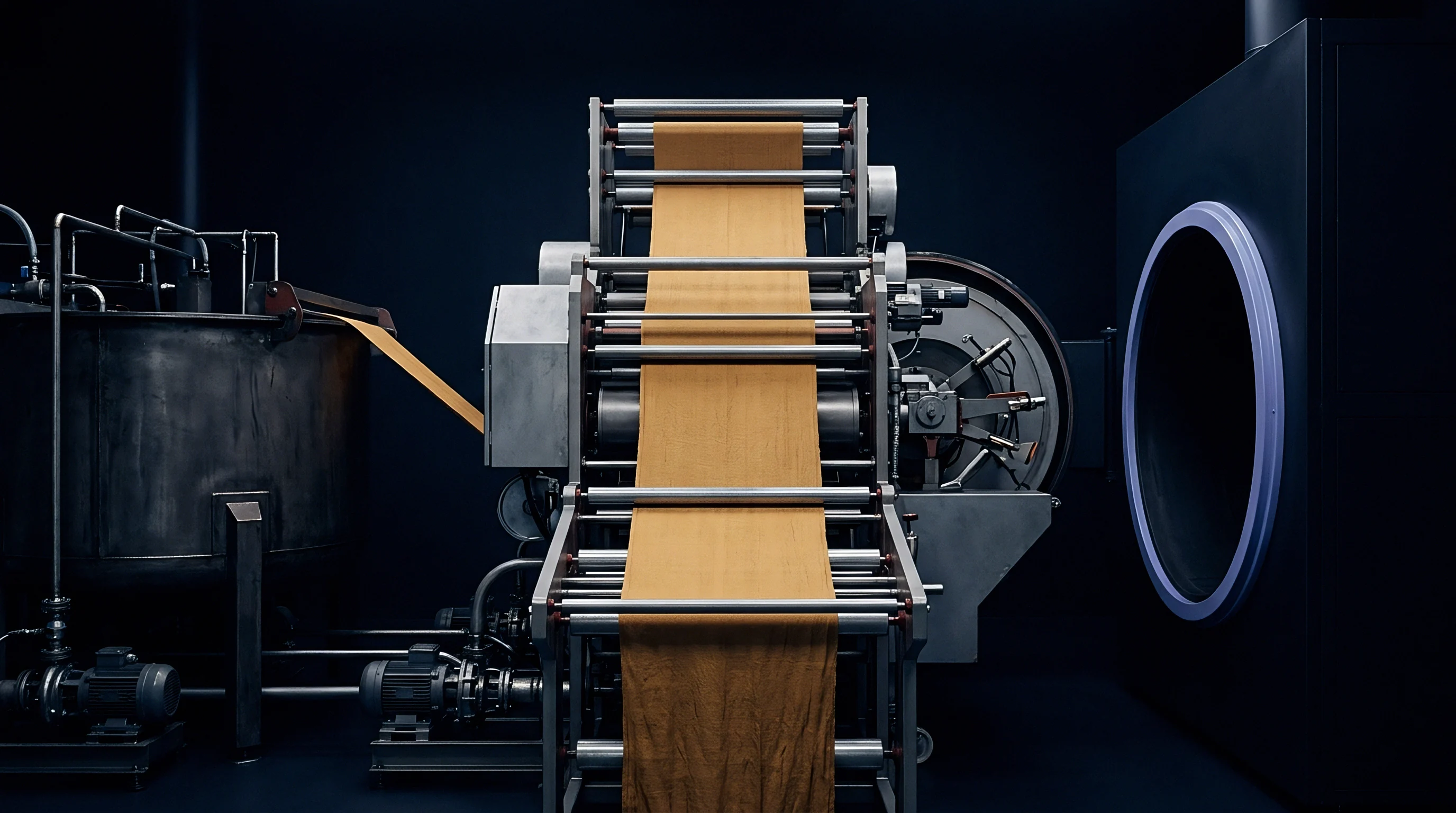
Worked Construction and Finish Matrix
Comparative trials across identical loom lots demonstrate how finishing machinery selection governs finished yarn geometry. Processing a single 40,000-metre greige lot across two distinct machinery configurations yields vastly different finished fabric structures despite identical starting yarns. The high-tension continuous range suppresses length contraction, yielding 61.54 picks per inch, whereas jet dyeing permits full crimp interchange, yielding 65.22 picks per inch.
A 100 percent cotton 3/1 twill experiencing 7.5 percent length contraction during jet scouring increases off-loom pick density from 64.0 picks per inch to a finished 69.2 picks per inch under zero-tension drying.
The difference in finished mass between these two routes equals 11.6 grams per square metre. This variance moves the fabric across commercial tariff categories and shifts garment hand feel from soft and flexible to stiff and boardy. Managing length contraction remains the primary mechanism for controlling finished GSM without altering yarn linear density.
Standard fabric purchase contracts incorporating ISO 3801 density clauses penalize pick count deviations exceeding plus or minus two picks per inch by adjusting the payable yardage per finished roll.

Stability
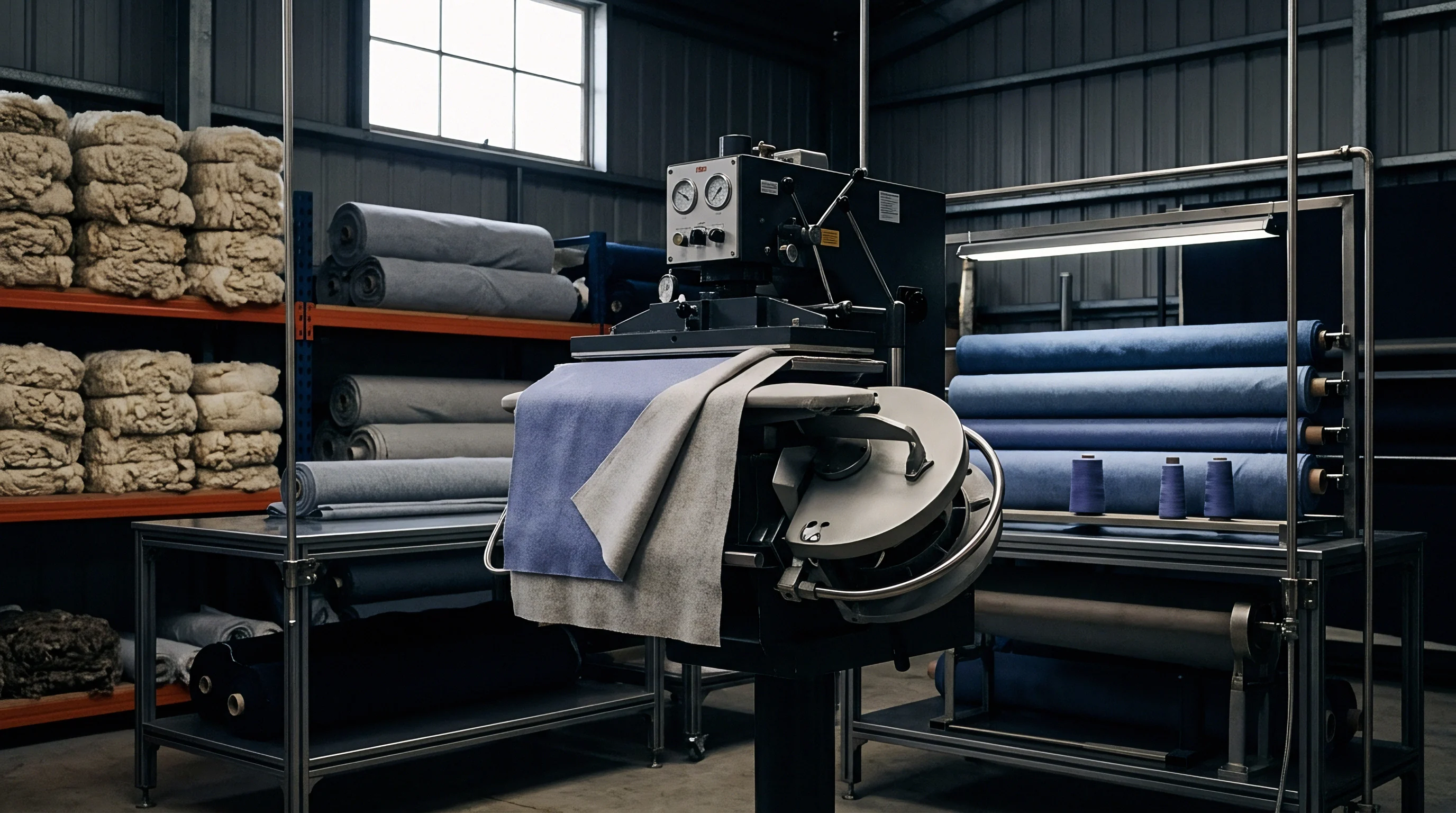
Preventing residual shrinkage in finished apparel requires locking the relaxed crimp geometry prior to garment cutting. Mechanical compaction systems like Sanforizing machines use thick rubber belts running over steam-heated cylinders to force warp contraction into woven goods. As the rubber belt flexes around the drive roll, its outer surface expands, grips the wet fabric, and contracts as it passes onto the heated drying cylinder.
This forced compression drives weft picks closer together mechanically.

Verification Protocol for Pick Count Density
Counting picks across finished cloth rolls demands standardized conditioning at 20 degrees Celsius and 65 percent relative humidity. Testing technicians place a calibrated optical pick glass or digital thread counter at five distinct positions across the usable fabric width, excluding the outer 50 millimetres near the selvedge. Residual shrinkage destabilizes cut panels. Measurements taken under variable humidity yield skewed pick counts because ambient moisture regain shifts yarn diameter and alters fabric dimensions.
Verification protocols mandate executing ISO 5077 dimensional stability tests alongside pick density counting. If a finished fabric displays the correct target pick density but fails ISO 5077 with length shrinkage exceeding 3.0 percent, the finishing process relied on temporary stretching rather than true relaxation. Compaction locks the final structure. Sanforizing overfeed rolls must apply sufficient longitudinal force to align finished pick counts with the natural fully-relaxed crimp state.
| Test Standard | Measured Parameter | Standard Conditioning / Method | Permissible Operational Tolerance |
|---|---|---|---|
| Mass per unit area (GSM) | 20°C, 65% RH; small specimen cut | ± 3.0% of target spec | |
| Threads per unit length (Picks/Ends) | Counting glass over 100 mm minimum | ± 2.0% of target pick count | |
| Dimensional change in washing | ISO 6330 wash cycle; flat dry | Max -3.0% length / -2.0% width | |
| Tensile strip strength | 50 mm strip width; constant rate traverse | Minimum threshold per buyer spec |

Standardized Testing of Finished Mass and Sett
Mass determinations executed under ISO 3801 reflect both thread density increases and finishing chemical pick-up. A technical auditor must separate weight gain caused by weft compaction from weight gain caused by added softening agents or water-repellent resins. Burning off organic chemical finishes through solvent extraction isolates the physical yarn mass contribution, permitting an accurate audit of the underlying woven structure.
Auditing finished rolls requires verifying pick count uniformities across the head, middle, and tail of every dyed batch. Pick count variance greater than 1.5 picks per inch between roll ends indicates slipping stenter clips, uneven heat distribution, or inconsistent overfeed drive synchronization.
- Stenter pin chain speed synchronization must match incoming wet fabric feed rates precisely to prevent unwanted longitudinal stretch.
- Sanforizing rubber belt durometer requires daily testing to ensure uniform mechanical compression force across the entire roll width.
- Steam box moisture pressure must maintain saturated vapor conditions to lubricate cotton fibres immediately prior to compaction.
- Drying cylinder surface temperature requires calibration to prevent flash-drying fabric before full length relaxation takes place.
Sanforizing rubber belt compression mechanically forces weft insertion frequency higher while permanently locking the warp crimp geometry against future laundering shrinkage.
Higher overfeed on the stenter chain produces lower residual laundering shrinkage in finished apparel panels.
Sourcing
Commercial procurement contracts that specify finished thread densities without adjusting greige yarn quantities force weaving mills to absorb yield losses. When a buyer contracts for 100,000 linear metres of finished 66-pick twill, the converter must purchase sufficient greige yardage to cover both wet processing length contraction and mechanical edge trimming losses. Converter margins depend on contraction. Underestimating a 7 percent wet length contraction means ordering 107,500 metres of grey cloth rather than the required 108,200 metres, leaving the bulk order short of buyer delivery commitments.
Commercial Route Pricing and Yield Adjustments
Weaving capacity commitments hinges on accurate longitudinal shrinkage estimations before yarn purchasing begins. Yield shifts reprice bulk orders. If a finishing mill changes its process route from jet dyeing to continuous pad-steam processing to reduce energy costs, the finished weft pick density drops due to suppressed length contraction. To achieve the same target pick count on continuous ranges, the weaving mill must increase off-loom insertion density on the loom, consuming more weft yarn per greige metre and driving up loom weaving costs per yard.
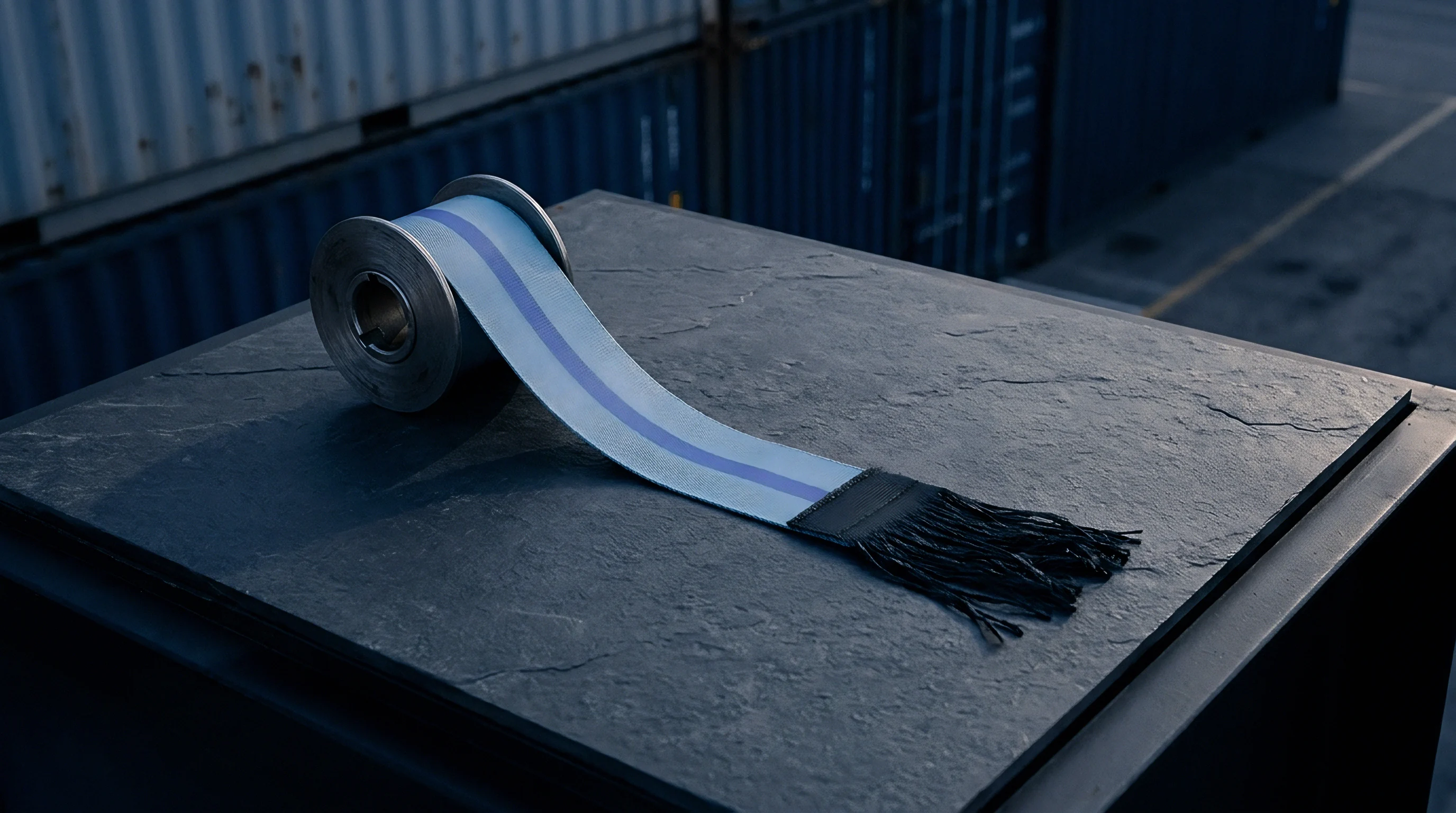
International shipping containers subject finished fabric rolls to fluctuating internal temperatures and microclimates during oceanic transit, occasionally triggering minor moisture regain shifts that alter post-arrival pick measurements. Sourcing engineers account for these transit environmental shifts by inserting ambient equilibrium clauses into international commercial purchase contracts.
Standard industry estimates place jet dyeing length contraction between 6.0 and 9.0 percent for medium-weight cotton, though actual values swing by plus or minus 1.5 percent based on starch formulation and size add-on levels. The desk relies on ISO 5077 five-wash testing data to bound this variance, acknowledging that variations in greige yarn twist multiplier can move the baseline beyond published mill charts.
Whether digital yarn tension monitors can predict real-time crimp interchange across variable humidity continuous dye ranges remains unanswered by current dyehouse instrumentation.