Laboratory Metrology Procedures for Standardizing Cotton Yarn Mass Calculations
Commercial cotton yarn mass standardizes through gravimetric oven-drying, removing ambient moisture, then applying statutory commercial regain allowances to net mass.


Tare
Package gross weights taken straight off pallet shipments mislead receiving departments if weighed without laboratory environmental controls. A package of carded or combed cotton breaks down into three distinct weight components: the winding core, moisture bound within the cellulosic fibrils, and the dry cellular substance itself. Reeling skeins for testing requires isolating the yarn from its delivery core.

Package Stripping and Reel Mechanics
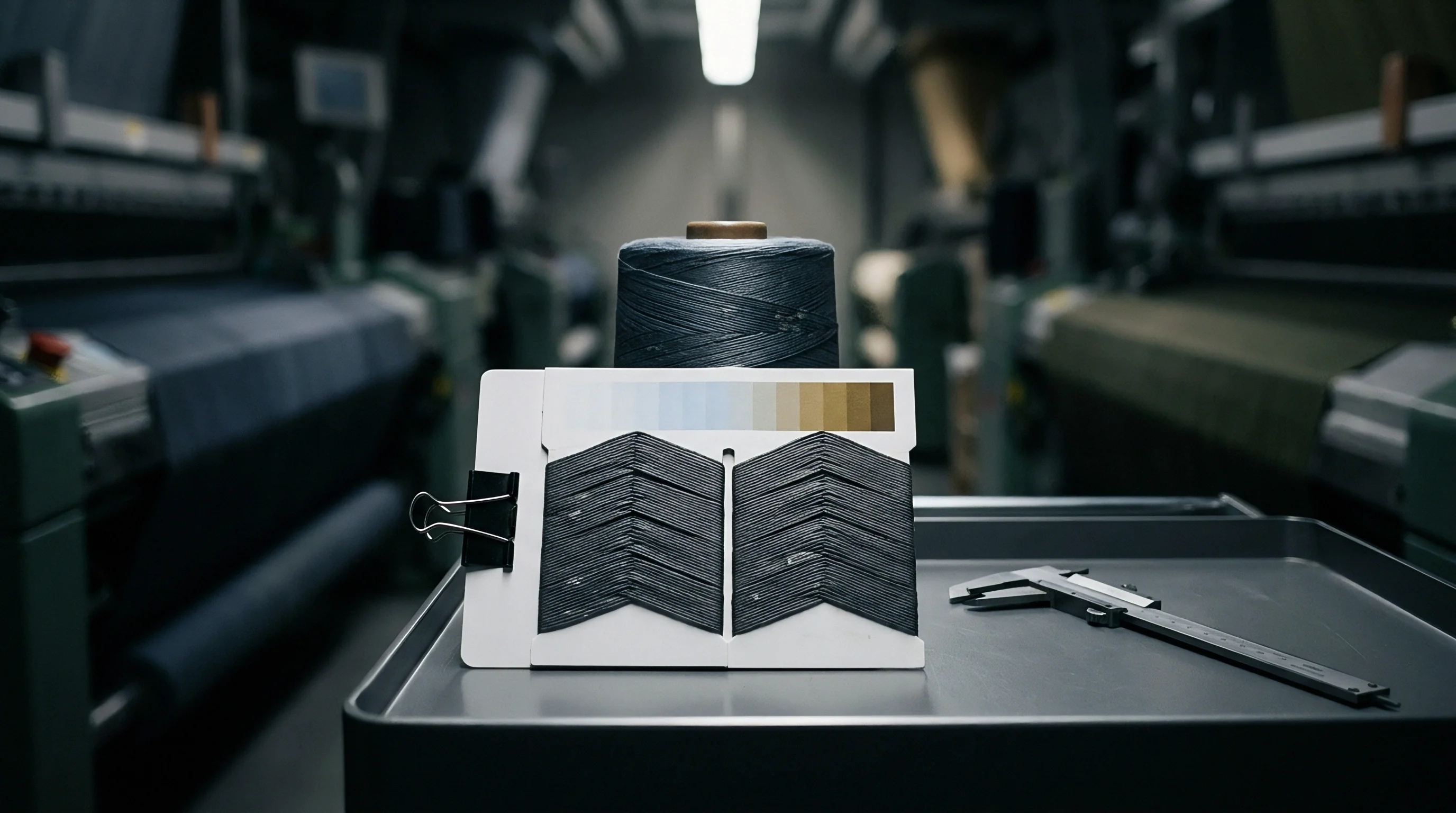
Sampling begins by stripping the outer wraps from the cone or cheese. The outer three hundred metres of yarn absorb surface scuffing, relative humidity spikes, handling oil, and contact with packaging during ocean transit. Technicians discard these outer layers before mounting the bobbin on a regulated wrap reel.
Test reels built to ISO 2060 or ASTM D1907 use a fixed perimeter of one metre or 1.125 yards, controlled by an electronic counter to turn exactly eighty or one hundred revolutions per skein.
Unwinding tension directly sets the skein perimeter length. Excessive brake drag stretches cotton fibres past their elastic limit, artificially lengthening the skein and lowering the measured linear density. Too little tension causes yarn to sag across the guides, resulting in loose perimeters, dropped strands, and an inflated skein mass.
Calibrated leaf-spring or disc pretensioners apply exactly 0.5 centinewtons per tex within a ten percent tolerance. A 20 tex yarn thus receives ten centinewtons of running drag through the porcelain eyelets.
Applying unregulated winding tension during wrap reeling alters the measured strand perimeter and invalidates subsequent linear density yields.
Laboratory balances for wrap skeins require an analytical accuracy of 0.001 grams when weighing individual eighty-turn skeins. Pallet scales weighing whole cartons resolve to five grams across fifty-kilogram containers. Unchecked scale drift across multi-container shipments compounds small calibration errors into substantial financial discrepancies.
Core Subtraction and Packaging Components
Paper cones, pressed paperboard tubes, and plastic bobbins vary noticeably in weight from lot to lot. Using nominal tube weights from a catalog introduces systematic errors on large orders. Standard tare testing requires weighing every carrier empty after complete unwinding.
| Core Carrier Construction | Nominal Unit Weight (g) | Observed Weight Spread (g) | Carrier Moisture Regain at 65% RH (%) |
|---|---|---|---|
| Pressed phenolic paper cone (4 deg 20 min) | 38.5 | plus or minus 2.4 | 8.2 |
| Perforated dye-tube polypropylene | 46.2 | plus or minus 0.6 | 0.2 |
| Spiral paperboard cylindrical tube | 52.1 | plus or minus 3.8 | 9.1 |
| Thin-wall open-end spinning plastic tube | 28.0 | plus or minus 0.4 | 0.1 |
Paperboard tubes absorb moisture readily inside humid ocean containers. A container at ninety percent relative humidity adds water directly into the tube walls. If receiving audits deduct nominal dry tube weights from humid shipments, that trapped water gets billed as yarn.
A buyer taking fifty tons of open-end yarn a month on paper cores ends up paying for water in the paperboard unless empty carriers are desiccated during testing.
Failing to account for core tare variations inflates reported linear density figures, causing yield losses from underweight yardage on creels.


Regain
Cellulose fibres absorb and release atmospheric vapor continuously. Cotton contains accessible hydroxyl groups throughout the amorphous regions of its microfibril matrix. Water molecules bind to these sites through hydrogen bonding, creating a monomolecular layer before condensing in capillary spaces.
Fluctuations in ambient air shift total package weight without altering polymer chain length.

Equilibrium Conditioning Chambers
Weighing unconditioned yarn distorts receiving records. ASTM D1776 and ISO 139 define standard laboratory conditions at twenty degrees Celsius plus or minus two degrees, and sixty-five percent relative humidity plus or minus four percent. Skeins on open wire racks reach equilibrium with circulating air over several hours.
Yarn is considered stable when consecutive weighings two hours apart differ by less than 0.1 percent.
Sorption hysteresis presents another source of error. Cotton brought into a standard testing room from a humid climate retains more moisture than identical yarn coming from dry storage. Laboratories eliminate this hysteresis effect by preconditioning samples in a ventilated oven at forty to fifty degrees Celsius and under twenty-five percent relative humidity for four hours.
Approaching sixty-five percent relative humidity strictly from the dry side brings all skeins onto the same adsorption curve.

How Frequently Do Conditioning Vaults Drift?
Data loggers need to monitor room conditions continuously. Humidifiers, steam injectors, and dehumidifiers cycling over twenty-four hours can create localized microclimates in large rooms. Skeins hanging near supply ducts will pick up moisture differently than those placed on lower bench shelves.
- Hygrometric sensors require calibration against chilled-mirror dewpoint devices every quarter to prevent relative humidity drift.
- Circulation air velocity must stay between 0.15 and 0.30 metres per second to promote vapor exchange without disturbing the yarn strands.
- Open-mesh hanging frames ensure uniform exposure by keeping packages from touching.
- Chamber door interlocks prevent outside room air from entering the enclosure during entry.
Determining absolute dry mass requires ventilated drying ovens conforming to ASTM D2495 or ISO 6741. Samples are heated to one hundred and five degrees Celsius plus or minus three degrees until all unbound moisture evaporates from the cellulose. Air circulation inside the oven balance chamber must stop during weighing to prevent lift errors on the balance pans.
Drying continues until two successive weighings fifteen minutes apart show less than 0.05 percent change in mass.
Thermal drying at one hundred and five degrees Celsius isolates the absolute bone-dry cellulose mass by driving out all unbound water molecules.
Ambient warehouse air in production regions frequently carries roughly nine percent moisture, creating routine baseline weight variances.


Metric
Expressing linear density requires choosing between direct systems based on mass per unit length and indirect systems based on length per unit mass. International markets use both traditional counts and metric units, making explicit conversions necessary on test certificates.

How Accurately Do Indirect Counts Map Denier?
Calculations convert between mass and length using fixed ratios. English cotton count (Ne) is the number of 840-yard hanks that weigh one pound. Tex represents the weight in grams of one thousand metres of yarn.
Decitex measures mass in grams per ten thousand metres, and denier covers nine thousand metres. Cotton spinners usually specify carded and combed yarns in Ne, whereas thread converters and technical knitters tend to use tex.
The relationship between Ne and tex relies on standard physical constants. One pound equals 453.59237 grams, and one yard equals 0.9144 metres. Multiplying 840 yards by 0.9144 gives 768.096 metres per hank.
Dividing 453.59237 grams by 768.096 metres and scaling by one thousand gives the conversion constant 590.541. Dividing 590.541 by the Ne yields tex; for example, Ne 30 equals 19.68 tex. Denier uses the constant 5314.9, so Ne 30 converts to 177.16 denier.
| English Cotton Count (Ne) | Direct Tex (g/km) | Decitex (dtex) | Commercial Skein Weight per 100m (g) | Target Weight 120-Yard Lea (g) |
|---|---|---|---|---|
| 10/1 Ne | 59.05 | 590.5 | 5.905 | 7.086 |
| 20/1 Ne | 29.53 | 295.3 | 2.953 | 3.543 |
| 30/1 Ne | 19.68 | 196.8 | 1.968 | 2.362 |
| 40/1 Ne | 14.76 | 147.6 | 1.476 | 1.772 |
| 50/1 Ne | 11.81 | 118.1 | 1.181 | 1.417 |
| 60/1 Ne | 9.84 | 98.4 | 0.984 | 1.181 |
Calculations for corrected yarn count adjust for moisture levels measured on the testing floor. If testing takes place outside sixty-five percent relative humidity, the raw count off the reel must be adjusted for moisture regain.
Let m represent the actual conditioned weight of a 120-yard lea skein in grains on a yarn balance. Let R equal the actual moisture regain percentage determined by oven drying a companion skein. Let R_s equal the standard commercial regain of 8.5 percent.
The corrected skein mass m_c follows this relation:
m_c = m multiplied by (100 + R_s) divided by (100 + R)
The corrected English count Ne_c then resolves directly:
Ne_c = 1000 divided by m_c
For example, a 120-yard skein wound from bobbins in a dry spinning room might weigh 3.42 grains with an actual moisture regain of 6.2 percent. Corrected to standard commercial conditions, the skein weight rises to 3.494 grains, shifting the effective yarn count from Ne 29.24 down to Ne 28.62. Without this correction, a buyer risks accepting yarn that falls outside specified count tolerances.
Ambient moisture variations during transit in unsealed containers can alter strand crimp before oven-dry testing, creating discrepancies in lab measurements.


Allowance
Raw cotton contains non-cellulosic materials alongside pure cellulose. Pectins, waxes, proteins, ash, and trace sugars adhere to the secondary wall of the cotton fibre. Mechanical processing also introduces lubricants, anti-static agents, and machine oil.
These components affect the calculated dry baseline of a shipment.

Commercial Regain versus Moisture Content
Testing standards strictly distinguish between moisture regain and moisture content. Moisture content measures water mass as a percentage of total initial weight. Moisture regain measures water mass as a percentage of dry weight.
Confusing the two in sales contracts leads directly to billing errors.
If one hundred kilograms of moist yarn yields ninety-one kilograms of dry fibre and nine kilograms of evaporated water, moisture content is nine percent. Moisture regain is nine divided by ninety-one, or 9.89 percent. Regain is always numerically higher than moisture content for the same sample.
- Gross mass is recorded from weighbridge receipts verified against packing lists.
- Representative packages are selected using ASTM D2258 random sampling across the lot.
- Empty cones and packaging are stripped and dried to determine true tare.
- Samples undergo convective drying at one hundred and five degrees Celsius to establish bone-dry mass.
- Soxhlet extraction with petroleum ether removes waxes and oils if commercial clean-dry mass terms apply.
- Contracted commercial regain percentages are applied to the clean dry mass.
Commercial regain formulas calculate contractual mass by adding a legally agreed moisture percentage directly onto oven-dry cellulose weight.
International trade rules define standard moisture regain allowances for commercial settlement. The allowance for raw, carded, and combed cotton yarn is 8.5 percent under ISO and ASTM standards. Mercerized cotton, treated with caustic soda to alter its structure to hydrated cellulose II, has more available hydroxyl sites and carries an allowance of 10.5 percent.
Blended yarns follow additional rules.
| Yarn Material Classification | Standard Regain Allowance (%) | Governing Standard Body | Solvent Extractable Limit (%) |
|---|---|---|---|
| Carded Ring Spun Cotton (Grey) | 8.50 | ASTM D1909 / BISFA | 1.50 |
| Combed Cotton (Grey) | 8.50 | ASTM D1909 / ISO 6741 | 1.25 |
| Mercerized Combed Cotton | 10.50 | BISFA / Commercial Rules | 1.00 |
| Cotton / Polyester Blend (60/40) | 5.26 | Proportional Calculation | 1.00 |
| Cotton / Viscose Blend (50/50) | 10.75 | Proportional Calculation | 1.75 |
Blended yarns use proportional regain calculations. For a 60/40 cotton-polyester yarn, sixty percent of the 8.5 percent cotton allowance combines with forty percent of the 0.4 percent polyester allowance to give a standard allowance of 5.26 percent. Ignoring blend proportions in settlement calculations distorts invoice amounts.
Under International Cotton Association rules, invoices settle on verified commercial dry mass plus official regain rather than scale weight at delivery.


Settlement
Applying laboratory measurements to commercial invoices protects purchasing capital. Transit times for ocean freight vary, and moisture shifts during transit make shipping weights unreliable for billing. Invoice mass must be derived by adjusting for moisture, subtracting actual carrier tare, and reconciling mass against contracted yardage.

Commercial Mass Calculation Architecture
Evaluating a shipment requires a systematic process. Let M_g equal the gross weight of the lot delivered at the dock. Let T equal total tare weight, including pallets, cartons, plastic wrap, and empty cones.
Net delivered weight M_n equals gross mass minus tare:
M_n = M_g – T
From this net consignment, the lab takes representative sample packages with an initial mass of m_s. Oven drying yields the bone-dry mass m_d, allowing actual moisture regain R_act to be calculated:
R_act = ((m_s – m_d) divided by m_d) multiplied by 100
Once m_d is determined, total bone-dry mass M_dry is calculated by applying the sample drying ratio across the entire shipment:
M_dry = M_n multiplied by (m_d divided by m_s)
Official commercial invoice mass C_m incorporates the standard commercial moisture allowance R_c (typically 8.5 percent for cotton) and any extractable allowance A:
C_m = M_dry multiplied by ((100 + R_c + A) divided by 100)
Contracts specify that mills bill based on C_m. If billed weight exceeds commercial mass, the buyer issues a debit note for the difference.

Worked Financial Reconciliation
Consider a twenty-ton shipment of combed 30/1 Ne cotton yarn purchased at 4.20 US dollars per kilogram based on standard 8.5 percent commercial regain.
The container arrives at the port. Weighbridge dockets show a gross weight M_g of 21,450 kilograms. Weighing packaging, pallets, and cones yields a total tare weight T of 1,650 kilograms, leaving a net delivered weight M_n of 19,800 kilograms.
Twelve sample packages taken across the shipment weigh 12.450 kilograms initially (m_s). After drying at one hundred and five degrees Celsius to constant weight, the dry sample mass m_d is 11.280 kilograms.
First, calculate actual moisture regain R_act upon unsealing:
R_act = ((12.450 – 11.280) divided by 11.280) multiplied by 100 = 10.37 percent
The yarn absorbed moisture during transit, reaching nearly two percentage points above the contractual 8.5 percent threshold. Next, calculate the bone-dry mass of the full shipment:
M_dry = 19,800 multiplied by (11.280 divided by 12.450) = 17,939.57 kilograms
Now calculate commercial mass C_m using the 8.5 percent regain allowance:
C_m = 17,939.57 multiplied by (108.5 divided by 100) = 19,464.43 kilograms
Comparing delivered net mass (19,800 kilograms) to verified commercial mass (19,464.43 kilograms) shows an overbilling of 335.57 kilograms due to excess moisture.
At 4.20 US dollars per kilogram, this difference comes to 1,409.39 dollars on one container. Across an annual volume of forty containers, unadjusted moisture regain can cost over 56,000 dollars.
Oven calibration should be verified before signing off on final container settlement claims.