Mathematical Calculation of Finished Warp Density across Standard Unit Systems
Finished warp density equals total working ends divided by finished width, calculated across unit systems by adjusting reed sett for width contraction.
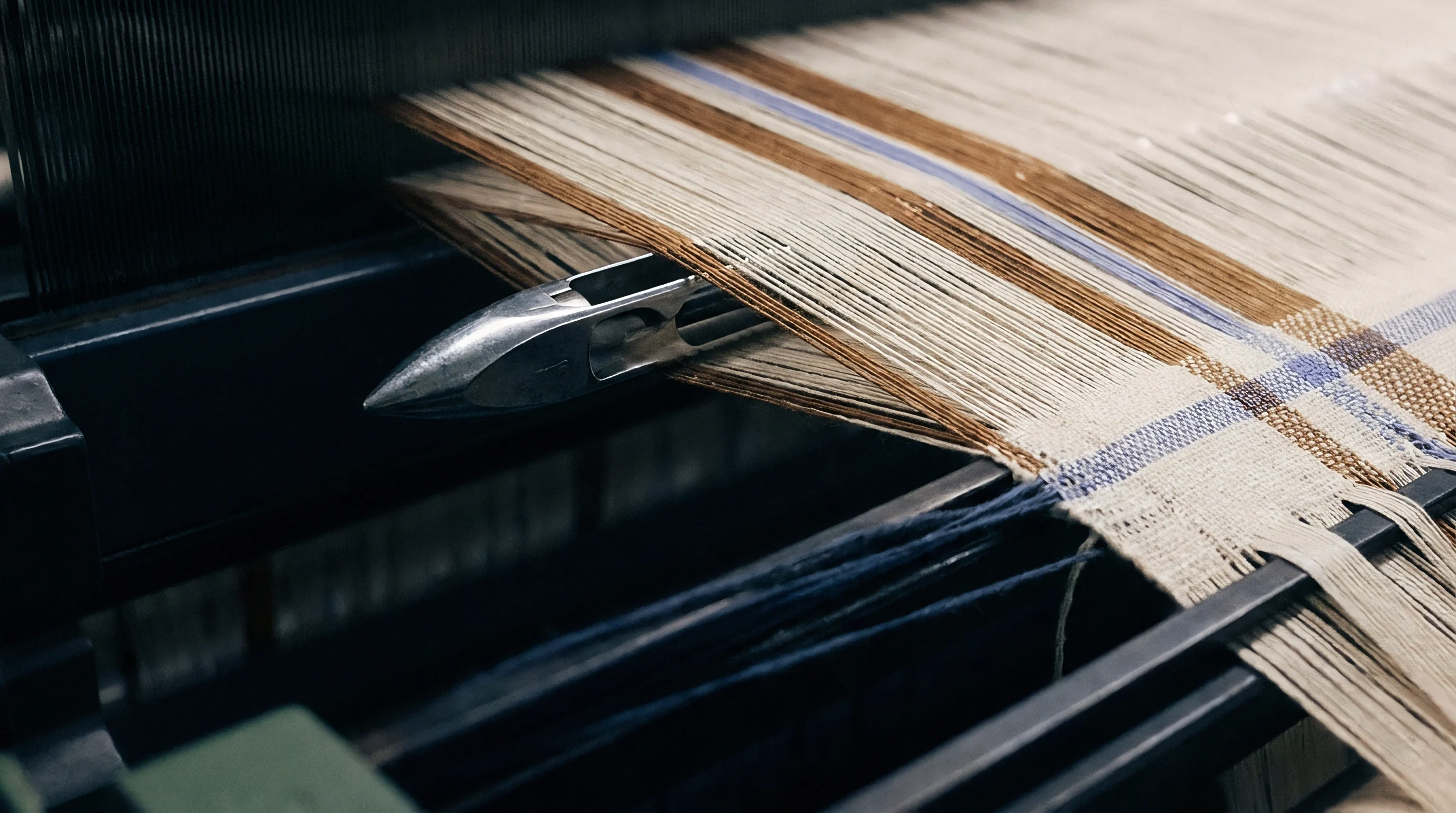

Reed
Loom sley dimensions establish initial warp sheet spacing before wet finishing takes over from mechanical tension. Determining finished warp density starts by taking the total working ends drawn through the reed wire and dividing them across the measured reed spread. Getting an accurate ends-per-unit figure at the loom stage requires accounting for selvedge construction, body ends, and reed occupancy together.
For instance, a reed specified at 16 dents per centimetre with two ends per dent gives a nominal loom sett of 32 ends per centimetre across the active denting field. But that nominal count shifts as soon as tension drops at the take-up motion and yarn deflection pulls the margins inward.
Dividing total warp count by reed width gives the greige insertion density. Specification sheets often record reed width in inches or centimetres while quoting reed counts in local conventions: the English system counts dents per inch, while Continental metric denotes dents per decimetre or centimetre. Confusing these base units throws off the end calculation before yarn even reaches the heald wires.
A technician verifying finished sett has to follow each warp end through the drawing-in plan to see if tape selvedges draw four ends per dent where the body draws only two, since that imbalance skews average density across the piece.
A reed calculation excluding selvedge crowding misstates total sheet width by up to fifteen millimetres before scouring.
Denting plans set up local density variations across the reed width. Heavy yarn concentrations in specific dents generate uneven lateral tension during beat-up, causing uneven contraction once the fabric clears the front rest. For example, a 40-inch reed carrying 3,200 total body ends yields an on-loom warp density of 80 ends per inch.
If extra selvedge ends add 48 ends to each flank in denser dent groupings, gross warp count rises to 3,296 ends. Dividing that gross total by nominal reed width produces an incorrect base density of 82.4 ends per inch, even though body sett right at beat-up is precisely 80 ends per inch.
- Working reed width defines the exact lateral space occupied by drawn ends between the outermost occupied dents on the loom.
- Denting arrangement governs how many individual yarns pass through each reed air space across the beam layout.
- Selvedge end balance separates reinforcing edge yarns from the primary ground sett calculation.
- Nominal loom count establishes the baseline ends per unit measure before warp tension relaxes and weft contraction sets in.
Greige sett calculations directly inform warp tension settings on air-jet and rapier looms. Dense warps increase beat-up resistance, demanding higher let-off tension to keep the shed clear. That added tension stretches warp yarns during insertion, triggering sharp elastic recovery after the roll unbinds from the take-up.
Specifying reed density without factoring in yarn modulus leads to severe width loss in scouring and caustic baths. Production teams that rely strictly on nominal reed counts to target finished density often end up with cut-edge curling, erratic widths, and rejected fabric at the cutting table.


Crimp
Lateral contraction starts as soon as weft picks interlace with warp ends under repeated beat-up force. As weft yarn bends around the tight warp sheet, interlacing pulls outer warp ends toward the centerline. This narrows the greige relative to reed width and immediately increases spatial warp density.
The Greige Contraction Percentage quantifies this loss: a 100-centimetre reed spread that shrinks to 94 centimetres on the roll shows a 6.0 percent width contraction, raising warp density by the inverse of that ratio.
Determining finished density requires adding wet-processing shrinkage to this initial mechanical consolidation. Scouring, bleaching, dyeing, and chemical finishing relieve polymer stresses built up during spinning and weaving. As the wash bath relaxes crimp and swells the fibers, the fabric contracts.
Stenter frames then mechanically pin or stretch the piece to its target width, setting the final warp spacing. Arriving at actual finished warp density means tying on-loom density, off-loom greige contraction, and finishing width adjustments into one continuous calculation.

Can Loom Takeup Distort Greige Calculations?
Loom take-up speed sets the pick density, which in turn controls weft crimp and warp deflection. High pick counts force warp ends into deeper serpentine paths, strengthening the inward pull on selvedges. A light plain weave shows far less warp crimp amplitude than a heavy warp-faced twill.
As weft crimp grows, width contracts further, pushing warp ends closer together. This shift is calculated through direct dimensional ratios:
Finished Warp Density = Loom Warp Density multiplied by the Reed Width divided by the Finished Cloth Width.
The calculation relies on conservation of total end count. Assuming no warp loss during processing, working ends remain constant from warper beam to finished roll. If 4,000 ends occupy 125 centimetres in the reed, on-loom warp density is 32 ends per centimetre.
If wet processing and sanforizing settle the cloth at a finished width of 112 centimetres, finished warp density is 4,000 divided by 112, resulting in 35.71 ends per centimetre. Expressed in imperial measures, 35.71 ends per centimetre multiplied by 2.54 yields 90.7 ends per inch.
| Construction Type | Yarn Count (Tex) | Reed Sett (ends/cm) | Reed Width (cm) | Grey Width (cm) | Finished Width (cm) | Finished Sett (ends/cm) | Finished Sett (EPI) |
|---|---|---|---|---|---|---|---|
| Plain Poplin 1/1 | 15 x 15 | 44.0 | 168.0 | 158.0 | 150.0 | 49.28 | 125.17 |
| Twill 2/1 Chino | 30 x 30 | 36.0 | 165.0 | 153.0 | 146.0 | 40.68 | 103.34 |
| Heavy Twill 3/1 Denim | 60 x 50 | 24.0 | 172.0 | 156.0 | 148.0 | 27.89 | 70.84 |
| Satin 4/1 Sheeting | 20 x 20 | 48.0 | 290.0 | 275.0 | 260.0 | 53.54 | 135.99 |
| Plain Voile 1/1 | 12/2 x 12/2 | 28.0 | 160.0 | 154.0 | 148.0 | 30.27 | 76.89 |
| Oxford 2/1 Shirting | 20/2 x 15 | 38.0 | 164.0 | 152.0 | 144.0 | 43.28 | 109.93 |
Width shrinkage calculations reveal critical structural limits. When mills attempt to increase finished warp density by over-shrinking narrow grey goods on the stenter, warp yarns buckle out of plane. The textile stiffens, tear strength plummets, and warp-direction abrasion accelerates.

Scale
Textile regions operate under competing measurement systems, making precise unit conversion essential. Imperial specs express warp sett in Ends Per Inch, while metric systems use Ends Per Centimetre or Ends Per Decimetre. Converting between them requires exact factors rather than rounded numbers.
One inch equals precisely 2.54 centimetres. Converting ends per centimetre to ends per inch involves multiplication by 2.54. Dividing ends per inch by 2.54 generates ends per centimetre.
Multiplying ends per centimetre by 10 yields ends per decimetre, the standard metric unit in European technical specifications.
Yarn numbering systems introduce further complexity to finished density calculations. Direct systems measure mass per unit length, so higher numbers mean thicker yarn. Indirect systems measure length per unit mass, meaning numbers decrease as yarn coarsens.
Metric count, English cotton count, and Tex system values all feed into warp density calculations when determining finished fabric weight and theoretical cover, requiring calculations to toggle between direct mass units and indirect spacing metrics.
Count conversions lose accuracy whenever technicians round conversion constants to fewer than four decimal positions.
Cross-system calculations depend on fixed identity formulas. In Tex, linear density equals the weight in grams of 1,000 metres of yarn; in English cotton count, it denotes the number of 840-yard hanks that weigh one pound. Converting English cotton count to Tex requires dividing 590.54 by the English count value.
Converting metric count to Tex requires dividing 1,000 by the metric count value. Keeping units aligned is critical when using finished density and yarn count together to predict fabric mass.
| Starting Parameter | Starting Unit | Target Parameter | Target Unit | Exact Conversion Formula | Numerical Factor |
|---|---|---|---|---|---|
| Warp Density | ends/cm | Warp Density | ends/inch (EPI) | Target = Starting x 2.54 | 2.5400 |
| Warp Density | ends/inch (EPI) | Warp Density | ends/cm | Target = Starting / 2.54 | 0.3937 |
| Warp Density | ends/cm | Warp Density | ends/10 cm | Target = Starting x 10 | 10.0000 |
| Yarn Linear Mass | English Count (Ne) | Yarn Linear Mass | Tex (g/km) | Target = 590.54 / Ne | 590.5412 |
| Yarn Linear Mass | Metric Count (Nm) | Yarn Linear Mass | Tex (g/km) | Target = 1000 / Nm | 1000.0000 |
| Yarn Linear Mass | Denier (g/9km) | Yarn Linear Mass | Tex (g/km) | Target = Denier / 9 | 0.1111 |
| Theoretical Cover | Peirce Cover (K1) | Metric Cover (Km) | Metric Ratio | Target = K1 / 9.57 | 0.1045 |
Conversion errors can alter production economics in international supply chains. A purchase order issued in the United States specifying 120 ends per inch translates to 47.24 ends per centimetre. An overseas mill rounding this requirement to 47 ends per centimetre weaves a finished textile carrying 119.38 ends per inch.
Across a 150-centimetre finished width, that subtle rounding error sheds 36 total warp ends across the cloth body. Omitting 36 ends saves raw yarn mass for the mill while lowering the tensile resistance of the finished piece goods below specified performance limits.
- Fractional rounding errors compound across thousands of warp ends, stripping structural density from production runs.
- System identification failures occur when direct formulas are applied to indirect yarn numbering systems, inverting cover calculations.
- Linear density discordance between nominal yarn purchase counts and actual conditioned yarn mass creates systematic density prediction errors.
Calculations stay accurate when conversions remain tied to physical definitions. Yarn count variation directly shifts the visual tightness of a given warp sett, as coarser yarns fill interstitial gaps faster than fine yarns at identical end counts. Sourcing departments avoid expensive disputes by specifying yarn count and end density in unrounded metric units alongside regional commercial numbers, keeping in mind that coarser structures require wider spacing to clear the shedding motion.


Cover
Finished warp density dictates how completely warp ends obscure the open spaces within the weave. This geometric condition is quantified as the warp cover factor. The classic Peirce cover factor for cotton systems defines warp cover as ends per inch divided by the square root of the English cotton count.
In metric terms, cover factor represents ends per centimetre multiplied by the square root of linear density in Tex, divided by 10. High cover factor values indicate compact, closed surfaces, whereas low values designate open, porous meshes.
Determining finished warp density helps verify whether a construction approaches theoretical jamming limits. When warp density climbs too high for a given yarn count and weave design, yarns compress laterally until mechanical jamming prevents further weft insertion. Near maximum theoretical density, beat-up forces rise exponentially: loom motors draw excessive current, heald wires wear out prematurely, and warp break frequencies surge.
Engineering jamming models provide mathematical bounds for maximum ends per inch before warp yarns shear under reed action.

Will Width Contraction Alter Finished Count?
Widthwise shrinkage during wet finishing compresses warp yarns laterally while pulling weft yarns into tighter bends. This action alters apparent yarn diameter through physical packing. Cotton and cellulosic yarns swell in aqueous dye baths, expanding their transverse diameter by up to fifteen percent.
When swollen yarns dry under tension on the stenter, the dried cross-section retains a flatter, elliptical profile. That lateral spreading increases optical cover even if finished ends per centimetre remain constant.
Verifying finished end density relies on formal laboratory analysis under conditioned atmospheric environments. Standard test procedures ISO 7211-2 and ASTM D3775 establish clear counting protocols. Technicians condition test rolls at 20 degrees Celsius and 65 percent relative humidity for at least 24 hours before unrolling.
Counts taken with a travelling microscope traverse at least five distinct sections across the usable width, excluding the outer ten percent near the selvedges. A digital counter averages these passes to establish certified finished warp density.
Under ASTM D3775, density measurements must occur across five distributed positions across the bolt width while avoiding selvedge zones.
Disputes often stem from mill delivery dockets citing nominal ends counted directly off inspection perches under plant humidity rather than conditioned lab readings. Plant temperatures and humidity swings alter immediate dimensions of hygroscopic fibres like wool, viscose, and cotton. Dry processing rooms make cloth expand, lowering apparent end counts per unit measure, while humid environments cause axial relaxation and transverse swelling, producing inflated end counts.
Formal acceptance criteria demand standardized atmospheric conditioning prior to verifying end compliance.
- Atmospheric conditioning verification confirms that samples achieved hygroscopic equilibrium under standardized temperature and humidity settings before testing begins.
- Specimen positioning protocol designates that counting traverses occur across distinct sections positioned away from selvedge influence.
- Optical traverse measurement utilizes a calibrated traversing microscope to tabulate yarn counts across a continuous field of five centimetres minimum.
- Arithmetic average determination establishes the certified commercial density value by calculating the arithmetic mean of all directional traverses.
Contracts governing bulk textile delivery routinely incorporate tolerance clauses specifying acceptable variances from targeted warp density. Standard commercial agreements based on international trade norms stipulate that finished goods falling within plus or minus three percent of specified warp density meet delivery requirements without financial penalty. Any variation exceeding five percent triggers buyer rejection or negotiated price deductions.

Drift
Finished warp density drifts continuously across large production runs, creating operational friction between converters, dyehouses, and buyers. While mathematical models assume uniform lateral contraction, reality presents a dynamic profile across every woven piece. Edge zones experience higher weft crimp contraction than the center of the sheet, causing warp density to peak near the selvedges and dip in the center.
A finished poplin measuring 50 ends per centimetre ten centimetres inside the left selvedge may measure only 47.5 ends per centimetre at the center crease.
Stenter frames battle this lateral profile drift through mechanical manipulation. Overfeed rolls, bowed rollers, and variable width adjustment spindles attempt to deliver a flat, uniform sheet. If a stenter operator expands the clips to force a narrow grey lot into a wider finished specification, warp density drops instantly.
Conversely, under-stretching width to gain running length concentrates warp ends, artificially raising finished warp density and increasing mass per square metre ~ a shift that disrupts the cost balance of the entire production order.
A mass change of ten grams per square metre shifts raw material costs across a fifty-thousand-metre production run by thousands of dollars.
Calculating fabric mass per unit area from finished warp density follows standard mass balance routines. Under ISO 3801 and ASTM D3776, fabric mass per square metre combines warp yarn mass, weft yarn mass, and chemical finish add-on. The warp component equals finished ends per centimetre multiplied by 100, multiplied by yarn linear density in Tex, multiplied by warp crimp factor, divided by 1,000.
When finished warp density drifts above target, the fabric consumes more warp yarn per square metre than the costing model budgeted.
Mass imbalances translate into direct freight and material penalties. A mill that produces a twill with 42 ends per centimetre instead of a contracted 39 ends adds nearly eight percent more warp yarn mass to every running metre. The resulting heavier fabric increases garment shipping weight, triggering airfreight surcharges and customs reclassification under higher tariff brackets.
When finished warp density drops below contract thresholds, garment manufacturers encounter seam slippage and structural breakdown under standard laundering trials.
Theoretical calculations provide exact targets, yet physical processing variables leave the final lateral packing state subject to continuous polymer relaxation, raising the question of whether digital loom monitoring can ever fully eliminate finished density drift across varying seasonal climates.