Measuring Yarn Linear Density from Unraveled Woven Samples
Measuring woven yarn linear density requires chemical finish stripping, precise pretensioning to eliminate crimp, and moisture regain adjustment on oven-dry fiber mass.

Specimen
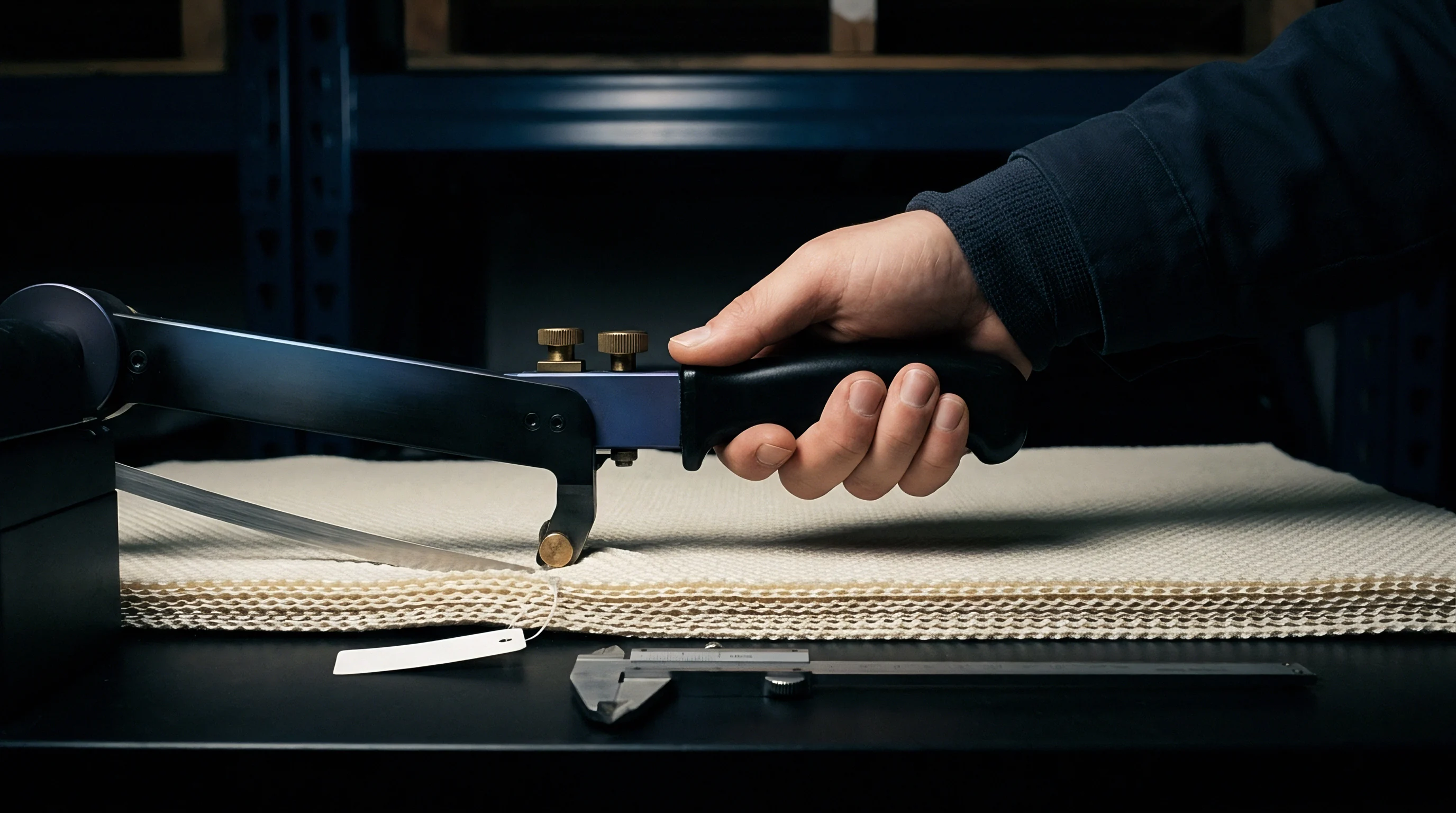
Extracting individual threads from a finished or greige fabric swatch forms the foundation of reverse-engineering yarn linear density. Operators begin by cutting a square or rectangular patch of cloth using a calibrated steel template and razor blade, following ISO 7211-5 or ASTM D1059 parameters. The swatch dimensions dictate the total length of yarn available for weighing: a 100-millimetre by 100-millimetre cut yields thread fragments of roughly 100 millimetres before crimp removal.
Because short individual thread segments increase the relative impact of cutting-edge deformation, standard protocols recommend dissecting a cumulative length of at least 10 metres for coarse yarns or 50 metres for fine filaments to get statistically valid readings on a calibrated micro-analytical balance.
Isolation requires separating the warp and weft systems without damaging the underlying fibers. Technicians fringe the edges of the cut rectangular specimen by pulling out initial threads along both axes and discarding damaged perimeter yarns. Threads are then gently pulled one by one using micro-tweezers.
Warp yarns stay separate from weft yarns throughout dissection, stored in distinct, labeled weighing containers to avoid cross-contamination. Warp threads frequently carry chemical sizing like polyvinyl alcohol or carboxymethyl cellulose, whereas weft yarns typically lack warp sizing but may contain lubricants or wax. Combining both systems into one bulk sample yields an invalid average linear density that matches neither true component count.
Mass determination demands analytical instruments with a scale interval of at least 0.0001 grams, though high-precision laboratories use balances resolving to 0.00001 grams when working with swatches smaller than 50 square centimetres. Drafts across the balance pan shift readings significantly, so all mass measurements take place inside a draft-shielded chamber after stabilizing for at least 30 seconds per specimen group.
- Cut a rectangular swatch measuring exactly 100 millimetres by 100 millimetres using a steel template, ensuring cuts align precisely parallel with warp and weft directions.
- Fringe all four edges of the cut swatch by pulling and discarding the outer five yarns in both thread directions to eliminate micro-trimmed or frayed fibers.
- Extract 50 individual warp threads sequentially with dissecting tweezers, taking care not to scrape away surface fibers or stretch the yarn during extraction.
- Repeat the extraction process for 50 individual weft threads, placing them into a second designated, pre-weighed aluminum weighing dish.
- Count and verify the exact thread tally in each dish under low-power magnification before transferring to the analytical balance chamber.
Failing to isolate enough total yarn length magnifies small cutting deviations into significant errors when scaling linear density up to commercial yarn purchases. An unrepresentative sample that skews yarn count by five percent distorts calculated fabric weight, leading to incorrect greige orders that trigger high warp breakage rates on high-speed air-jet looms.
Stripping
Woven fabrics off the loom or out of the dyehouse contain non-fibrous additions that add weight to unraveled yarns. Warp threads carry starch, synthetic binders, and anti-static lubricants applied during beam preparation, while dyed and finished goods retain dyes, flame retardants, water-repellent fluorocarbon resins, or softeners. Weighing unwashed yarns yields an inflated linear density figure that reflects chemical finish loads rather than the true structural yarn count.
Determining true linear density requires solvent extraction and chemical desizing under standard protocols like ISO 1833 or ASTM D2257 to return yarns to a bare fiber state before weighing.
Chemical extraction of non-fibrous matter must drop residual finish content below 0.1 percent total dry mass before linear density calculations occur.
Heavy shade reactive dyeing or dark vat dyeing can add up to three percent mass to cellulose fibers, while resin finishing adds up to eight percent total weight to cotton outerwear builds. To strip these additions without degrading the base polymer, technicians process unraveled thread hanks through sequential extraction. The process begins with petroleum ether or hexane in a Soxhlet extractor to dissolve fats, oils, and waxes, followed by an ethanol wash to remove water-soluble finishes.
Enzymatic desizing with alpha-amylase degrades starch size without damaging cotton or rayon polymers. Synthetics like polyester require hot water scouring with non-ionic surfactants to clear anti-static spinning lubricants.
- Thermal Degradation results from excessive drying temperatures during solvent evaporation, causing polymer scission and unrecoverable fiber weight loss.
- Incomplete Size Removal occurs when cold solvent baths fail to dissolve cross-linked synthetic warp sizing resins, leaving phantom weight on warp threads.
- Fiber Filament Loss happens during aggressive mechanical agitation of unraveled thread hanks in extraction baths, washing loose short fibers down the drain.
- Chemical Fiber Scission develops when acid desizing baths run at incorrect pH levels, hydrolyzing cellulosic fibers and understating true yarn mass.
Treating finish application rates as an integral component of finished yarn specifications conflicts with international testing consensus. Linear density defines bare fiber mass per unit length under standardized moisture regain, independent of post-spinning chemical add-ons. When suppliers include finish weight in yarn count quotes, buyers end up paying yarn prices for cheap chemical softeners.

Elongation
Yarn woven into fabric does not lie straight; it curves over and under opposing thread systems in a series of undulations known as crimp. Extracting a thread from a woven matrix leaves these bends intact. Measuring an unraveled yarn in its wavy state understates its true length, leading to a calculated linear density that is artificially high.
To determine the yarn’s length as spun on the bobbin, technicians apply specific tension to remove crimp without stretching the underlying fibers, following ISO 7211-3 or ASTM D3883 procedures.
The force applied to straighten unraveled yarns depends directly on yarn structure and fiber composition. Applying too little tension leaves residual crimp, recording a shorter length than exists. Applying excessive tension stretches the elastomeric core or aligns spun fibers beyond their resting state, creating an artificially long reading.
Standard testing frameworks specify a pretension formula based on nominal linear density: typically 0.5 centinewtons per tex for spun yarns and 0.25 centinewtons per tex for continuous filament yarns. Direct measurement uses a manual or computerized crimp tester equipped with a linear scale and adjustable micro-clamps.
| Weave Construction | Yarn Type | Nominal Crimp Range (%) | Standard Pretension (cN/tex) | Straightening Tolerance (%) |
|---|---|---|---|---|
| Plain Weave (1/1 Poplin) | Cotton Spun 15 tex | 7.5 – 12.0 | 0.50 | ±0.25 |
| Twill (3/1 Chino) | Cotton Spun 30 tex | 4.0 – 7.5 | 0.50 | ±0.20 |
| Sateen (5/1 Float) | Polyester Filament 8.3 tex | 1.5 – 3.5 | 0.25 | ±0.15 |
| Plain Weave Stretch | Cotton/Elastane Core 25 tex | 15.0 – 35.0 | 0.75 | ±0.50 |
Highly twisted yarns, such as crepe or hard-twist voile yarns, exhibit significant twist contraction alongside geometric weave crimp. When unraveling high-twist yarns, releasing the restraint of the fabric causes them to snarl and kink immediately. Straightening these yarns requires mountings that prevent untwisting during tension application, ensuring geometric crimp measurements isolate structural bending without altering mechanical twist.
Unraveled threads must be tensioned precisely to the point of crimp removal without inducing secondary fiber draft or elastomeric core extension.
A simple operational guideline governs crimp evaluation on the bench: if an unraveled yarn shows visible waves when mounted under load, the tension is insufficient. Correct tension eliminates visible undulations while maintaining a stable length reading over a five-second hold period.
Moisture
Ambient humidity rapidly alters fiber mass due to its hygroscopic nature. Cellulosic fibers like cotton and viscose absorb significant atmospheric water, whereas synthetics like polyester and nylon take up very little under laboratory conditions. Comparing linear density values measured at different relative humidity levels creates false variances.
Accurate testing requires either pre-conditioning and testing specimens in a standard atmosphere (20 ± 2 degrees Celsius and 65 ± 4 percent relative humidity according to ISO 139) or drying specimens completely in an oven to establish oven-dry mass before applying official commercial moisture regain factors.

Which Moisture Regain Factors Apply to Commercial Fiber Blends?
Determining the commercial linear density of unraveled yarn from a fiber blend demands precise multi-fiber mass calculations. When a fabric uses intimate blend yarns, such as 65 percent polyester and 35 percent cotton, total oven-dry mass must be partitioned according to blend proportions before applying standard regain percentages. Commercial regain values are set by international convention under ISO 6741-1 and ASTM D1909 standards.
| Fiber Classification | Standard Moisture Regain (%) | Commercial Regain Allowance (%) | Governing Standard Reference |
|---|---|---|---|
| Cotton (Carded or Combed) | 8.50 | 8.50 | ISO 6741-2 / ASTM D1909 |
| Viscose / Rayon | 13.00 | 13.00 | ISO 6741-2 / ASTM D1909 |
| Polyester (PET) | 0.40 | 0.40 | ISO 6741-3 / ASTM D1909 |
| Polyamide (Nylon 6,6) | 4.50 | 4.50 | ISO 6741-3 / ASTM D1909 |
| Wool (Scoured) | 17.00 | 18.25 | ISO 6741-4 / ASTM D1909 |
Drying unraveled yarn hanks involves heating specimens in a ventilated oven at 105 ± 2 degrees Celsius until constant mass is attained ~ reached when successive weighings at 15-minute intervals show less than 0.05 percent change. High temperatures volatilize certain fiber lubricants, so continuous filament synthetics carrying low-boiling spin finishes require drying at 50 degrees Celsius under vacuum to prevent weight loss from finish evaporation.
Oven-dry mass determinations require specimen weighing inside airtight weighing bottles immediately upon removal from the drying chamber to prevent rapid regain from ambient air.
Under standard commercial terms, linear density calculated from oven-dry mass must be adjusted by the official moisture regain percentage before comparing delivered yarn counts against purchase order specifications.
Calculus
Converting raw measurements into recognized linear density units requires mathematical adjustments for straightened length, extracted mass, non-fibrous content removal, and moisture regain factors. Direct yarn numbering systems express linear density as mass per unit length, where Tex represents grams per 1,000 metres and Denier represents grams per 9,000 metres. Indirect systems express density as length per unit mass, such as English Cotton Count (Ne) representing 840-yard hanks per pound, or Metric Count (Nm) representing kilometres per kilogram.
Direct linear density calculation in Tex uses the fundamental relationship:
Tex = (Mass in grams / Straightened Length in metres) × 1,000
When unraveled yarns are weighed after chemical stripping and oven-drying, the calculation incorporates the commercial moisture regain percentage to yield the commercial linear density:
Corrected Tex = (Mass_dry / Straightened Length) × (1 + R / 100) × 1,000
Where Mass_dry is the oven-dry mass of the stripped thread bundle in grams, Straightened Length is the total cumulative length of all straightened yarns in metres (calculated as the number of unraveled threads multiplied by the average straightened length per thread), and R is the standard commercial moisture regain percentage for the fiber type.
Consider a laboratory verification of an unraveled cotton poplin fabric, where a 100-millimetre by 100-millimetre cut specimen yields 50 warp threads. Testing measures an average straightened length per thread of 0.108 metres under 0.5 cN/tex pretension, giving a cumulative thread length of 5.40 metres. After size extraction and oven-drying, the 50-thread bundle registers a dry mass of 0.0912 grams.
Cotton carries an official commercial regain of 8.5 percent.
Applying the corrected formula gives:
Corrected Tex = (0.0912 / 5.40) × (1 + 8.5 / 100) × 1,000
Corrected Tex = (0.01689 × 1.085) × 1,000 = 18.32 Tex
To convert this Direct Tex figure to English Cotton Count (Ne), apply the standard constant conversion factor of 590.5:
Ne = 590.5 / Tex = 590.5 / 18.32 = 32.23 Ne
Unraveling plied yarns introduces an additional twist-length factor. Plied yarns consist of two or more single yarns twisted together, requiring untwisting to isolate individual single components. Singling tension must remove plying twist without drafting the single fibers.
Weighing unraveled plied threads directly without separating single elements yields the resultant yarn count, denoted as Tex (R), which is heavier than constituent single yarn counts due to mass accumulation per unit length from inserted plying twist.
Accurate reverse engineering accounts for each structural parameter. Combining crimp corrections, extraction losses, regain adjustments, and ply twist factors allows technicians to back-calculate spinning specifications from small woven cuttings, establishing solid baseline data for mill production setup.

Margin
Commercial fabric specifications establish acceptable tolerance bands around nominal yarn counts. A contract specifying 20 Tex cotton warp yarn does not guarantee that every thread measures precisely 20.0 Tex; trade standards like ISO 2267 and ASTM D1907 define acceptable manufacturing variances, typically setting tolerances at ±3.0 to ±5.0 percent for single spun yarns and ±2.5 percent for continuous filament synthetic yarns. When reverse-engineered yarns unraveled from delivered fabric fall outside these bands, buyers have technical grounds for lot rejection or commercial price adjustments.
| Yarn Classification | Nominal Count Range | Commercial Tolerance (%) | Dispute Action Threshold (%) | Primary Failure Mode |
|---|---|---|---|---|
| Carded Ring Spun Cotton | 15 – 60 Tex (10 – 40 Ne) | ±5.0 | 5.1 Shift | Fabric mass deficit, low tear strength |
| Combed Ring Spun Cotton | 10 – 30 Tex (20 – 60 Ne) | ±3.5 | 3.6 Shift | Hand feel distortion, pick density drift |
| Textured Filament Polyester | 5 – 30 Tex (45 – 270 Den) | ±2.5 | 2.6 Shift | Uneven dye absorption, streakiness |
| Flat Filament Nylon 6,6 | 1.5 – 15 Tex (15 – 135 Den) | ±2.0 | 2.1 Shift | Bursting strength loss, cover loss |
Discrepancies between mill spec sheets and laboratory reverse-engineering often stem from where measurement occurred along the manufacturing route. Mills measure yarn linear density on bobbins before weaving, where yarn sits in an unstressed, unsized state under standard spinning tension. Once woven, yarns experience severe warp tension on the loom, chemical sizing, heat setting in the stenter frame, and compressive shrinkage during finishing.
Heat setting polyester at 195 degrees Celsius causes thermal shrinkage that increases effective yarn linear density by three to six percent compared to greige spinning records. Conversely, heavy tentering draft stretches filling yarns, reducing weft linear density relative to original package specs.
- Standard Test Method Compliance verification requires matching ISO 7211-5 protocols against ASTM D1059 procedures to harmonize tension and extraction differences.
- Specimen Replicate Count validation mandates testing at least three independent swatches cut across the usable fabric width to average out selvedge-to-center weave tension variance.
- Conditioning Environmental Log examination demands checking temperature and humidity continuous recorder tracks inside the testing facility for atmospheric drift during massing.
- Chemical Extraction Certificate validation requires verifying complete binder resin removal through infrared spectroscopy on extracted residue samples.
Determining whether a three-percent increase in unraveled warp thread density stems from mill under-spinning or thermal shrinkage during stenter finishing remains a frequent point of dispute on the dyehouse floor. The technical dossier must isolate structural crimp and finishing draft from true fiber mass to assign financial liability for off-spec fabric deliveries.