Quantifying Crimp Interchange Energy Balances across Stenter Overfeed Range Adjustments
Calibrating stenter overfeed to match yarn crimp relaxation energy balances minimizes residual length shrinkage without sacrificing finished structural width.


Chamber
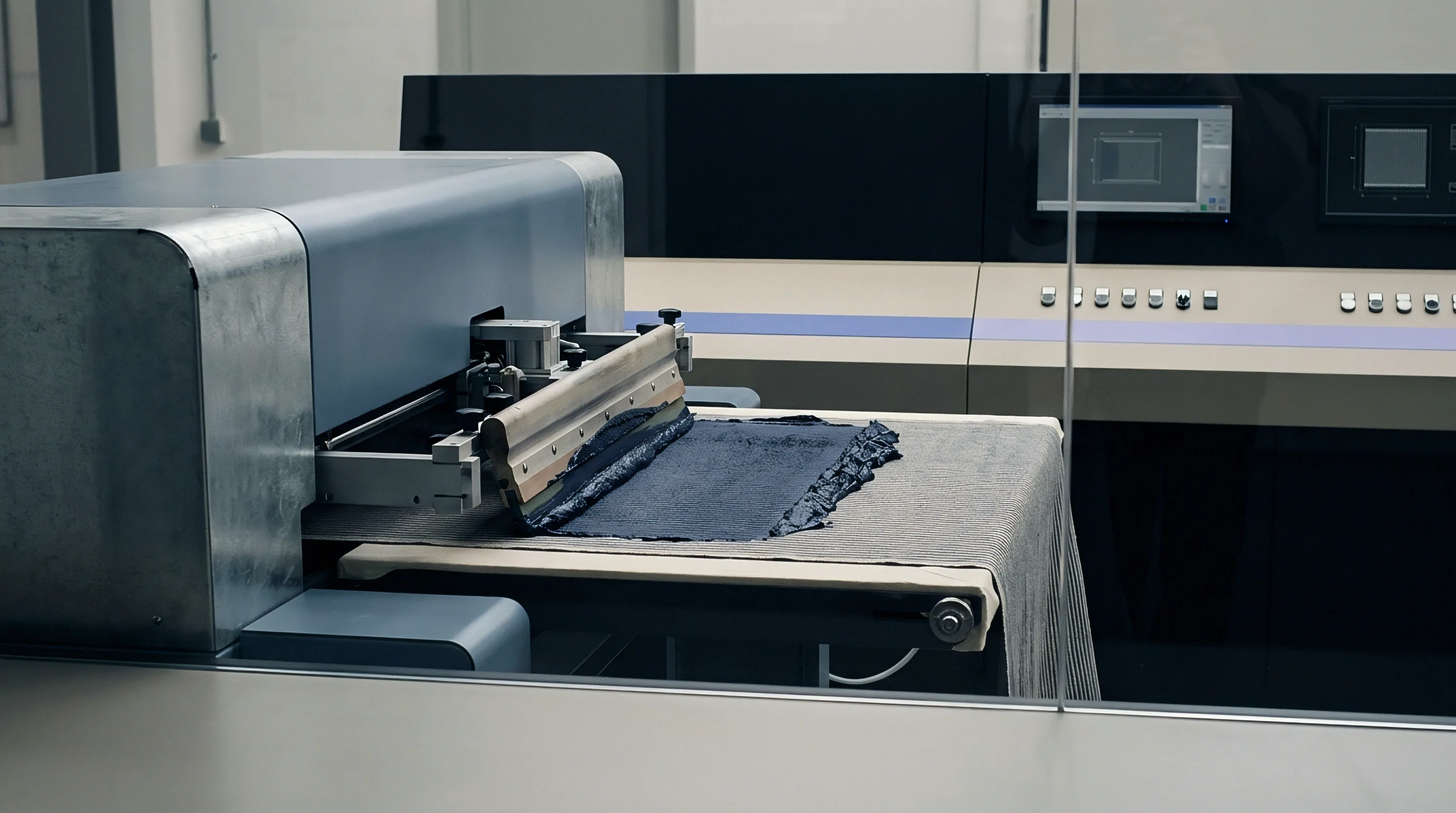
Overfeed delivery systems on industrial stenters feed cloth into pin or clip transport chains at speeds higher than the main drive rate. Mechanical feeding rollers deliver extra length per unit time to allow structural relaxation before thermal exposure. When gray goods enter the heating zones, pre-existing warp tension creates high internal strain energy along the length direction.
Applying positive overfeed between 0% and +18% alters the mechanical force balance at every yarn crossover point. Overfeed relaxes length tension.
Linear tension reduction along the length axis releases strain previously imparted during weaving and preparation. As length tension drops, warp yarns contract and increase their sinusoidal amplitude, forcing weft yarns to flatten under the transverse pin-chain holding force. This redistribution of geometric curvature between warp and weft threads defines crimp interchange.
Steam injected at the entry field lowers fiber modulus, accelerating the conversion of stored mechanical tension into geometrical crimp reorganization before high temperatures lock the structure.
Overfeed rollers deliver extra cloth length onto transport pins to release longitudinal tension prior to entry into high-temperature drying chambers.
Warp thread strain drops. Steam softens polymer bonds. Pin misalignment ruins selvedge edges.
High overfeed ratios without adequate steam setting result in mechanical bowing, where central warp yarns shrink faster than pinned edges. The table below outlines physical structural shifts observed across standard cotton and synthetic constructions across specified overfeed settings under ISO 5077 washing cycles.
| Construction Build | Overfeed Setting (%) | Warp Crimp Delta (%) | Weft Crimp Delta (%) | Mass Shift (g/m²) | Residual Length Shrinkage (%) |
|---|---|---|---|---|---|
| Poplin 120 g/m² Cotton | +2.0 | +0.4 | -0.6 | +2.5 | -4.2 |
| Poplin 120 g/m² Cotton | +6.0 | +1.8 | -1.2 | +7.1 | -1.8 |
| Poplin 120 g/m² Cotton | +10.0 | +3.1 | -1.9 | +11.8 | -0.5 |
| Twill 210 g/m² Poly-Cotton | +4.0 | +1.1 | -0.8 | +8.0 | -2.6 |
| Twill 210 g/m² Poly-Cotton | +8.0 | +2.6 | -1.5 | +16.4 | -1.0 |
| Twill 210 g/m² Poly-Cotton | +12.0 | +4.0 | -2.2 | +24.1 | -0.2 |
| Data obtained following ISO 7211-5 crimp unravel testing and ISO 5077 dimensional stability analysis after 5 standard laundering cycles at 40°C. | |||||
Dyehouse managers frequently claim that excessive length contraction during drying is an inevitable consequence of high-speed processing rather than a mechanical failure to calibrate entry overfeed ratios.
Equilibrium
Linear tension along length threads balances transverse force across width threads at the intersection point. Total strain energy inside an interlaced thread structure equals the sum of warp bending energy, weft bending energy, and inter-yarn compression energy. When mechanical tension along the warp direction drops during stenter overfeeding, the system seeks a state of minimal potential energy.
Heat resets polymer memory.
Strain energy distribution follows flexural rigidity and curvature vectors across warp and weft intersections. Yarn bending strain energy per unit cell is expressed by the integral of flexural rigidity multiplied by the square of yarn curvature along the thread path. Peirce crimp geometry models confirm that warp crimp height and weft crimp height maintain an inverse trigonometric relationship bound by thread spacing and yarn diameter.
Reducing warp length tension allows warp threads to increase curvature, which mechanically forces weft threads into a flatter configuration across the held width. Yarn bending absorbs strain energy.
Warp yarns absorb thermal relaxation by increasing crimp amplitude whenever longitudinal tension drops below the transverse bending threshold.
Thermal heat fixes thread crimp. Yarn flexural rigidity limits contraction. Tension shifts between thread systems.
When heat setting synthetic fibers above their glass transition temperature, thermal energy disrupts intermolecular hydrogen and van der Waals bonds. This thermal softening allows yarn bending moments to relax into the new spatial geometry established by overfeed ratios.

Quantified Energy Equilibrium Case Analysis
Evaluating a 210 gram per square metre twill structure demonstrates how strain transfers between thread systems. Consider a gray substrate with yarn linear densities of 30 tex warp and 30 tex weft, woven at 40 ends per centimetre and 24 picks per centimetre. On entering the stenter entry zone under nominal length tension, warp crimp measures 6.5% and weft crimp measures 8.2%.
Applying an overfeed of +8.0% at a heat-setting temperature of 190°C reduces warp tension from 180 Newtons to 15 Newtons across a 1.6-metre working width. Warp thread curvature increases from 420 m⁻¹ to 580 m⁻¹, while weft thread curvature decreases from 510 m⁻¹ to 360 m⁻¹. The total stored bending strain energy shifts from a warp-dominated state of 1.42 Joules per square metre to a balanced state of 0.88 Joules per square metre.
Warp crimp expands to 9.1%, while weft crimp contracts to 6.7%. This redistribution eliminates internal elastic strain, locking dimensional memory into the finished material.
Lowering warp tension allows crimp amplitude to migrate naturally toward the yarn system carrying the lesser flexural resistance during thermal setting.


Metrology
Standard testing protocols isolate thread crimp percentage using precise unravelling techniques. Measuring crimp interchange across stenter overfeed adjustments requires establishing baseline yarn length before and after manual straightening under standard pretension. Tension shifts crimp between systems.

Standardized Test Protocols
Executing ISO 7211-5 requires removing twenty warp and weft specimens under a baseline pretension of 0.5 centinewtons per tex. The unravelled straight length is compared against the initial distance in the intact substrate to calculate crimp percentage. Dimensional change after domestic laundering is determined using ISO 5077 paired with ISO 6330 washing procedure 4N at 40°C. Flexural rigidity testing following ASTM D1388 option A cantilever method quantifies bending stiffness changes caused by overfeed crimp shifts.
ISO 5077 testing shows residual length shrinkage drops below 1.5 percent when overfeed exceeds warp yarn relaxation potential by two percentage points.

Is Overfeed Adjustment Sufficient to Eliminate Residual Wash Shrinkage?
Achieving zero dimensional change after repeated laundering demands a complete balance between thread crimp states. Overfeed adjustments relax mechanical strain imparted during weaving, but fiber relaxation shrinkage remains governed by chemical composition and thermal history. Cotton fibers exhibit progressive swelling shrinkage upon wetting, which alters yarn diameter and demands higher crimp values than overfeed alone can deliver.
Polyester blend materials achieve near-complete dimensional stability through overfeed thermofixation because synthetic polymer chains lock their crystalline orientation at heat-setting temperatures.
Applying overfeed beyond structural equilibrium limits induces geometric distortions and mechanical processing errors on the stenter line:
- Selvedge Pin Tearout ~ Excessive longitudinal relaxation paired with wide tentering width causes intense shear force along pinning edges, tearing transport holes.
- Horizontal Surface Waves ~ Overfeeding beyond yarn crimp capacity creates unabsorbed longitudinal slack that manifests as loose ripples across the central chamber.
- Skewed Weft Realignment ~ Asymmetrical warp relaxation across transport chains causes transverse threads to angle away from 90 degrees.
- Mass Fluctuation Spikes ~ Irregular overfeed delivery yields erratic weight distributions along the length of bulk production rolls.
Calibrating stenter overfeed requires systematic operational control of transport mechanisms. The sequential steps for establishing correct overfeed ratios appear below:
- Measure gray warp crimp percentage using ISO 7211-5 prior to wet processing.
- Record wet length change across pad-mangle immersion and extraction.
- Adjust entry feed roll speed relative to pin chain speed to match calculated warp relaxation percentage.
- Verify selvedge pin engagement depth to prevent edge slipping under steam tension.
- Check dried substrate weight against Target GSM specifications using ISO 3801 circle cutter samples.
- Conduct fast 100°C moisture dissipation test to confirm drying complete before heat-setting chamber exit.
The table below provides metrological data tracking crimp interchange performance under varying heat-setting temperatures and dwell times for synthetic blend structures.
| Thermal Zone Temp (°C) | Dwell Time (s) | Overfeed Ratio (%) | Warp Crimp (%) | Weft Crimp (%) | Bending Stiffness (mg·cm) |
|---|---|---|---|---|---|
| 160 | 15 | +4.0 | 7.2 | 8.0 | 145 |
| 175 | 30 | +6.0 | 8.4 | 7.2 | 128 |
| 190 | 30 | +8.0 | 9.3 | 6.5 | 112 |
| 195 | 45 | +10.0 | 9.8 | 6.1 | 108 |
Commercial finishing contracts specifying ISO 5077 dimensional stability compliance enforce maximum length shrinkage thresholds of 2.0 percent, transferring financial liability for unrelaxed warp crimp directly to the processing mill.

Outturn
Mass per unit area increases directly with longitudinal relaxation and transverse contraction. When stenter overfeed allows warp yarns to shrink and increase crimp height, thread density per centimetre rises along the length axis. High overfeed increases mass density.
Chamber temperature drives drying rates. Overfeeding generates surface waves. Finished weight in grams per square metre shifts proportionally with overfeed selection.
Running finishing lines at elevated overfeed shifts linear output calculations while altering thermal energy consumption per metre. Increasing overfeed from +2% to +10% reduces total linear yardage produced from a fixed gray goods batch by 8%, while increasing unit weight. Finishing mills pricing goods on a linear metre basis lose billable length when maximizing overfeed, whereas mills selling on a weight basis gain revenue.
Balancing overfeed parameters against contract yield obligations requires analyzing cost drivers across processing operations.
Standard purchase terms reject bulk lots exhibiting weight deviations exceeding plus or minus three percent from approved pre-production swatches.
Thermal fixation fixes thread crimp configuration once the polymer matrix passes its glass transition point. Dwell time must suffice for internal thread temperature to reach setting thresholds before exiting transport chains. Insufficient dwell time causes elastic recovery, reversing overfeed crimp gains when material cools on rolling units.
Evaluating commercial viability requires analyzing finishing adjustments across machine parameters and operational costs:
- Target Weight Matching ~ Adjusting overfeed to meet specified grams per square metre bounds without exceeding thread density limits.
- Line Speed Efficiency ~ Maximizing stenter throughput metres per minute while maintaining thermal dwell time requirements.
- Energy Consumption Management ~ Controlling thermal oven fan speeds and burner output during high-moisture drying phases.
- Contractual Outturn Protection ~ Aligning linear yield expectations with customer dimensional stability targets before batch signoff.
| Overfeed Setting (%) | Stenter Speed (m/min) | Finished GSM (g/m²) | Linear Outturn per 1000m Gray | Gas Consumption (kWh/m) | Landed Cost Shift (%) |
|---|---|---|---|---|---|
| +2.0 | 45 | 182 | 980 m | 0.42 | Baseline |
| +6.0 | 40 | 189 | 940 m | 0.47 | +4.2 |
| +10.0 | 34 | 197 | 900 m | 0.55 | +8.9 |
| +14.0 | 28 | 205 | 860 m | 0.67 | +14.5 |
Miscalculating overfeed range limits reduces linear output speeds, elevates thermal energy consumption per finished unit, and creates irreversible mass per square metre rejections at incoming garment inspection.
Governance
Contractual specifications define permissible dimensional shrinkage tolerances alongside maximum allowable weight variance. Buyers setting technical standards specify ISO testing limits to ensure substrate stability during garment cutting and automated assembly. Skewed or over-stretched goods relax unpredictably during steam pressing in garment plants, causing sizing failures.
Proper dwell ensures permanent set.
Monitoring stenter drive logs confirms pin-on ratio consistency across multi-thousand-metre bulk runs. Mill auditors inspect digital speed tachometer records from overfeed rollers against main clip chain drives. Variance exceeding 0.5% across a batch indicates mechanical clutch slipping or operator override, resulting in shade variations and weight bands across finished rolls.
Uncertainty remains regarding how dynamic yarn-to-yarn frictional coefficients shift under varying chemical finish viscosity levels across high-temperature heat-setting zones.