Warp and Weft Crimp Interchange Principles in Fabric Weaving
Crimp interchange governs how warp and weft yarns swap geometric deflection under tension, dictating fabric dimensions, tensile balance, and residual shrinkage.
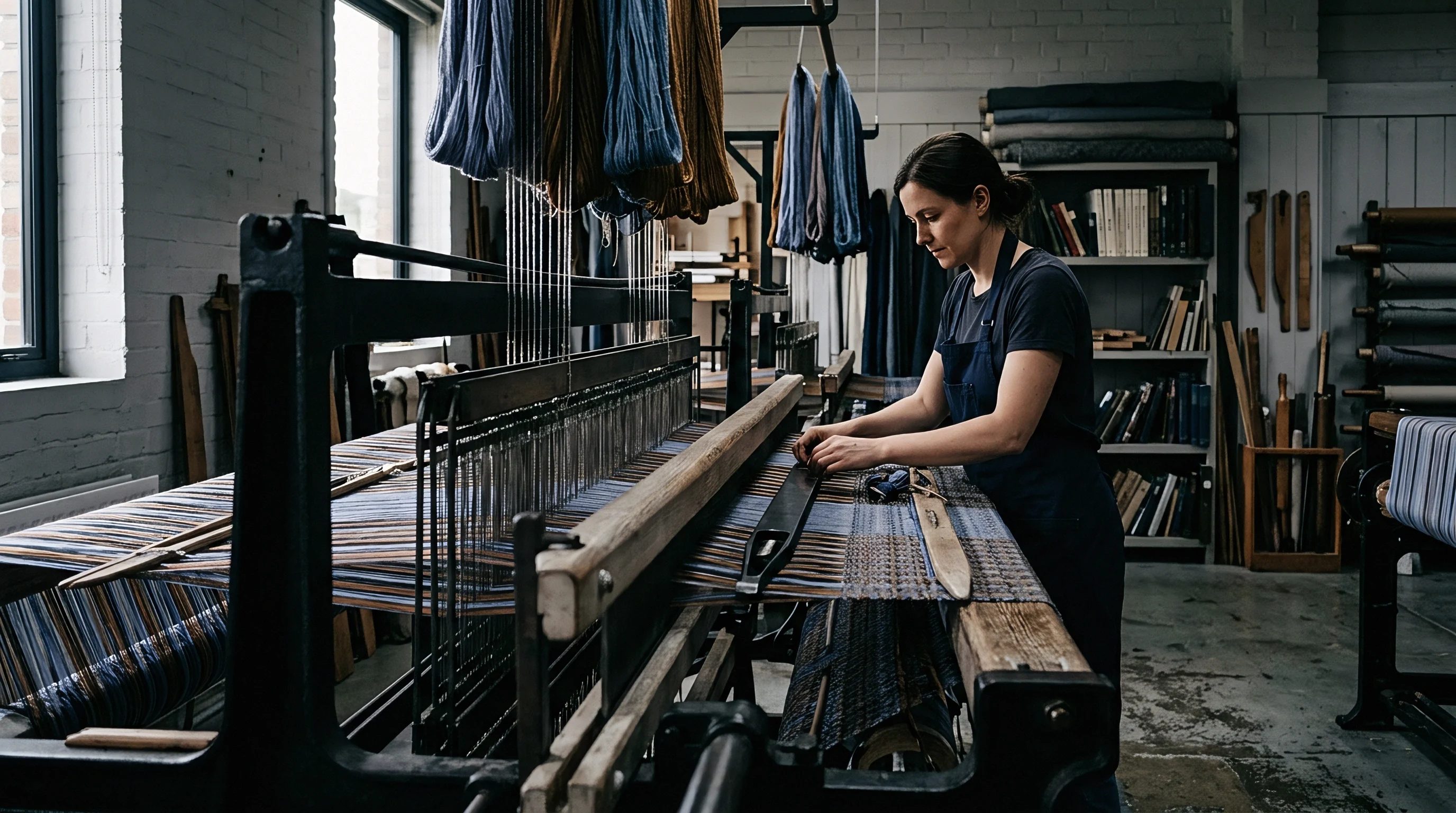

Geometry
Pierce Model and Structural Balance
Warp and weft yarns do not occupy straight axes inside a woven matrix. Interlacing forces each yarn system to follow a wavy trajectory around the transverse set, dividing total fabric thickness into individual thread displacements. Frederick Peirce formalized this spatial relationship in 1937, establishing that the sum of the maximum yarn axis deflections equals the sum of the yarn diameters when threads make tangential contact.
Yarn length along the crimped path exceeds the planar boundary of the cloth. Crimp percentage expresses this geometric surplus, calculated as the straightened yarn length minus the cloth length, divided by the cloth length, multiplied by one hundred according to ISO 7211-3. Setting loom warp tension high flattens the warp threads into near-straight lines.
That planar alignment forces the filling yarn to bend over and under every end, shifting weave displacement entirely into the cross direction.
Greige fabric fresh off the loom reflects machine dynamics rather than thermodynamic equilibrium. Loom warp let-off tensions frequently reach 0.3 to 0.5 grams per denier, while filling insertion occurs at fractional tensions under modern air-jet or rapier systems. This mechanical disparity leaves the loom-state cloth with suppressed warp crimp and elevated weft crimp.
Immersion into wet processing relaxes these locked internal forces. The yarn cross-sections swell, fiber moduli drop, and the entire assembly seeks minimal internal strain energy. Warp yarns shorten and buckle into arches.
Filling yarns pull flat, widening the reed space displacement unless mechanical tenter chains hold the selvedges to target dimensions.
A loom-state balance of four percent warp crimp and fourteen percent weft crimp will invert to eleven percent warp and five percent weft during scouring unless tenter rail tensions oppose the relaxation.
The mechanical interdependence of the two yarn systems defines crimp interchange. Any action that straightens the yarn in one direction increases the path deflection of the intersecting yarn. This exchange preserves the total geometric volume occupied by the interlacing zone.
When a finishing operator increases longitudinal tension on a continuous preparation range, warp crimp pulls out. The transverse filling yarn instantly contracts, increasing its crimp amplitude and pulling the fabric width inward. The converse behavior governs width expansion.
Forcing clip chains outward on a stenter flattens the filling yarn, driving crimp amplitude directly back into the warp system. The structural balance changes continually until resin crosslinking or heat setting fixes the final positions.
Predicting Structural Thread Deflection
Yarn count, twist factor, and raw polymer modulus limit the extent of interchange. A fine combed cotton yarn with a twist multiplier of 3.8 bends readily around a coarse open-end filling yarn. Stiff, high-modulus yarns resist curvature, forcing softer adjacent threads to execute the entire deflection arc.
The effective packing density of the yarn determines whether thread deformation remains circular or flattens into an ellipse at crossover points. The Peirce equations assume circular, incompressible rods, an assumption that diverges from actual high-sett apparel fabrics.
| Yarn System | Actual Sett (threads/cm) | Yarn Diameter (mm) | Thread Spacing (mm) | Crimp Percentage (%) | Weave Angle (degrees) |
|---|---|---|---|---|---|
| Warp (Greige Loom-State) | 24.0 | 0.245 | 0.417 | 4.2 | 14.8 |
| Weft (Greige Loom-State) | 20.5 | 0.252 | 0.488 | 12.8 | 26.1 |
| Warp (Boil-Off Relaxed) | 26.2 | 0.260 | 0.382 | 11.4 | 24.5 |
| Weft (Boil-Off Relaxed) | 19.2 | 0.268 | 0.521 | 5.1 | 16.2 |
| Warp (Heat-Set Finished) | 25.1 | 0.251 | 0.398 | 7.8 | 19.6 |
| Weft (Heat-Set Finished) | 20.0 | 0.255 | 0.500 | 8.4 | 20.8 |
Subsequent modifications by Kemp introduced the racetrack cross-section model, splitting thread geometry into a central flat rectangle bounded by semicircular edges. This correction accounts for flattening induced by yarn-on-yarn lateral pressure during beat-up. In dense industrial ducks or tightly packed poplins, yarn compression reaches thirty percent of initial unconstrained diameter.
That compression alters the thread spacing, shifting the jam point where no further threads can pack into the horizontal repeat. When a weaver attempts to pack picks beyond the jam point, the warp cannot deflect further. The loom experiences heavy reed bounce, pick variation, and uneven edge crimp.
Fabric structural mechanics leaves the exact energy dissipation during beat-up unmeasured across high-speed weaving cycles.


Tenter
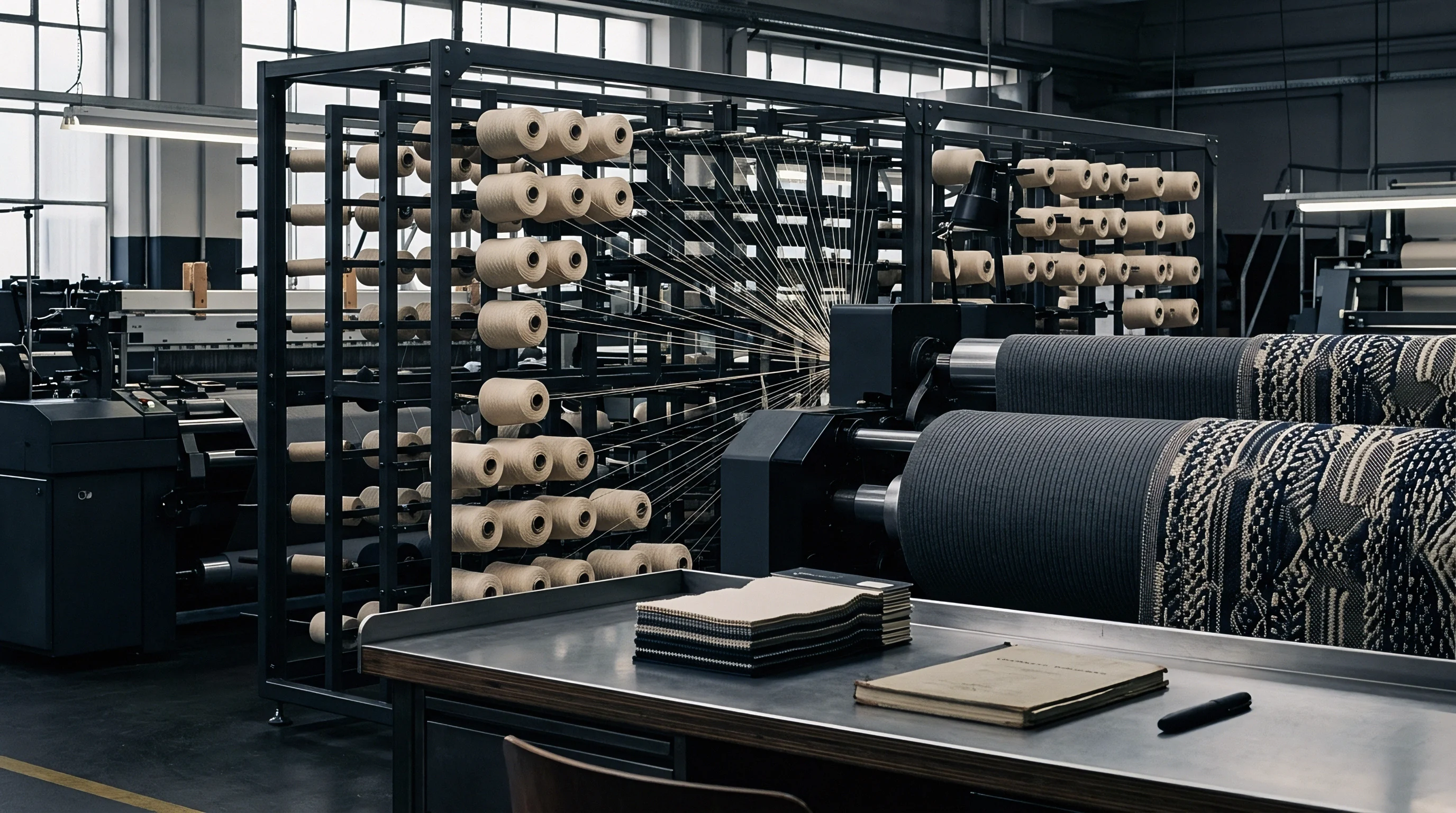
Biaxial Stress on the Finishing Rail
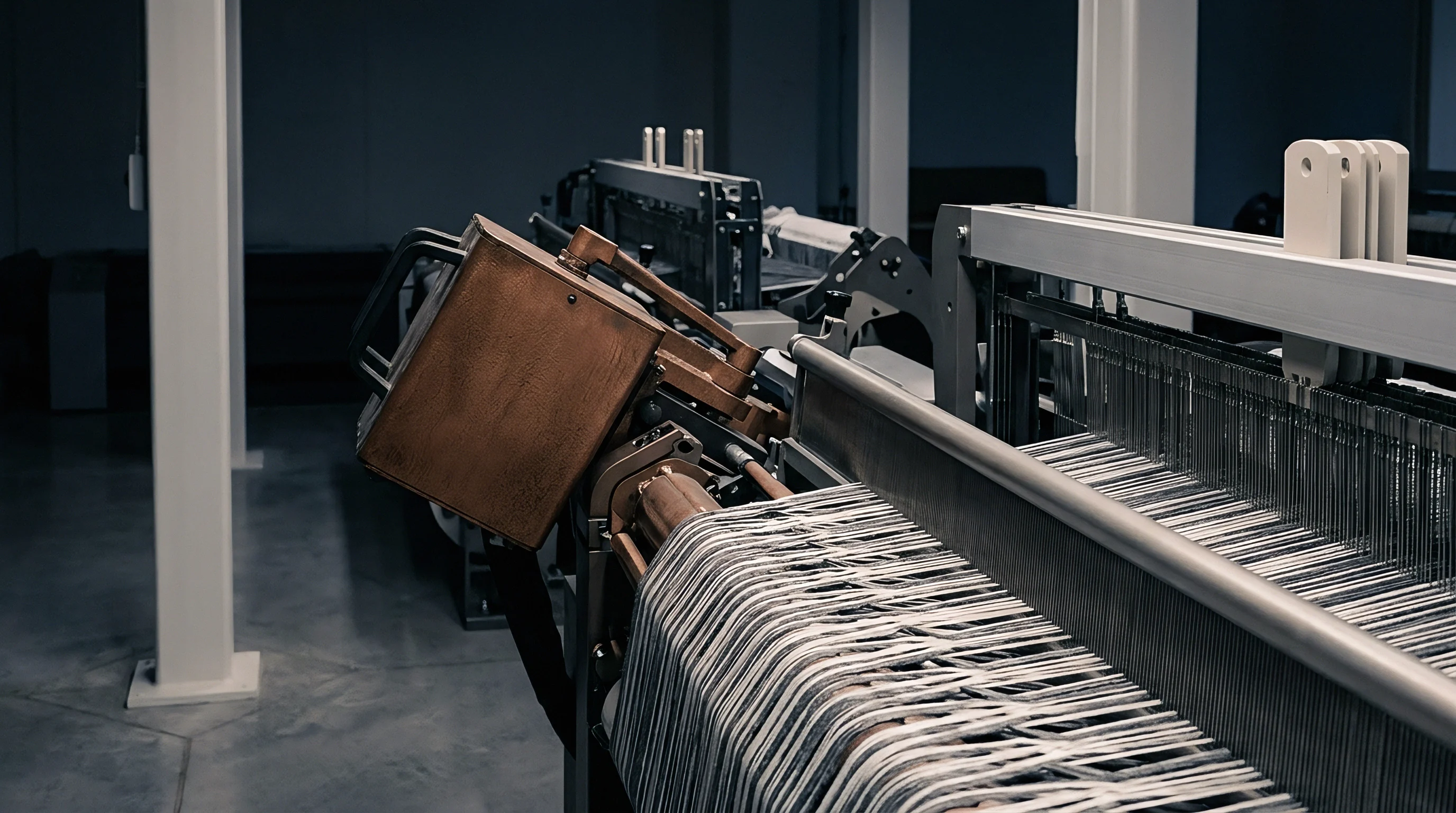
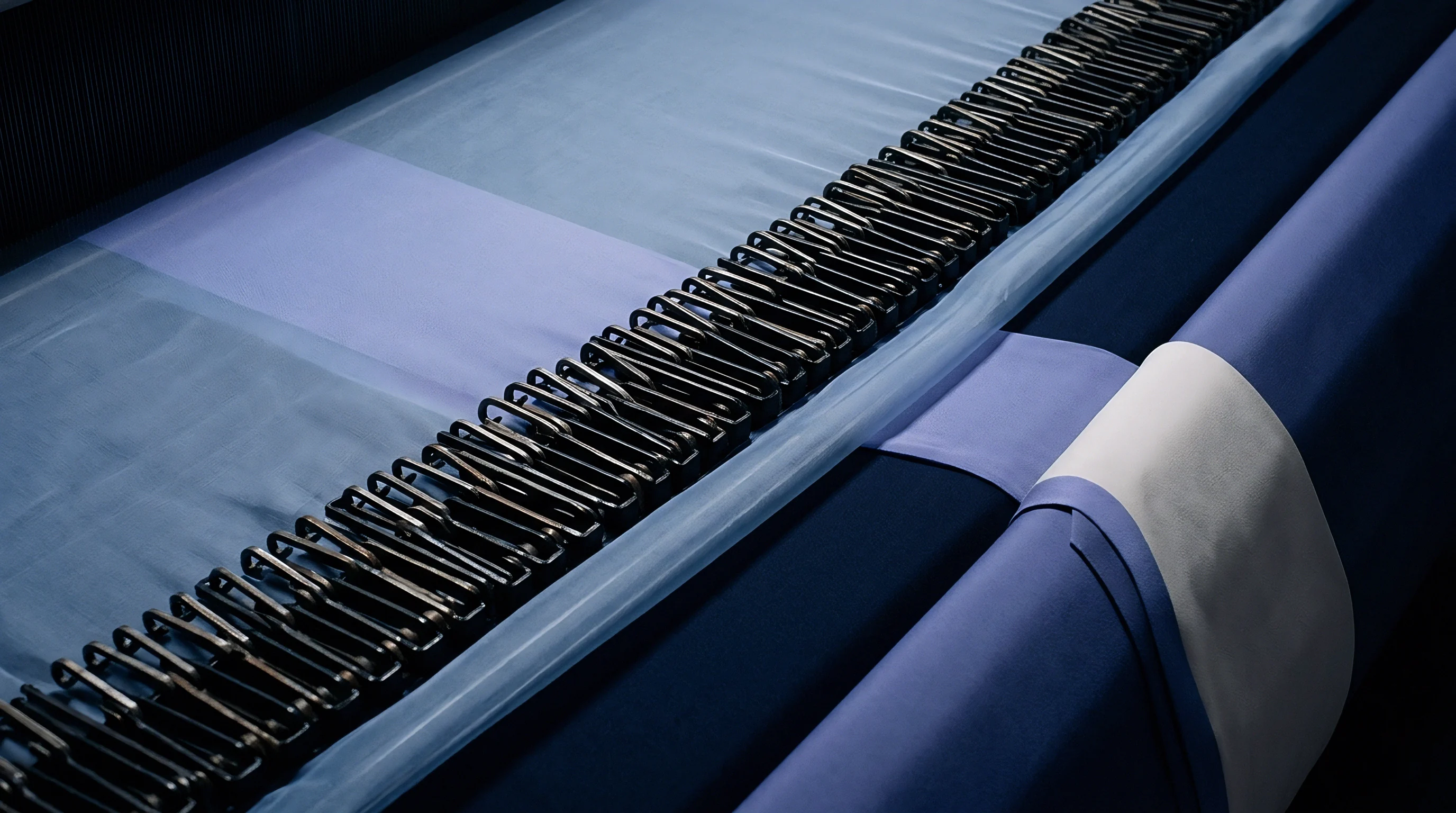
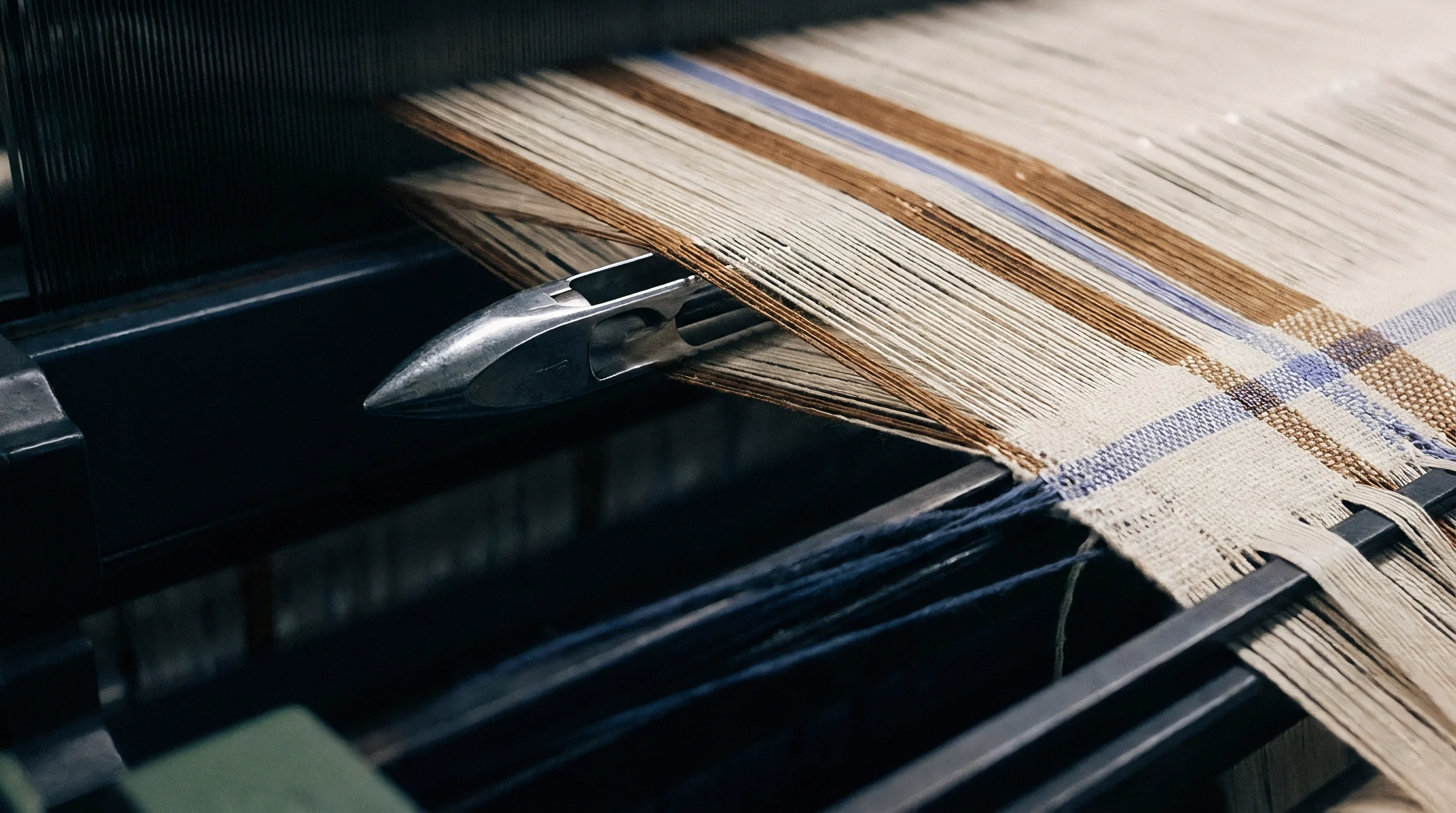
Continuous stenter frames apply controlled biaxial deformation to wet-processed wovens. Fabric enters the entry rail pinned or clipped along both selvedges, passing through heated chambers where drying, curing, or heat-setting occurs. The machine applies longitudinal tension through differential drive speeds between entry nip rolls and delivery rolls, while transverse tension is applied by divergence of the clip rails.
Here, crimp interchange acts as an unavoidable physical mechanism. An operator driving warp-tension rollers to eliminate center sag removes warp crimp, compelling the filling to crimp up and narrow the cloth width. If the stenter pins prevent width reduction, internal lateral tensions rise sharply, introducing severe latent stresses into the interlacing points.
Overfeed mechanisms control this tension transfer. Modern tenter entry heads permit overfeed ranges from minus ten percent to plus forty percent, dropping surplus length onto pins before rail divergence. Feeding length faster than the chain speed releases longitudinal tension.
The warp threads buckle outward into their relaxed, crimped state within the drying zone. That deliberate warp crimp injection allows the filling threads to pull straight under minimal lateral load. Proper balance yields finished goods showing equalized shrinkage properties during subsequent garment laundering tests.
Calibrating Width and Residual Extension
Operating without sufficient overfeed locks the warp in an elongated state. The stenter sets the warp threads straight, driving the filling into deep crimp arches. The fabric exits the delivery end meeting the target commercial width, but carries high potential warp shrinkage.
Water immersion during laundering breaks temporary hydrogen bonds or relaxes thermal crystallization, permitting the warp to reclaim its natural crimp arch. The finished garment shortens severely in length while gaining width across the chest.
Setting finishing lines requires precise alignment between rail spread and longitudinal roll drives. The target finished weight per unit area, measured by ISO 3801, depends on this crimp redistribution. Straightening the warp drops the warp sett count per centimeter through elongation while increasing picks per centimeter via weft contraction.
The fabric mass distributes unevenly across axes. The operational window demands continuous tracking of both thread counts across the stenter delivery console.
Improper clip rail settings cause immediate yardage rejections at the inspection dock when warp shrinkage exceeds commercial tolerances.

Heft
Cover Factor Trade-Offs
Fabric cover expresses the fraction of surface area obscured by parallel yarn systems. The classical Peirce fractional cover factor calculates as yarn diameter divided by thread spacing. Practical mill operations utilize the simplified formula: ends or picks per inch divided by the square root of the indirect cotton yarn count.
Summing warp and weft cover factors yields total fabric cover factor. Crimp interchange alters this metric without changing yarn mass. When finishing tension straightens the warp, its projected planar silhouette widens slightly due to untwisting and tensile flattening, raising local warp cover.
The filling yarn bends sharply into three-dimensional arches, presenting a reduced projected planar surface area and opening voids between picks.
Air permeability tests run under ISO 9237 at 100 Pascal differential pressure expose this structural shift. Flattening the filling yarn via stenter cross-stretching seals lateral spaces between warp yarns, decreasing bulk air flow. Conversely, pulling the warp straight under heavy continuous processing line tension opens spaces along the filling direction, increasing porosity.
Industrial filter media and downproof barrier fabrics depend entirely on balancing crimp interchange to seal pore diameters below forty micrometers without chemical coatings.
ISO 9237 air permeability on high-density 40s poplin drops from 28 liters per square meter per second to 11 liters when weft crimp is shifted below six percent via lateral tenter tension.
Dense technical weaves operate near theoretical jam limits. At these thresholds, crimp interchange reaches an asymptote where one yarn system cannot straighten without crushing the transverse yarn beyond its plastic recovery threshold. Weavers attempting to manufacture high-cover apparel wovens encounter this limit during loom setup.
Increasing warp tension to clear shedding problems flattens the warp sheet, forcing the filling to deflect deeply around ends. The shuttleless insertion nozzle then encounters high friction against the elevated weft peaks, causing pick stalls, short picks, and structural barre bands.
Which Processing Variable Governs Crimp Inversion?
Mechanical fabric tension inside the wet preparation range governs crimp redistribution more aggressively than bath temperature or surfactant chemistry. Continuous washing ranges apply direct drive torque to dozens of intermediate transport rollers. A cumulative draft of merely three percent across an eight-compartment washer removes half of the warp crimp established at the loom.
The cloth reaches the drying cylinders structurally distorted, carrying high warp elongation and severe weft crimp accumulation. Chemical auxiliaries lower the inter-fiber friction coefficient, accelerating this thread displacement under minimal applied tension.
Batch processing inside high-temperature jet dyeing machines produces a divergent dynamic. The fabric rope circulates in a relaxed state driven by hydrodynamic liquor flow through a venturi nozzle. Longitudinal and transverse tensions remain low and intermittent.
Both yarn systems relax simultaneously, allowing warp and weft to achieve natural thermodynamic equilibrium crimp. High-density twills processed on jigs retain linear warp tension throughout six to eight end-to-end passes under tensioned roll drives. The jig-dyed cloth emerges with flat warp and crimped filling, showing high residual warp shrinkage.
Jet-dyed equivalents of identical greige construction exhibit balanced crimp, square tensile strength distribution, and minimal residual shrinkage.
Mills often run jig dyeing to maximize yardage yield, accepting poor warp stability to gain two percent additional finished length.

Yield
Tensile Distribution and Modulus Transfer
Standard strip tensile tests conducted according to ISO 13934-1 reveal that crimp interchange controls the initial slope of the stress-strain curve. When a tensile jaw grips a strip of woven cloth, initial load does not stretch the fiber polymer. The applied load flattens the crimp arches of the stressed yarn system, pulling threads toward a coplanar axis.
This initial elongation phase represents pure structural uncrimping. Only after crimp falls toward zero does true fiber extension begin. A yarn system bearing twelve percent crimp displays an extended low-modulus toe region, absorbing displacement without substantial load resistance.
This uncrimping deformation drives transverse contraction within the tensile specimen. As warp threads straighten under longitudinal tensile load, they force transverse filling yarns into deeper crimp waves. This mechanical exchange pulls the sides of the test specimen inward, generating substantial necking before specimen failure.
The magnitude of this Poisson effect in woven fabrics relates directly to the ease of crimp transfer between warp and weft crossover points.
Tear resistance evaluated under ISO 13937-2 via the trouser method responds conversely to crimp distribution. High crimp provides mobility. When warp yarns carry significant crimp amplitude, they deflect and slide under tearing loads, grouping into tight bundles at the tear apex.
Bundled threads share the applied load collectively, elevating peak tear force values. Straightened yarns lacking crimp remain isolated in their matrix slots, breaking individually in rapid succession under low tearing energies. Wet processing setups that pull warp crimp out degrade finished warp tear strength by thirty percent.
Linear Meter Calculations across Finishing Routes
Fabric buyers purchase woven goods by the linear meter while mills price raw yarn inputs by the kilogram. Crimp interchange serves as the mechanical lever determining how many linear meters of finished cloth emerge from a given weight of warp and weft yarn. A mill engineer designs the greige construction on the loom with precise yarn lengths.
If the finishing line runs under excessive longitudinal tension, the cloth pulls out in length, delivering a yield bonus to the converter at the direct expense of finished fabric performance.
The arithmetic governing a standard 10,000-meter production order of a 2/1 twill chino demonstrates this financial and physical trade-off. Assumptions: yarn counts are 30/2 Ne warp and 16/1 Ne filling; loom-state construction is 42 ends per centimeter and 24 picks per centimeter; greige reed width is 168 centimeters to yield 150 centimeters finished width; greige crimp values are 6.0 percent warp and 10.5 percent weft. Total planned yarn consumption accounts for sizing take-up and operational waste.
Route A utilizes a low-tension continuous range featuring relaxed open-width scouring, high overfeed pin stenter drying, and compressive sanforizing. Warp crimp expands to 11.5 percent while filling crimp drops to 4.5 percent under stenter width expansion. The finished fabric relaxes longitudinally, delivering 9,650 finished linear meters from 10,000 greige meters.
Finished weight measures 252 grams per square meter. Warp shrinkage on a 60-degree cotton wash cycle under ISO 6330 settles at 1.8 percent.
Route B processes the same greige lot across an older continuous bleaching range with tensioned guide rolls, followed by minimal stenter overfeed of one percent to maximize finished yardage. Warp crimp drops to 3.2 percent while filling crimp climbs to 13.0 percent. The finishing plant produces 10,220 linear meters of fabric, generating an unearned length windfall of 570 meters.
Finished weight drops to 238 grams per square meter. Warp wash shrinkage spikes to 6.8 percent, failing standard commercial garment specifications.
| Performance Parameter | Test Method | Route A (Relaxed) | Route B (Tensioned) | Commercial Specification |
|---|---|---|---|---|
| Finished Linear Length (m) | Direct Tally | 9,650 | 10,220 | Contract Target: 9,700 |
| Areal Weight (g/m²) | ISO 3801 | 252 | 238 | 245 ± 5% (233 to 257) |
| Warp Crimp (%) | ISO 7211-3 | 11.5 | 3.2 | Reference Only |
| Weft Crimp (%) | ISO 7211-3 | 4.5 | 13.0 | Reference Only |
| Warp Tensile Strip (N) | ISO 13934-1 | 840 | 790 | Min. 700 |
| Warp Elongation at Break (%) | ISO 13934-1 | 18.5 | 9.8 | Min. 14.0 |
| Warp Trouser Tear (N) | ISO 13937-2 | 38 | 24 | Min. 30 |
| Dimensional Stability Warp (%) | ISO 5077 / 6330 | -1.8 | -6.8 | Max. -3.0 |
| Dimensional Stability Weft (%) | ISO 5077 / 6330 | -1.2 | +1.5 | Max. ± 2.0 |
The Route B lot delivers 570 extra meters on the invoice, but garment makers cutting these rolls encounter pattern warping, panel twisting, and heavy consumer returns from post-wash shrinkage.
Process control demands constant oversight of yarn interchange across every machine interface. The converter cannot alter warp tension without altering filling density, finished width, and tensile elongation.
- Yarn crimp verification tracks straightened-to-woven path length differences using an accurate crimp tester with standardized pretension clamps.
- Continuous tension monitoring requires load-cell idler rolls positioned at wet-compartment transitions to catch excessive mechanical drafts before fabric enters drying cylinders.
- Overfeed synchronization links stenter pinned entry speeds directly to delivery drives, forcing the warp into target crimp curves before thermal stabilization locks molecular orientation.
- Shrinkage audit protocols mandate immediate ISO 6330 testing on the first 500 meters of finished bulk to verify that crimp balance meets cut-and-sew stability envelopes.
Mills frequently justify excessive longitudinal delivery draft by asserting that customer-specified areal weight tolerances remained within nominal limits.
Sanforizing
Compressive Shrinkage Mechanics
Compressive shrinkage equipment, universally referred to as sanforizers, handles the final mechanical calibration of crimp interchange. The machinery relies on a thick continuous rubber belt wrapped around a steam-heated chrome drying cylinder. As the flexible rubber belt passes around a smaller reverse-curve roller before contacting the cylinder, its convex outer surface stretches longitudinally.
The fabric enters the machine damp, contacting the stretched rubber surface. As the belt transitions onto the primary heated cylinder, its outer surface contracts sharply, compressing the adhering fabric in the warp direction. This intense longitudinal mechanical thrust drives the warp yarns inward, forcing straight threads into tight, deep crimp arches.
Crimp interchange operates instantaneously during this rubber belt compression. Forcing the warp threads into deeper arches pushes the filling threads outward. Because the sanforizer does not clamp fabric edges with pins or clips, the fabric expands in width during processing.
The filling crimp straightens as warp crimp rises. An operator setting a sanforizer for eight percent warp compression anticipates a transverse width gain of one to two percent. Failure to allow for this weft uncrimping results in finished goods running wider than specification, dropping pick count per centimeter below target limits.
Contract terms specifying maximum two percent residual wash shrinkage under ISO 5077 compel the finishing line to increase warp crimp via compressive shrinkage.
Yarn shear resistance limits the effectiveness of compressive shrinkage. If a fabric features high yarn counts and a tight weave structure approaching the jamming limit, warp threads lack physical clearance to form deeper arches. Applying high compressive pressure to a jammed construction crushes the yarn cross-sections, producing mechanical creases, surface glazing, and bruised fibers without achieving permanent shrinkage stabilization.
In such constructions, the energy transfers into fiber damage rather than geometric crimp redistribution.

Can Compressive Belt Systems Stabilize Cross-Tensioned Goods?
Sanforizing cannot correct goods damaged by extreme earlier line tensions where the weft was pulled straight and heat-set. If earlier tenter passes locked the filling yarn into zero crimp through synthetic resin crosslinking or polyester thermal setting, the warp cannot form deeper crimp waves under compressive rubber belts. The crosslinks or crystalline domains anchor the filling threads against bending.
The compressed warp buckles locally, causing corrugated cockles, surface ripple defects, and severe loss of shear stiffness.
Proper sanforizing preparation requires the upstream finishing line to deliver fabric carrying sufficient transverse moisture and relaxed resin states. A water-spray conditioning chamber applies an exact ten to fifteen percent moisture add-on across the cloth before the rubber belt entry nip. This moisture plasticizes cellulose amorphous regions, reducing the inter-yarn friction coefficient and allowing threads to slide smoothly over each other during crimp interchange.
Without adequate conditioning, the dry yarns resist mechanical displacement, springing back toward their pre-sanforized geometry within twenty-four hours of roll winding.
Contractual disputes arise when cut panels shrink inconsistently across a single production lot. This variance traces back to sanforizer rubber belt wear. Belts develop concave thickness profiles across their width after thousands of processing hours, applying higher compressive displacement at the selvedges than at the center.
Warp crimp becomes uneven across the cut width, causing side-to-center shrinkage variance that ruins tiered production markers in the cutting room.
Residual internal stresses stay latent in the wound roll until the cutter splits the package on the spreading table.