Frictional Amplification Principle
Exponential tension magnification occurring when a flexible line wraps around a curved stationary cylinder characterizes the mechanical interaction governed by the Euler-Eytelwein relationship. The capstan effect defines how incoming yarn tension scales across an included angle of wrap against guides, tensioners or delivery pulleys. Mathematically, the exit tension equals the entrance tension multiplied by Euler’s constant raised to the product of the kinetic friction coefficient and the total wrap angle measured in radians.
This formula isolates geometric wrap and surface resistance as the sole drivers of tension magnification. The physical rule ceases to hold when the flexible line exhibits significant bending rigidity, slips plastically, or collapses under internal compressive stresses against the cylinder.
Geometry Mechanics
Incoming holding force converts into massive gripping resistance across small cumulative curvatures. When tensioned strands bend around guide pins, the radial pressure exerted against the cylindrical boundary increases along the arc of contact. Because normal force drives frictional resistance, each incremental angular advance compounds total sliding drag.
Ceramic eyelets, stop motions and tension posts within winding frames accumulate substantial wrap angles across a manufacturing line. Small variations in entry tension amplify exponentially into massive tension spikes at the exit point. Higher machine operating speeds elevate the boundary friction coefficient, compounding the resulting tension increase.
Yarn Delivery Control
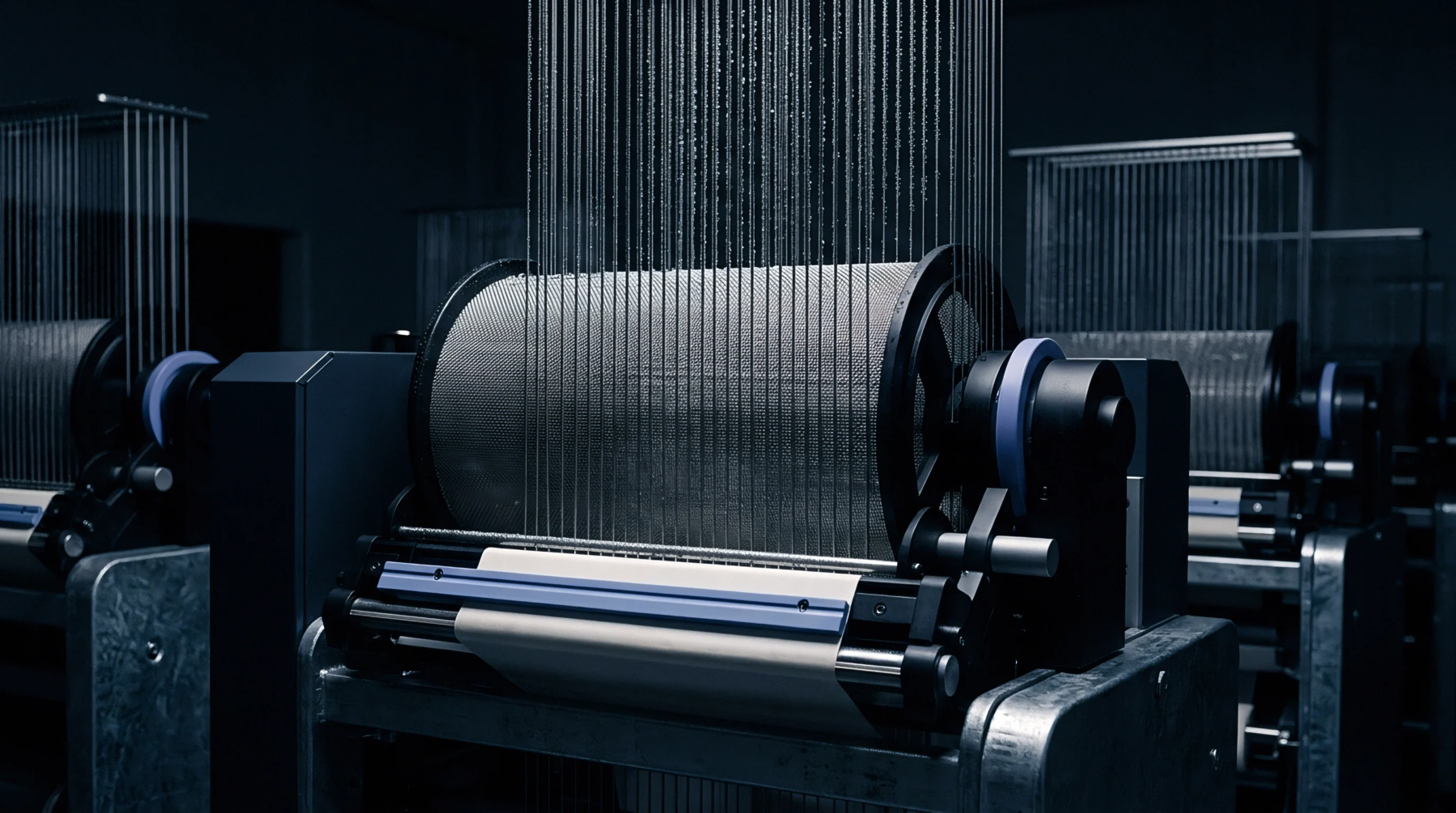
Manufacturing processes exploit this frictional relationship to brake, stabilize and deliver strand materials uniformly. Ring spinning travelers generate necessary winding tension by utilizing the capstan effect as the thread wraps across the curved metallic foot sliding along the ring track. Creels supplying direct-warping machines integrate adjustable wrap-post tensioners, allowing operators to calibrate strand tension by turning guide bars through fixed angles.
Circular knitting machines deploy cylindrical tension disks where small changes in wrap angle govern yarn feed consistency to prevent stitch length variation. If surface deposits alter local frictional resistance, downstream fabric yields develop streaks or horizontal barré defects. Laboratory validation relies on ASTM D3108 procedures, measuring yarn drag across fixed pins at defined angular wraps.
Structural Limits
Excessive tension escalation damages synthetic filaments and induces premature yarn rupture during high-speed take-up. Stiff yarns like carbon, aramid or high-tenacity glass fibers resist pure bending, violating the zero-rigidity assumption of Euler’s formula and inducing asymmetric internal shearing. Filaments flatten against hard ceramic pins, generating heat that softens thermoplastic binders or synthetic spin finishes.
Guide pins with larger diameters lower contact curvature and mitigate concentrated radial pressures. Process technicians minimize total angular deflection along yarn paths to prevent structural deformation and avoid filament breaks. Polished guide surfaces maintain a predictable friction coefficient, preventing erratic tension spikes across industrial creel arrays.