Automated Chemical Kitchen Dosing Precision and Fluid Dynamics in Continuous Dyeing
Automated chemical kitchen precision and pad trough fluid dynamic control eliminate shade tailing and cut chemical scrap rates below 0.2 percent in continuous dyeing.
Tank
Gravimetric Solution Preparation and Automated Dissolving Mechanics
Automated chemical kitchens weigh liquid and solid dye concentrates before feeding them to the continuous dye line. Dissolution accuracy rests on load cell sensitivity, water temperature control, and impeller speeds inside the stock tank. Errors made while preparing stock solution carry through the entire lot, causing unrecoverable shade shifts across thousands of metres of fabric.
Dye powders are dispensed using multi-stage gravimetric loss-in-weight feeders accurate to within plus or minus 0.1 grams per kilogram. For reactive dyes, cold-water solubility limits cap stock solution concentration. Monochlorotriazine dyes hold a stable concentration at 100 grams per litre at 60 degrees Celsius, while vinyl sulfone dyes must stay strictly between 40 and 50 degrees Celsius to avoid premature hydrolysis prior to alkali dosing.
Automatic stock tanks combine targeted ultrasonic agitation with variable-speed impellers running from 300 to 1200 revolutions per minute to break up micro-agglomerates without whipping air into the liquor balance.
| Dye Category | Maximum Concentration (g/L) | Dissolution Temperature (°C) | Agitation Speed (RPM) | Gravimetric Dosing Tolerance (%) |
|---|---|---|---|---|
| Vinyl Sulfone Reactive | 120 | 45 to 50 | 800 | ± 0.10 |
| Monochlorotriazine Reactive | 100 | 60 to 65 | 1000 | ± 0.10 |
| Disperse (High Energy) | 150 | 50 to 55 | 1200 | ± 0.15 |
| Vat (Solubilized) | 80 | 25 to 30 | 600 | ± 0.05 |
| Acid (Metal Complex) | 70 | 80 to 85 | 500 | ± 0.10 |
Preparing liquor automatically requires a strict sequence so chemicals do not precipitate inside the stock vessel. Each step runs under fixed thermal and volumetric limits.
- Fill the stock vessel to 60 percent of batch volume using softened process water rated below 0.5 degrees German hardness.
- Heat the water to target dissolution temperature with direct steam injection kept within plus or minus 1 degree Celsius.
- Start the primary mixer at 400 revolutions per minute while feeding solid dye granules through the dust-extracted gravimetric hopper.
- Increase mixer speed to 1000 revolutions per minute for 12 minutes to achieve complete dispersion of the dye.
- Dose auxiliary wetting agents using high-precision piston pumps to hold surface tension between 28 and 32 millinewtons per metre.
- Top off the vessel with cold process water to final target volume while bringing the liquor down to pad-line storage temperature.
Off-spec batches often stem from lax load cell calibration. Recalibrating twice a year is often assumed to keep drift negligible, but field measurements show load cell hysteresis can shift target weigh-outs by up to 1.8 percent within ninety days of continuous multi-shift operation in a humid dyehouse.
Meter

Mass Flow Control and Dynamic Proportioning at the Manifold
Continuous pad-steam and pad-batch lines rely on real-time dosing that scales chemical flow directly to fabric speed. Dynamic proportioning units pair electromagnetic or Coriolis mass flow meters with variable-frequency pump drives. Running 100 percent woven cotton drill at 60 metres per minute requires continuous feeding, with alkali and dye mixing only seconds before entering the pad trough.
Flow rate accuracy in mass flow meters handling high-viscosity dye lines drops by 0.35 percent for every 5 Centipoise rise in dynamic viscosity above baseline water calibration.
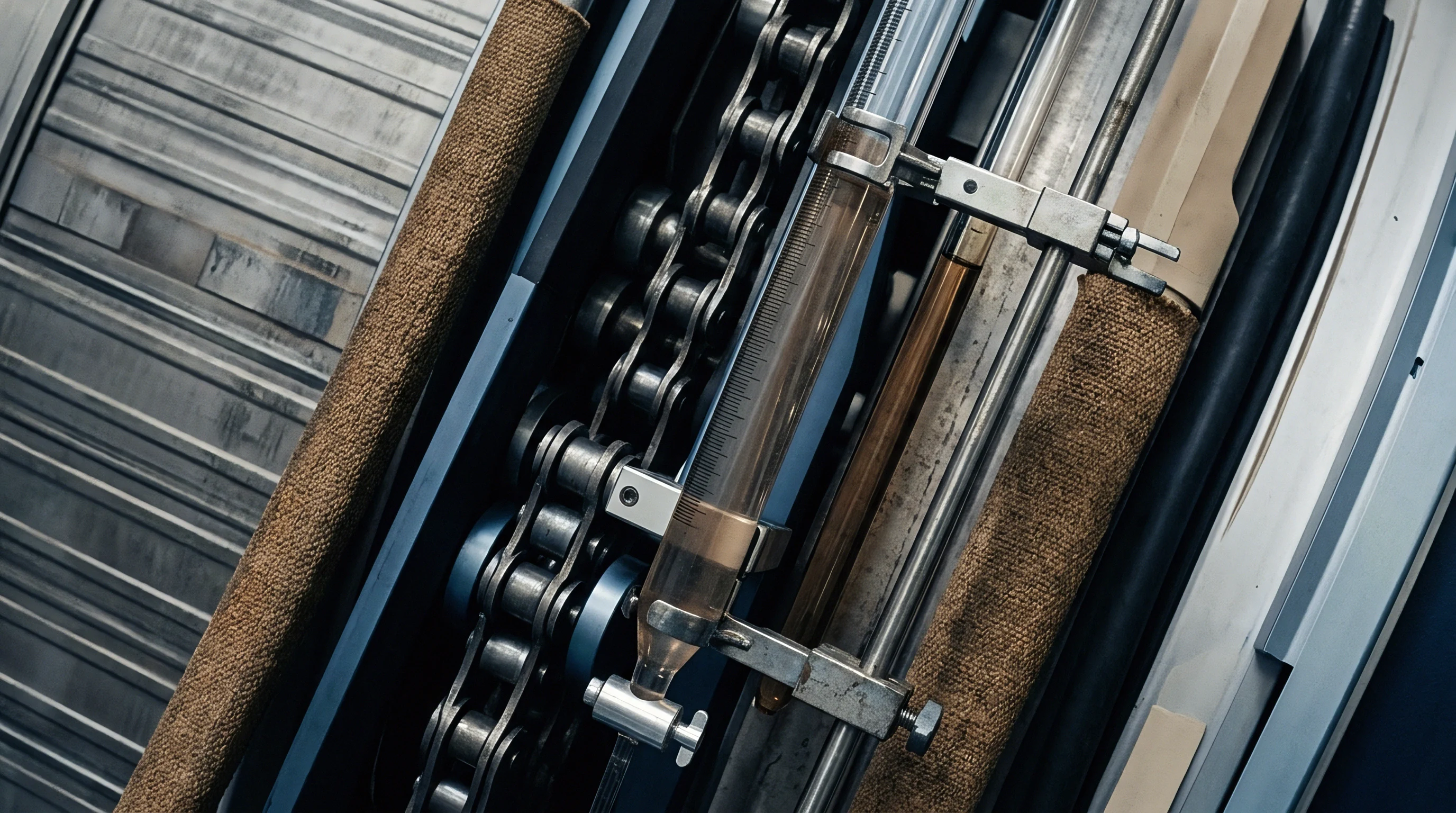
Coriolis mass flow meters measure mass directly, unaffected by shifts in fluid density, temperature, or viscosity. Electromagnetic meters cost less up front, but require stable electrical conductivity above 20 Microsiemens per centimetre, leaving them sensitive to air bubbles and non-ionic auxiliary buildup. In semi-continuous reactive pad-batch dyeing, dye liquor and alkali must join at a strict ratio, usually four parts dye to one part alkali (4:1 volumetric ratio).
High-pressure injection manifolds force sodium silicate or sodium hydroxide into the dye stream through counter-current micro-nozzles, creating thorough turbulent mixing in less than 150 millimetres of pipe.
Colorimetric Variance Derived from Flow Deviations
The practical impact of volumetric dosing errors shows up clearly in shade shifts on heavy fabrics. Take a 20,000-metre run of woven cotton twill (310 grams per square metre, 3/1 construction, 40 ends per centimetre, 22 picks per centimetre) dyed with a three-component reactive formula (Reactive Blue 19, Reactive Red 198, Reactive Yellow 145) at 68 percent target wet pickup on a pad-steam range.
The recipe specifies 24.0 grams per litre of Reactive Blue 19, 8.5 grams per litre of Reactive Red 198, and 3.2 grams per litre of Reactive Yellow 145, alongside 15.0 grams per litre of sodium carbonate and 2.5 grams per litre of sodium hydroxide (66 degrees Twaddell). Running at 50 metres per minute, total liquor delivery through the trough injection line is 63.24 litres per minute.
If roller wear in a peristaltic pump causes an unnoticed 2.2 percent drop in Reactive Blue 19 flow across a 4,000-metre section, blue concentration drops from 24.00 to 23.47 grams per litre. Spectrophotometer readings across this section under Illuminant D65, 10-degree standard observer show:
Delta L star increases by plus 0.42 (lighter shade balance), Delta a star shifts by minus 0.18 (greener tone), and Delta b star drops by minus 0.55 (yellow/red axis divergence). Total color difference reaches a Delta E CMC (2:1) of 0.88. Commercial supply chains generally cap allowable shade deviation against master lab dips at a Delta E CMC (2:1) of 0.50.
A 2.2 percent flow drop thus triggers full rejection of the 4,000-metre section, bringing re-dyeing costs, scrap losses, and delivery delays.
Uncorrected pump drift over long runs creates roll-to-roll color variation that fails shade sorting during garment cutting.
Pipe

Fluid Dynamics inside Delivery Pipelines and Fluid Shear Effects
Piping subjects dye liquor to dynamic stress as it flows from the chemical kitchen to the pad trough. Viscosity, inner pipe diameter, wall roughness, and flow velocity determine whether movement stays laminar or turns turbulent. These internal fluid dynamics set purge volume requirements, system pressure drops, and chemical shear risks.
| Internal Pipe Diameter (mm) | Flow Velocity (m/s) | Dynamic Viscosity (mPa·s) | Reynolds Number | Flow Regime | Pressure Drop (kPa/m) |
|---|---|---|---|---|---|
| 15 | 0.5 | 1.0 (Water-like) | 7,500 | Turbulent | 0.42 |
| 15 | 1.5 | 1.5 (Auxiliary Mix) | 15,000 | Fully Turbulent | 3.10 |
| 25 | 0.8 | 5.0 (Thickened Feed) | 4,000 | Transitional | 0.68 |
| 25 | 1.2 | 12.0 (High Viscosity) | 2,500 | Laminar/Transitional | 1.85 |
| 40 | 0.4 | 1.0 (Water-like) | 16,000 | Turbulent | 0.08 |
At Reynolds numbers below 2,300, flow remains laminar, producing a parabolic velocity profile where liquor near the pipe wall hardly moves. This boundary layer retains residual dye during shade changes. Crossing into turbulent flow (Reynolds numbers above 4,000) flattens the velocity profile across the pipe cross-section, allowing fast line purges and preventing high-viscosity thickeners from building up.
Polymeric leveling agents and alginates thin under shear: in tight pipe elbows where shear rates spike, viscosity drops sharply, shifting effective head loss and pump output.
Standard ISO 105-C06 wash fastness protocols enforce tight limits, yet shear inside delivery piping can destabilize auxiliary dispersions before liquor ever reaches the fabric.
Flow failures inside transport lines disrupt chemical feed stability and introduce physical defects at the pad trough.
- Air Cavitation Entrapment occurs when aggressive pump suction pulls dissolved air out of solution, creating micro-bubbles that skew density readings in downstream flow meters.
- Chemical Shear Degradation shears long-chain polymeric wetting agents inside narrow globe valves, lowering wet-out speed on grey cotton.
- Dead-Leg Stagnation leaves reactive dye sitting in unpurged tee-junctions and bypass loops, where it hydrolyzes before sloughing back into active production lines.
- Pulsation Friction Surge from positive displacement diaphragm pumps creates pressure pulses that vibrate flow sensors, corrupting feedback signals.
Fluctuations in pipeline shear rate during line acceleration can unbalance micro-emulsion wetting agents before the liquor hits the web.
Wedge

Pad Trough Hydraulics and Liquid Wedge Micro-Mechanics
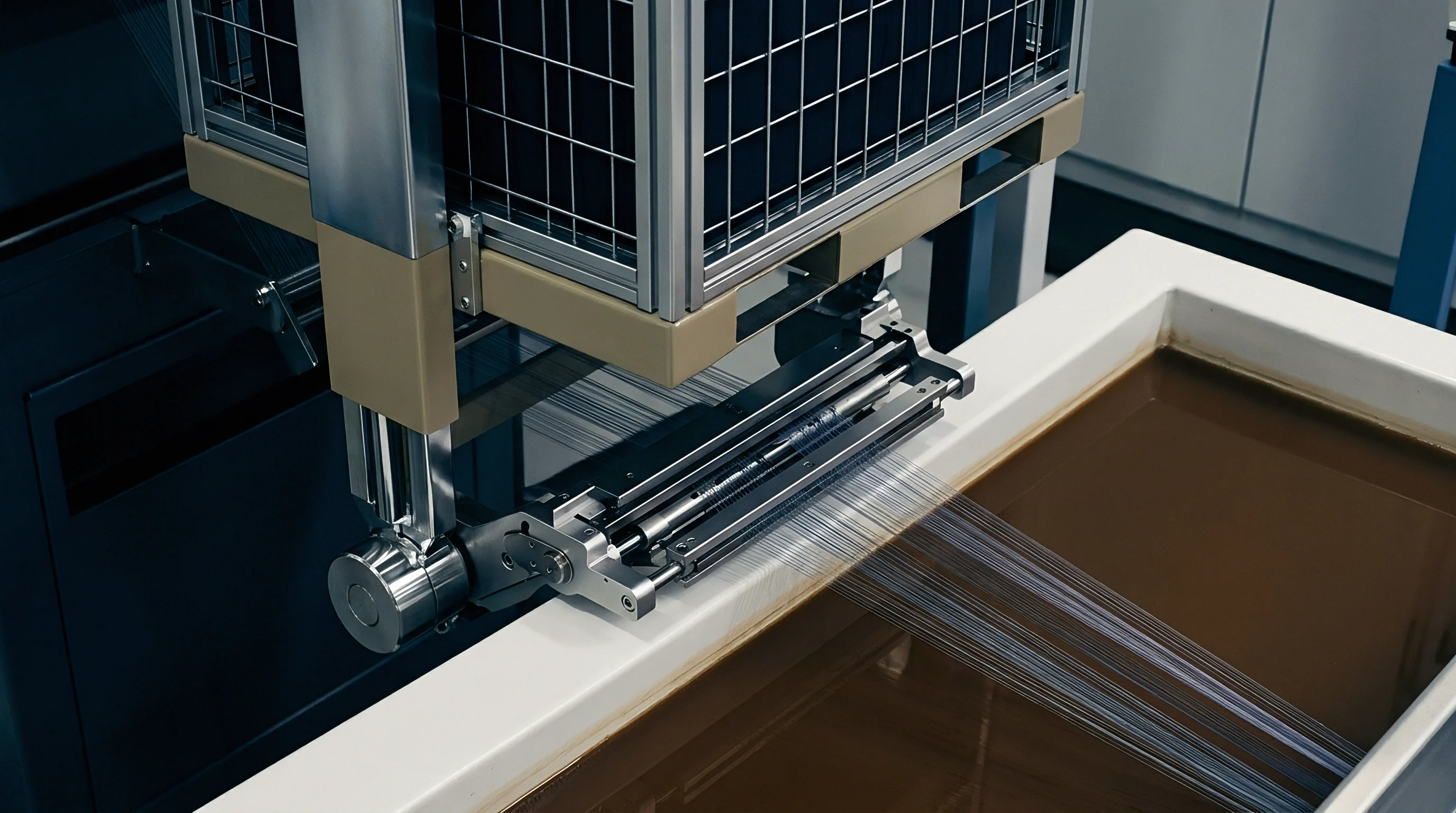
Continuous dyeing ranges apply dye solution to the moving fabric web inside the padding mangle nip. As fabric enters the trough and passes into the squeeze rolls, it carries a hydrodynamic boundary layer of liquid. Where the two rubber-covered steel rolls meet under pneumatic load, a liquid wedge forms under high dynamic pressure.
Trough geometry determines liquid volume and exchange rates. Compact modern troughs hold 5 to 15 litres, replacing older 50-litre designs. At 40 metres per minute, a small trough turns over completely every 30 to 60 seconds.
Fast turnover stops high-affinity dye molecules from stripping out early and causing head-to-tail shade drift. The liquid wedge just ahead of the nip acts as a pressure reservoir, forcing trapped air out of the web and replacing it with dye liquor at pressures up to 3.5 bar.
Low bath volumes and high exchange rates eliminate head-to-tail shade drift over long production runs.
Can Dynamic Trough Leveling Prevent Tailing Failures?
Holding a constant liquor level in the pad trough maintains uniform submersion time and hydraulic pressure. Ultrasonic sensors track bath height down to fractions of a millimetre, signaling kitchen pumps to adjust feed rates dynamically.
- Submersion Distance Control fixes fabric immersion length to keep initial capillary pickup stable before the nip.
- Trough Displacement Bars streamline fluid paths, cutting out stagnant pockets behind roll mountings where dye settles.
- Level-Linked Injection Loops vary kitchen pump speeds in real time, matching chemical feed rates to line speed changes.
- Temperature-Controlled Trough Jackets keep liquor temperatures within plus or minus 0.5 degrees Celsius, stabilizing dye affinity during fast runs.
Line speed must stay locked to chemical dosing rates. Doubling fabric velocity alters boundary layer thickness in the liquid wedge. Lower speeds give longer bath contact, whereas higher speeds rely on mechanical nip pressure to force dye into the yarn core.
Shade

Colorimetric Evaluation and Substrate Submersion Physical Kinetics
After leaving the pad mangle, fabric enters infrared pre-dryers and hot-flue chambers to fix the dye. Shade uniformity depends on stopping dye migration during early drying. When surface water evaporates too quickly, it pulls unfixed dye outward toward the heat, producing side-to-center listing or face-to-back shade splits.
Color acceptance requires comparing production fabric against the master dip under multiple illuminants (D65 daylight, TL84/F11 store lighting, and Illuminant A domestic tungsten). Online spectrophotometers measure left, center, and right web lanes continuously. Standard ISO 105-J03 specifies color evaluation using the CMC (2:1) formula, which draws an ellipsoidal tolerance boundary around target color coordinates (L , a , b ).
| Performance Parameter | Applicable Test Standard | Commercial Tolerance / Rating | Failure Mode / Mechanism |
|---|---|---|---|
| Shade Difference (Delta E) | ISO 105-J03 (CMC 2:1) | Delta E CMC ≤ 0.50 | Dosing precision drift or trough level fluctuation |
| Washing Fastness (60°C) | ISO 105-C06 (A2S) | Grade 4-5 (Staining/Change) | Incomplete unfixed dye removal during post-wash |
| Rubbing Fastness (Dry) | ISO 105-X12 | Grade 4 | Dye migration to surface during hot-flue drying |
| Rubbing Fastness (Wet) | ISO 105-X12 | Grade 3-4 | Poor ring-dyeing penetration inside yarn core |
| Light Fastness (Xenon) | ISO 105-B02 (Method 2) | Blue Wool Grade ≥ 5 | Photolytic degradation of chromophore structure |
Immersion depth and roll nip pressure determine whether dye penetrates the yarn core or remains on the surface. Heavy canvas (420 grams per square metre cotton warp, high twist construction) absorbs by capillary action far slower than lightweight weaves. Excessive nip pressure squeezes liquor past yarn intersections without penetrating individual fiber bundles, leaving surface dye deposits that fail ISO 105-X12 wet rubbing tests.
Monitoring three web positions online catches side-to-center shade variation before an entire lot is ruined.
Commercial supply contracts routinely allow buyers to reject fabric lots if cross-width shade variation exceeds Delta E CMC (2:1) of 0.60 under standard mill quality terms.
Margin
Financial Engineering of Automated Dosing and Yield Scrap Reduction
Replacing manual dye mixing with automated chemical kitchen dosing costs 150,000 to 450,000 USD, depending on the number of stock tanks, metering lines, and manifold feeds. Justifying the investment relies on lowering chemical scrap, shortening changeovers, and avoiding bulk shade rejections. For mills running 15 million metres annually, chemicals account for 25 to 35 percent of total wet-processing expenses.
Manual chemical preparation wastes 1.5 to 3.0 percent of total dye volume through operator weighing errors, unrecorded stock evaporation, and tank residue. Automated dosing brings batch preparation scrap down below 0.2 percent. Eliminating tailing and side-to-center listing raises first-pass fabric yield from 94.5 percent to 98.8 percent.
Financial returns show up clearly in a mill producing 10,000,000 metres of medium-weight twill (240 grams per square metre) annually using reactive recipes averaging 0.38 USD per finished metre in chemical cost:
Manual dosing scrap rate (2.2 percent average chemical waste): 83,600 USD annual chemical loss. Automated dosing scrap rate (0.15 percent average chemical waste): 5,700 USD annual chemical loss. Direct annual chemical savings: 77,900 USD.
Higher first-pass yields deliver even larger savings. Stripping or re-dyeing off-shade cloth wastes steam, water, and labor, costing about 0.85 USD per metre in direct rework while degrading tensile strength under ISO 13934-1 testing. Cutting off-shade rejections from 4.0 percent down to 0.8 percent across 10,000,000 metres saves 320,000 metres of rework, saving 272,000 USD in direct processing costs.
Fabric supply agreements increasingly require documented chemical kitchen specifications inside technical dossiers. Sourcing audits demand verified machine logs covering gravimetric calibration intervals, flow meter types, and trough volumes before approving production orders.
Purchase agreements routinely spell out explicit parameters in their chemical kitchen annexes:
- Gravimetric Feeder Specifications specifying load cell accuracy within plus or minus 0.1 percent across the full operating range.
- Flow Sensor Technology Types requiring Coriolis mass flow meters on primary chemical, dye, and alkali feed lines.
- Pad Trough Volume Limits capping bath capacity at 15 litres with integrated ultrasonic dynamic leveling.
- Automated Line Flushing Logs recording automatic dead-volume water purges between color changes.
Automated kitchen systems pay back in under fourteen months at monthly production volumes above 600,000 metres. Running continuous dye lines on manual chemical prep leaves operations vulnerable to yield loss, unfixable shade variation, and steady margin erosion.