Nonlinear Relaxation Kinetics in High Elasticity Knitted Greige Structures during Continuous Open Width Wet Processing
Controlled hydrothermal overfeed in continuous open width washing suppresses elastane creep memory, ensuring cross-width density consistency and dimensional stability.
Creep
Circular and warp-knitted greige rolls arrive at the continuous open-width line with severe frozen deformation. Knitting needles pull elastane yarns into high extension ~ often between 180 percent and 320 percent draft ~ locking structural energy directly into the loop intermeshing points. The loops stay distorted because synthetic spinning lubricants, silicone oils, and knitting waxes coat the filaments, forming temporary frictional bonds that hold back immediate recovery.
Once unrolled for open-width preparation, this stored strain releases over time through mechanisms driven by polymeric viscoelasticity and inter-yarn friction.
When circular knit tubes unwind through driven slitting systems, internal stresses decay unevenly. Transverse tension gradients develop as fabric edges shed confinement while the center holds onto axial knitting tension. Viscoelastic recovery then moves through distinct phases: an instantaneous snapback right at slit release, followed by the slow, logarithmic chain reticulation of polyurethane segmented blocks.
If processing lines fail to accommodate this multi-stage contraction the moment the roll opens, the fabric develops differential density bands that persist through every subsequent wet stage.
Single jersey knits with 20 percent elastane shed up to 14 percent of their greige width within ninety seconds of tension-free exposure at ambient moisture.
Recovery slows the longer a roll sits in storage. Greige rolls left on warehouse pallets for six weeks undergo substantial stress relaxation while still wound, behaving quite differently from rolls delivered to the wet range within forty-eight hours of knitting. High winding tension during knitting forces the elastane core into permanent creep under ambient storage, shifting where the recovery curve begins.
Finishing plants frequently overlook this storage delta, applying uniform wash settings across mixed yarn lots.
- Intermeshing Friction Lock holds loop heads in asymmetrical contact until aqueous wetting breaks down yarn-to-yarn boundary wax layers.
- Elastomeric Retraction Force pulls adjacent ground loops into three-dimensional puckers whenever external web tension drops below zero point zero five centinewtons per tex.
- Slit Edge Differential forces outer wales to contract faster than central ones, curling the edges tightly toward the technical face.
Dimensional variation is often assumed to balance out during downstream thermofixation regardless of early processing tension.
Heat
Thermal activation accelerates how polyurethane macromolecular segments rearrange during wet processing. Dry greige goods resist complete contraction because hard urethane segments function as physical crosslinks below their primary thermal transition temperatures. Dunking the open-width fabric into hot wash liquor plasticizes these domains, dropping the activation energy barrier for relaxation and triggering heavy structural shrinkage in fractions of a second.
Bath temperature directly dictates structural shrinkage: when open-width fabric enters water above 60 degrees Celsius, soft polyether or polyester segments in the elastane gain sudden conformational mobility. Knitted loops round out, stitch density spikes, and total surface area contracts rapidly. Running high-elastane knits through an abrupt thermal gradient causes shock marks, as adjacent areas contract at different speeds from uneven liquor penetration.

Can Hydrothermal Shock Lock Viscoelastic Recovery?
Entering an 80-degree wash bath without progressive pre-wetting introduces severe distortion. Greige structures contract unevenly because water takes measurable time to penetrate dense circular knit packages. Outer faces of the yarn bundles relax almost instantly while inner cores stay dry and extended for several seconds.
Multi-stage ramp compartments prevent this issue by stepping the web through 40 degrees, 60 degrees, and 85 degrees Celsius to synchronize recovery across the fabric’s thickness.
As polyurethane soft segments mobilize, chemical scouring additives accelerate relaxation by stripping hydrophobic paraffin and mineral lubricants that retard fiber movement. Once surfactants emulsify these oils, the true elastic recovery curve steepens sharply, requiring immediate mechanical overfeed synchronization to prevent web necking.
| Knit Construction | Elastane Proportion | Greige Mass per Area | Initial Elastic Recovery Rate | Total Hydrothermal Area Contraction | Residual Boiling Water Shrinkage |
|---|---|---|---|---|---|
| Single Jersey 44 Gauge | 18 Percent | 140 g/m² | 4.2 Percent per Second | 28.5 Percent | 3.8 Percent |
| Single Jersey 36 Gauge | 25 Percent | 175 g/m² | 6.8 Percent per Second | 34.2 Percent | 4.5 Percent |
| Interlock 40 Gauge | 22 Percent | 210 g/m² | 3.1 Percent per Second | 22.4 Percent | 3.1 Percent |
| Warp Knit Tricot 32 Gauge | 28 Percent | 160 g/m² | 7.4 Percent per Second | 38.0 Percent | 2.6 Percent |
| Warp Knit Raschel 28 Gauge | 38 Percent | 240 g/m² | 9.1 Percent per Second | 46.5 Percent | 2.1 Percent |
Hydrothermal relaxation reaches structural equilibrium only when bath chemistry completely strips spin finish without mechanical web pull.
Finishing engineers continue to debate the exact mechanisms that ensure residual contraction stays uniform across wide-width elastic knits.


Nip
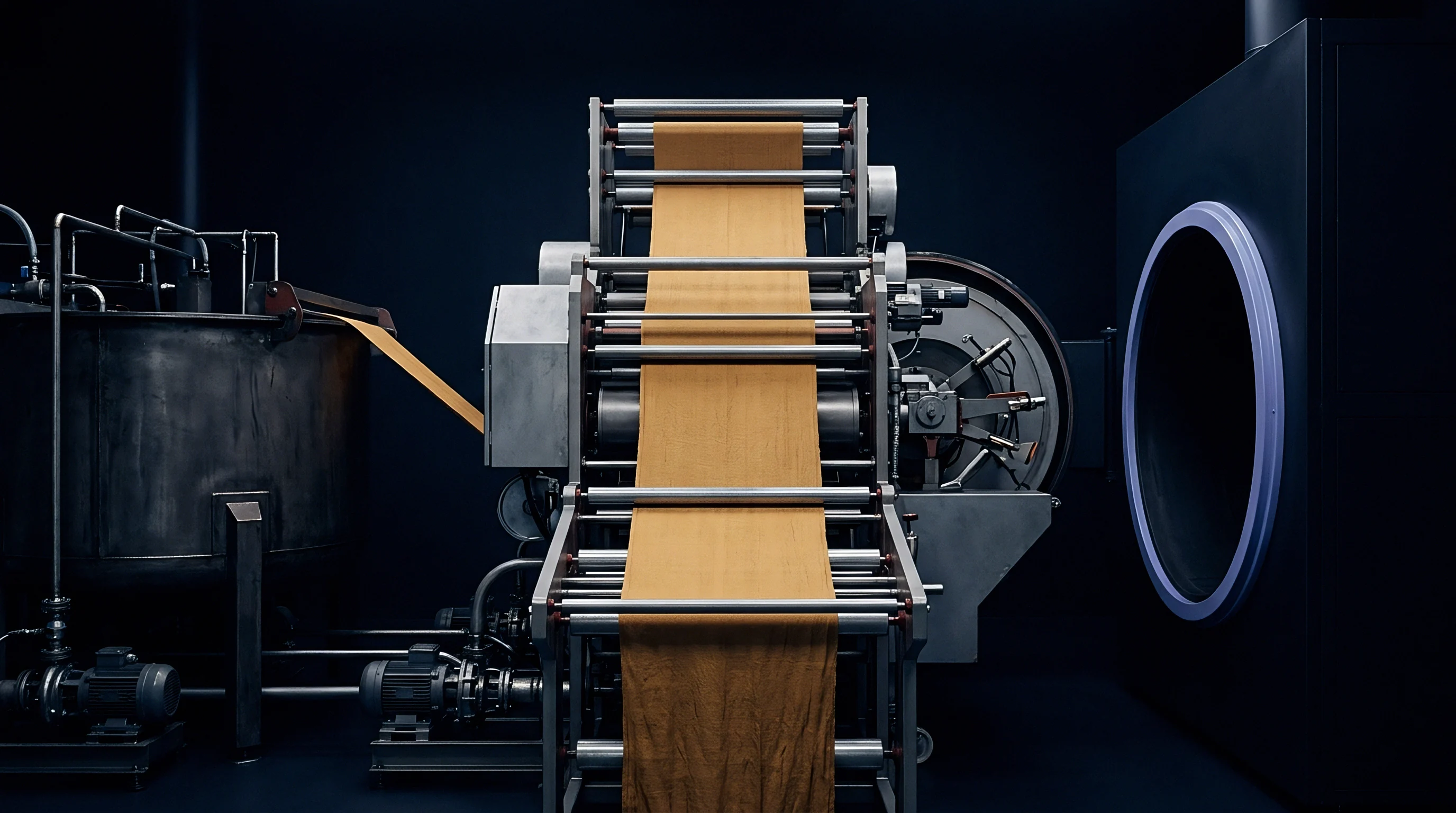
Continuous open-width lines rely on driven rollers and squeegee extractors to transport and dewater running fabric. Every contact point between the web and a steel roll introduces longitudinal stress that directly counters natural relaxation. When a range pulls 180-gram single jersey through submerged guide rolls, lengthwise tension stretches the loops, converting potential area shrinkage into artificial elongation.
Driven rolls inevitably introduce drag. Conventional squeeze rolls exert linear pressure that flattens wet, relaxing loop crowns while pulling the fabric forward. If the speed of consecutive drive motors fails to match the contraction rate of the substrate, the machine exerts parasitic draft.
This draft halts transverse relaxation, causing the web to narrow excessively and locking tension into the lengthwise wales.

Does Segmented Tension Control Prevent Centre Creasing?
Individual drive motors fitted with sensitive load-cell dancers eliminate line draft by decoupling roll speed from fabric resistance. As greige knit contracts in the liquor, linear length decreases while mass per unit area rises. Modern ranges run continuous overfeed setups, feeding 5 to 15 percent excess fabric length into each washing tank.
Submerged driven conveyor belts or perforated drums support the open structure without subjecting it to roll-face friction.
Running at speeds between 25 and 60 meters per minute, modern high-efficiency lines allow less than twelve seconds of active liquor contact per compartment. At these velocities, edge-unrolling spirals and scroll rolls must continuously open up selvedges before every nip point. A folded selvedge passing through a high-pressure squeegee roll undergoes localized over-compression, setting permanent creases that heat setting cannot remove.
- Driven feed spreaders introduce fabric into the first scouring bath with synchronized mechanical overfeed to permit immediate longitudinal loop contraction.
- Scroll decurlers sweep edge loops outward right upstream of each extraction nip, counteracting curling forces from asymmetric stitch torque.
- Submerged load cells continuously measure web tension, tweaking roll speed in 0.1 percent increments to keep line draft under five Newtons per meter.
- Soft rubber squeeze nips with calibrated shore hardness provide progressive dewatering, pressing out suspended lubricant emulsions without flattening loop crowns.
Standard quality protocols under ISO 13934 specify that shipments showing variable roll-to-roll tensile elongation from nip draft will fail final inspection.
Defect
Failing to accommodate non-linear relaxation kinetics results in severe flaws across finished rolls. When an elastic knit contracts unevenly under improper line draft, internal stresses become chaotic. The most common defect is barrel distortion ~ high fabric density along roll edges paired with an under-relaxed, low-density center zone.
This occurs because guide roller curvature stretches the middle of the web while the edges shrink without lateral restraint.
Severe edge curl quickly disrupts downstream feeding. As single jersey structures relax, the mechanical imbalance between loop face and loop back forces edges to roll tightly toward the technical face along selvedges, and toward the technical back along cut ends. On continuous lines, these tight curls shield inner layers from liquor exchange, trapping spinning oils within the folds.
Subsequent stenter heat setting bakes these residual oils into the fiber, leaving dark yellow oxidation bands along both selvedges.
Section 4 of commercial purchase agreements authorizes unconditional lot rejections whenever edge curl oil residues exceed one-half inch from the trimmed pin line.
Torque differences generate pronounced skew. High-twist single yarns combined with high-draft elastane produce severe spirality once hydrothermal relaxation unbinds the knit loops. In an unconstrained open-width range, fabric tracks diagonally across guide rollers, slanting course lines up to twelve degrees off perpendicular.
Passing skewed fabric through high-tension nips permanently distorts loop geometry, causing finished garments to twist after laundering.
- Density Variation Across Width leaves garment panels cut from the center lighter than edge panels, creating noticeable shade and fit variations.
- Hydrothermal Craze Lines develop when cold rinses shock semi-relaxed hot elastane webs, freezing irregular longitudinal contraction marks into the ground yarn.
- Pinhole Edge Tears occur on stenter frames when over-contracted, heavy selvedges exert lateral forces beyond the strength of the pin plates.
Producing off-spec goods with irregular density gradients leads directly to cutting room rejections, as automated marker systems fail to reach yield targets across warped widths.
Margin
Managing relaxation kinetics on the wet processing floor involves a direct balance between running speed, chemical costs, and fabric yield. Greige high-elasticity fabrics undergo area shrinkage from 20 percent to nearly 50 percent during full relaxation. If a plant skips full relaxation during open-width preparation ~ relying instead on heavy overfeed during final stenter heat setting ~ the finished fabric retains latent kinetic strain.
The buyer receives goods that meet roll-weight specs on delivery but shrink out of tolerance after the first wash, shifting liability right back to the processor.
Line stoppages severely degrade elasticity. High-elastane textiles sitting stationary in an 85-degree scouring tank for three minutes suffer irreversible thermal degradation in the polyurethane hard segments. Core filaments lose modulus, creating localized baggy zones that force operators to cut out and scrap long fabric sections.
A single unplanned stop on a high-speed line can turn several hundred meters of technical substrate into second-quality scrap.
Deliberate overfeed in continuous relaxation compartments preserves finished width, though it reduces line speed ~ dropping daily throughput from forty thousand meters to twenty-eight thousand meters on a dedicated range. While this lower speed raises processing costs per linear meter, fabrics finished under controlled low tension show predictable course densities and stable width profiles, preventing costly customer chargebacks and spreading penalties.
| Processing Configuration | Continuous Speed | Longitudinal Line Draft | Effective Area Contraction | Finished Width Stability | Total Wet Processing Cost per Metre |
|---|---|---|---|---|---|
| High Tension Driven Rolls | 55 m/min | +8.5 Percent | 14.2 Percent | Unstable (8.2 Percent Shrinkage) | 0.28 USD |
| Standard Dancer Control | 42 m/min | +2.1 Percent | 22.6 Percent | Moderate (5.1 Percent Shrinkage) | 0.36 USD |
| Conveyor Relaxation Range | 28 m/min | -6.0 Percent | 31.5 Percent | Stable (2.8 Percent Shrinkage) | 0.49 USD |
| Perforated Drum Overfeed Line | 32 m/min | -4.5 Percent | 30.2 Percent | Stable (2.4 Percent Shrinkage) | 0.46 USD |
Width variations penalize cutting, as unstable dimensions quickly increase marker waste. Buyers who optimize greige unit prices without accounting for width loss and relaxation kinetics simply absorb the missing margin at the cutting table.
Fabrics given room to contract freely under wet heat repay that investment with reliable dimensional stability on the marker table.