Predictive Loop Shape Constant Calibration across Thermal Wet Processing of Elastomeric Plated Knitted Formats
Calibrating loop shape constants across thermal wet processing prevents fabric yield deficits, spirality skew, and post-cut dimensional shrinkage in plated knits.
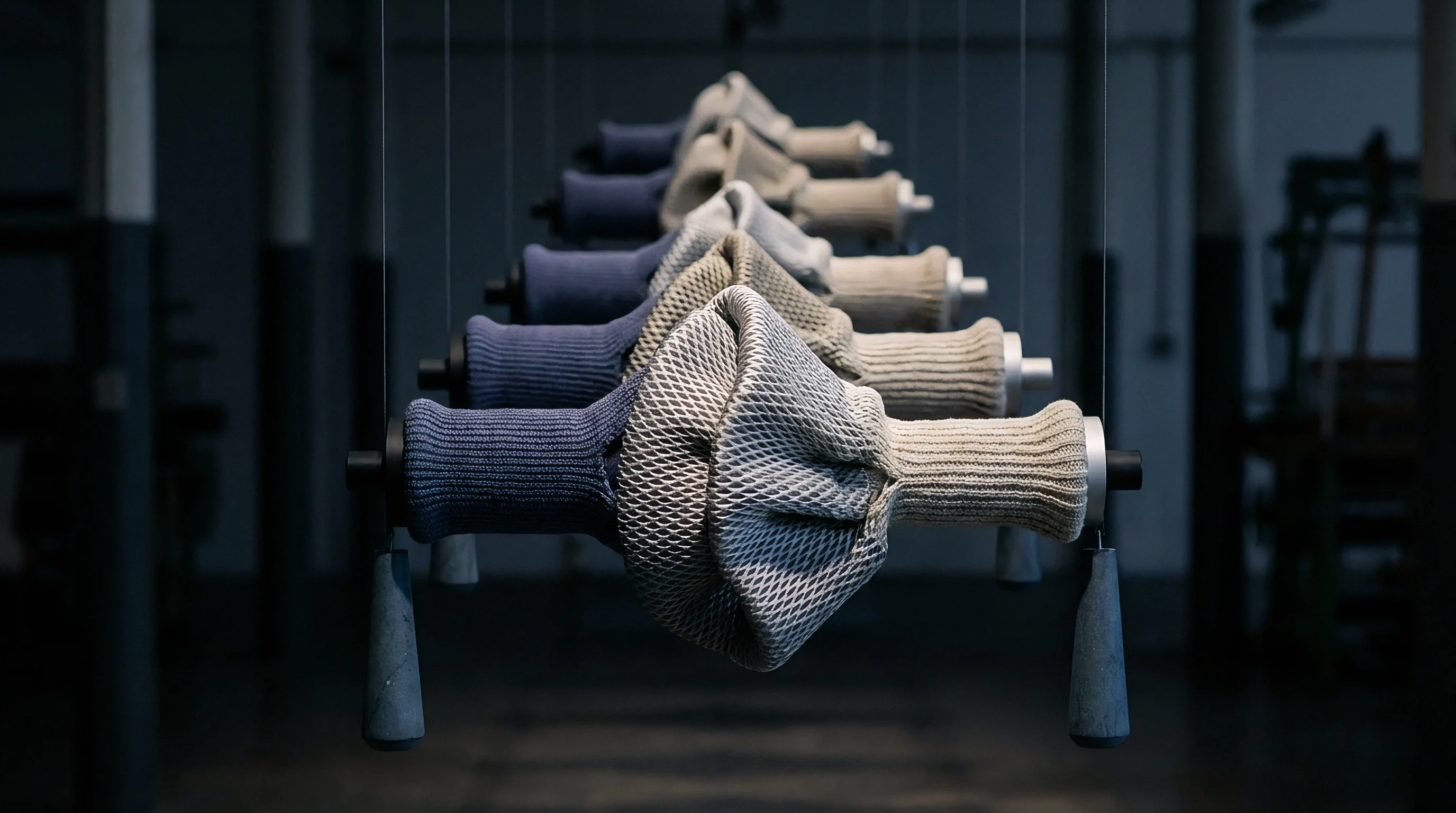
Swell
Dimensional equilibrium in knitted fabrics depends on the geometry of the interlocking stitch unit. Classical loop models, developed by Doyle and expanded by Munden, define single jersey geometry using dimensionless constants that link course density, wale density, and stitch length. In unplated single-yarn knits, these constants stabilize once internal torque and bending moments release during wet relaxation.
Doyle expressed the stitch density constant as courses per centimetre multiplied by wales per centimetre and the square of course length. Munden added distinct constants for course density, wale density, and loop shape ratio, showing that a fully relaxed loop settles into a minimum energy state regardless of yarn linear density or machine gauge.
Plating an elastomeric core yarn disrupts this equilibrium by creating a dual-component loop, placing a continuous elastane strand parallel to the host staple or filament yarn within the sinker loop. Because draft settings dictate retractive force, an elastomeric yarn fed under mechanical draft holds substantial residual tension across the loop arc. This plating tension shifts the loop balance: the core yarn pulls adjacent wales inward, forcing loop heads out of the flat plane into three-dimensional shapes.
Thermal wet processing triggers yarn swell and fabric contraction. As steam or water penetrates the fiber matrix, the host yarn expands in diameter, raising intra-loop friction and locking the elastomeric core into a compressed loop architecture. At this point, classical two-dimensional assumptions no longer accurately predict finished dimensions; uncalibrated Doyle and Munden constants underestimate course contraction and overstate finished width, creating broad gaps between greige calculations and finished targets.
| Fabric Format | Processing State | Course Constant (kc) | Wale Constant (kw) | Stitch Constant (ks) | Aspect Ratio (ka) |
|---|---|---|---|---|---|
| 100% Combed Cotton Single Jersey | Dry Relaxed | 5.00 | 3.80 | 19.00 | 1.31 |
| 100% Combed Cotton Single Jersey | Fully Wet Relaxed | 5.30 | 4.10 | 21.73 | 1.29 |
| 95% Cotton / 5% Elastane Plated Jersey | Dry Relaxed | 5.85 | 4.65 | 27.20 | 1.26 |
| 95% Cotton / 5% Elastane Plated Jersey | Fully Wet Relaxed | 6.70 | 5.20 | 34.84 | 1.29 |
| 92% Nylon / 8% Elastane 1×1 Plated Rib | Dry Relaxed | 6.10 | 3.90 | 23.79 | 1.56 |
| 92% Nylon / 8% Elastane 1×1 Plated Rib | Fully Wet Relaxed | 7.40 | 4.80 | 35.52 | 1.54 |
Moving from a dry to a wet relaxed state drives a marked increase in the stitch density constant for elastomeric plated knits. While standard cotton jersey exhibits a wet shift of about fourteen percent, plated elastomeric structures experience increases above twenty-seven percent as water and heat allow the polyurethane filaments to retract freely.
Higher elastomeric draft values force loop head curvature inward while expanding course density under tensionless wet processing.
Ignoring how loop constants shift during wet processing leads directly to downstream manufacturing problems on the cutting and assembly floor.
- Selvage Edge Curling occurs when tension differences between the main body fabric and unplated selvages cause tight rolling, stalling automated cutting tables.
- Course Density Skewing happens when uncalibrated stenter tension stretches loops lengthways, distorting the aspect ratio and driving spirality along seam lines.
- Spirality Instability develops if heat setting fails to compensate for internal yarn torque, leaving finished garments prone to twisting after washing.
- Dimensional Creep appears as gradual width loss in storage as unrelaxed elastomeric cores slowly recover over time.
Miscalculating greige loop constants leaves finished rolls permanently narrow and generates knife-line torque during cutting.
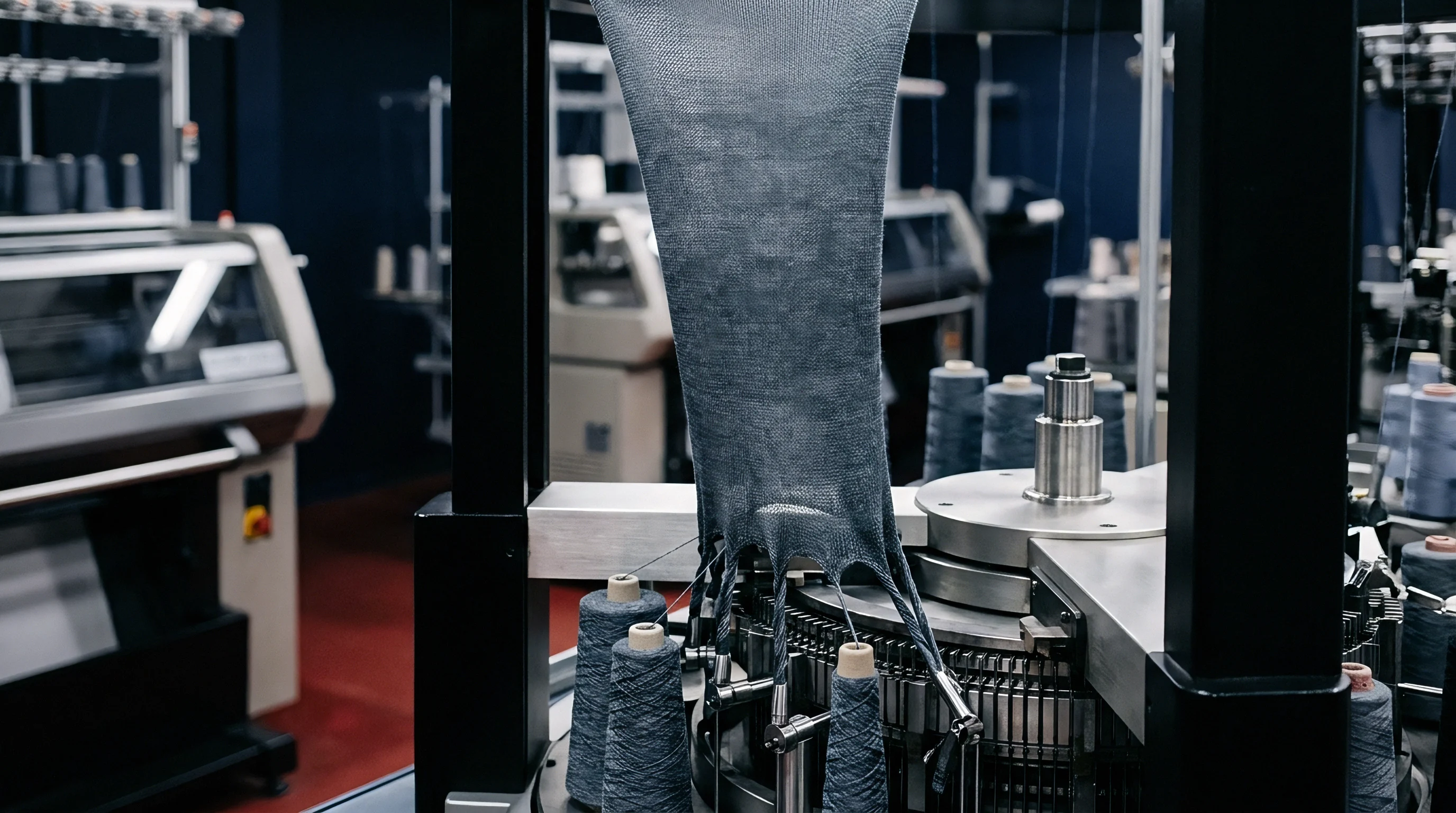
Steam
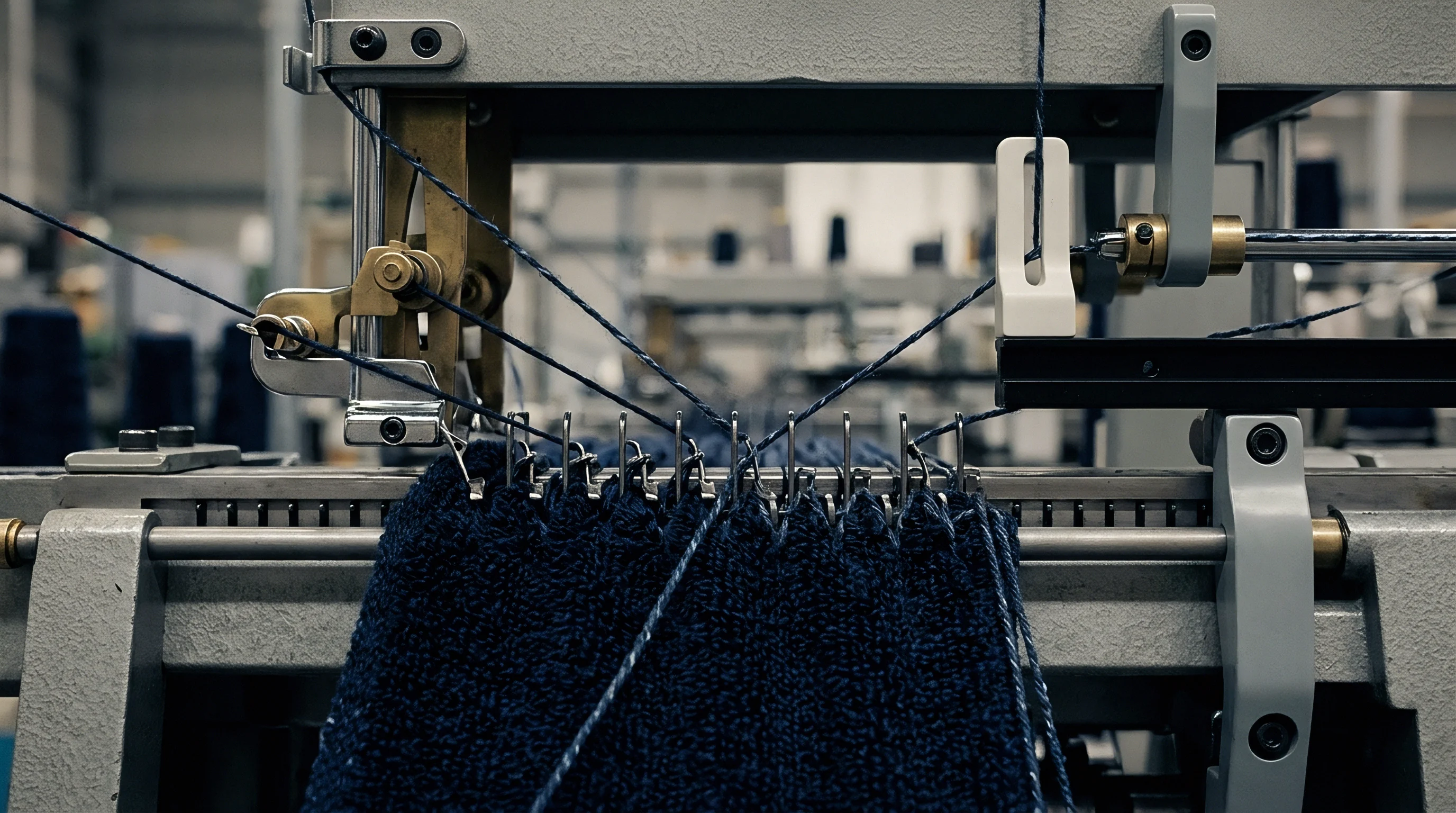
Thermal wet processing converts raw grey knitted rolls into dimensionally stable fabric through a controlled sequence of thermal and mechanical stages. Steam unslips the locked elastomeric loop while hot water forces core relaxation, and scouring removes residual knitting lubricants. Thermal treatment of polyurethane-based elastomeric yarns modifies their crystalline and amorphous segments, permanently resetting the core filament’s stress-free length inside the host yarn loops.
The process begins with either greige presetting or direct wet relaxation, depending on fiber content. Presetting synthetic elastomeric blends on a stenter frame at one hundred eighty to one hundred ninety degrees Celsius relaxes internal strains from extrusion and machine drafting; skipping this step causes severe creasing and patchy dye uptake in jet dyeing.
- Pass the grey knitted tube through a continuous tensionless steaming unit to relax loops and relieve mechanical knitting strains.
- Scour the fabric at eighty-five degrees Celsius in an alkaline bath with non-ionic surfactants to strip paraffin waxes, machine oils, and silicone lubricants.
- Dye in a low-liquor-ratio jet dyeing vessel, heating at one and a half degrees Celsius per minute to avoid thermal shock marks.
- Rinse, apply softeners, and run through continuous hydro-extraction with a rope opener and vacuum extractor to minimize stretching.
- Pin fabric onto stenter rails with predetermined overfeed ratios and run through heat zones at one hundred eighty degrees Celsius to set final dimensions.
During heat setting, polyurethane soft segments melt and realign while hard segments preserve structural integrity. Chamber temperature and dwell time determine how much retractive force remains in the yarn core. Overfeeding fabric onto the stenter chain allows longitudinal shrinkage while expanding the width, enabling loop constants to settle into equilibrium without mechanical tension holding them out of shape.
| Process Stage | Temperature (C) | Dwell Time (s) | Stenter Overfeed (%) | kc Modifier Factor | kw Modifier Factor |
|---|---|---|---|---|---|
| Grey Relaxation | 20 – 25 | N/A | 0 | 1.00 | 1.00 |
| Presetted Stenter | 185 – 190 | 30 – 45 | +15 | 1.12 | 1.08 |
| Alkaline Scour | 85 – 90 | 1200 | N/A | 1.22 | 1.15 |
| Jet Dyeing Cycle | 98 – 130 | 2700 – 3600 | N/A | 1.30 | 1.20 |
| Final Heat-Setting | 175 – 182 | 30 – 40 | +25 to +35 | 1.34 | 1.23 |
Elastane degradation during high-temperature dyeing stems from yarn lot variation rather than uncalibrated stenter speed.
Equation
Calibrating loop shape constants mathematically requires integrating elastomeric variables into classical loop equations. Doyle defined stitch density through a single linear constant:
ks = c w l^2
In this formulation, c represents courses per centimetre, w represents wales per centimetre, and l represents course length in centimetres per loop. For elastomeric plated structures, this simple quadratic relationship breaks down due to differential elasticity between the ground yarn and core yarn, where uncalibrated constants cause garment distortion. Because finished weight follows stitch length directly, predictive calibration requires equations that incorporate the elastomeric draft ratio and thermal wet contraction factor.
The modified course constant equation incorporates the elastomeric draft ratio (De) and the wet processing temperature coefficient (alpha):
kc_calibrated = kc_base (1 + (alpha (De – 1))) (1 + wet_shrinkage_course)
The modified wale constant equation accounts for transverse core retractive force through a lateral contraction coefficient (beta):
kw_calibrated = kw_base (1 + (beta elastane_percentage)) (1 + wet_shrinkage_wale)
Multiplying the calibrated course constant by the calibrated wale constant yields the predictive stitch density constant for fully finished elastomeric plated fabric:
ks_calibrated = kc_calibrated kw_calibrated
The volumetric cover factor (K) must also account for yarn linear density modifications resulting from core draft. The effective tex of the plated combination combines ground yarn linear density (Tex_ground) with drafted elastomeric linear density (Tex_elastane / De):
Tex_effective = Tex_ground + (Tex_elastane / De)
K_volumetric = square_root(Tex_effective) / l
A five percent change in stitch length moves finished fabric weight by twelve grams per square metre after heat setting at one hundred eighty degrees Celsius.
Because course counts shift after thermal exposure and heat setting locks elastomeric core recovery, calculating fabric mass per unit area (Grams per Square Metre, GSM) with calibrated constants relies on the relationship between effective tex, course density, wale density, and loop length:
GSM = (c w l Tex_effective) / 10
Relying on unadjusted greige loop constants causes mass calculations to deviate from finished roll weights by up to twenty percent. Precise calibration bridges yarn input parameters and finished fabric yield.
The exact interactive friction coefficient between micro-denier synthetic fibers and polyurethane cores under high-pressure steam remains unquantified across non-linear speed profiles.
Benchmark
A practical application of predictive calibration can be seen in a standard commercial run of elastomeric plated single jersey fabric. Consider a forty-tonne order knitted on twenty-eight gauge circular machines with thirty-inch cylinders, targeted at a finished weight of two hundred grams per square metre and a usable cuttable width of one hundred seventy centimetres.
The host yarn is 19.7 tex (30s Ne) combed cotton plated with 44 dtex (40 denier) elastane, knitted with an elastane feeder draft of 3.2 and a target course length of 0.285 centimetres per loop. Baseline unplated dry constants for this gauge and yarn linear density are kc = 5.00, kw = 3.80, and ks = 19.00.
Running this fabric through tensionless scouring, jet dyeing at ninety-eight degrees Celsius, and stenter heat-setting at one hundred eighty degrees Celsius shifts these values. Empirical laboratory fitting yields calibrated constants of kc_calibrated = 6.65, kw_calibrated = 5.15, and ks_calibrated = 34.25, reflecting how wet heat collapses internal loop curvature.
| Heat-Set Temp (C) | Stenter Overfeed (%) | Calibrated kc | Calibrated kw | Predicted Courses/cm | Predicted Wales/cm | Finished GSM | Usable Width (cm) |
|---|---|---|---|---|---|---|---|
| 175 | +15 | 6.20 | 4.85 | 21.75 | 17.02 | 188 | 182 |
| 180 | +25 | 6.65 | 5.15 | 23.33 | 18.07 | 210 | 171 |
| 180 | +35 | 7.10 | 5.35 | 24.91 | 18.77 | 231 | 165 |
| 185 | +25 | 6.40 | 5.00 | 22.45 | 17.54 | 198 | 176 |
These calibrated figures show that applying twenty-five percent stenter overfeed at one hundred eighty degrees Celsius delivers 23.33 courses per centimetre and 18.07 wales per centimetre. This combination hits a weight of 210 grams per square metre while yielding a cuttable width of one hundred seventy-one centimetres.
Failure to meet the ISO 5077 dimensional stability limit of three percent after five washing cycles triggers immediate roll rejection at the cutting facility.
ISO 3801 mass-per-unit-area compliance mandates sampling across five non-adjacent roll positions, preventing averaged mill reports from obscuring edge-to-center yield variation.
Sampling
Verifying loop constants requires strict physical measurement standards, with course length forming the foundation of all geometry testing. Measuring course length on elastomeric plated fabrics using standard manual unraveling introduces operator tension error, as the elastomeric core contracts as soon as it releases from adjacent stitches and hides the true knitted loop length.
BS 5441 specifies the standard method for determining course length by unraveling fifty continuous loops under calibrated pretension. On elastomeric plated knits, a dual-tension unwinding head separates the ground yarn from the core, applying a load calculated from combined linear density to extend the yarn to a straight, uncrimped state without stretching the core beyond zero strain.
Which Test Standard Prevents Elastomeric Relaxation Skew?
ISO 5077 combined with ISO 6330 laundering procedures governs dimensional change testing in washing and drying. Achieving full wet relaxation for constant calibration requires five consecutive laundering cycles at forty degrees Celsius under procedure 4N, followed by flat tensionless drying on absorbent mesh racks, since cold wash cycles alter course spacing while relaxation shrinkage stabilizes loop geometry.
Optical image analysis offers non-destructive measurement. Digital projection microscopes capture high-resolution surface images under controlled LED lighting, while software measures loop height, width, course spacing, and stitch angle directly to calculate instantaneous kc and kw values across hundred-stitch fields.
| Test Parameter | Standard Specification | Sample Condition / Tension | Acceptable Tolerance |
|---|---|---|---|
| Course Length Determination | BS 5441 | Dual-pretension unraveling (0.05 cN/tex) | +/- 1.5% |
| Dimensional Stability | ISO 5077 / ISO 6330 | 5 cycles 4N (40C), Flat Dry | +/- 3.0% max |
| Mass per Unit Area | ISO 3801 | Conditioned 20C / 65% RH, 24 hours | +/- 3.0% g/m2 |
| Wale & Course Count | ISO 7211-2 | Counting glass under zero tension | +/- 2.5% |
Optical loop projection detects asymmetrical elastomeric core contraction long before dimensional skew appears on the inspection table.
Loop shapes measured under tension never reflect the dimensions fabric takes after laundering.
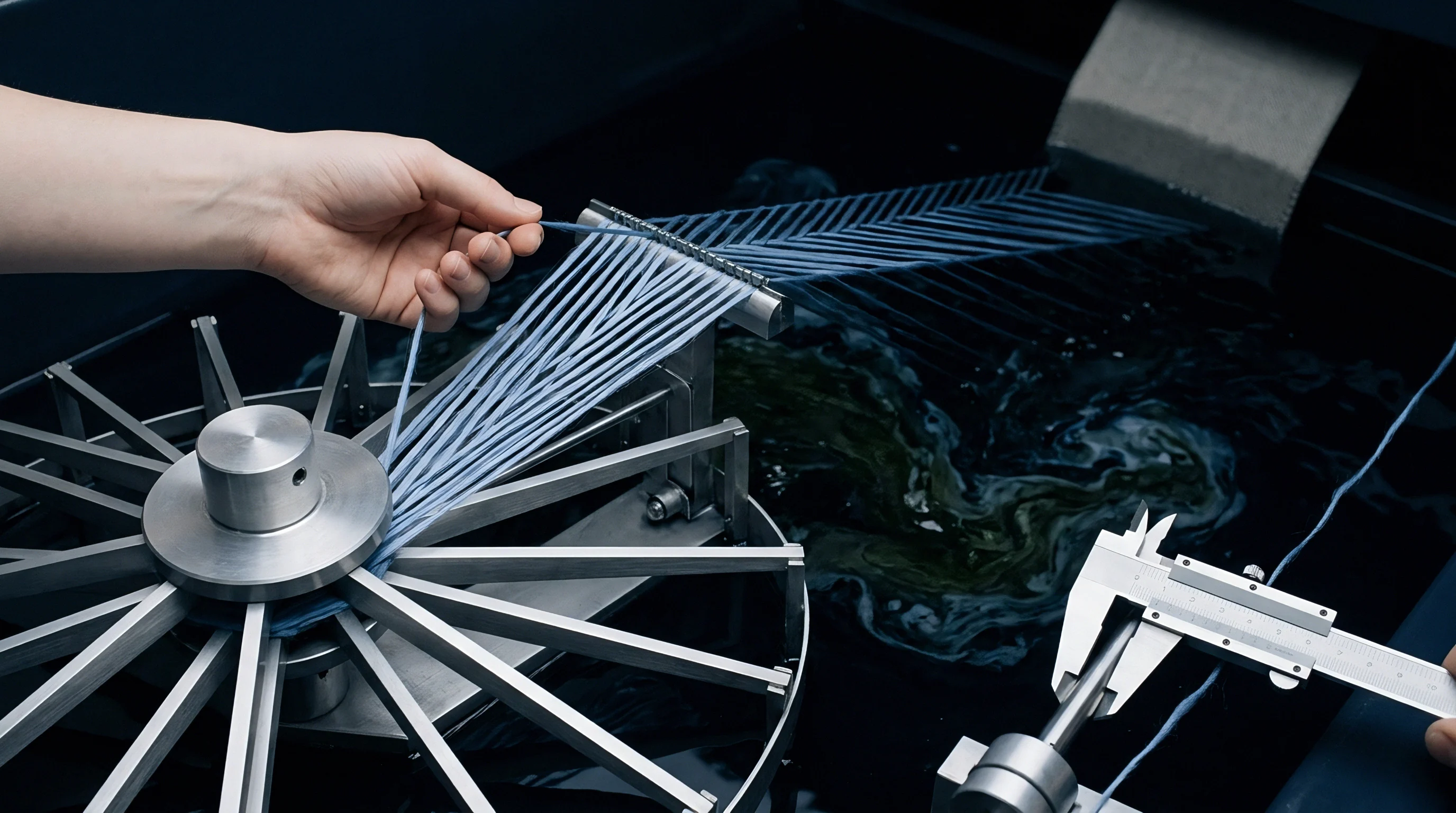
Logistics
Translating predictive calibration into commercial procurement requires strict control over factory routes, mill capacity, and specification documents. Fabric buyers committing capital to bulk runs cannot rely on swatches or unverified mill specs. Proper overfeeding prevents selvage curl distortion and loop density dictates final fabric mass, meaning the technical parameters set during calibration directly drive landed costs, greige yarn purchasing, stenter schedules, and delivery timelines.
Greige knitted yield directly sets landed cost per finished metre. Miscalculating wet relaxation shrinkage leads to incorrect yarn orders; if a mill underestimates the course contraction constant (kc), it knits insufficient length, producing short rolls that fail to meet cutting marker layouts. The resulting yield shortfall forces extra machine setups and delays production schedules by weeks.
Mill qualification dossiers must include calibrated loop constant profiles before placing bulk yarn orders. A comprehensive dossier commits the dyehouse to specific processing envelopes, locking down temperature, overfeed rates, and dwell times.
- Grey Course Length Dossier establishes baseline stitch length under BS 5441 standards across all knitting cylinders dedicated to the order.
- Heat Setting Temperature Logs document continuous temperature recordings across all stenter heating zones during bulk runs.
- Elastane Draft Verification Certificates confirm feeder input draft settings and elastane lot numbers across every shift.
- Shrinkage Tolerance Agreements define financial liability and roll rejection thresholds for dimensional stability deviations exceeding contractual limits.
Stenter line capacity is often the primary bottleneck in thermal wet processing. Heat-setting elastomeric plated knits requires low line speeds ~ typically fifteen to twenty-five metres per minute ~ to ensure sufficient dwell time inside the chambers. Faster speeds reduce heat exposure, preventing core relaxation and leaving residual shrinkage in the fabric.
While dyehouses on tight margins may push speeds to boost throughput, specifying calibrated loop constants in purchase contracts holds them to verified speeds, protecting structural stability and yield across the entire order.