Customs Duty Tariff Heading Drift Introduced by Mill Wet Processing Contraction
Wet processing dimensional contraction increases fabric weight per square metre, pushing imported textiles across critical tariff thresholds and triggering mandatory tariff reclassification.
Bath
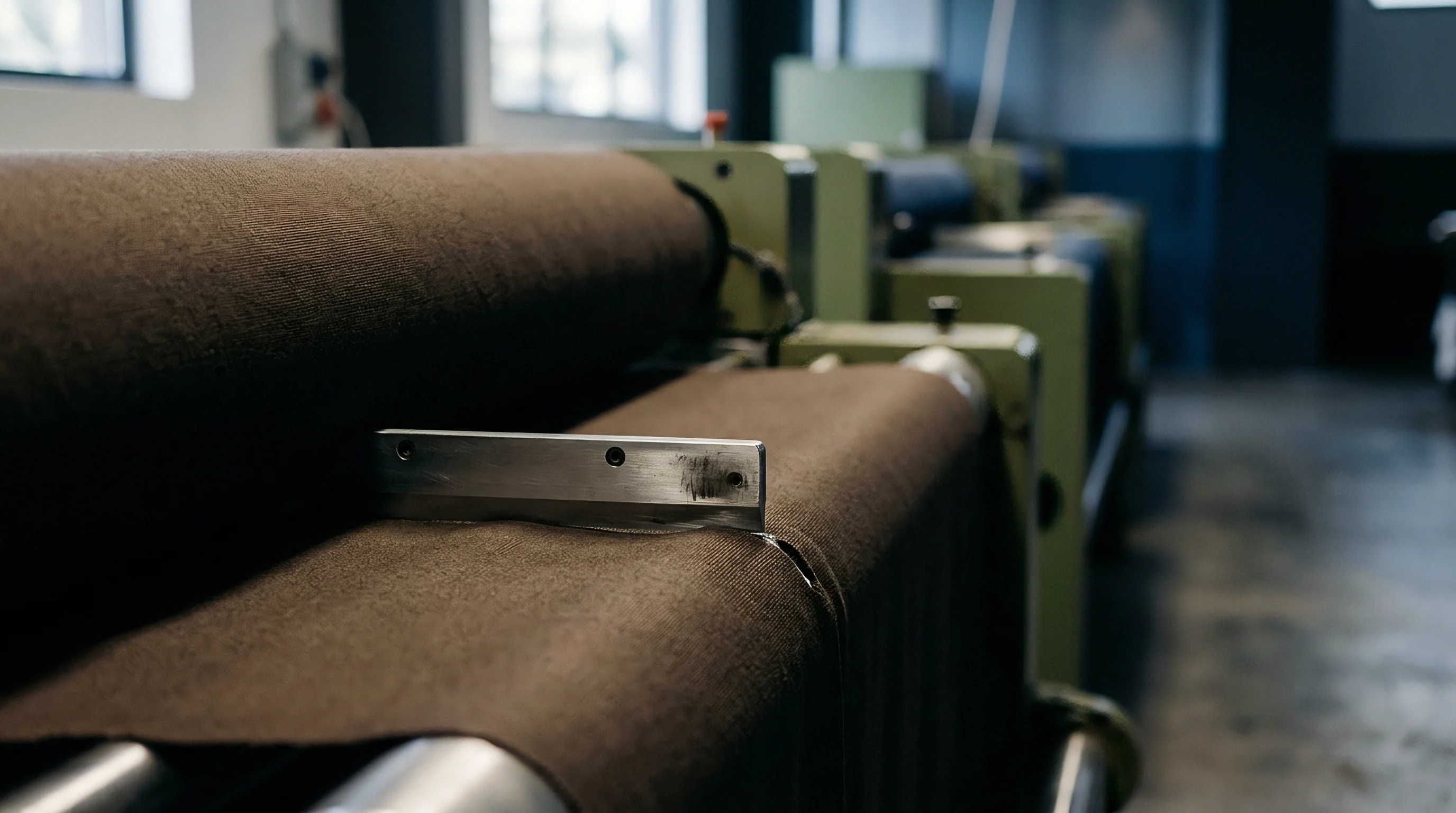
Aqueous finishing causes significant structural movement in woven and knitted substrates. As grey woven cloth enters the finishing line, fiber swelling and mechanical stress relief contract the fabric along both warp and weft directions. A fabric specified at 190 grams per square metre in the grey state routinely loses six to twelve percent of its surface area during scouring, mercerization, and continuous dyeing.
This physical shrinkage concentrates fiber mass into a smaller footprint, driving finished mass per square metre well beyond nominal grey specifications.
At the same time, chemical treatments strip non-fibrous impurities while depositing synthetic resins, dyes, and functional softeners. Caustic mercerization under tension reorganizes cellulose crystallites to raise cotton fiber density even as yarn length shrinks. Scouring removes natural fats, waxes, and pectins, cutting dry mass by three to five percent, while enzymatic desizing breaks down starch sizing applied before weaving.
Subsequent resin padding, flame-retardant treatments, or hydrophobic coatings, however, add crosslinked polymer mass back to the substrate.
The net result of these competing wet processes determines whether finished cloth ultimately gains or loses mass relative to its grey dimensions. On a typical high-density cotton continuous dyeing line, total surface shrinkage easily outpaces mass loss from chemical scouring. A loom-state fabric woven at 192 grams per square metre with a four percent longitudinal shrinkage target ends up at 208 grams per square metre after stenter drying and sanforizing compaction.
Caustic scouring removes up to five percent of natural non-cellulosic impurities before chemical padding adds synthetic finish mass back into the yarn structure.
Dimensional contraction varies considerably across blended fiber types. Synthetic filaments like continuous polyester hold their dimensions in aqueous environments, whereas cellulosic and protein fibers shrink substantially. In wool-polyester blends, wet milling induces aggressive wool felting and fiber migration, contracting the protein component while the synthetic network retains its geometry.
The resulting density shift alters physical mass distribution across every square metre cut from the roll.
- Caustic mercerization swelling forces structural yarn compaction while removing residual seed hull fragments, elevating fabric weight per unit area.
- Sanforizing compressive shrinkage mechanically drives warp yarns together through rubber-belt compaction, altering square-metre mass calculations without adding raw fiber.
- Enzymatic desizing extraction eliminates starch additives from grey warp yarns, creating counteracting non-fibrous mass loss during initial wash stages.
- Resin crosslinking deposition embeds permanent synthetic polymer mass inside cellulosic fibers, artificially raising measured finished fabric density.
Weight discrepancies are frequently traced back to procurement contracts that rely solely on nominal loom-state specifications as the benchmark for grey cloth.


Shift
Customs classification authorities evaluate imported textiles strictly in the physical condition presented at clearance. Tariff lines under Chapters 52 and 55 of the Harmonized System rely on strict weight thresholds to determine applicable duty rates. Woven cotton fabrics under HS 5208 fall under different duty schedules than those under HS 5209, where the classification boundary sits at 200 grams per square metre.
An importer filing entry documentation using grey-state mill specs risks immediate reclassification if port laboratory analysis shows the finished weight crossing that line.
Synthetic fiber blends encounter identical tariff hurdles. Under HS 5513 and HS 5514, woven polyester staple and cotton mixtures face a major classification boundary at 170 grams per square metre. A grey substrate woven at 162 grams per square metre falls squarely under HS 5513 at an ad valorem duty rate of 8.0 percent.
But if wet processing contracts the fabric by seven percent, finished weight reaches 174 grams per square metre, prompting customs inspectors to reclassify the entry under HS 5514 and push the duty rate to 12.0 percent.

What Triggers a Tariff Reclassification under Dimensional Contraction?
Reclassification occurs when shrinkage alters total square-metre mass or shifts constituent fiber percentages past statutory limits. In cotton-viscose blends, differential solubility during finishing can alter fiber proportions. If caustic scouring removes cellulosic mass unevenly or differential contraction concentrates one fiber component within a square metre, chief weight calculations change.
Under tariff classification rules, the dominant fiber material is determined by total dry mass after all non-fibrous elements have been extracted.
While commercial invoices typically cite grey-state weights, standard finishing operations alter substrate dimensions, area mass, and tariff classification lines across common woven constructions.
| Substrate Composition | Grey GSM | Finishing Treatment | Finished GSM | Initial HS Code | Final HS Code | Duty Impact |
|---|---|---|---|---|---|---|
| 100% Plain Woven Cotton | 192 g/m² | Mercerized & Sanforized | 208 g/m² | 5208.32 | 5209.31 | +4.0% Duty Shift |
| 65% Polyester / 35% Cotton | 164 g/m² | Continuous Dye & Heatset | 175 g/m² | 5513.21 | 5514.21 | +3.5% Duty Shift |
| 50% Wool / 50% Polyester | 198 g/m² | Wet Milling & Decatizing | 216 g/m² | 5111.30 | 5112.30 | +2.8% Duty Shift |
| 85% Viscose / 15% Nylon | 142 g/m² | Resin Finish & Wash | 151 g/m² | 5408.32 | 5408.33 | +1.5% Duty Shift |
Yarn count measurements offer another path to tariff reclassification. Linear yarn density measured in decitex or single cotton count changes as wet contraction increases yarn crimp. When warp crimp climbs from five percent to eleven percent after stenter drying, yarn extracted from finished fabric measures heavier than the grey yarn delivered to the loom.
Because customs laboratories calculate decitex using finished crimp geometry, this increase can shift the fabric into subheadings designated for coarser yarns.
Loom-state fabrics crossing the 200 gram per square metre threshold after finishing face an immediate tariff reclassification from HS 5208 to HS 5209.
The core operational risk stems from declaration timing. Importers who rely on mill certificates based on grey-state cloth specs submit data that fails laboratory testing at entry. When customs agents draw swatches directly from landed rolls and weigh them after standard conditioning, discrepancies between declared grey metrics and measured finished metrics trigger immediate duty adjustments and formal notices of action.
- Weight threshold boundaries divide tariff lines at key cutoff figures, moving fabrics between separate subheadings as linear density increases.
- Chief weight predominance shifts alter multi-component fiber rankings when differential boiling loss degrades one fiber type faster than another.
- Yarn count classifications change when dimensional contraction increases yarn weight per unit length, altering calculated single yarn decitex values.
Underestimating post-finishing mass contraction exposes importers to unrecorded tariff shifts that trigger retroactive duty assessments, administrative fines, and container holds at port.
Standard
Determining commercial fabric mass in a laboratory requires precise conditioning and chemical isolation. Accredited testing houses measure fabric weight under ISO 3801, conditioning specimens at twenty degrees Celsius and sixty-five percent relative humidity for at least twenty-four hours, while customs labs rely on ISO 6741 to establish commercial mass for classification. Both standards account for moisture regain, which varies sharply between natural and synthetic fibers.
Official moisture regain rates directly affect commercial mass calculations: standard cotton is rated at 8.5 percent, polyester at 0.4 percent, and viscose at 13.0 percent. Hydrophilic resins or moisture-retentive softeners applied during finishing significantly alter ambient water absorption. To determine true fiber content, customs chemists strip non-fibrous additives via continuous dichloromethane solvent extraction before running quantitative fiber separation under ISO 1833 guidelines.
| Fiber Type | Official Regain (%) | Solvent Extractable Limit (%) | ISO Separation Test Method |
|---|---|---|---|
| Cotton (Scoured/Mercerized) | 8.5% | 1.5% | ISO 1833-1 (Acetone) |
| Polyester (Staple/Filament) | 0.4% | 0.5% | ISO 1833-11 (Dichloromethane) |
| Viscose / Rayon | 13.0% | 2.0% | ISO 1833-7 (Formic Acid/Zincate) |
| Wool (Combed/Carded) | 18.25% | 2.5% | ISO 1833-4 (Hypochlorite) |
Quantitative analysis of binary fiber blends requires specific correction factors to account for fiber loss during chemical dissolution. ISO 1833-1 outlines chemical separation using selective solvents like seventy-five percent sulfuric acid or hot formic acid. In cotton-polyester blends, acid dissolves the cellulosic portion, leaving synthetic residue to be dried and weighed.
Heavy mercerization during finishing alters cotton solubility, requiring adjusted correction values so the cotton mass contribution is not underestimated.
- Condition test specimens at twenty degrees Celsius and sixty-five percent relative humidity until moisture equilibrium is reached according to ISO 139 protocols.
- Determine grey and finished area mass using precise sample cutters according to ISO 3801 test parameters.
- Extract non-fibrous materials using dichloromethane solvent washing to establish true fiber-only dry mass.
- Execute quantitative chemical dissolution under ISO 1833 guidelines to separate constituent fiber ratios.
- Calculate commercial mass by applying standard moisture regain allowances defined in international trade regulations.
Discrepancies between commercial laboratory reports and customs audit findings often stem from how non-fibrous residues are handled. Commercial test reports round component percentages to one decimal place under an ISO tolerance band of plus or minus two percentage points. Customs classification laws, however, recognize no tolerance bands at heading boundaries: a measured fiber content of 85.1 percent polyester places an entry in HS 5512, whereas 84.9 percent forces reclassification into HS 5514.
Standard quantitative chemical separation under ISO 1833 requires solvent stripping of all non-fibrous finishes before calculating clean dry fiber mass.
Citing ISO 3801 Method 5 alongside ISO 1833-1 extraction tolerances directly in purchase specifications helps keep post-finishing mass variance within a strict two percent limit.
Audit
Post-clearance verification relies on physical sampling drawn from imported containers at the port. Inspection officers cut swatches across selected lots and forward sealed specimens to central analytical laboratories to verify whether physical properties match the declared tariff subheadings on entry summaries. Discrepancies between declared grey specifications and border samples trigger immediate duty reassessments across historical shipments within statutory audit windows.
Customs authorities use risk-profiling algorithms to select shipments for physical testing, targeting entries with declared weights near tariff thresholds. When laboratory analysis reveals mass drift crossing a 200 g/m² boundary, authorities routinely expand the audit to cover past shipments of identical style numbers across preceding financial quarters.
| Laboratory Jurisdiction | Sampling Standard | Non-Fibrous Extraction Protocol | Classification Enforcement Threshold |
|---|---|---|---|
| United States CBP | ASTM D3776 / ISO 3801 | Direct Solvent Extraction | Strict Metric Limit (0.1 g Variance) |
| European Customs Union | EN ISO 12127 | ISO 1833 Quantitative Clean | Heading Limit Without Tolerances |
| Japan Customs Bureau | JIS L1096 Method A | Boiling Water & Solvent Washing | Strict Statutory Weight Lines |
Defending an audit requires technical dossiers that link grey loom-state mill reports to finished fabric inspection certificates. Importers relying solely on grey-state documentation are ill-prepared for post-clearance scrutiny. Documenting length, width, and weight changes through every wet processing stage proves whether dimensional drift stems from standard manufacturing contraction rather than deliberate post-production alteration.
Customs risk engines flag textile shipments declaring area weights within five percent of statutory Harmonized System classification boundaries.
Customs authorities continue to examine whether residual sizing in contracted yarns should be treated as an intentional addition of non-fibrous material intended to manipulate classification metrics.
Ledger
Commercial procurement contracts assign financial liability for customs reclassification penalties across supply chain partners. Purchase orders that specify technical parameters purely in loom-state terms shift all dimensional drift risk onto the importer. Structuring master supply agreements around finished, conditioned fabric metrics aligns specifications directly with customs requirements, provided contracts define clear weight tolerances backed by mandatory pre-shipment testing on finished rolls.
Mitigating financial risk requires explicit indemnity clauses in mill agreements. If finishing contraction exceeds agreed limits and pushes an imported lot into a higher tariff bracket, contractual chargebacks recover the duty differential. Technical procurement dossiers with certified ISO 3801 finished weight reports provide the necessary evidence to defend classifications during formal customs protests.
Fabric specifications defined at the grey loom state provide no legal safe harbor against finished-state tariff reclassifications during post-entry customs clearance.