Calculating Plain Weave Jamming Coefficients for Combed Cotton Broadcloth
Plain weave jamming coefficients for combed cotton broadcloth rely on yarn packing density, twist multipliers, and measured crimp interchange after finishing.


Geometry
Peirce’s classic structural formulations define the physical boundaries of plain woven textiles through circular thread cross-sections and idealized helical central axes. In combed cotton broadcloth, high end counts and fine yarn numbers push warp and weft yarns into close contact, creating mechanical resistance against further yarn packing. The jamming coefficient expresses the ratio between the combined yarn diameters and the thread axis spacing.
When this ratio reaches unity, adjacent threads touch without lateral deformation. Beyond unity, thread packing forces cross-sectional flattening, severe crimp interchange, or loom shedding failure.
Calculating the theoretical maximum sett for a 100 percent combed cotton broadcloth begins with thread spacing and yarn diameter equations. Let p1 represent warp thread spacing in centimeters, p2 represent weft thread spacing in centimeters, d1 represent warp yarn diameter, and d2 represent weft yarn diameter. The warp thread spacing equals the reciprocal of ends per centimeter, while weft thread spacing equals the reciprocal of picks per centimeter.
In a jammed plain weave state, the inter-thread space collapses until yarn contact occurs across the inter-yarn boundary.
A plain weave structure locks mechanically when the sum of adjacent yarn diameters equals the thread spacing in both directions.
When modeling broadcloth, yarn cross-sections flatten from ideal circles into race-track or elliptical geometries under beat-up pressure at the reed. Mechanical force applied by the reed forces yarn compression at intersection points. This compression alters the effective horizontal diameter while increasing the vertical contact axis.
The classical fractional cover factor formula, defined as the yarn diameter divided by thread spacing, understates the actual physical cover achieved in high-density broadcloth constructions because yarn flattening expands the effective horizontal profile.

Peirce Geometric Equations for Plain Weave Jamming
Analytical determination of the jammed threshold requires solving the interdependent geometric system linking yarn crimp, thread bending axis, and weave angle. Let theta1 and theta2 represent the weave angles in radians for warp and weft yarns, respectively. Let h1 and h2 represent the crimp heights.
The spatial relation governing complete jamming in the warp direction occurs when the warp thread spacing p1 satisfies the boundary equation where p1 equals the product of d1 plus d2 and the sine of theta1, added to the projection of the yarn central axis length. When warp yarns run straight through the cloth structure with zero crimp angle, weft yarns carry all structural bending, reaching the complete weft-jammed state.
Combed cotton broadcloth constructions typically operate near the warp-jammed boundary to achieve a smooth, dense face. A standard construction utilizing 60s Ne single combed cotton yarns in both warp and weft exhibits distinct physical limits at varying pick counts. When warp density reaches 54 ends per centimeter (137 ends per inch), the internal clearance between adjacent warp ends drops below the uncompressed diameter of the weft yarn.
Beat-up force during weaving must deform the yarn matrix to insert additional picks.
| Yarn Count (Ne) | Ends per cm (EPI) | Picks per cm (PPI) | Warp Cover Factor (K1) | Weft Cover Factor (K2) | Calculated Jamming Coefficient |
|---|---|---|---|---|---|
| 40/1 combed | 43 (110) | 28 (70) | 17.4 | 11.1 | 0.89 |
| 50/1 combed | 49 (125) | 31 (80) | 17.7 | 11.3 | 0.92 |
| 60/1 combed | 55 (140) | 35 (90) | 18.1 | 11.6 | 0.97 |
| 80/2 combed plied | 63 (160) | 39 (100) | 17.9 | 11.2 | 1.04 |

Thread Flattening Factors in High Count Cotton
Combed cotton fibers yield a uniform yarn structure with high parallel fiber alignment, permitting predictable mechanical deformation under transverse pressure. The yarn flattening ratio, defined as the major cross-sectional axis divided by the minor axis, ranges between 1.15 and 1.35 in finished broadcloth fabrics. Incorporating flattening into jamming calculations requires modifying the nominal diameter d by a compression factor derived from yarn twist and fiber packing density.
Un-flattened circular models overestimate fabric thickness and underestimate maximum attainable end counts by approximately 8 to 12 percent.
Relying on idealized circular yarn geometry leads to incorrect reed selection during loom setup, primarily because warp threads jam first.
- Warp-jammed state occurs when warp thread spacing equals the sum of warp and weft yarn flattened diameters, forcing all crimp into the weft system.
- Weft-jammed state develops when weft threads reach maximum packing density, preventing further pick insertion without severe yarn abrasion.
- Dual-jammed state represents the theoretical maximum density where both warp and weft yarn systems reach simultaneous contact boundaries.
- Flattened-yarn jammed state accounts for lateral elliptical spread under high loom beat-up tension, shifting physical contact limits past circular projections.
Attempting to weave past the dual-jammed boundary causes structural defects on the loom, as high beat-up resistance creates reed marks, excessive warp end breakage, uneven pick spacing, and loom stoppage. Converting greige cloth woven beyond safe jamming coefficients into finished shirting yields severely reduced tear strength along the jammed yarn direction due to absolute restriction of yarn movement under stress concentrated during tearing.


Draft
Calculating accurate thread diameters demands precise evaluation of yarn linear density, fiber density, and internal void ratios. For 100 percent combed cotton, the solid fiber density equals 1.54 grams per cubic centimeter. Single yarn diameter cannot be derived strictly from yarn count without incorporating the fiber packing density parameter phi.
The packing density parameter represents the ratio of solid fiber volume to total yarn volume within the yarn envelope. Highly combed yarns exhibit higher packing density than carded ring-spun yarns due to the removal of short fibers and alignment achieved through multiple combing passages.
The relationship between yarn count in English Cotton Count (Ne) and theoretical yarn diameter in millimeters follows a precise inverse square root scale. The nominal diameter d in millimeters equals 0.0357 divided by the square root of Ne, assuming an average fiber packing density of 0.60. Increasing yarn twist increases packing density up to the critical twist limit, reducing the nominal diameter.
Decreasing twist produces a loftier, larger-diameter yarn that jams at lower thread counts.
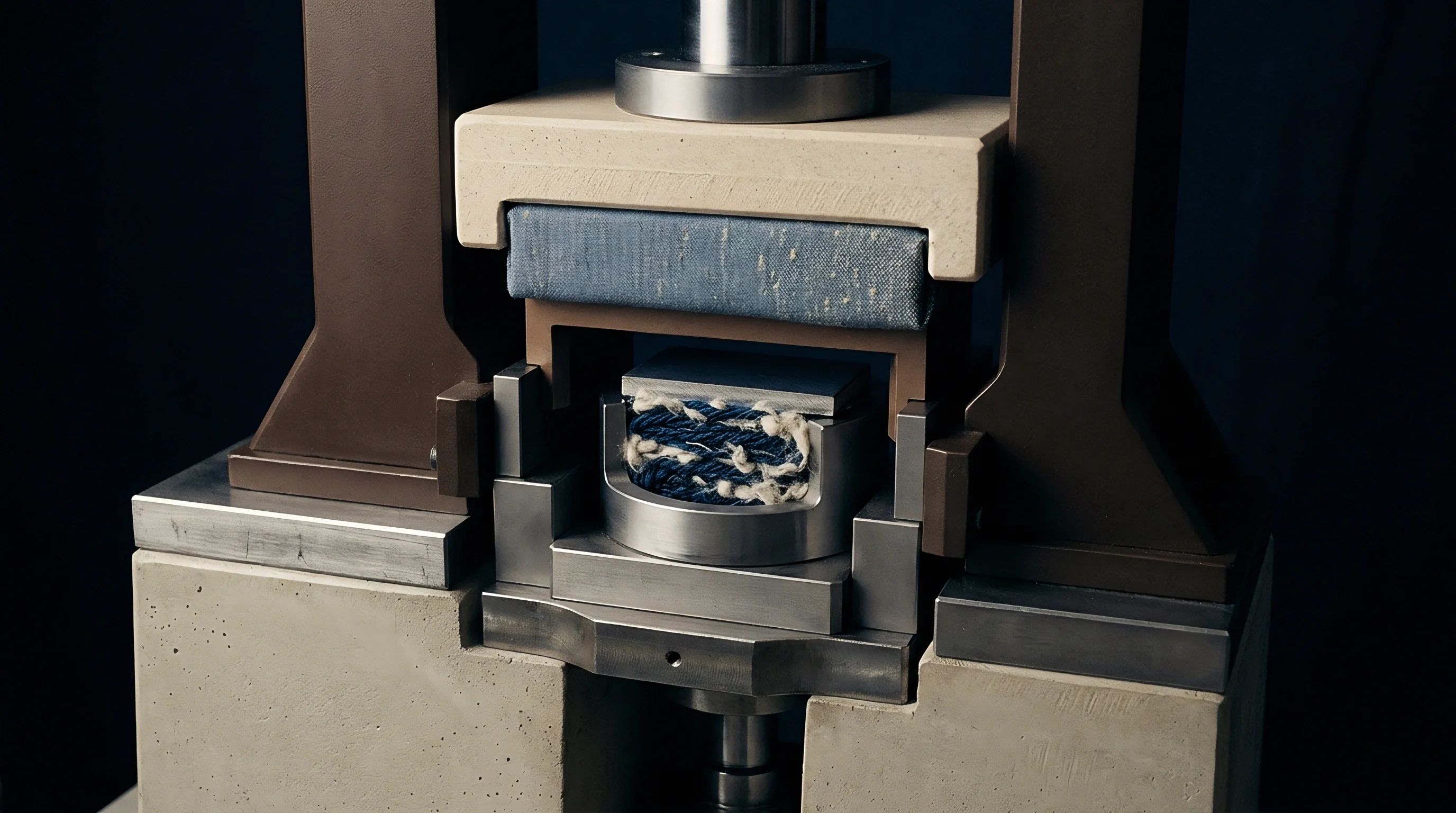
Deriving Yarn Diameters from Combed Cotton Twist and Fiber Packing
Combed cotton yarns specified for high-grade broadcloth utilize twist multipliers ranging from 3.5 to 4.2 for single ring-spun yarns, and 3.8 to 4.4 for plied constructions. The twist multiplier alpha-e directly governs fiber helix angle and cross-sectional compaction. Mathematical calculation of effective diameter d1 uses the formula where d1 equals the square root of tex divided by the product of 1000, pi, solid fiber density 1.54, and the specific packing density factor phi.
Combed cotton yarn with a twist multiplier of 3.8 achieves an effective fiber packing density of 0.62 in un-tensioned greige state.
Compact spinning technology alters packing density dynamics by eliminating the spinning triangle during yarn formation. Compact combed cotton yarns achieve packing density values between 0.65 and 0.70. This structural compaction yields a smaller nominal diameter for an identical Ne count compared to conventional ring-spun yarn.
Consequently, compact combed yarns allow higher picking rates and elevated ends per inch before reaching mechanical jamming boundaries.
| Yarn Type and Count | Twist Multiplier (alpha-e) | Packing Density (phi) | Calculated Diameter (mm) | Measured Flattened Diameter (mm) |
|---|---|---|---|---|
| Ring Combed 40/1 Ne | 3.6 | 0.58 | 0.148 | 0.166 |
| Compact Combed 40/1 Ne | 3.6 | 0.66 | 0.139 | 0.152 |
| Ring Combed 60/1 Ne | 3.8 | 0.60 | 0.119 | 0.133 |
| Compact Combed 60/1 Ne | 3.8 | 0.68 | 0.112 | 0.122 |
| Compact Combed 80/2 Ne | 4.0 | 0.71 | 0.096 | 0.104 |
Compact Spun versus Conventional Ring Spun Densities
Selecting compact combed cotton over standard ring combed cotton shifts the physical jamming threshold significantly. A 60s Ne compact yarn displays an effective diameter approximately 6 percent smaller than its conventional counterpart. When calculating the warp cover factor, this diameter reduction permits an increase of roughly 8 to 10 ends per inch in the loom reed without elevating beat-up tension, effectively increasing yarn density.
Because twist multipliers govern diameter, designing fabric specifications around standard ring-spun tables while sourcing compact-spun yarn creates excess clearance in the weave matrix. The broadcloth loses its firm, crisp hand and fails to meet target fabric weight specifications unless thread density is adjusted upward to compensate for compact yarn diameter reduction.


Bench
Empirical verification of theoretical jamming values requires laboratory determination of crimp, thread count, and linear density under controlled standard atmosphere conditions. Testing conforms to ISO 139 for atmospheric conditioning at 20 degrees Celsius and 65 percent relative humidity. Yarn crimp percentage represents the measure of yarn undulation within the fabric matrix, calculated as the difference between unraveled straightened yarn length and the length of the yarn in the woven fabric, divided by the woven fabric length.
Measuring crimp interchange provides direct insight into structural jamming. When warp yarns are held under high tension on the loom, warp crimp decreases while weft crimp increases to accommodate thread intersections. Upon loom removal and off-loom relaxation, elastic recovery causes warp crimp to rise and weft crimp to drop until internal bending moments reach equilibrium as crimp interchange shifts the load.

Physical Determination of Crimp and Thread Spacing
Accurate determination of jammed states relies on physical measurements executed according to ISO 7211-3 for yarn crimp and ISO 7211-2 for thread count per unit length. The laboratory analyst must apply correct straightening tension during yarn unravelling; applying excessive tension stretches the combed cotton fibers, generating artificially high crimp figures that skew the calculated jamming coefficient upwards.
- Condition fabric specimens under standard atmospheric conditions for a minimum of 24 hours prior to dissecting yarn samples.
- Extract 20 warp and 20 weft threads from the central area of the sample, avoiding edges within 10 centimeters of the selvedge.
- Apply standard pretension calculated as 0.5 centinewtons per tex to each thread segment during unravelling and straight-length measurement.
- Record extended yarn length on a precision crimp tester to an accuracy of 0.5 millimeters.
- Calculate mean crimp percentage for warp and weft directions independently, establishing the active crimp ratio.
Compliance with ISO 7211-3 requires stripping yarn crimp under a standard tension calculated directly from linear density to avoid false elongation readings.
Laboratory findings frequently reveal discrepancies between theoretical geometric models and actual woven cloth. High warp cover factors force weft yarns into deep undulations, driving weft crimp values up to 12 or 14 percent while warp crimp drops below 4 percent in dense broadcloth constructions. Under these conditions, the weft yarn system achieves complete mechanical jamming, preventing lateral compaction during finishing.
When broadcloth exhibits irregular pick density or fails weight specifications, the issue is often attributed to yarn count variance or natural fiber swell during sizing, though microscopic cross-sectional analysis consistently points to improper loom tension settings that pushed warp crimp past the mechanical jamming threshold during beat-up.


Shrinkage
Wet processing alters the physical dimensions of combed cotton broadcloth through fiber swelling, stress relaxation, and chemical restructuring. Caustic mercerization treatment using 28 to 30 degrees Baume sodium hydroxide solution induces profound morphological changes in combed cotton fibers. The kidney-bean cross-section of raw cotton swells into a near-circular profile, while internal lumen volume contracts.
Fiber longitudinal shrinkage during unrestrained mercerization can reach 5 to 8 percent, driving significant fabric dimensional shifts.
Swelling increases yarn diameter d while total fiber density increases. As yarn diameter expands in the mercerization bath, the calculated jamming coefficient K increases dynamically. If a greige broadcloth is woven close to its theoretical jamming limit of 0.95, wet swelling forces the structural jamming coefficient past 1.0.
This physical pressure forces the fabric to contract laterally or elongate longitudinally, depending on the tension profiles applied across the continuous finishing range.

Could High Warp Cover Force Excessive Weft Crimp during Mercerization?
High warp cover restricts the ability of weft yarns to shift position during caustic swelling. When a dense 60s Ne broadcloth with 140 ends per inch enters the mercerizing bath, warp yarns swell radially, closing remaining inter-thread voids. The weft yarn, trapped within rigid warp intersections, cannot expand laterally.
Weft crimp increases sharply, causing broadcloth fabric width to contract by as much as 10 percent if stenter chain tension does not maintain width control against the fiber-swelling force of caustic soda.
Managing overfeed on the stenter frame allows processors to balance warp and weft crimp states prior to final drying and compacting. Standard broadcloth processing utilizes a stenter overfeed of 2 to 4 percent to relieve warp tension imparted during weaving and continuous scouring. Proper tension balancing adjusts the final jamming coefficient to ensure stable fabric dimensions during subsequent laundering cycles.
| Processing State | Warp Density (ends/cm) | Weft Density (picks/cm) | Warp Crimp (%) | Weft Crimp (%) | Effective Jamming Coeff. |
|---|---|---|---|---|---|
| Greige off-loom | 54.0 | 34.0 | 4.2 | 11.5 | 0.94 |
| Desized and Scoured | 55.5 | 34.5 | 5.8 | 10.8 | 0.97 |
| Mercerized (Tensioned) | 57.0 | 35.0 | 6.5 | 9.2 | 1.02 |
| Finished and Sanforized | 58.5 | 36.0 | 7.2 | 8.5 | 0.98 |
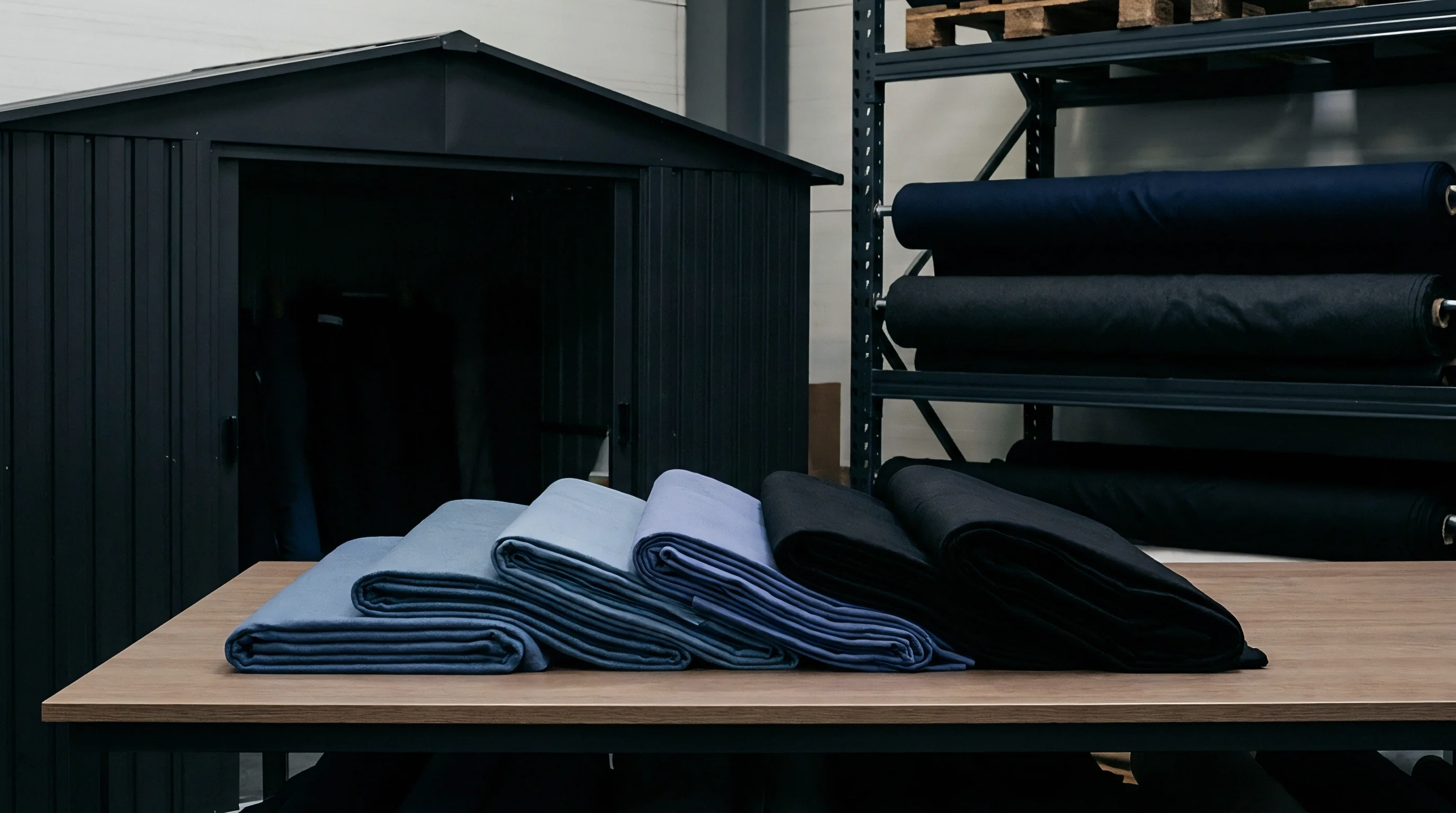
Dimensional Restructuring in Wet Processing Floors
Sanforizing or mechanical compressive shrinking serves as the final dimensional adjustment step for combed cotton broadcloth. Compressive shrinking forces controlled warp-way mechanical compaction, intentionally increasing warp crimp to guarantee residual dimensional stability under ISO 5077 testing. The process pushes weft yarns closer together, driving final pick counts up by 3 to 5 percent.
Caustic mercerization expands the circular cross-section of combed cotton fibers while collapsing yarn twist length.
Controlling process parameters across wet processing stages prevents structural failure of high-density constructions. Fabrics finished beyond their jammed limit lose structural elasticity, exhibiting poor tear strength and harsh hand feel.
- Caustic swelling ratio determines the volumetric increase of combed cotton fibers, directly driving yarn diameter expansion in the bath.
- Stenter chain width setting controls lateral tension, preventing excessive weft crimp growth during high-temperature drying cycles.
- Compressive shrinking percentage dictates final warp thread compaction, locking the finished fabric density near the optimal jammed coefficient.
- Resin cross-linking density fixes yarn mobility, preventing post-garment laundering shrinkage by locking polymer chains within fiber walls.
Commercial fabric contracts specifying dimensional stability must stipulate test standards and acceptable tolerances. Standard purchase agreements incorporate the ISO 5077 procedure across three domestic wash cycles at 40 degrees Celsius with tumble drying, setting acceptable dimensional change limits at a maximum of negative 2.0 percent in warp and negative 1.5 percent in weft direction.

Tolerance
Commercial execution of combed cotton broadcloth specifications relies on translating theoretical jamming limits into practical weaving tolerances and clear purchase specifications. Designing a fabric construction too close to the absolute physical jamming boundary creates severe commercial risk. Mill weaving efficiency drops due to frequent loom stops from warp breakage, while landed fabric costs rise due to degraded yield per loom hour as reed force spikes exponentially.
An optimal broadcloth specification balances structural density against manufacturing feasibility. The target greige jamming coefficient should sit between 0.88 and 0.93 for conventional broadcloths, allowing sufficient structural clearance for fiber swelling during wet processing without forcing excessive crimp interchange. A construction targeted at a jamming coefficient of 0.98 in greige state leaves zero margin for yarn count variation, resulting in off-quality fabric lots whenever yarn linear density swings upward within standard commercial tolerances.
Reed Width Calculations and Loom Beat-Up Resistance
Calculating reed width for high-density broadcloth requires adding off-loom warp crimp allowance and wet processing width contraction to the target finished width. Let W_fin represent target finished fabric width, C_w represent finished weft crimp fraction, and S_w represent finishing width shrinkage fraction. The required reed width W_reed is calculated by dividing W_fin by the product of 1 minus C_w and 1 minus S_w, reflecting the sharp width contraction experienced during finishing.
When weaving 60s Ne combed broadcloth at 150 centimeters finished width, incorrectly accounting for jammed weft compression results in under-width bulk rolls. If weft yarns reach maximum packing density inside the reed before target reed width is achieved, the loom operator cannot stretch the fabric to width during stenter processing without tearing the selvedges.
Commercial Limits for Combed Broadcloth Specifications
Preventing quality disputes requires establishing clear specification boundaries in the original mill contract. The technical dossier must define linear density tolerances, minimum pick thresholds, and maximum permissible jamming coefficients.
- Yarn count variance tolerance must not exceed plus or minus 2.5 percent of nominal Ne according to ISO 2060 standards.
- Finished thread count allowance permits a maximum deviation of plus or minus 2.0 percent from target ends and picks per inch.
- Minimum tear strength threshold stipulates a lower limit of 12 Newtons warp and 10 Newtons weft per ISO 13937-2 single tear method.
- Seam slippage resistance boundary mandates a minimum load of 100 Newtons to produce a 6 millimeter seam opening under ISO 13936-1.
High jamming coefficients cause tear strength to drop precipitously by restricting thread mobility under tearing force, preventing threads from grouping together to resist applied load. When thread movement is blocked by complete structural jamming, single threads break sequentially under minimal stress, causing immediate failure under ISO 13937-2 testing protocols.
Specifying combed broadcloth constructions requires rigorous verification of loom capability, yarn quality parameters, and finishing range tension controls. The route strategist balances end count, pick density, and yarn twist to hit exact performance targets while maintaining high loom efficiency. Woven construction parameters locked into contract specifications dictate the physical limits of the finished cloth, establishing non-negotiable boundaries for weight, drape, strength, and laundering performance across bulk manufacturing runs.