Dynamic Mass Transport Equilibrium Limits in Closed Loop Low Capacity Pad Dyeing Troughs
Low-capacity pad troughs require dynamic feedback dosing compensation to maintain mass transport equilibrium and eliminate head-to-tail shade tailing.

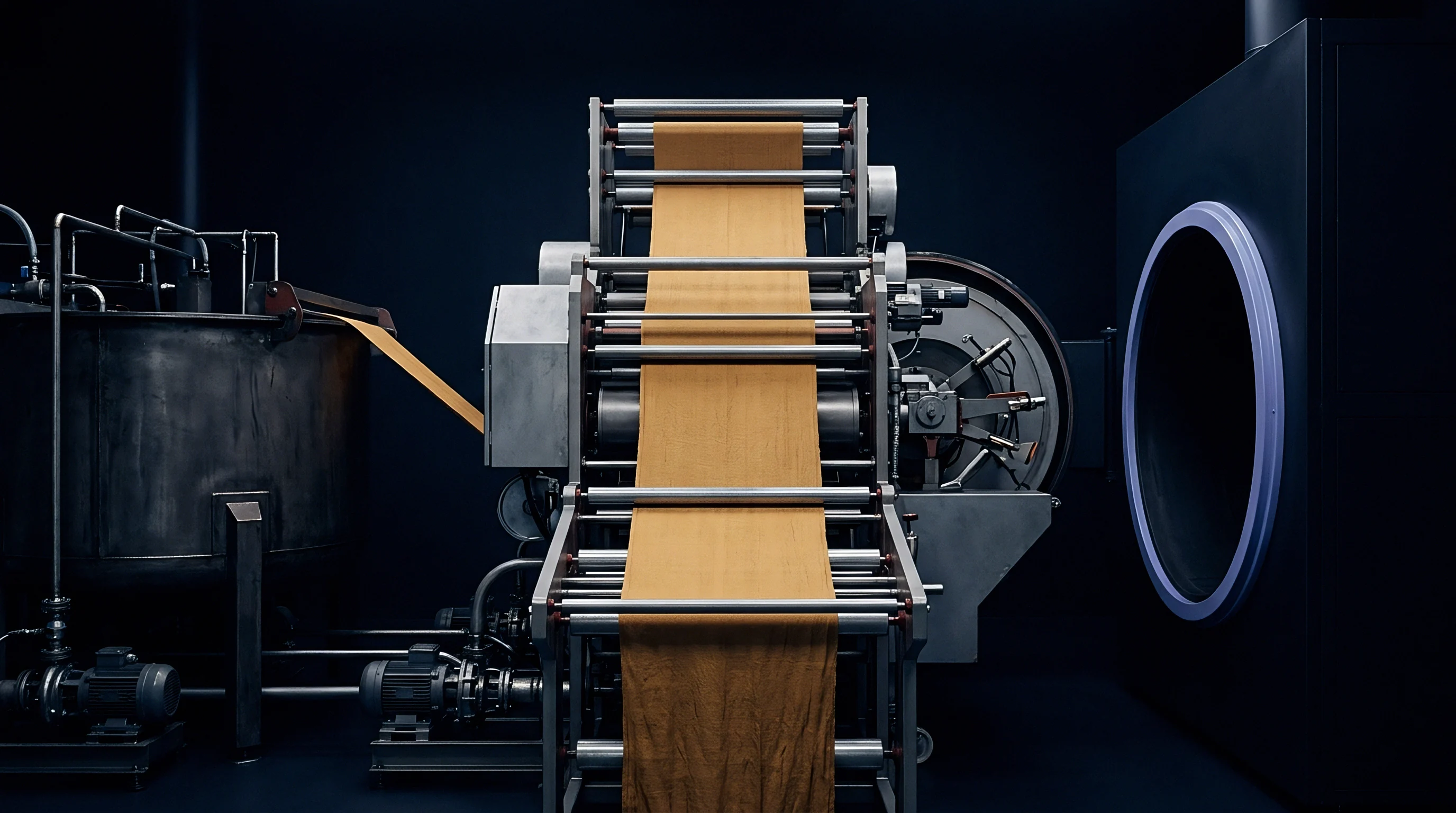
Liquor

Hydrodynamic Volume and Residence Time Dynamics
Continuous pad dyeing ranges rely on low-capacity troughs to cut chemical waste during shade changes and lower overall liquor consumption. Replacing a traditional 100-liter dip tank with a 10 to 25-liter trough fundamentally alters process physics: the bath ceases to act as a static buffer reservoir and becomes a rapid-turnover transport zone where dye and auxiliary concentrations shift quickly with fabric speed, wet pickup, and bath replenishment rates.
When a woven substrate passes through an 18-liter trough at 60 metres per minute, web speed cuts immersion duration below 0.6 seconds. In that fraction of a second, the moving textile must displace entrained boundary air, wet out the fiber surfaces, and initiate dye adsorption. Dividing the trough’s working volume by the volumetric extraction rate gives the average liquor residence time; at production speeds, the web pulls liquor faster than the small volume can buffer, turning the entire bath over every 60 to 90 seconds.
| Trough Volume (L) | Web Speed (m/min) | Fabric Weight (gsm) | Wet Pickup (%) | Liquor Consumption (L/min) | Bath Residence Time (min) |
|---|---|---|---|---|---|
| 12.0 | 40.0 | 180 | 65.0 | 7.49 | 1.60 |
| 12.0 | 80.0 | 180 | 65.0 | 14.98 | 0.80 |
| 18.0 | 60.0 | 220 | 70.0 | 14.78 | 1.22 |
| 25.0 | 50.0 | 300 | 60.0 | 14.40 | 1.74 |
| 25.0 | 100.0 | 300 | 60.0 | 28.80 | 0.87 |
Operating at high turnover requires close balance between liquor delivery and extraction. Whenever the rate of dye adsorption onto the fiber outpaces the arrival of fresh dye via replenishment feed, bath concentration drops progressively across the run. The result is continuous shade fading along the yardage.
Maintaining consistent color over long runs requires balancing physical liquid throughput against dye affinity kinetics.
Substrate construction largely governs how fast liquid displaces air inside small troughs. Open weaves wet out easily, but dense, high-count fabrics present substantial hydraulic resistance at the nip entry, restricting penetration into yarn capillaries during short immersion windows. Without adequate squeeze roll pressure and bath agitation to compensate for reduced dwell time, mass transfer falls short of equilibrium.
A low-capacity trough requires liquor replenishment rates matched directly to fabric extraction volume to prevent dynamic bath depletion.
Shallow immersion windows limit diffusion into the fiber core before fabric reaches the squeeze rolls. While the nip forces surface-held liquor into macro-pores, absorption into micro-pores depends on molecular diffusion. If dynamic mass transport leaves micro-voids starved during immersion, dye migrates toward the surface during initial infrared pre-drying, causing two-sidedness or poor levelness.
Tight control of liquor viscosity, web tension, and temperature is necessary to keep mass transfer within commercial tolerances.
Trough geometry dictates fluid circulation patterns around the moving web. Curved U-shaped pans direct flow tightly against the bottom guide roll, generating shear that strips away stationary fluid boundaries. Flat-bottom pans tend to form stagnant pockets in lower corners, trapping dyestuff that washes out intermittently during speed adjustments and disrupts shade consistency across roll joins.

Boundary

Interfacial Mass Transport and Fluid Boundary Mechanics
Boundary layers at the moving textile surface govern the rate of dye uptake. As dry fabric plunges into the liquor, it carries an adhering sheath of air and viscous fluid that resists mass transfer. The thickness of this boundary film depends on liquor kinematic viscosity, fabric roughness, and line speed, acting as a physical resistance barrier to dye diffusion from bulk solution to the fiber surface.
Mass transport through this layer follows convective diffusion dynamics, where higher Reynolds numbers in the trough raise the local mass transfer coefficient. Agitation inside compact troughs produces micro-vortices that thin the boundary layer, accelerating dye flux toward the yarns. Without deliberate recirculation or mechanical liquor movement, molecular diffusion alone fails to supply dye fast enough to match high-speed extraction.
- Boundary Layer Shear Compression disrupts stagnant fluid films at yarn surfaces, raising local mass transfer coefficients across high-speed continuous dyeing runs.
- Capillary Air Entrapment blocks liquid ingress into inner yarn bundles when immersion duration drops below the critical capillary wetting time threshold.
- Hydrodynamic Drag Pressure forces bulk fluid through inter-yarn apertures, overriding slow molecular diffusion in open-structure woven fabrics.
- Viscous Wall Friction along trough walls reduces effective mixing efficiency, producing edge-to-center concentration variations inside shallow liquid pans.
Once boundary layer resistance is overcome, capillary pressure drives liquid into the structure. Woven fabrics hold two primary void networks: macro-pores between warp and weft yarns, and micro-pores between individual filaments within yarn bundles. Hydrodynamic pressure forces liquor into macro-pores almost instantly, whereas micro-pore filling follows surface tension and contact angle kinetics governed by the Washburn equation.
If liquor sits mostly in macro-pores prior to the squeeze, excess unadsorbed dye expresses back into the pan, destabilizing bath concentration.
Dynamic wet pickup measured immediately after squeeze nip rollers must match calculated bulk liquor depletion within a two percent margin to verify uniform capillary saturation.
Boundary layer equilibrium shifts with every change in line speed. Ramping a range from 30 to 80 metres per minute increases boundary shear but cuts immersion dwell time and can induce splash drag. As a result, net chemical pickup per square metre frequently drops at higher line speeds despite stronger agitation, requiring coordinated nip pressure profiling to hold pickup steady through speed transitions.
Although high-velocity fluid injection nozzles can suppress boundary layer thermal and concentration gradients at the macro scale, technical audits show that micro-channel turbulence around dense cotton or synthetic fiber bundles remains constrained by structural yarn packing densities.

Tailing

Differential Substantivity and Dynamic Bath Depletion
Formulations combining multiple dyes create operational hurdles in low-capacity troughs. Dyes in a ternary mix rarely share identical strike rates or diffusion speeds. When high-affinity components exhaust preferentially onto the fabric during the first fraction of a second, the small bath volume rapidly loses its high-affinity fraction, changing the proportion of dyes remaining in solution.
This differential exhaustion produces tailing. Head-to-tail shade drift develops whenever the web consumes one dye component faster than fresh feed liquor replenishes it. Over the first few hundred metres, bath concentrations drift away from the make-up formulation toward an altered dynamic equilibrium.
If that equilibrium does not match the target recipe ratio, the beginning of the run will not match the end.

Why Does Differential Affinity Force Shade Drift in Low Volume Baths?
Modeling shows how rapid bath turnover magnifies shade drift when dyes exhaust unevenly. Take a 200 gsm woven cotton twill running at 60 metres per minute through an 18-liter trough. At 65 percent wet pickup, the fabric draws 14.04 liters per minute, turning the bath over every 1.28 minutes ~ the time it takes for 76.8 metres of fabric to pass through the nip.
The recipe uses a ternary mix of Reactive Yellow 145 (low affinity), Reactive Red 195 (medium affinity), and Reactive Blue 222 (high affinity).
| Fabric Length (m) | Elapsed Time (min) | Yellow 145 Bath Conc (% of initial) | Red 195 Bath Conc (% of initial) | Blue 222 Bath Conc (% of initial) | Calculated Color Difference (Delta E CMC) |
|---|---|---|---|---|---|
| 0 | 0.0 | 100.0 | 100.0 | 100.0 | 0.00 |
| 100 | 1.67 | 98.5 | 93.2 | 84.1 | 0.42 |
| 250 | 4.17 | 96.8 | 86.5 | 68.9 | 0.98 |
| 500 | 8.33 | 95.1 | 80.1 | 54.2 | 1.75 |
| 1000 | 16.67 | 94.2 | 76.4 | 45.8 | 2.41 |
| 2000 | 33.33 | 93.9 | 75.1 | 43.1 | 2.68 |
Without feed concentration compensation, the concentration of high-affinity Reactive Blue 222 falls by more than 50 percent within 1,000 metres. Red 195 drops nearly 24 percent, while low-affinity Yellow 145 drifts down by under 6 percent. Under ISO 105-J03 color difference formulas, total color error exceeds standard commercial tolerance (Delta E CMC < 0.80) inside 220 metres.
Letting the bath find unmanaged equilibrium locks in severe, permanent shade deviation across the batch.
Preventing tailing requires establishing an enrichment factor for each dye in the feed tank. Feed concentrations must exceed the initial bath concentration for high-affinity dyes, whereas low-affinity dyes need feed strengths virtually equal to the starting bath. This enrichment factor depends on fiber substantivity, wet pickup, web speed, and liquor temperature, meaning any adjustment to squeeze roll pressure changes the required feed mathematics.
Affinity discrepancies are sharpest on cellulosics dyed with direct or vat classes, where fast strike rates exaggerate unequal exhaustion. Dynamic mass transport models must also account for alkali dosing in reactive pad-batch applications, where added base raises reactivity and affinity simultaneously and narrows the stable operating window. Counteracting these localized substantivity changes during rapid line-speed transitions requires dynamic, real-time recalculation of multi-component feed ratios.

Recirculation

Closed-Loop Control Dynamics and Feedback Dosing Kinetics
External circulation loops stabilize low-volume pad troughs by continuously cycling dye liquor through conditioning circuits. Pumps draw liquor from trough outlets, pass it through heat exchangers and inline monitoring cells, and return it via distribution manifolds at the inlet. While vigorous circulation evens out cross-trough concentration variations and flow meters track feed rates, excessive pumping generates turbulence and entrained air, creating foam that disrupts wet-out.
Transport lag between measurement and dosing pump response introduces instability. If an external circuit requires 15 seconds to detect a concentration drop and deliver enriched feed, several dozen metres of fabric run through depleted chemistry before correction occurs. Minimizing loop plumbing volume and injecting feed stock directly ahead of high-shear mixing zones keeps latency within acceptable limits.
| Recirculation Loop Variable | Optimal Target Operating Range | Under-Range Consequence | Over-Range Consequence |
|---|---|---|---|
| Turnover Ratio (Pump Flow / Trough Vol) | 3.0 – 5.0 min⁻¹ | Localized exhaustion, shade banding | Severe foaming, liquor splashing |
| Dosing Response Latency | < 4.0 seconds | Extended head-to-tail shade drift | System hunting, concentration oscillation |
| Inline Spectrophotometric Path Length | 1.0 – 2.5 mm | Low signal-to-noise ratio | Optical saturation on dark shades |
| Mixer Shear Rate | 450 – 800 s⁻¹ | Incomplete feed liquor blending | Dyestuff hydrolysate agglomeration |
Automated dosing loops rely on inline spectrophotometers or conductivity sensors to monitor real-time concentrations. Spectrophotometric flow cells track absorbance across targeted wavelengths, resolving individual dye components via multi-component matrix calculations. Sensor window fouling remains a primary failure mode; dye and auxiliary build-up over long runs distorts baseline optical signals, leading to over-dosing unless automated flush cycles periodically clean the sight glasses.
Purchasing contracts must mandate that continuous pad dyeing range suppliers specify total closed-loop hydraulic response latency, measured from sensor detection to complete bath homogenization at maximum feed rates.
Feed pump accuracy determines concentration stability. Positive displacement peristaltic or diaphragm units must meter concentrated stock accurately across varying speeds, with drive motors slaved directly to line tachometers. When the range decelerates for a roll change, dosing rates must drop instantly to avoid over-concentrating the low-volume bath and throwing subsequent rolls off shade.
Supply agreements for continuous ranges routinely stipulate dynamic shade tolerances. Standard specifications demand that closed-loop dosing systems hold nominal bath concentration within plus or minus 1.5 percent of setpoint across production runs up to 5,000 metres, verified through ISO 105-J03 color measurement methods.


Verification
Analytical Testing and Quality Qualification Protocols
Confirming mass transport stability in continuous low-capacity troughs requires rigorous testing. Laboratory beakers and pad hand-dips cannot simulate the fluid shear and sub-second immersion times encountered on production machinery. Range qualification depends on pilot-scale continuous trials combined with strict incoming fabric checks before commercial yardage enters the padder.
- Verify incoming greige fabric absorbency by running drop absorption tests according to AATCC Test Method 39, rejecting any cloth lot exhibiting absorption times greater than 3.0 seconds.
- Measure residual size and non-cellulosic impurities using ISO 20743 or TEGEWA purple scale ratings, establishing a minimum absorbency threshold of rating 6 prior to pad application.
- Determine fabric wet pickup profile across the left, center, and right sections of the squeegee roller using high-precision gravimetric cut-and-weigh sampling at target production speeds.
- Fill pad trough with target dye recipe solution and calibrate spectrophotometric feedback dosing loops using known reference concentration standards across three transmission wavelengths.
- Run a continuous 500-metre test fabric roll at full production speed, taking physical swatch samples at 50-metre intervals from head to tail.
- Evaluate color difference values for all swatch samples against the initial head sample using ISO 105-J03 color measurement under illuminant D65 and 10-degree observer conditions.
- Confirm fastness to washing under ISO 105-C06 standards to verify dye penetration depth into yarn interiors versus superficial surface deposition.
Uniform greige absorbency underpins pad bath stability. Patchy desizing, residual spinning oils, or uneven mercerization produce localized wetting variations that immediately destabilize pickup. Capillary suction measurements run per DIN 53924 quantify liquid transport rates; cloth with erratic wicking across its width produces side-center-side shade variation regardless of how well the trough recirculates.
Standardized absorption testing of incoming fabric lots prevents wet pickup variations that undermine dynamic equilibrium balance in short immersion pad troughs.
Spectrophotometric evaluation across continuous yardage must track both bulk tailing and local levelness. Optical density readings taken across yarn crowns and inter-yarn valleys show whether dyestuff migrated during pre-drying. Excess surface deposition relative to yarn cores indicates incomplete core penetration during trough dwell, routinely showing up as lower crocking fastness under ISO 105-X12.
Skipping incoming fabric absorbency screening before starting low-volume continuous runs risks full-width or longitudinal shade banding across thousands of metres, resulting in rejected inventory or costly chemical stripping.


Margin

Commercial Yield Mechanics and Landed Fabric Cost Structures
Operating low-capacity pad ranges involves a direct trade-off between chemical savings and process sensitivity. The central economic argument for small troughs is reduced changeover waste: while a 100-liter dip pan dumps substantial volumes of active chemistry between colors, a 15-liter pan cuts chemical discard by over 80 percent, delivering meaningful savings on short yardages.
Because bath volume governs changeover loss, reducing residual liquor allows lower Minimum Order Quantities per shade, letting continuous converters compete directly with exhaust dyeing mills on short-run orders. However, compact troughs leave little buffer for error. Minor fluctuations in fabric basis weight, line speed, or pump calibration register immediately in the fabric face, where off-shade yardage quickly erodes the chemical savings.
| Cost Parameter / Operating Metric | Traditional Pad Trough (90 L) | Low-Capacity Trough (15 L) | Economic Difference per Order |
|---|---|---|---|
| Liquor Waste at Drain (L) | 90.0 | 15.0 | -75.0 L (-83.3%) |
| Chemical Waste Value ($ USD at $4.50/L) | $405.00 | $67.50 | -$337.50 saved |
| Tail-End Setup Waste (Metres) | 45.0 | 110.0 | +65.0 m scrap |
| Fabric Setup Waste Value ($ USD at $3.20/m) | $144.00 | $352.00 | +$208.00 cost |
| Net Chemical and Fabric Changeover Cost | $549.00 | $419.50 | -$129.50 net benefit |
| Shade Reject Rate Risk Factor (% of run) | 1.2% | 3.8% | +$166.40 risk cost |
Plant qualification for continuous dyeing ranges must inspect mechanical capability alongside floor discipline. Running low-volume troughs requires automated dosage compensation and consistent greige preparation. Sourcing audits should review dosing loop calibration history, sensor maintenance intervals, and greige absorbency logs before placing production orders on technical or tight-tolerance fabrics.
- Hardware Response Qualification verifies that automated feed dosing pumps adjust delivery rates within four seconds of detected line speed changes during production ramps.
- Substrate Absorbency Controls require incoming greige fabric rolls to demonstrate uniform wetting absorbency times under three seconds across all width zones.
- Recirculation Maintenance Records establish regular cleaning schedules for optical inline flow cells to prevent calibration drift caused by chemical deposits.
- Shade Sampling Protocols enforce physical head, middle, and tail cut evaluations under calibrated light sources against ISO 105-J03 color difference standards.
Careful mass transport management turns low-capacity pad dyeing from a volatile application method into a repeatable production route, lowering landed fabric cost per metre while keeping pace with tight delivery schedules on multi-shade orders.