Mass Transfer Rate Drift in Heated Dye Pad Troughs under Variable Relative Humidity
Relative humidity drops accelerate solvent evaporation in heated pad troughs, concentrating liquor and causing head-to-tail shade drift in continuous dyeing.
Film
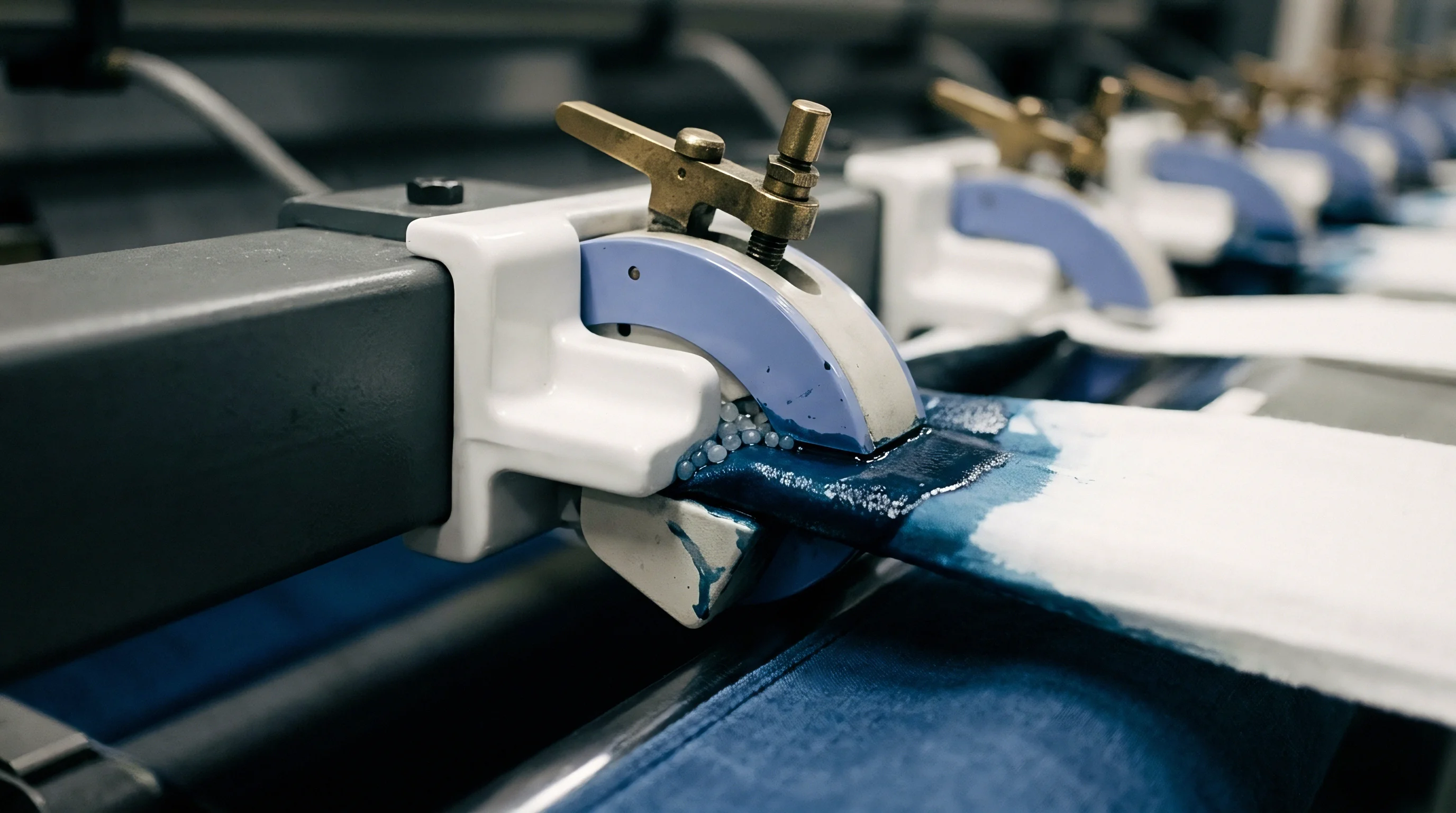
Continuous pad dyeing operations establish an open liquid boundary where heated dye liquor contacts ambient plant air before mechanical squeeze rollers exert pressure on the moving textile web. Pad troughs operating at temperatures between 50 degrees Celsius and 75 degrees Celsius generate substantial water vapor pressure gradients against surrounding factory air. When the ambient relative humidity within the dyehouse drops during seasonal shifts or localized extraction ventilation cycles, evaporation rates at the trough surface surge.
The dye bath evaporates rapidly. The water solvent vaporizes into the unsaturated air layer while dye molecules, wetting agents, and dissolved auxiliary salts remain trapped within the liquid volume. This selective loss of solvent shifts the concentration of the bath continuously during long production runs.
Liquor volume inside a standard low-capacity trough ranges from 8 liters to 25 liters to promote rapid bath turnover. Running a 180-centimetre wide woven poplin at 60 metres per minute draws between 40 litres and 70 litres of liquor per hour depending on wet pick-up targets. When ambient relative humidity plunges from 65 percent to 30 percent during winter heating or dry summer shifts, the rate of water vaporization from the exposed liquid boundary can remove up to 1.8 liters of solvent per hour directly from the surface.
Pad liquor concentration climbs steadily. Dyes with high substantivity strike faster onto hydrophilic cellulosic yarns under elevated salt and dye concentrations, distorting the intended equilibrium partition coefficient before the cloth enters the nip.
A fifteen percent drop in ambient relative humidity shifts bath concentration upward by six percent across an eight-hundred-meter run when trough volume exceeds twelve liters.
The interfacial mass transfer coefficient across the liquid-air boundary layer scales with the velocity of ambient drafts around the dye pad entrance. Exhaust hoods installed directly above pad troughs to remove steam generate localized laminar and turbulent air currents across the open bath. Surface boundary layers thin out.
These air movements accelerate convective mass transfer, sweeping moisture-laden vapor away from the surface and maintaining a steep chemical potential gradient between the heated bulk solution and the ambient atmosphere. The trailing yardage shifts darker.
Woven poplins constructed from 40s combed cotton ring-spun yarns at 133 ends per inch and 72 picks per inch exhibit distinct capillary suction forces compared to open knitted jersey structures. Dense yarn intersections slow the penetration of concentrated surface liquor into the core of the yarn bundle during the brief dwell time in the trough. The liquor boundary layer adhering to the exterior face of the moving web experiences rapid solvent loss during the transit distance between trough submersion and the nip entry line.
This micro-film evaporation elevates dissolved solid concentration on the exterior yarn crowns, promoting frosting and two-sidedness before the squeeze rollers achieve mechanical penetration.
Uncontrolled interfacial evaporation alters the bath balance faster than standard level-sensor feed systems can replenish the consumed liquor.
Vapor
Psychrometric conditions surrounding the wet-processing line dictate the driving force for mass transfer between the heated bath and the dyehouse environment. The saturated vapor pressure of water at a trough operating temperature of 60 degrees Celsius stands at 19.94 kilopascals. At an ambient dyehouse temperature of 24 degrees Celsius with 60 percent relative humidity, the partial pressure of water vapor in the surrounding room air measures approximately 1.79 kilopascals.
When the plant relative humidity falls to 30 percent at the same dry-bulb temperature, the ambient partial pressure drops to 0.89 kilopascals. Vapor pressure drives the flux. This drop widens the vapor pressure differential across the boundary layer by nearly ten percent, accelerating water loss into the air stream.
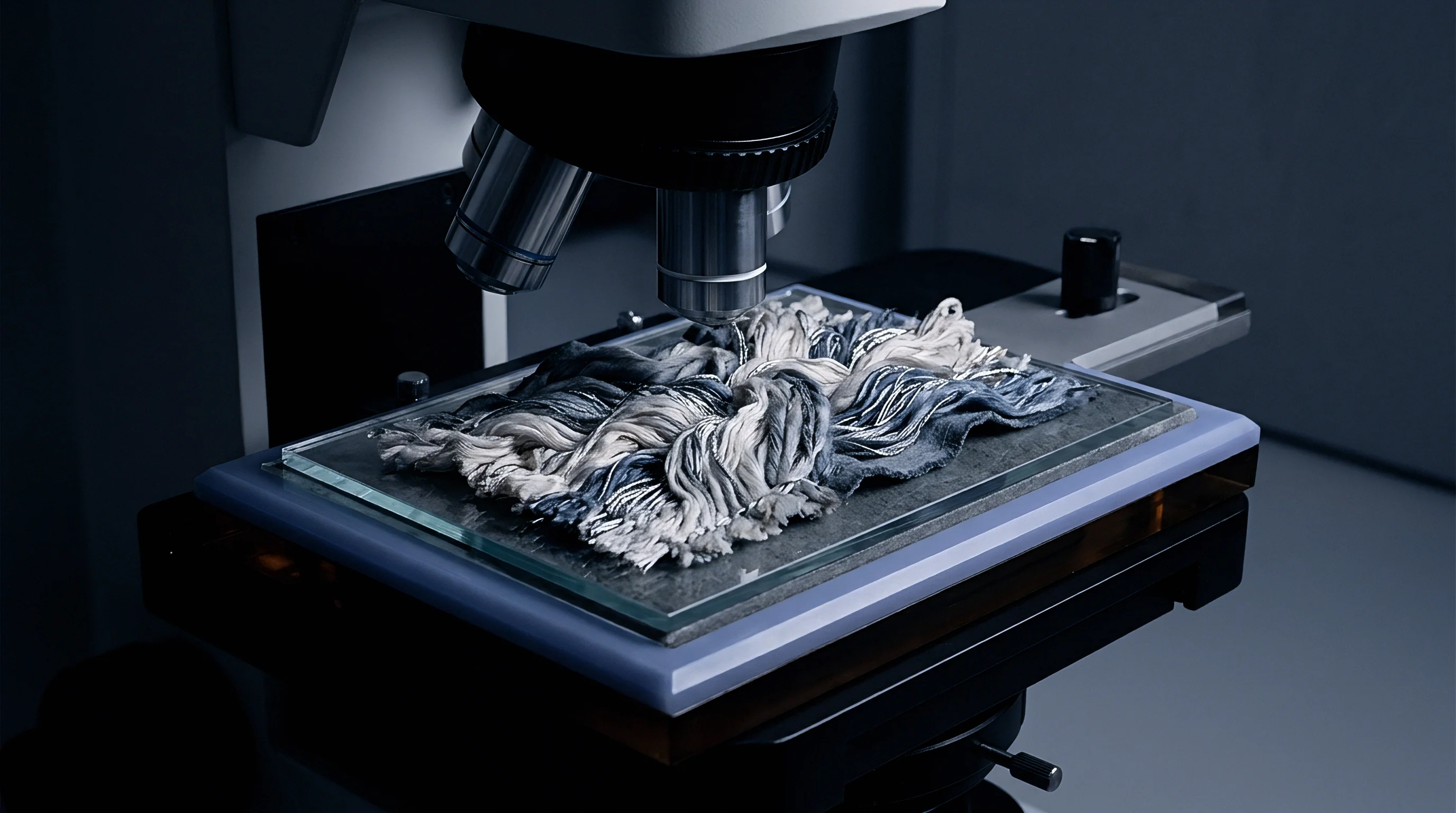
What Governs Interfacial Evaporation across Open Pad Liquor?
The mass flux of evaporating solvent from the exposed trough surface follows boundary layer transport mechanics governed by the concentration gradient and convective velocity profiles. Calculating the evaporation rate requires balancing the thermal energy supplied by heated trough jackets against the latent heat of vaporization removed by the escaping steam. Trough designs featuring uninsulated liquor surfaces, agitated return channels, and high-speed roller entry points multiply the effective interfacial surface area.
Air velocity spikes across troughs.
| Ambient Relative Humidity (%) | Ambient Vapor Pressure (kPa) | Vapor Pressure Deficit (kPa) | Evaporation Rate (kg/m²·h) | Bath Concentration Drift (%/h) |
|---|---|---|---|---|
| 70 | 2.09 | 17.85 | 3.42 | +1.8 |
| 55 | 1.64 | 18.30 | 4.15 | +2.9 |
| 40 | 1.19 | 18.75 | 4.92 | +4.4 |
| 25 | 0.75 | 19.19 | 5.78 | +6.2 |
Process control in continuous dyeing relies on maintaining a steady-state equilibrium between the mass of dye and water removed by the moving textile substrate and the mass introduced through the replenishment feed line. When evaporation strips pure water from the bath without removing dissolved dyestuff, the equilibrium shifts toward higher concentrations. Dyes classified under ISO 105-C06 wash fastness categories often utilize complex salt formulations that respond aggressively to moisture loss.
Relative humidity drops across midday. The resulting bath concentration drift generates continuous tailing along the run, producing significant Delta E shade variance between the head and tail of a single production lot.
Local atmospheric pressure variations and extraction hood exhaust dampers influence the stability of this vapor barrier. Plant air make-up systems operating without closed-loop relative humidity controls expose the open pad trough to cyclic environmental swings between early morning shifts and dry afternoon processing hours. Direct replenishment restores balance.
Slower line speeds intensify this defect because the ratio of exposed surface evaporation to volumetric throughput increases proportionally as linear cloth speed decreases.
Evaporative drift rates expand threefold when cloth delivery speed drops below twenty-five meters per minute.
A mill technician commonly attributes tailing defects to faulty nip roll crowning rather than psychrometric drift across the trough interface.
Affinity
Dye strike behavior in continuous padding operations depends directly on the substantive attraction between the chromophore molecule and the swollen cellulosic or synthetic polymer chain. Elevated temperatures in the trough decrease the physical dye-fiber substantivity, which prevents premature strike and ensures uniform liquor penetration before the squeeze rollers. When ambient humidity drops and water vaporizes out of the bath, the effective concentration of electrolyte salts like sodium sulfate or sodium chloride rises alongside dyestuff concentration.
Dye strike accelerates along edges.
Why Do Differential Strike Rates Diverge under Humidity Drops?
Ternary dye formulations rely on individual dye components possessing matched strike rates, diffusion coefficients, and substantivity values. When selective evaporation concentrates the bath liquor, individual dye molecules within a combination recipe respond differently based on their molecular weight and sulfonic acid group count. Low-affinity leveling dyes remain stable in solution longer, while high-affinity dyes exhaust preferentially onto the exterior surfaces of incoming yarns.
Pad liquor concentration climbs steadily. This mechanism triggers catastrophic shade migration, shifting ternary mixtures off-tone and altering the target color coordinate under standard D65 and point-of-sale LED light sources.
- Tri-reactive vinyl sulfone dyes exhibit rapid strike acceleration when electrolyte concentrations rise above thirty grams per liter due to bath evaporation.
- Heterobifunctional monochlorotriazine chemistries maintain uniform migration indices only when the trough liquor volume replaces itself within four minutes of dwell time.
- Direct dyes of class B demonstrate extreme sensitivity to salt concentration shifts, precipitating unlevel tailing along continuous runs if water loss exceeds five percent.
- High-molecular-weight vat dispersions suffer agglomeration within the heated trough when the water boundary layer evaporates, causing localized specking on finished cotton twills.
Yarn construction geometry modulates the severity of these affinity differentials under changing evaporation rates. Heavy 3/1 cotton twills woven at 280 grams per square metre with coarse 16s open-end rotor yarns absorb liquor through both inter-yarn capillary void networks and direct intra-fiber swelling. When the bath concentrates through moisture loss, the outer yarn sheath captures the fast-striking dye fractions immediately upon contact.
Pick-up percentages drift downward. The inner core of the yarn receives only a depleted, off-tone liquor mixture, resulting in poor ring-dyeing penetration and substandard Martindale abrasion color fastness under ISO 12947 testing.
| Dye Chemistry Class | Nominal Bath Temp (°C) | Critical Salt Limit (g/L) | Migration Index (ISO 105-F10) | Shade Drift Threshold (ΔE ) |
|---|---|---|---|---|
| Bis-monochlorotriazine Reactive | 70 | 45 | 0.82 | 0.45 |
| Vinyl Sulfone Reactive | 50 | 30 | 0.68 | 0.35 |
| Low-Substantivity Disperse | 60 | 5 | 0.91 | 0.60 |
| Solubilized Vat Leuco Ester | 65 | 20 | 0.74 | 0.40 |
Cellulose cross-linking efficiency and subsequent fixation yields drop when dyestuff distribution across the substrate profile becomes asymmetrical. As evaporation strips water from the open trough, dye aggregates form inside the concentrated solution, reducing the effective diffusion coefficient of the chemistry into the amorphous regions of the fiber. The tail end fails inspection.
Subsequent atmospheric steaming or pad-dry-cure fixation lines cannot resolve this initial unlevelness, leaving permanent side-to-center and end-to-end shading defects across finished yardage rolls.
Failure to regulate trough evaporation produces irreversible shade separation across ternary dye recipes.
Nip
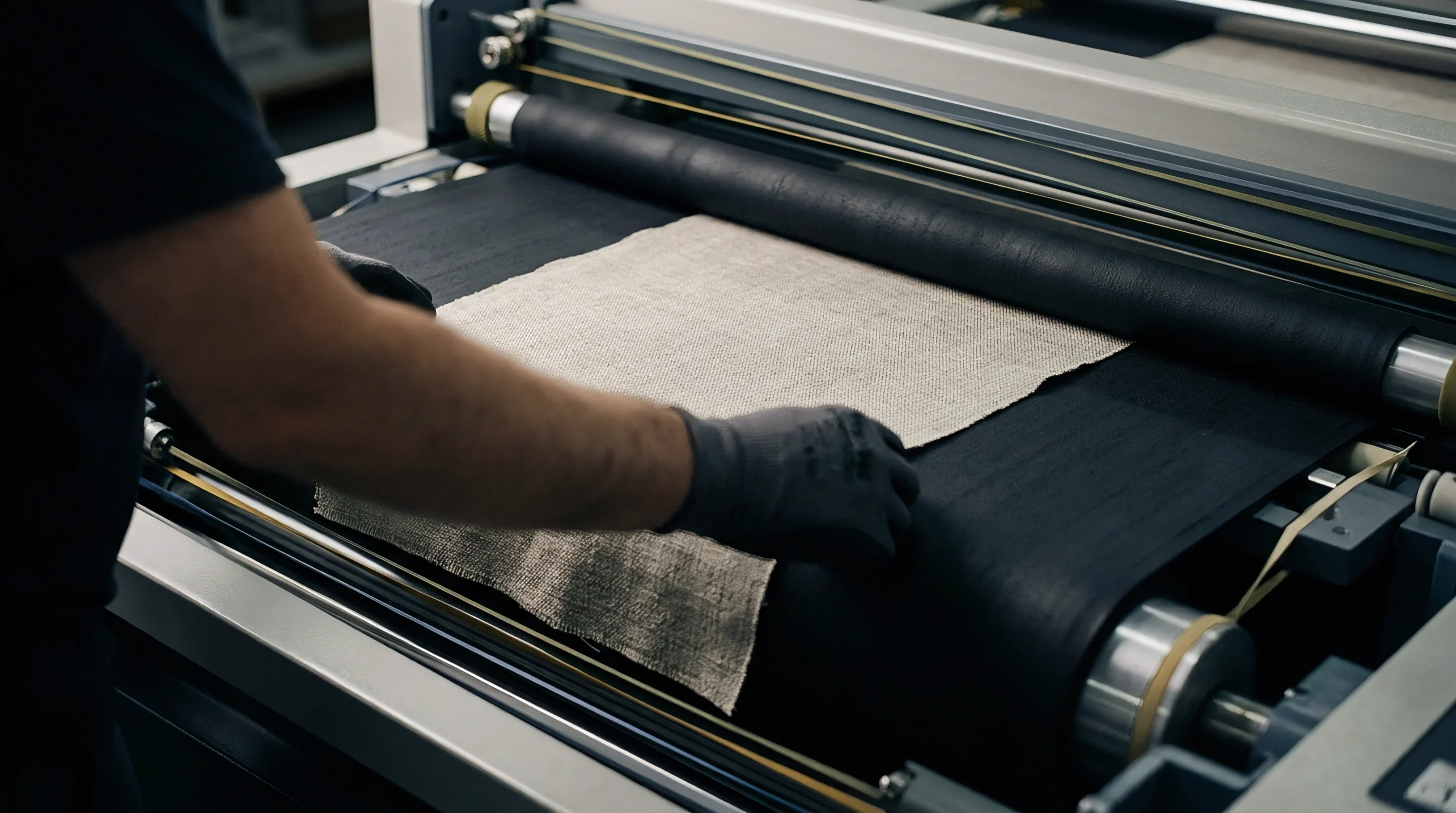
Mechanical extraction at the squeeze rolls governs the mass transfer of liquor from the bath into the internal pore structure of the traveling substrate. The nip rollers exert linear pressure between 15 kilonewtons per meter and 45 kilonewtons per meter, compressing the yarn bundles to expel trapped air and force dye solution into micro-capillary voids. When the incoming bath concentration fluctuates due to environmental evaporation, the wet pick-up calculation no longer directly correlates with intended dye add-on percentages.
Liquor volume drops per meter. A stable mechanical expression of 65 percent wet pick-up delivers progressively heavier solid dye mass per gram of dry fiber as solvent loss continues inside the trough.
Consider a continuous dyeing line running a 100 percent plain-weave combed cotton poplin measuring 120 grams per square metre at a target production speed of 50 metres per minute. The production run spans 5,000 metres of cloth across an unconditioned finishing room floor. The pad trough holds an active liquor volume of 15 liters, maintained at 65 degrees Celsius with an exposed surface area of 0.45 square meters. replenishment chemistry arrives at a target concentration of 25 grams per liter of reactive dye and 40 grams per liter of electrolyte salt to maintain a calibrated 65 percent wet pick-up.
Assume the dyehouse relative humidity drops from a calibrated 60 percent down to 28 percent over a four-hour daytime production window. Under these psychrometric conditions, the surface evaporation rate rises to 5.2 kilograms per square meter per hour, extracting 2.34 kilograms of pure water solvent every hour from the trough. The fabric throughput consumes 195 liters of solution per hour at the designated pick-up rate.
Because the mechanical level float replenishes the bath volume with standard-concentration liquor rather than pure water, solid dye and salt accumulate relentlessly within the 15-liter active volume.
Over the 100-minute run duration required for the 5,000-metre lot, the total water lost exclusively through interfacial evaporation reaches 3.9 liters. This solvent extraction raises the effective concentration of the dye bath from 25.0 grams per liter to 26.8 grams per liter by the end of the roll run. Shade variance exceeds tolerance.
The trailing 1,500 metres of cloth receive an effective dye add-on of 1.74 percent on weight of fabric compared to the initial 1.62 percent deposited on the lead yardage.
Spectrophotometric batch qualification requires reading five cross-directional swatches across both leading and trailing roll ends under ISO 105-J03 color measurement standards.
Mechanical nip adjustments cannot counteract chemical concentration gradients established inside the trough liquid phase. Increasing roll hardness from 65 Shore A to 80 Shore A tightens the pressure profile curve, reducing overall pick-up values without correcting the unequal dye-to-liquor ratio in the delivered solution. Automated trough covers, infrared surface temperature monitoring, and high-frequency refractive index sensors positioned in the recirculation loop represent practical hardware modifications that arrest steady-state evaporative drift.
- Refractometer readings are logged every ten minutes from the main recirculation feed line.
- Deionized water injection pulses activate automatically when solution solids exceed target setpoints by 1.5 percent.
- Trough level probes are calibrated to hold liquid capacity below ten liters total volume.
- Nip pressure transducers record real-time linear force across the left, center, and right roll zones.
The standard procurement contract specifies that shade conformity across five thousand continuous meters must stay within a Delta CMC 2:1 limit of 0.8 against the approved master lab dip.
Ledger
Color shading rejections originating from pad trough evaporative drift generate direct commercial chargebacks that erode manufacturing margins across continuous conversion programs. When bulk yardage exhibits head-to-tail shade drift exceeding Delta E tolerances, garments cut sequentially from the roll present mismatched panels during final assembly. Garment dye lots cannot correct pre-existing continuous unlevelness on finished piece goods.
The entire rejected yardage must undergo chemical stripping and redyeing into darker shades or suffer total write-off at salvage market valuations.
Stripping reactive dyeings from cellulosic poplin substrates damages yarn tensile and tear performance under ISO 13934-1 and ISO 13937-1 test methods. Caustic soda and sodium hydrosulfite stripping baths degrade cellulose molecular chain lengths, dropping warp tensile values by up to 22 percent below original greige specifications. Trough volume stays under ten liters.
Re-dyeing stripped goods into deep navy or black shades adds secondary energy, chemical, and effluent treatment costs while pushing delivery lead times past contracted shipping dates.
Sourcing practices auditing continuous wet-processing facilities review environmental controls on the dyehouse floor to prevent these downstream financial failures. Mills operating open, unheated pad troughs without automated moisture barriers or psychrometric compensation systems risk substantial lot rejections on long continuous dyeing contracts. Controlling the mass transfer rate across the heated pad trough protects color consistency, eliminates lot sorting surcharges, and secures commercial profitability across demanding global fabric supply chains.