Standard Atmospheric Conditioning Regimes in Modern Textile Testing Laboratories
Standard atmospheric conditioning at 20°C and 65% RH fixes fabric moisture regain to eliminate testing errors and secure accurate commercial weight settlement.

Regime
Atmospheric control within physical testing environments establishes the baseline state for every quantitative fabric property. International standards define specific environmental envelopes to ensure test repeatability across global supply chains. Standard atmospheric setpoints dictate an ambient temperature of 20.0 degrees Celsius with a tolerance of plus or minus 2.0 degrees, alongside a relative humidity of 65.0 percent with a tolerance of plus or minus 4.0 percent, as set forth in ISO 139.
Modern automated testing facilities often enforce a tighter class-one tolerance envelope, tightening temperature bounds to plus or minus 1.0 degree Celsius and relative humidity to plus or minus 2.0 percent. Standard atmosphere fixes regain. Precision dictates test validity.
Regional variations exist to accommodate local climate dynamics or historical commercial practices. ASTM D1776 specifies a standard atmosphere for textile testing at 21.0 degrees Celsius plus or minus 1.0 degree, combined with 65.0 percent relative humidity plus or minus 2.0 percent. Specialized tropical standard atmospheres elevate the setpoint to 27.0 degrees Celsius plus or minus 2.0 degrees while maintaining 65.0 percent relative humidity, accommodating regional mill conditions in South and Southeast Asia.
At 20.0 degrees Celsius and 65.0 percent relative humidity, hydrophilic fibers absorb water vapour until thermodynamic equilibrium balances atmospheric chemical potential.

Standard Setpoints across Global Testing Specifications
Textile physical properties respond directly to localized atmospheric shifts inside testing enclosures. Maintaining setpoint stability prevents false passes on mill specifications. The choice of governing standard dictates operational limits for environmental controls, sensor calibration intervals, and HVAC compressor cycle profiles.
| Standard Body | Atmosphere Type | Target Temperature | Temperature Tolerance | Target Relative Humidity | Humidity Tolerance |
|---|---|---|---|---|---|
| ISO 139 | Standard Temperate | 20.0 °C | ± 2.0 °C | 65.0 % | ± 4.0 % |
| ISO 139 Class 1 | Arbitration Temperate | 20.0 °C | ± 1.0 °C | 65.0 % | ± 2.0 % |
| ASTM D1776 | Standard Textile | 21.0 °C | ± 1.0 °C | 65.0 % | ± 2.0 % |
| ISO 139 Tropical | Tropical Standard | 27.0 °C | ± 2.0 °C | 65.0 % | ± 5.0 % |
Arbitration Tolerances and Microclimate Stability
Climatic drift inside testing enclosures invalidates test data long before physical instruments lose mechanical calibration. Air distribution systems inside high-tier conditioning chambers maintain continuous circulation to eliminate temperature gradients across specimen racks. Unconditioned specimens fail inspection.
- Standard Temperate Envelope regulates general commercial verification at 20.0 degrees Celsius and 65.0 percent relative humidity for primary quality reporting.
- Arbitration Tight Envelope restricts environmental fluctuation to half standard tolerances, isolating genuine structural fabric defects from ambient noise during dispute resolution.
- Tropical Alternative Envelope provides localized testing baselines for mills operating in high-ambient zones, reducing refrigeration load while maintaining constant humidity.
ISO 139 Clause 5.2 invalidates test reports whenever continuous environmental monitoring records show environmental excursions exceeding the specified tolerance envelope for more than fifteen consecutive minutes during specimen conditioning.
Regain
Water uptake in polymeric fiber networks follows thermodynamic rules governed by molecular structure and accessible chemical bonding sites. Fiber polymer chains containing polar functional groups, such as the hydroxyl groups in cellulose or the amide groups in polyamide, actively attract gaseous water molecules from surrounding air. Equilibrium takes time.
Water adsorption continues until the chemical potential of absorbed moisture equals the chemical potential of ambient atmospheric water vapor. Moisture changes fiber volume.
Moisture regain measures the mass of water present in a material expressed as a percentage of its oven-dry weight. Moisture content expresses absorbed water mass as a percentage of the total wet fabric weight. Distinguishing between these two mathematical expressions prevents errors during commercial weight adjustments and mass yield calculations.
Standard conditioning regimes ensure that test specimens reach equilibrium moisture regain prior to mechanical stress testing.
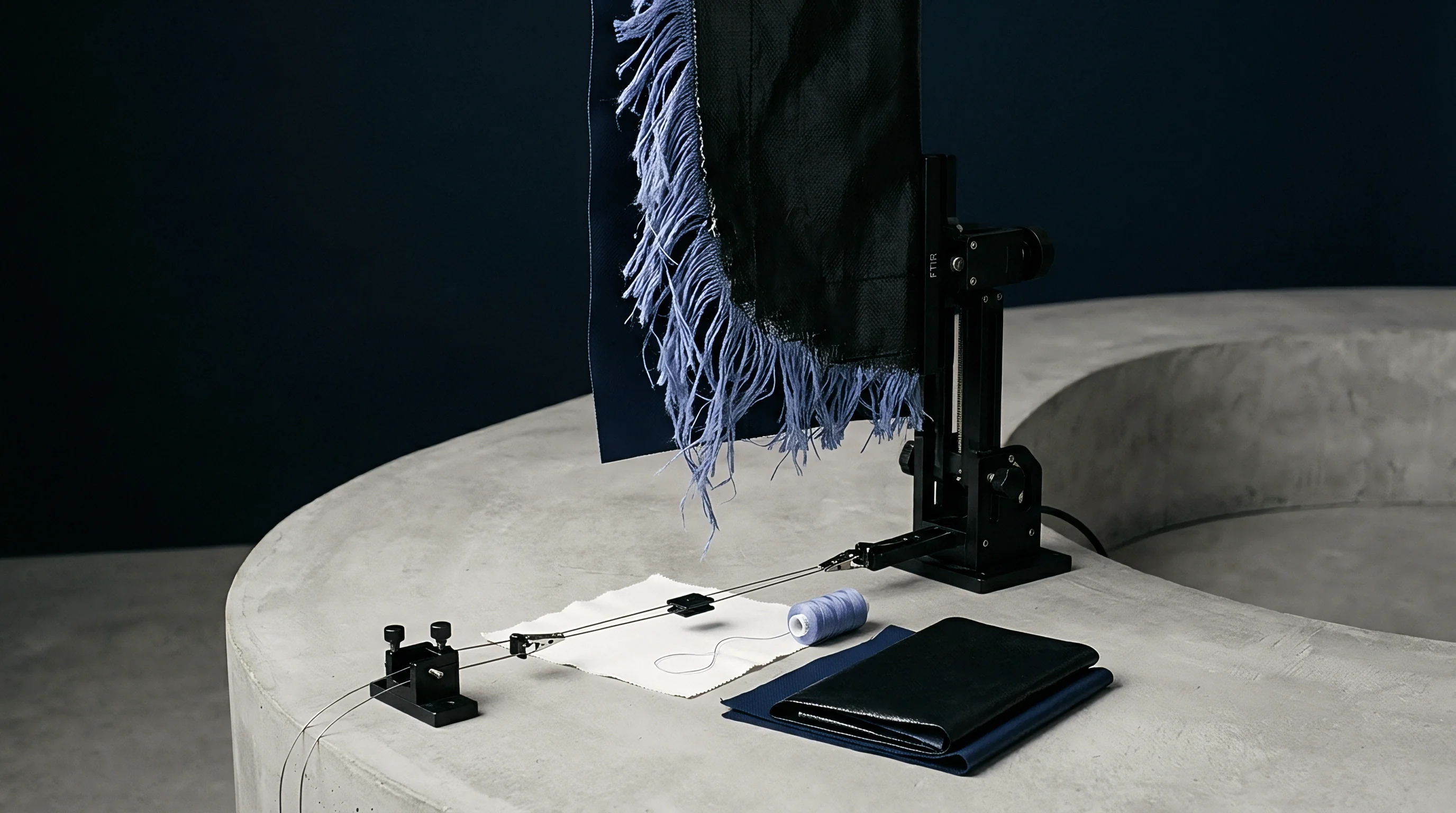
Thermodynamic Equilibrium in Fiber Structures
Hydrophilic functional groups along molecular chains attract polar water vapor through hydrogen bonding. Amorphous regions within natural and regenerated fibers house accessible hydroxyl sites, driving high regain values. Highly crystalline synthetics restrict water access to surface polymer chains, yielding low absorption values.
| Fiber Classification | Chemical Structure Base | Equilibrium Moisture Regain (%) | Conditioning Time to Equilibrium (Hours) |
|---|---|---|---|
| Wool | Keratin Protein | 14.0 – 16.0 | 24 – 48 |
| Viscose Rayon | Regenerated Cellulose | 12.0 – 13.0 | 12 – 24 |
| Cotton (Scoured) | Native Cellulose | 7.0 – 8.5 | 6 – 12 |
| Nylon 6,6 | Polyamide | 4.0 – 4.5 | 6 – 12 |
| Polyester (PET) | Aromatic Polyester | 0.4 – 0.5 | 2 – 4 |
| Acrylic | Polyacrylonitrile | 1.5 – 2.0 | 2 – 4 |
The Hysteresis Lag between Absorption and Desorption
Divergence between environmental equilibrium states creates an operational trap for unmonitored laboratory environments. Fibers approaching equilibrium from an artificially wet state retain a higher mass of water than specimens approaching equilibrium from a dry state under identical ambient conditions. Hysteresis distorts specimen mass.
Specimens approaching equilibrium from the wet side retain higher moisture mass than specimens conditioned from the dry state.
The hysteresis loop proves that ambient environmental history alters physical fabric mass. Cellulosic materials exhibit a hysteresis gap of 0.8 to 1.5 percent regain between absorption and desorption curves at 65.0 percent relative humidity. Eliminating this history requires thermal preconditioning before standard climate exposure.
Textile structures approaching equilibrium along the absorption path consistently achieve reproducible mechanical performance baselines.


Draft
Convective mass transfer across fabric surfaces governs the speed at which moisture equilibrium occurs inside testing enclosures. Airflow alters regain speed. Enclosures demand precise control over internal velocity profiles to supply fresh conditioned air without generating mechanical vibration across sensitive weighing scales.
Insufficient air movement leaves boundary layers intact, trapping stagnant microclimates around dense woven swatches.
Air velocity inside testing cabinets must remain balanced within defined physical limits. Velocities between 0.15 and 0.50 metres per second sweep away localized moisture gradients without disturbing low-capacity load cells. Proper enclosure design uses perforated distribution plenums to create uniform laminar flow across hanging test specimens.
Airflow Velocity and Stagnant Boundary Layers
Movement of conditioned air inside testing cabinets disrupts boundary layer resistance at the fabric-air interface. High-density weave constructions impede internal air movement, prolonging the required dwell time for inner-yarn conditioning. Properly spaced specimen suspension racks prevent physical contact between hanging swatches and maintain uniform air passage.
Stagnant boundary air around dense woven structures delays moisture equilibrium by suppressing vapor pressure differentials.
Why Does Boundary Layer Airflow Control Equilibrium Rate?
Boundary air surrounding stationary textiles forms an insulating vapor barrier that dampens local vapor pressure differentials. Static air pockets quickly reach equilibrium with the immediate fiber surface, drastically reducing the concentration gradient needed to drive further water vapor transfer into or out of the yarn core. Introducing controlled low-velocity laminar airflow sweeps away this saturated air layer, maintaining a steep water vapor pressure differential between the conditioned environment and the fiber matrix until true bulk equilibrium occurs.
Sensor placement inside conditioning enclosures dictates control accuracy. Capacitive polymer thin-film sensors positioned directly in the primary return air draft track true bulk air conditions, whereas sensors mounted against chamber walls miss microclimate pockets formed around high-density fabric loads. Commercial machinery suppliers frequently cite thermal recovery speed after chamber door openings as justification for aggressive airflow, ignoring the mechanical disturbances high air velocities introduce to precision balances placed within the conditioned volume.

Preconditioning
Thermal drying before final environmental exposure neutralizes moisture history and clears hysteresis memory. Dry cloth absorbs rapidly. Exposing samples to low relative humidity at elevated temperatures drives off excess absorbed water, forcing all subsequent environmental conditioning to follow the lower absorption equilibrium curve.
ASTM D1776 mandates preconditioning for all hydrophilic materials where precise quantitative physical results govern commercial acceptance. The preconditioning environment maintains a relative humidity between 10.0 and 25.0 percent with temperatures not exceeding 50.0 degrees Celsius. Temperature shifts relative humidity.

Thermal Clearance of Hysteresis Memory
Elevated temperatures paired with low relative humidity force internal water molecules out of molecular binding sites. Lowering internal moisture content below final equilibrium targets ensures every specimen absorbs moisture until thermodynamic equilibrium seals the structural baseline. Skipping preconditioning introduces a two to five percent variability spread across subsequent tensile and mass measurements.
Sequential Conditioning Procedure for High-Accuracy Testing
Laboratory technicians execute standardized preparatory stages to guarantee absolute baseline consistency across all physical test lots.
- Expose incoming fabric samples to a ventilated preconditioning oven set at 45.0 degrees Celsius and 15.0 percent relative humidity for a minimum duration of two hours.
- Verify specimen mass reduction using a calibrated electronic balance until successive weighings taken at fifteen-minute intervals show less than 0.1 percent mass change.
- Transfer preconditioned specimens immediately into the main conditioning room maintained at 20.0 degrees Celsius and 65.0 percent relative humidity using open mesh transport trays.
- Suspend specimens individually on conditioning racks, ensuring a minimum air gap of 50 millimetres between adjacent fabric panels.
- Maintain continuous exposure inside the standard atmosphere for the required stabilization period specified for the specific fiber blend under evaluation.
- Confirm final equilibrium by verifying mass constancy across two consecutive weighings separated by a one-hour interval prior to destructive mechanical testing.
What degree of unrecorded hysteresis error persists in commercial test dossiers when laboratories omit the preconditioning cycle on blended synthetic-natural fabrics to accelerate sample throughput times?
Errors
Deviations from standard atmospheric setpoints introduce immediate physical variations in test data. Moisture alters tensile strength. Hydrophilic fibers undergo structural modification as water molecules penetrate amorphous polymer zones, breaking inter-chain hydrogen bonds while forming plasticizing bridges.
Unconditioned test results generate false non-compliance reports or conceal structural weaving flaws.
Cellulosic materials like cotton, linen, and hemp exhibit increased tensile strength when wet due to structural alignment improvements and internal strain relief under moisture uptake. Polyamide and regenerated cellulose fibers suffer substantial strength loss under high humidity, as absorbed water reduces intermolecular friction across polymer chains. Synthetic polyester and polypropylene remain largely unaffected by atmospheric humidity shifts due to their hydrophobic molecular backbones.
Tensile and Tear Strength Distortion in Cellulosics
Mechanical response during load application varies as ambient relative humidity drifts away from the 65.0 percent baseline. Cotton grab-tensile strength according to ISO 13934-1 increases by 0.5 to 1.2 percent for every 1.0 percent increase in relative humidity above standard limits. Viscose rayon tearing strength drops up to 1.5 percent for each 1.0 percent increase in relative humidity due to severe inter-chain hydrogen bond disruption.
| Test Parameter | Governing Method | Fiber Type | Shift per +5% RH Drift | Shift per -5% RH Drift |
|---|---|---|---|---|
| Tensile Strength | ISO 13934-1 | Cotton Woven | + 3.5 % to + 5.0 % | – 3.5 % to – 4.5 % |
| Tensile Strength | ISO 13934-1 | Viscose Woven | – 6.0 % to – 8.5 % | + 5.5 % to + 7.5 % |
| Mass Per Unit Area | ISO 3801 | 100% Wool Knit | + 1.8 % to + 2.4 % | – 1.8 % to – 2.2 % |
| Air Permeability | ISO 9237 | Cotton Tight Weave | – 2.5 % to – 4.0 % | + 2.0 % to + 3.5 % |
| Martindale Abrasion | ISO 12947-2 | Nylon/Wool Blend | – 8.0 % Rub Cycle Count | + 6.0 % Rub Cycle Count |
Mass Measurement Variance and Area Yield Shifts
Specimen weight changes proportionally with absorbancy, altering measured mass per unit area values under ISO 3801. Unconditioned fabric weighed in a dry room yields a falsely low grams-per-square-metre calculation, leading converters to over-feed finishing stenters to hit Target weight limits. Fiber swelling under high humidity reduces yarn spacing, artificially restricting fabric air permeability during ISO 9237 testing.
Abrasion Resistance Shifts under Ambient Fluctuation
Friction testing results depend on localized fiber moisture content to dissipate mechanical friction heat. Martindale abrasion cycle counts drop sharply under elevated relative humidity as lubricated surface fibers shear more easily under multidirectional rubbing forces. Sensors drift over time.
Precision dictates test validity. Water weakens cellulosic bonds.
- Strength Overestimation occurs in native cellulosic woven goods when tested above target relative humidity thresholds, masking insufficient yarn twist or low thread counts.
- Premature Tensile Failure arises in regenerated cellulose and silk yarns when testing occurs in high-humidity zones without atmospheric controls.
- Commercial Weight Shortfalls occur when bulk fabric shipments are weighed in low-humidity environments, underreporting billable mass.
- Dimensional Instability Miscalculations happen when shrinkage panels undergo pre-wash measurement without reaching moisture equilibrium.
ISO 139 Clause 5.2 voids physical test reports whenever ambient conditioning log traces exceed specified tolerance bands during specimen preparation.
Failing to control conditioning parameters during mill qualification trials leads directly to rejected bulk shipments, lost air-freight expense on replacement lots, and unpaid insurance claims following garment dimensional failures on store shelves.
Invoice
Financial settlement for commercial fabric lots relies on commercial weight calculations derived from oven-dry mass modified by standard regain allowances. Regain drives commercial weight. Raw container weights taken directly off shipping vessels reflect ambient transit humidity rather than true dry fiber mass.
Sourcing agreements enforce standardized moisture allowances under ISO 1833 to lock billable mass figures against climate variations encountered during cross-border transit.
Commercial moisture regain allowances represent standardized values agreed upon by international trading bodies to convert oven-dry weight into billable commercial weight. Buyers avoid paying for excess absorbed transit water by calculating commercial mass through precise formulaic adjustments. Invoiced weight calculations protect both buyer and seller from ambient humidity fluctuations occurring during sea freight carriage.

Commercial Weight Calculations from Oven Dry Mass
Trading practices adjust raw container weight using the standardized commercial weight equation:
Commercial Mass = Oven Dry Mass x (100 + Standard Commercial Regain Allowance) / 100
Standardized commercial regain allowances vary by fiber content under international trading rules: combed cotton carries an allowance of 8.5 percent, wool top carries 18.25 percent, viscose staple carries 13.0 percent, nylon filament carries 5.75 percent, and polyester filament carries 1.5 percent. Mixed-blend fabrics use weighted proportions matching their component fiber percentages.
Worked Case Analysis of Container Lot Mass Settlement
Consider a bulk shipment transaction involving twenty metric tons (20,000 kilograms) of 100 percent combed cotton woven fabric shipped across high-humidity oceanic routes. Assume the incoming container manifest records a gross fabric landing weight of 20,800 kilograms due to water absorption inside ambient transit spaces. The agreed contract price stands at 4.50 USD per kilogram based on standard commercial regain.
Laboratory testing extracts representative specimen swatches immediately upon container unsealing. Oven-dry testing according to ISO 3801 confirms an actual oven-dry fabric mass of 18,900 kilograms across the full lot. Applying the standard commercial cotton regain allowance of 8.5 percent yields the true billable commercial weight:
Commercial Mass = 18,900 kg x (100 + 8.5) / 100 = 20,506.50 kilograms.
Settling the transaction against raw landed container mass (20,800 kg x 4.50 USD) yields an invoice total of 93,600.00 USD. Settling against true conditioned commercial weight (20,506.50 kg x 4.50 USD) yields a corrected invoice total of 92,279.25 USD. Enforcing the commercial regain adjustment saves the buyer 1,320.75 USD on a single container load by stripping out excess transit moisture.
Contract Clauses for Moisture Audit in Bulk Shipments
Cross-border purchasing agreements specify exact protocols for sampling incoming fabric containers prior to financial release. Sampling protocols demand core extraction from five percent of sealed rolls within two hours of container opening. Specimen sealing inside vapor-tight aluminum foil laminates prevents ambient moisture gain during transfer to the conditioning laboratory.
Enforcing standard laboratory conditioning regimes guarantees that dispute settlements rest on verified physical data rather than unconditioned mill claims.