Quantifying Crimp Interchange Dynamics during Wet Mercerization of Heavy Cotton Twills
Warp tension during wet mercerization straightens warp yarns, driving crimp into swollen weft picks and dictating twill skew, tear strength, and wash shrinkage.
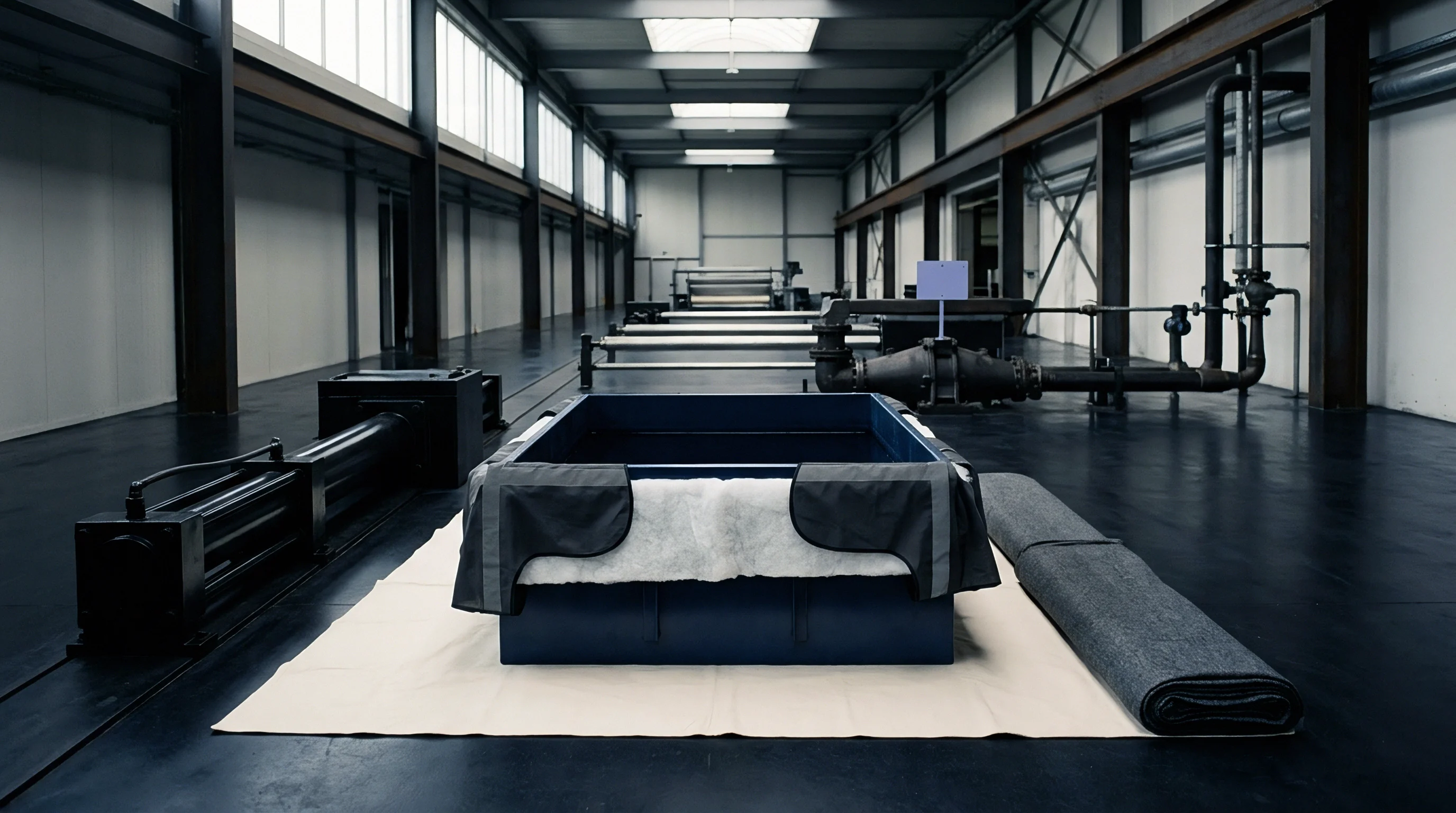

Bath
Concentrated sodium hydroxide liquor at 28 to 30 degrees Baume induces immediate transverse swelling in raw cotton fibers, expanding the cross-sectional area by 40 to 50 percent while triggering a spontaneous 12 to 18 percent longitudinal shortening drive. In greige bottomweight textiles running 380 grams per square meter, this rapid swelling takes place within three to five seconds of total immersion. The interior yarns of dense 3/1 and 2/1 structures resist fluid displacement when raw sizing waxes remain unextracted.
Caustic penetration requires rapid wetting.
Under immersion in 29 degrees Baume sodium hydroxide at 18 degrees Celsius, raw cotton fiber diameter expands 46 percent within 3.5 seconds.
Caustic Impregnation Mechanics
Liquid density governs the diffusion gradient through twisted singles yarns. At 300 grams per liter of active alkali, the viscosity of the impregnating solution increases sharply, resisting core saturation in 10s and 12s Ne ring spun yarns. Mill operators run wetting auxiliaries stable in high alkali concentrations, maintaining surface tension below 32 millinewtons per meter to prevent surface-only mercerization.
Alkali cleavage alters cell walls. When alkali saturates only the outer sleeve of the yarn bundle, the periphery contracts against an unswollen dry core, causing severe internal shear stress that splits weak points during subsequent transverse tentering.
- Caustic concentration threshold maintains active sodium hydroxide between 270 and 300 grams per liter to sustain complete conversion of Cellulose I into swollen sodium-cellulose complexes.
- Temperature control band holds the processing bath between 15 and 20 degrees Celsius, because higher thermal values suppress mercerization luster gains.
- Submersion residence interval grants a minimum of 40 seconds under liquor before entering intermediate nip rollers to guarantee core hydration across 400 gram weights.
- Wet pickup target calibrates squeeze rolls to exactly 95 to 105 percent liquor retention, preventing uneven longitudinal tension down the machine train.
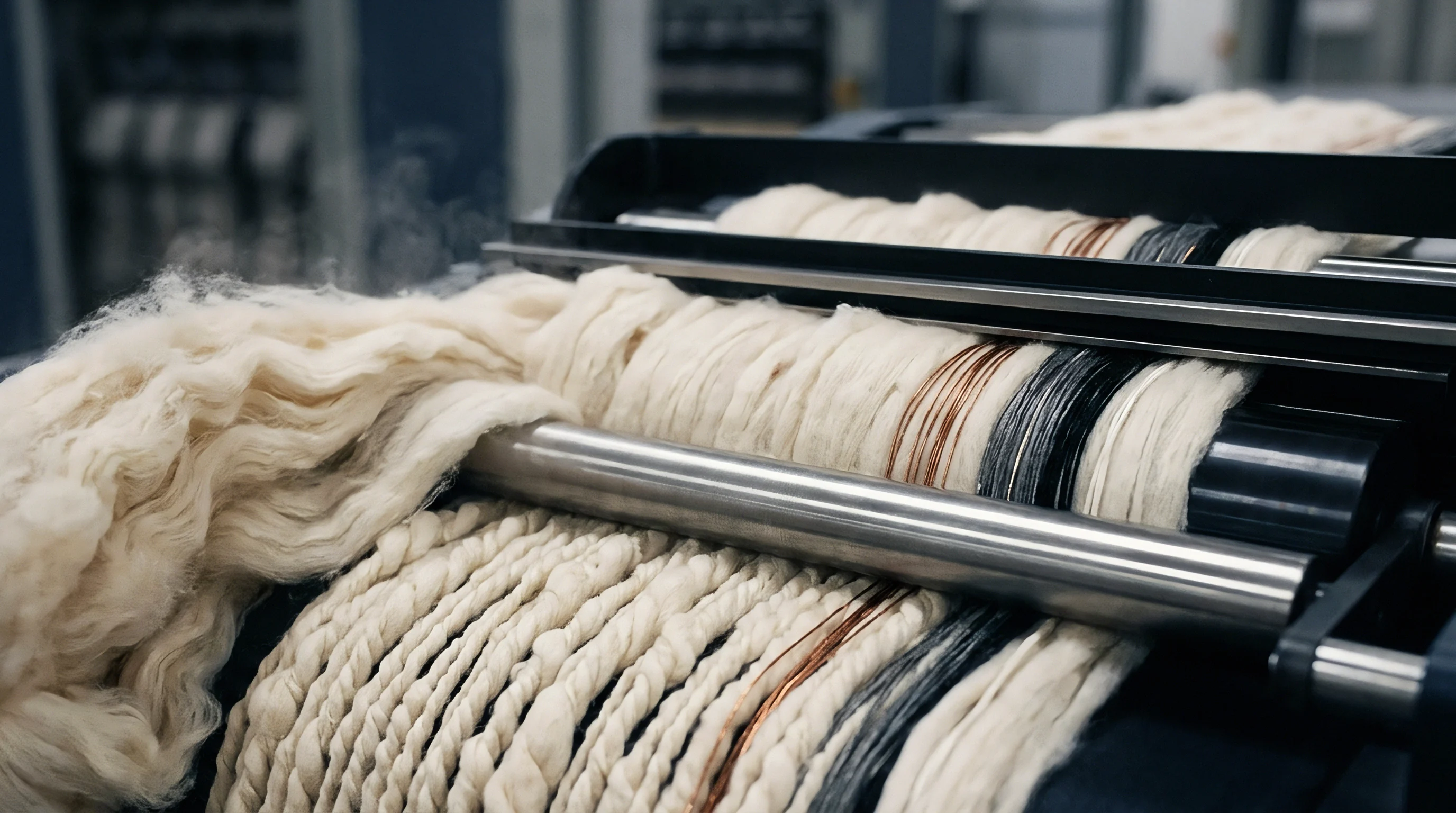
Swelling Pressure in Twill Interlacements
Lateral expansion of heavy yarns generates internal contact pressure exceeding 15 megapascals at cross-over junctions. Cotton cellulose chains hydrate, untwist, and force adjacent filaments into tight hexagonal packing within the interstitial voids. The structural float length of a 3/1 diagonal pattern provides three consecutive warp crowns over one weft pick, establishing an unequal mechanical resistance between the face and back.
As the warp swells, it exerts direct lateral force against the single crossing pick, forcing the weft into severe out-of-plane displacement.
Twill lines torque under load. This unbalance causes the greige goods to curl at the selvages unless guided by continuous edge-spreading scroll rollers prior to the high-pressure squeeze. Dye uptake differences trace directly to uneven liquor penetration at these high-compression crossover points.
The converter excuses these streak defects as ordinary raw cotton lot variation.
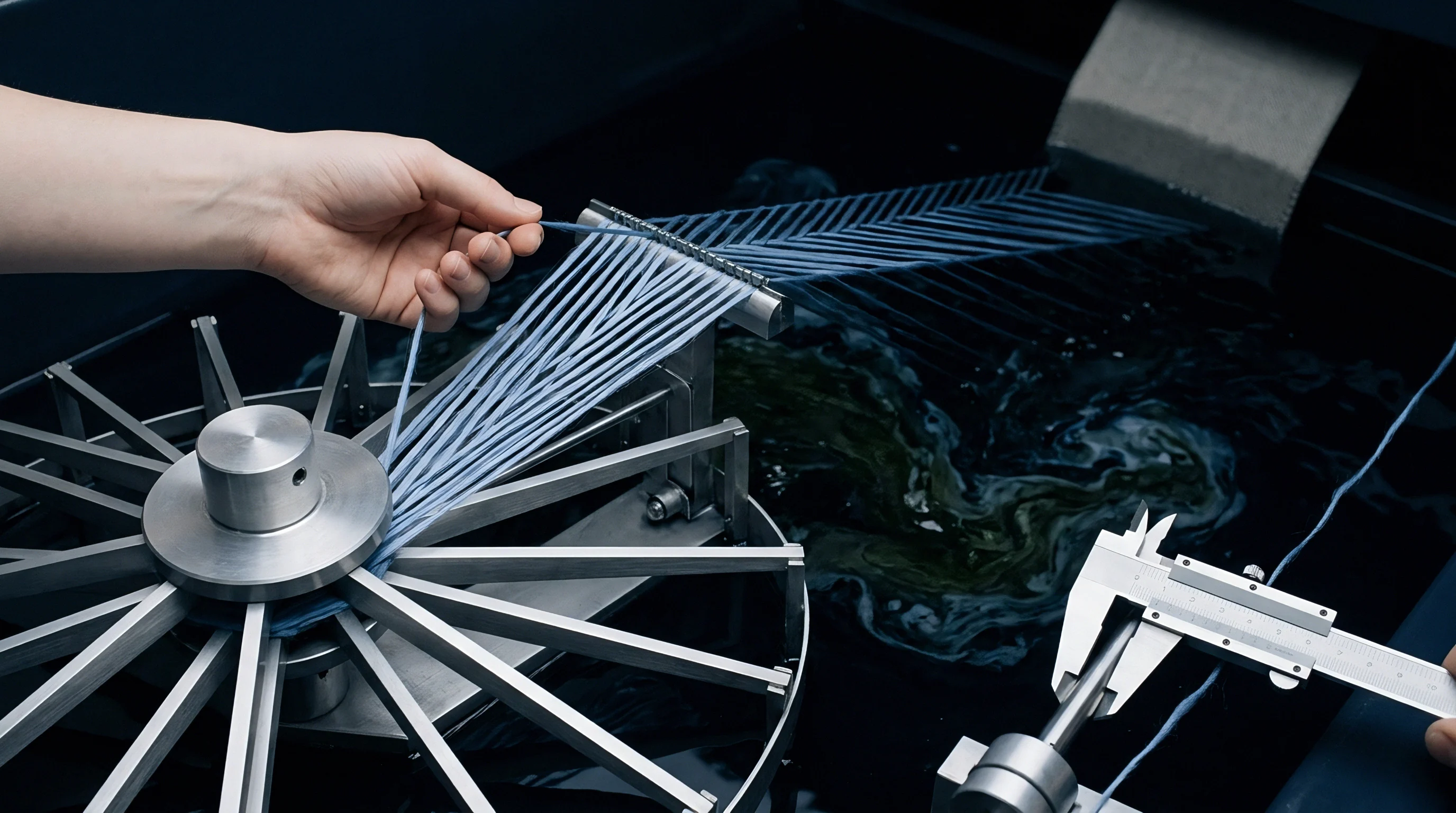

Pin
Mechanical tentering carriages establish the longitudinal and transverse balance required to counteract uncontrolled caustic shrinkage. Heavy twills entering a clip or pin stenter after roller impregnation carry hundreds of liters of caustic solution per thousand meters. Heavy mechanical grips hold the thickened selvages against the transverse inward pull generated by the swollen weft yarns.
Warp straightening compresses weft floats.
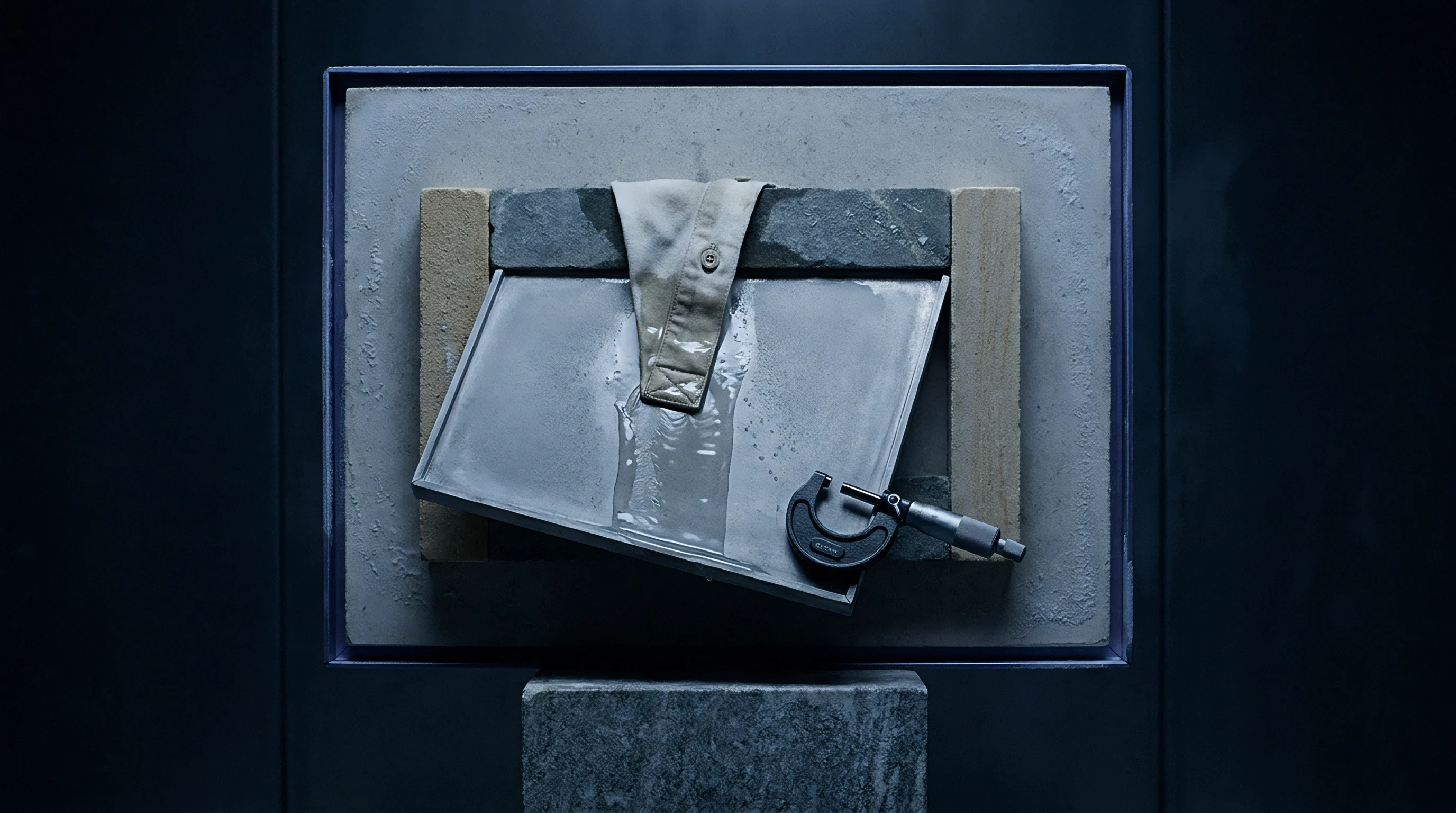
Chain Guidance across Width Restraint Zones
Longitudinal draw rollers apply up to 6000 newtons of tension across a 160-centimeter width to lengthen the warp axis back toward its greige dimension. This longitudinal force pulls the warp yarns taut, eliminating their structural crimp while transferring the undulation directly into the transverse weft system. The pin chain pulls hard.
When the clip chains separate along the diverging rails, the transverse tension must overcome the newly locked yarn-on-yarn friction at every intersection point.
- Entry overfeed calibration sets longitudinal feeding between plus one and plus three percent to prevent premature warp tearing at the initial liquor squeeze rolls.
- Width expansion indexing spreads the diverging chain rails by three to five centimeters beyond desired greige width to compensate for inevitable post-rinse snap-back.
- Mid-frame spray washing delivers declining concentrations of warm caustic wash liquor to leach alkali from the yarn core while the cloth remains clamped under full mechanical width.
- Exit nip release transfers the partially washed textile into stabilizing recuperators only after total caustic drops below five percent active alkali on dry fiber weight.
Differential Skew under Asymmetric Twill Line
Right-hand diagonal ridges create asymmetric diagonal force vectors across the width during cross-directional extension. The diagonal float angle of approximately 63 degrees in steep twills causes the weft picks to shift forward on one selvage while lagging on the opposite edge. The resulting parallelogram distortion introduces permanent grain skewing across the lot.
Skew angles distort square panels. Stenter rails operating without automated skew-straightening systems leave heavy twills with three to six percent spiral torque. Cutting pattern pieces from such skewed goods produces finished trousers with leg twist that fails garment wash inspections.
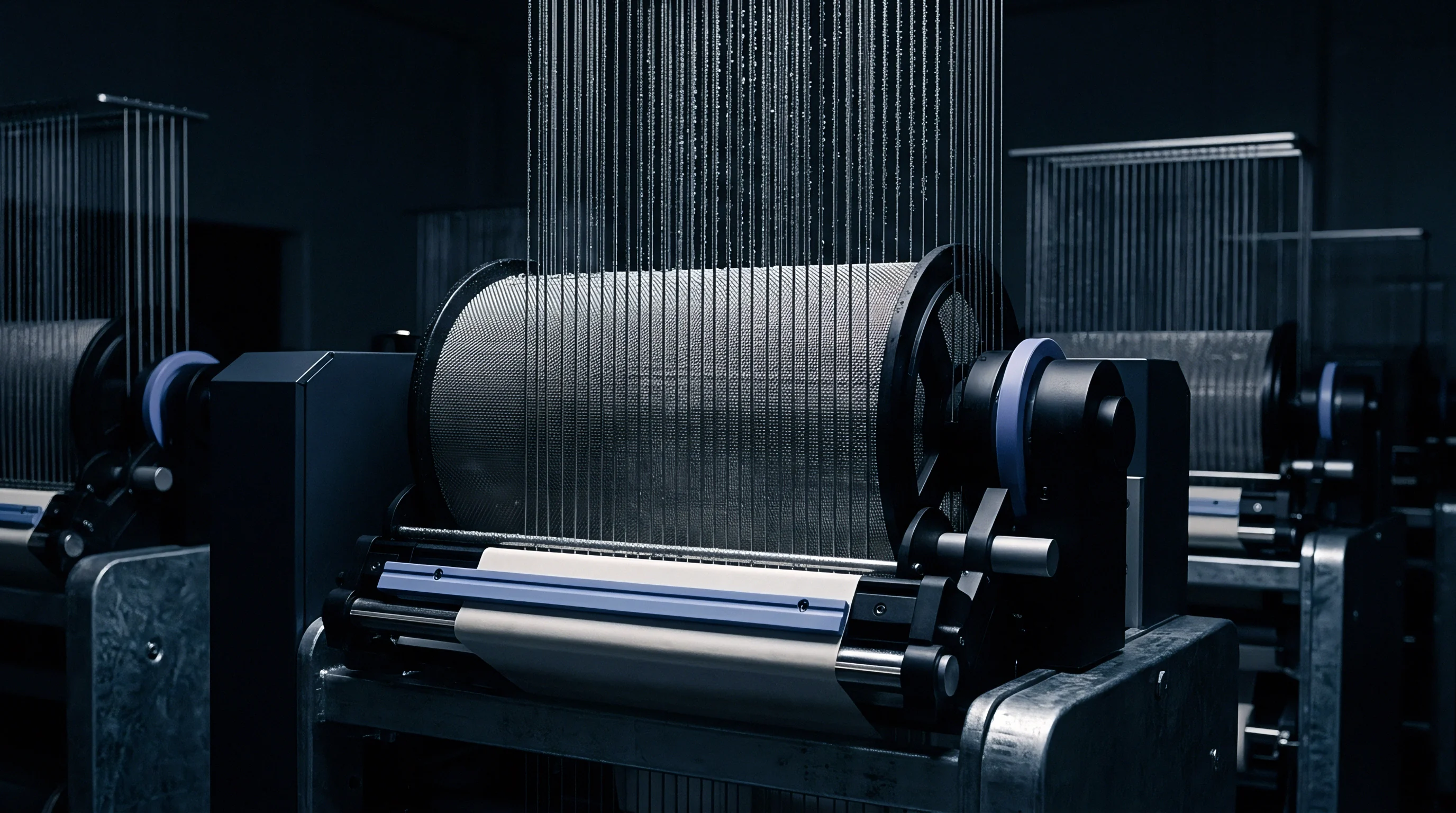
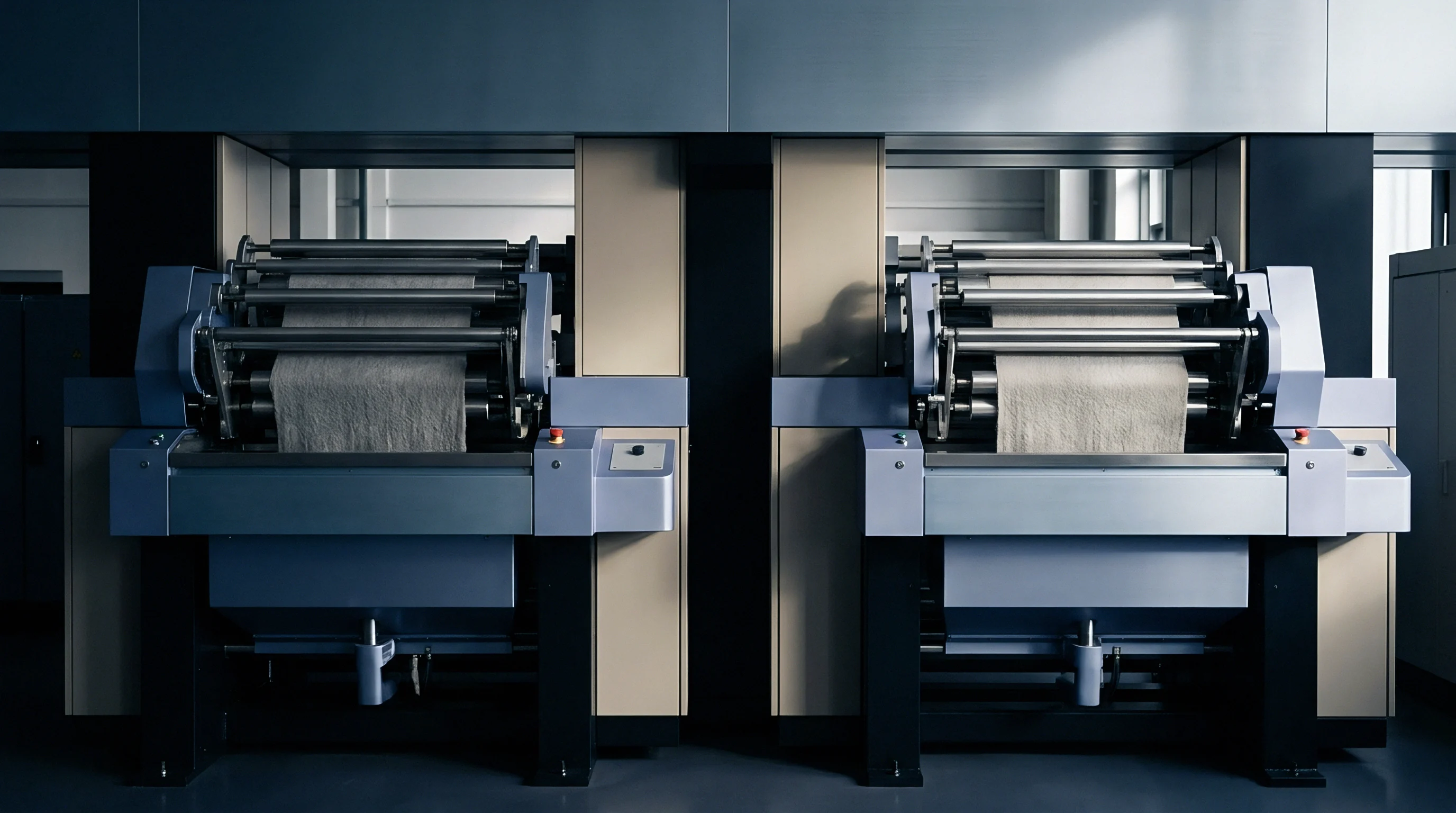
Interchange
Straightening the longitudinal warp system under high caustic tension forces the crosswise yarns to bend around the rigid warp cylinders. In classical textile mechanics, crimp interchange defines the trade-off where crimp percentage diminishes in the direction under mechanical load while rising proportionally in the passive perpendicular direction. In heavy bottomweight cottons, the yarn diameter swells by 20 to 25 percent during caustic contact.
Crosswise contraction drives jammed packing. Because the sum of yarn axis paths cannot exceed the spatial boundaries defined by yarn diameters and center-to-center distances, any reduction in warp crimp forces the swollen weft picks into an exaggerated serpentine wave.
A decrease in warp crimp produces an immediate and predictable increase in weft crimp under active caustic width restraint.
Peirce Geometry under Crosswise Fiber Expansion
Mathematical modeling of heavy structures relies on the equilibrium equations derived by Frederick Peirce, modified for swollen yarn circularity and compressibility. Consider a 3/1 twill containing 42 warp ends per centimeter of 12s Ne cotton and 20 weft picks per centimeter of 10s Ne cotton. The greige yarn diameters measure 0.28 millimeters for warp and 0.31 millimeters for weft.
Swelling in 30 degrees Baume caustic increases these effective diameters to 0.35 millimeters and 0.39 millimeters. Weft crimp rises immediately.
When longitudinal stenter tension pulls the warp crimp down from nine percent in the greige state to two percent on the exit frame, the warp thread axis approaches a straight line. The interlacing weft picks must now make full excursions around these rigid, expanded warp cylinders. Because the warp threads are packed closely at 42 ends per centimeter, the space between adjacent warp ends drops to 0.08 millimeters.
The swollen weft pick, measuring 0.39 millimeters in diameter, enters a state of severe transverse jamming. The weft crimp climbs from 12 percent up to 21 percent.
| Construction Metric | Greige State (3/1) | Mercerized Tension (3/1) | Greige State (2/1) | Mercerized Tension (2/1) |
|---|---|---|---|---|
| Warp Count (Ne / Tex) | 12s / 49.2 | 12s / 49.2 | 16s / 36.9 | 16s / 36.9 |
| Weft Count (Ne / Tex) | 10s / 59.0 | 10s / 59.0 | 12s / 49.2 | 12s / 49.2 |
| Warp Sett (ends/cm) | 42.0 | 45.5 | 38.0 | 41.2 |
| Weft Sett (picks/cm) | 20.0 | 19.2 | 22.0 | 21.0 |
| Warp Crimp (%) | 9.2 | 2.1 | 10.8 | 3.4 |
| Weft Crimp (%) | 12.4 | 21.6 | 11.2 | 19.8 |
| Fabric Skew (%) | 1.2 | 4.8 | 0.8 | 3.2 |
Worked Quantification on Heavy Twill Construction
Assume a bulk order specification based on 50,000 meters of 3/1 drill twill, weighing 410 grams per square meter, woven with 10s Ne open-end warp and 8s Ne rotor weft. Ring spun yarns compact tighter. Greige warp crimp sits at 8.5 percent, and greige weft crimp sits at 11.0 percent.
The greige reed space measures 180 centimeters, aimed at delivering 160 centimeters of finished cutting width.
Upon soaking in 28 degrees Baume caustic liquor without longitudinal slip, the warp tension reaches 380 decanewtons on the chainless mercerizer rolls. The warp crimp drops to 1.8 percent, elongating the warp by 6.7 linear percent. This longitudinal extension pulls the picks closer together along the length while drawing the selvages inward.
The weft crimp increases by 10.4 percentage points, reaching 21.4 percent. The total width of the web contracts from 180 centimeters down to 154 centimeters. To recover the 160-centimeter target, the stenter chains must exert high lateral pulling forces, stretching the swollen, jammed weft yarns.
This crosswise force flattens the crowns of the weft floats, redistributing crimp back into the warp until warp crimp stabilizes at 4.2 percent and weft crimp levels at 16.5 percent.
Failure Modes in Extreme Crimp Distortion
Structural jamming limits lead directly to characteristic defect profiles when mechanical limits are breached. The tight interlacement traps tension within the yarn intersections, which releases during secondary wet operations.
- Weft tear resistance degradation drops cross-directional tear values by up to 35 percent according to ISO 13937-1 testing because jammed picks cannot shift to form load-bearing yarn bundles under tear tongues.
- Warpway ridge formation creates visible parallel ridges along the length when excessively flattened warp yarns displace adjacent floats into uneven vertical planes.
- Tear drop porosity defects occur where the severe deflection of jammed weft picks forces pairs of warp ends together, leaving open micro-voids between adjacent yarn pairs.
- Spontaneous wash-off shrinkage causes severe length loss in garment form when high residual weft crimp collapses back into its natural swollen curvature during domestic washing.
The exact division of mechanical work between yarn flattening and true bending axis translation under high-alkali conditions remains an unresolved problem across continuous processing models.


Mill
Continuous mercerization lines execute chemical reaction, physical extension, and hot water extraction in uninterrupted automated sequences. Processing a 400 gram twill through this plant involves heavy capital equipment spanning over 60 linear meters. Open chains expose fresh liquor.
The chainless plant format uses closely spaced, driven roller beds that maintain warp tension continuously while relying on calculated surface friction to limit width contraction. The pin-clip hybrid plant, by contrast, grips the selvages with hardened steel clips, providing absolute positive control over width dimensions during both caustic impregnation and initial extraction.
A contract clause rejecting goods showing more than three percent residual skewing obligates the dyehouse to run differential rail settings on the clip chain.
Washing Extraction and Neutralization Sequences
Caustic dilution must take place while the cloth remains under mechanical tension to prevent immediate irreversible contraction. Wash boxes strip residual soda. The textile travels through successive recuperators applying boiling water in counter-current stages, dropping the alkali content from 280 grams per liter down to 40 grams per liter while held against large-diameter driven drums.
If tension releases while the internal alkali exceeds 50 grams per liter, the twill snaps back in width, regaining up to eight percent weft crimp within three seconds.
Neutralization takes place in the subsequent tanks using dilute sulfuric or acetic acid, followed by exhaustive rinsing. Acid neutralization halts cellulose swelling. Inadequate rinsing leaves trapped sulfate salts within the jammed yarn crossings, generating localized fiber embrittlement during downstream cylinder drying and curing passes.

Commercial Finishing Route Cost Implications
Choosing between a commission converter using a chainless roller frame and an integrated vertical plant operating a chain mercerizer alters both the bill of materials and the final cost per finished meter. A chainless frame runs at higher speeds, typically 60 meters per minute compared to 35 meters per minute on a chain machine, reducing processing labor and machine-hour rates. The chainless frame cannot enforce crosswise width, losing between four and six percent more width than a clip chain.
Width loss inflates finished cost.
When a heavy twill loses six centimeters of usable cuttable width on a chainless unit, the garment manufacturer must adjust cutting markers, consuming between five and seven percent more linear yardage to cut the same garment run. That consumption penalty eliminates any processing savings negotiated at the dyehouse. The standard commercial purchase order line stating compliance with ISO 5077 dimensional tolerances shifts the financial liability for excess marker consumption back onto the converter.

Sett
Construction metrics measured on finished textiles document the permanent spatial reorganization imposed by crimp interchange. Greige ends and picks per centimeter never carry through to the inspection table unchanged. Finished sett dictates garment torque.
In a typical 3/1 bottomweight twill, the warp density increases by 8 to 12 percent through finishing shrinkage, while weft density remains static or drops slightly due to transverse stenter extension. Tensile and tear strengths diverge: warp tensile rises by 15 to 25 percent from fiber alignment and molecular consolidation under tension, while weft tensile remains unchanged or drops slightly.
Balanced warp and weft crimp levels prevent garment seam puckering across domestic wash cycles.

Finished Specification Settlement and Tolerances
Technical data sheets must specify sett counts, weight, and dimensional stability evaluated strictly on fully conditioned finished goods per ISO 139 standards. Measuring weight off the stenter delivers artificially light results because hot, bone-dry textiles lack standard moisture regain. A heavy cotton twill absorbs up to 8.5 percent moisture under standard conditions of 20 degrees Celsius and 65 percent relative humidity.
Sourcing specifications must state tolerances clearly: plus or minus three percent on finished width, plus or minus four percent on areal mass, and a maximum of 2.5 percent residual shrinkage in either direction under ISO 6330 laundering test programs.
| Test Parameter | Test Standard | Greige State | Finished State | Commercial Tolerance |
|---|---|---|---|---|
| Mass per Unit Area (g/m²) | ISO 3801 | 385 | 418 | ±3% |
| Warp Sett (ends/10 cm) | ISO 7211-2 | 420 | 460 | ±2% |
| Weft Sett (picks/10 cm) | ISO 7211-2 | 200 | 195 | ±2% |
| Warp Tensile Strength (N) | ISO 13934-1 | 1150 | 1380 | Minimum 1300 N |
| Weft Tensile Strength (N) | ISO 13934-1 | 780 | 810 | Minimum 750 N |
| Warp Tear Strength (N) | ISO 13937-1 | 48 | 42 | Minimum 38 N |
| Weft Tear Strength (N) | ISO 13937-1 | 58 | 39 | Minimum 35 N |
| Dimensional Change Warp (%) | ISO 5077 | -8.5 | -1.8 | Max -2.5% |
| Dimensional Change Weft (%) | ISO 5077 | -2.0 | -1.2 | Max -2.0% |
Residual Shrinkage Balance across Laundering Cycles
Laundering tests expose the locked-in strain left by improper crimp interchange management. When a garment cut from high-tension mercerized twill undergoes repeated domestic washing at 60 degrees Celsius, water penetrates the jammed cross-overs, swelling the fibers again and releasing mechanical strain. If the warp crimp was pulled excessively low during processing, the warp absorbs water, relaxes, and contracts severely, driving finished garment shrinkage past five percent.
Maintaining equalized yarn curvature between warp and weft during wet processing protects the cutter from post-assembly garment distortion.
A balanced yarn structure holds its shape through laundering without twisting the seams.