Stenter Overfeed Influence on Finished Warp Density and Cover Factor
Positive stenter overfeed relaxes warp tension, increasing finished ends per unit length and total fabric cover factor while reducing residual laundry shrinkage.
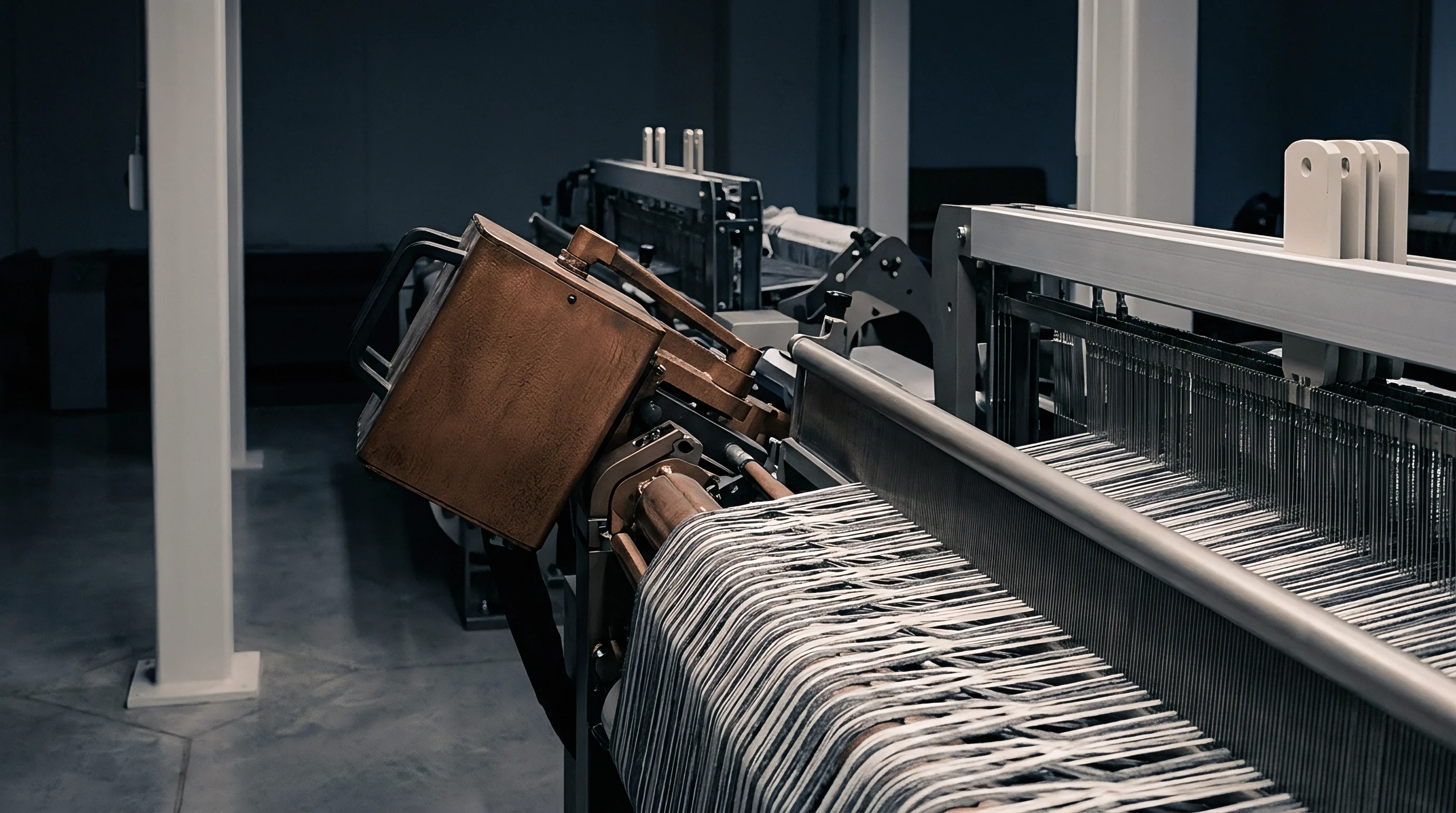

Pins
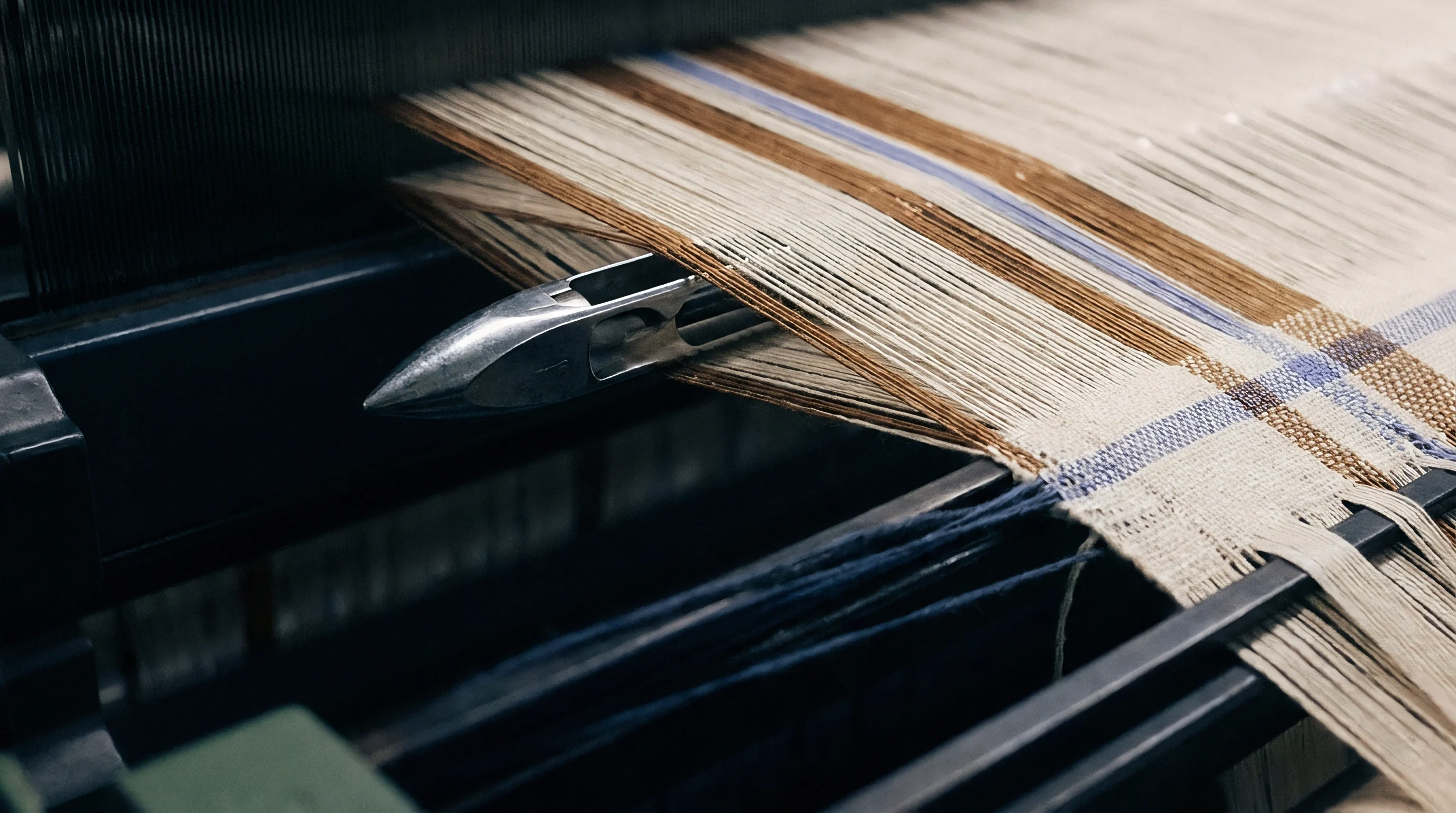
Mechanical overfeed at the stenter entry regulates the structural relaxation of woven goods prior to drying and heat-setting. Because delivery rolls run faster than the pin chain, surplus fabric length feeds continuously into the pins. Driven brush wheels press the selvedges down over the steel pins, releasing warp tension and creating fine undulations along the web.
These micro-folds supply the physical slack required for longitudinal contraction as the cloth travels through the drying chambers.
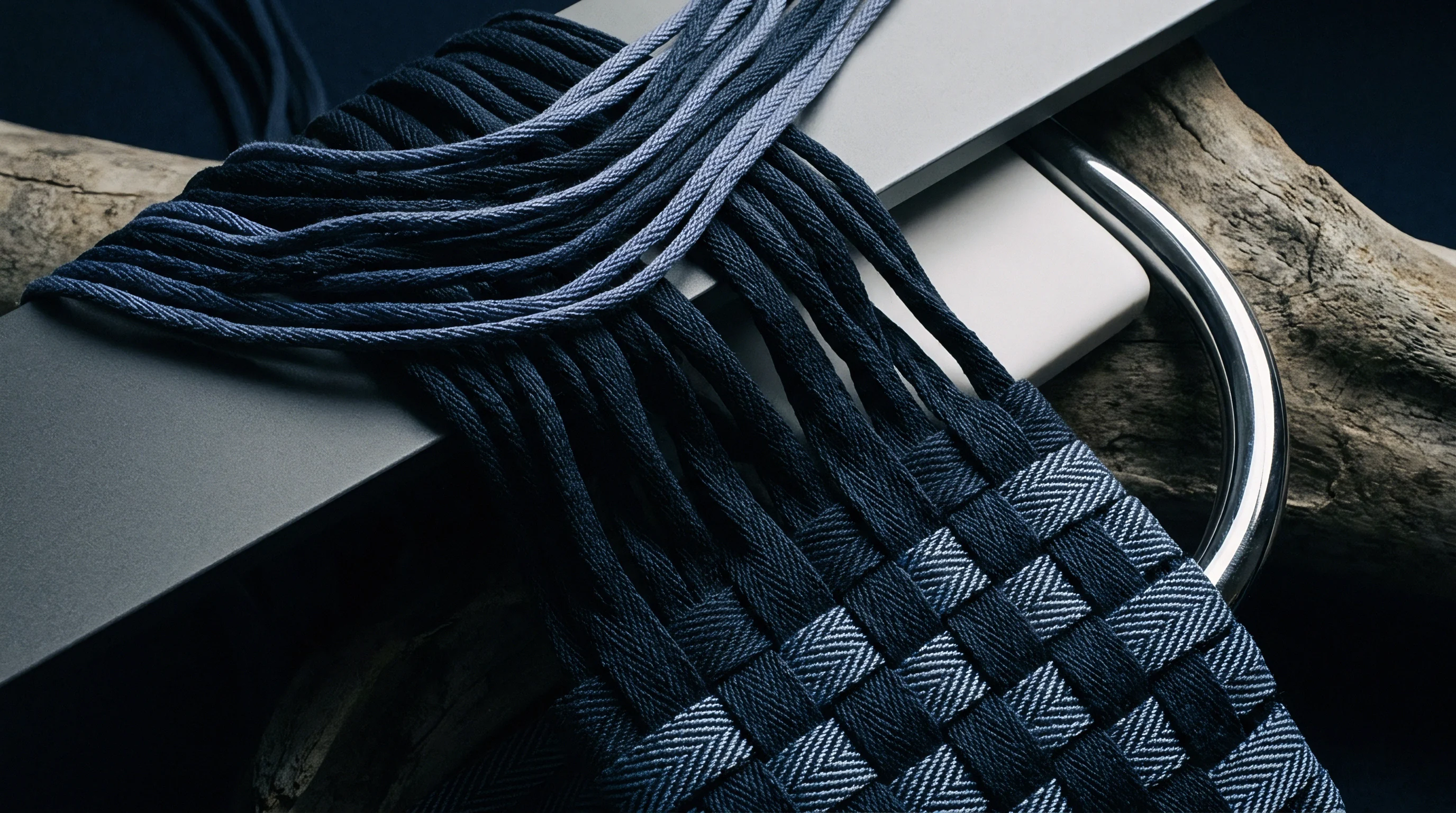
Chain Entry Kinetics and Mechanical Slack
Entry speed governs the initial longitudinal density of the fabric before drying begins. Nominal overfeed is set by the ratio of feed roller surface speed to stenter pin chain velocity. Running at zero overfeed matches roll speed to chain speed, locking warp yarns under steady lengthwise tension.
Pushing overfeed into positive values delivers more greige length than the chain travels, forcing the surplus to gather into slack loops between pin plates that relieve warp stress across the web.
Independent servo drives at modern entry fields allow precise control of this ratio to suit the wet contraction profile of the yarn. Hydrophilic fibers like cotton or viscose swell in the padder and pull tight along the warp. If the fabric enters the chain without adequate positive overfeed to offset this shrinkage, high residual tension remains locked in the weave.
Setting a matching positive overfeed lets the yarns contract freely across the pin bed without resistance.
| Nominal Overfeed Setting (%) | Feed Roller Speed (m/min) | Chain Velocity (m/min) | Linear Slack Delivered (m/100m chain) | Initial Warp Stress State |
|---|---|---|---|---|
| 0.0 | 40.0 | 40.0 | 0.0 | High tension |
| +5.0 | 42.0 | 40.0 | 5.0 | Moderate relaxation |
| +10.0 | 44.0 | 40.0 | 10.0 | Full tensionless state |
| +15.0 | 46.0 | 40.0 | 15.0 | Micro-buckling threshold |

Pin Engagement and Longitudinal Relaxation
Pin plates grip the selvedges firmly while allowing the interior of the fabric to settle. Steel pins pierce both edges to establish fixed lateral anchors. Once inside the drying zones, circulating hot air drives off water and lowers friction between crossing yarns, allowing the mechanical slack from entry overfeed to absorb directly into the weave crimp.
Warp yarns shorten along the running direction, increasing their wave amplitude around stationary picks.
Positive mechanical overfeed translates machine speed differentials into immediate yarn slack inside the pin field.
Insufficient pressure on the entry brush wheels prevents full transfer of the selected overfeed. If the bristles fail to drive selvedges all the way to the pin base, the cloth rides up and slips on the pin tips. Finishing plants often blame machine speed calibration for resulting density shortages when the actual issue is simply worn brushes or shallow pin penetration.

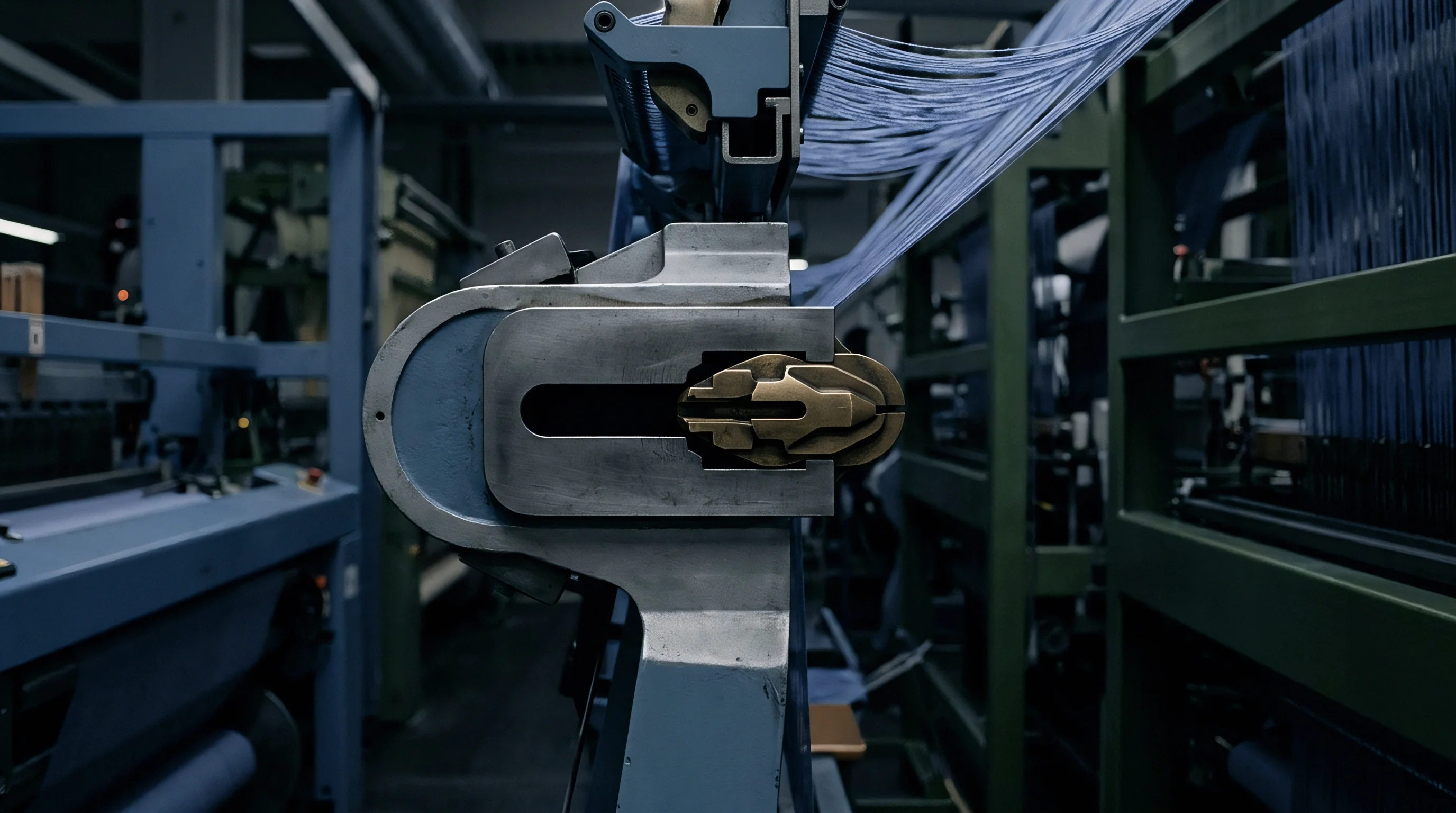
Geometry
Stentering alters the spatial geometry between warp and weft. Longitudinal contraction packs warp ends closer together while forcing them into steeper paths over and under the picks. This rearrangement shifts finished ends per unit length, crimp percentage, fabric weight, and total cover factor.
Calculating these outcomes requires standard cloth geometry formulas adjusted for finishing shrinkage.

Warp Crimp Accumulation and Ends Conversion
Warp crimp represents the yarn length consumed relative to the flat linear length of the cloth. Overfeed increases crimp directly by forcing warp threads to follow steeper curves around the weft picks. As crimp accumulates, the longitudinal spacing per pick contracts.
Because yarn linear density in Tex remains constant, this compaction raises ends per unit length across the width, provided lateral stenter tension holds the fabric to its target width.
Finished warp density depends on greige ends, loom crimp, stenter overfeed, and wet contraction. The calculation follows a standard mass balance along the fabric length:
The mathematical relationship governing finished warp density is expressed by:
n_w_finished = n_w_greige / (1 – S_w_net)
Where n_w_finished is finished warp density in ends per centimeter, n_w_greige is loom-state warp density, and S_w_net is fractional longitudinal length reduction from wet contraction and applied overfeed. As S_w_net rises with higher overfeed, the denominator shrinks and finished ends per centimeter increase.

Cover Factor Equations in Tex Systems
Fabric cover factor defines the proportion of total surface area masked by yarns. In the Tex system, yarn diameter is derived from linear density and fiber density using the standard relationship for staple yarns:
d_yarn = 0.037 sqrt(Tex / rho_fiber)
Where d_yarn is diameter in millimeters, Tex is yarn linear density, and rho_fiber is fiber density in grams per cubic centimeter (1.54 g/cm³ for cotton, 1.38 g/cm³ for polyester). Fractional cover factors for warp (C_w) and weft (C_f) are calculated as:
C_w = n_w d_w
C_f = n_f d_f
Where n_w and n_f represent ends and picks per millimeter, and d_w and d_f are the respective yarn diameters in millimeters. Total fractional cover factor K_total accounts for thread crossover overlaps:
K_total = C_w + C_f – (C_w C_f)
Increasing stenter overfeed raises n_w, which increases C_w and elevates K_total without altering the loom setup.

Worked Construction Sensitivity Analysis
Consider a plain weave fabric produced with a 20 Tex 100% cotton warp (rho_fiber = 1.54 g/cm³) and a 20 Tex cotton weft. Loom settings specify 40.0 ends/cm and 24.0 picks/cm. Greige warp crimp measures 6.0%.
The yarn diameter d_w equals 0.037 sqrt(20 / 1.54) = 0.1332 mm. At loom state, warp cover factor C_w equals (4.0 ends/mm) 0.1332 mm = 0.5328. Weft cover factor C_f equals (2.4 picks/mm) 0.1332 mm = 0.3197.
Total cover factor K_total equals 0.5328 + 0.3197 – (0.5328 0.3197) = 0.6822.
Processing this fabric across four overfeed settings (+0%, +5%, +10%, +15%) at fixed finished width produces predictable shifts in density, cover factor, and linear mass.
| Overfeed Level (%) | Finished Warp Density (ends/cm) | Warp Crimp (%) | Finished Warp Cover C_w | Finished Weft Cover C_f | Total Cover Factor K_total | Finished Mass (g/m²) |
|---|---|---|---|---|---|---|
| +0.0 | 40.8 | 6.5 | 0.5435 | 0.3330 | 0.6955 | 133.4 |
| +5.0 | 42.8 | 10.8 | 0.5701 | 0.3330 | 0.7133 | 139.7 |
| +10.0 | 44.9 | 15.2 | 0.5981 | 0.3330 | 0.7319 | 146.4 |
| +15.0 | 46.9 | 19.6 | 0.6247 | 0.3330 | 0.7497 | 153.0 |
Determining finished cover factor across varying overfeed settings requires working through standard dimensional steps:
- Determine loom-state ends per centimeter and yarn Tex from greige quality audit records.
- Measure total longitudinal relaxation percentage resulting from wet processing and stenter overfeed.
- Calculate finished warp density by dividing greige warp density by the net fabric length retention factor.
- Compute yarn diameter using fiber density and linear yarn Tex.
- Multiply finished ends per millimeter by yarn diameter to establish warp fractional cover factor.
- Combine warp and weft fractional cover factors using the Peirce overlap subtraction formula to land total finished cover.
A ten percent increase in stenter overfeed elevates finished warp cover factor by 0.055 under constant weft tension.
Pushed too far, overfeed hits a structural jamming limit where warp threads can no longer absorb crimp without displacing adjacent picks.
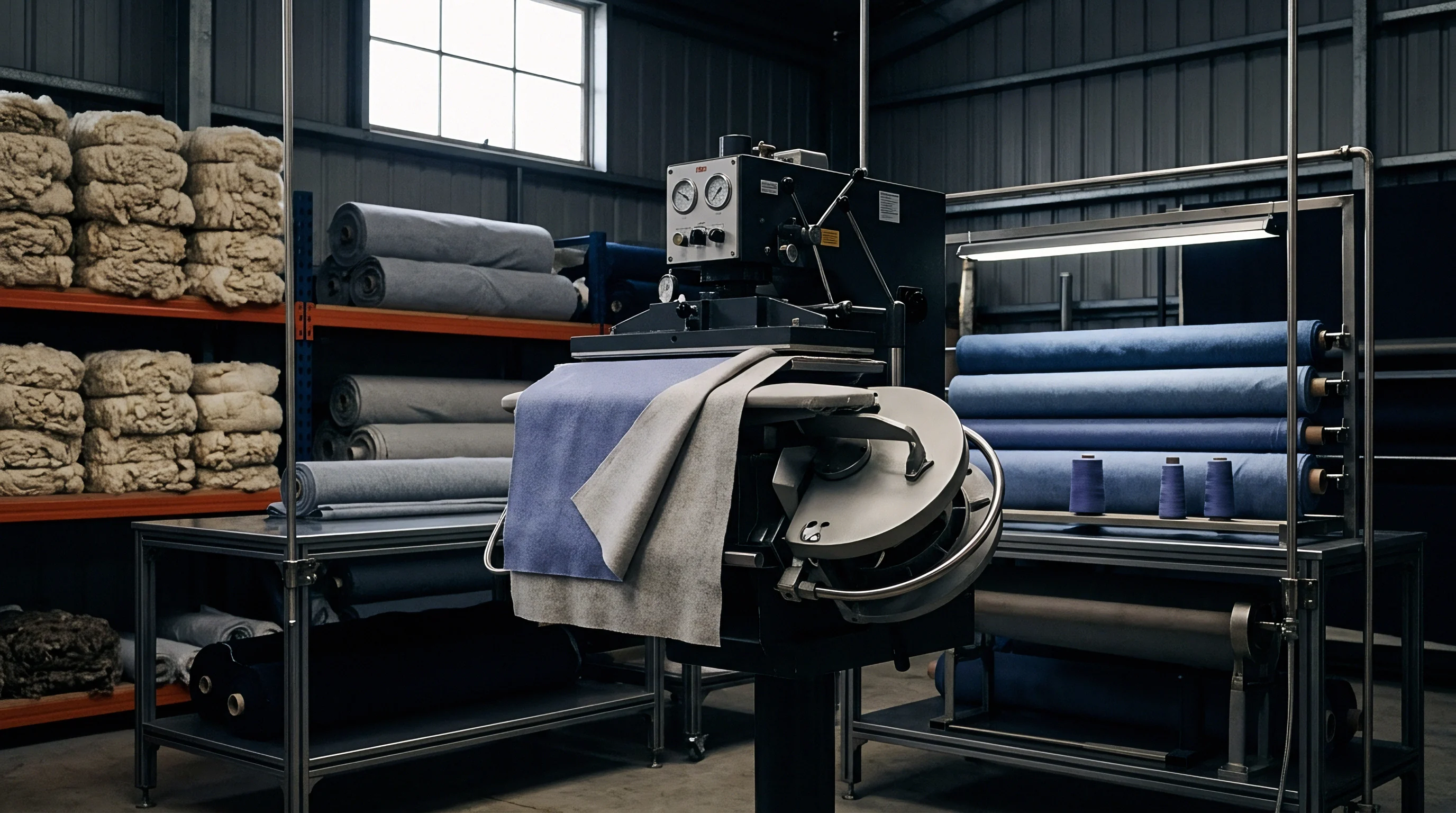
Chamber
Thermal energy inside the stenter heating zones stabilizes the crimp configuration introduced at the entry field. High-velocity air nozzles direct heat onto both fabric faces, removing remaining water and heating polymer chains above their glass transition point to lock in the crimp. Without adequate heat setting, the induced warp crimp pulls out under the slightest tension during winding, inspection, or laundering.

Thermal Fixation of Induced Yarn Crimp
Heat transfer rates determine how permanently overfed warp slack converts into structural crimp. For synthetic fibers like polyester and polyamide, stenter temperatures must reach setting thresholds (180 to 210 degrees Celsius) to break and reform hydrogen bonds and crystallite crosslinks. With cellulosics, cross-linking resins applied in the padder lock the crimp geometry as the fabric dries and cures in the chambers.
Air velocity and nozzle placement control evaporation rates in the entry bays. Rapid drying right off the pins freezes the yarn undulations before air currents and mechanical vibration shake the slack out of the web. When chamber temperatures run below specification, yarn stress relaxation remains partial, leaving the cloth with high residual shrinkage on exit.
Will Excess Overfeed Induce Fabric Buckling in Finishing?
Feeding more fabric length than the weave structure can accommodate causes immediate surface defects. Once the extra yarn exceeds pick spacing and yarn compressibility limits, the web contracts laterally and forms diagonal buckles or crosswise ripples down the center. When these folds travel under the drying nozzles, the heat sets them into permanent creases that ruin the roll.
Unset warp crimp relaxes completely during wet laundering if drying temperatures fail to exceed the polymer glass transition point.
Matching overfeed to the true thermal shrinkage of the yarn prevents buckling in the heat zones. Partially oriented polyester warp yarns shrink substantially more than fully drawn filaments and can absorb much higher overfeed without rippling. Pinpointing whether fabric waviness originates from a chain-to-roll speed mismatch or uneven nozzle pressure is a regular troubleshooting task on finishing lines.
Shrinkage
Overfeed provides primary control over dimensional stability and finished fabric weight. Running positive pin overfeed pre-shrinks warp yarns inside the stenter, driving down residual shrinkage during standardized wash testing. Trading potential laundry shrinkage for added warp density also increases finished weight per square meter, altering hand and cover.
Dimensional Stability and Mass per Unit Area
ISO 5077 evaluates dimensional changes following domestic wash and dry cycles. Goods finished at zero overfeed carry high internal warp strain; when exposed to water, fiber lubrication allows these locked strains to release, causing excessive longitudinal shrinkage. Delivering positive overfeed on the stenter lets warp yarns relax within the frame, keeping post-wash shrinkage inside standard commercial limits (commonly under 3.0%).
Fabric weight under ISO 3801 rises in direct proportion to overfeed. Since yarn Tex does not change, packing more ends and picks into a square meter adds physical fiber mass. Because buyer specifications impose narrow mass tolerances (frequently plus or minus 3.0% of target weight), operators must tune overfeed to hit stability targets without exceeding the upper weight limit.
- Excessive Warp Shrinkage occurring during ISO 5077 testing stems from insufficient entry overfeed, leaving residual tensile strains locked inside the yarn structure.
- Fabric Surface Rippling results from overfeed settings that exceed the structural crimp capacity of the yarn weave, forcing web wave formations.
- Selvedge Pin Tears arise when entry overfeed falls below wet fabric contraction rates, placing extreme tension on pin engagement points.
- Non-Compliant Mass Deficits occur when finishing plants reduce overfeed to maximize linear roll output, yielding under-weight fabric.
Quality Verification under ISO Standards
Standard laboratory methods verify construction and physical performance after finishing. ISO 7211-2 governs thread counts per unit length, while ISO 13934-1 measures tensile strength along warp and weft axes. Higher overfeed builds warp crimp, which increases ultimate warp elongation at break while moderately softening initial tensile modulus.
| Applied Overfeed (%) | ISO 5077 Warp Shrinkage (%) | ISO 3801 Mass (g/m²) | ISO 7211-2 Warp Ends/cm | ISO 13934-1 Warp Elongation (%) | ISO 9237 Air Permeability (mm/s) |
|---|---|---|---|---|---|
| +0.0 | -8.2 | 133.4 | 40.8 | 12.5 | 420 |
| +4.0 | -4.5 | 138.2 | 42.4 | 15.1 | 385 |
| +8.0 | -2.1 | 143.5 | 44.0 | 18.4 | 340 |
| +12.0 | -0.5 | 149.0 | 45.7 | 21.8 | 295 |
Air permeability tested under ISO 9237 decreases as overfeed climbs. Denser warp counts and higher total cover factor close up interstitial spaces between threads, restricting air passage through the fabric.
Compliance with ISO 5077 dimensional stability mandates balancing pin overfeed against maximum allowable width reduction.
Contracts specifying residual shrinkage without setting upper limits on mass per unit area create an incentive for finishers to run excessive overfeed to pass shrinkage tests, delivering heavier goods. Standard sourcing contracts prevent this by tying both ISO 3801 square-meter weight and ISO 7211-2 warp density to rigid tolerance bands.

Contract
Overfeed settings involve a direct commercial balance between linear yield and finished fabric weight. Feeding excess greige cloth to produce a target finished meterage naturally lowers linear output. Sourcing teams must account for how commission overfeed levels influence landed cost per finished meter, cutting room marker efficiency, and overall yardage deliverables.
Yield Losses and Linear Metre Costing
Greige fabric is bought by the linear meter, but finished goods are often sold by weight or contracted finished length. Running a stenter at +10% overfeed yields roughly 90.9 meters of finished cloth from 100 meters of greige input. This length reduction constitutes structural yield loss and raises finished unit costs accordingly.
Determining landed cost per finished meter requires adjusting raw fabric pricing, finishing conversion rates, and transport costs against net lengthwise shrinkage:
Cost_finished = (Cost_greige + Cost_conversion) / (1 – Loss_overfeed) + Cost_freight
Where Cost_finished is final landed cost per finished meter, Cost_greige is base fabric cost per input meter, Cost_conversion is commission finishing cost per input meter, Loss_overfeed is fractional length loss from overfeed, and Cost_freight is freight cost per finished meter.

Specification Clauses for Converter Qualification
Finishing contracts need explicit operating parameters for commission work. Converter quotations can disguise yield drop by billing finishing surcharges on incoming greige length while returning shorter finished rolls.
Clear contractual overfeed and density parameters prevent finishers from under-feeding goods to stretch linear output at the cost of fabric stability and cover.
Omitting strict overfeed ranges and finished density targets from purchase orders exposes buyers to lot-to-lot weight shifts that undermine cutting room marker yields and garment sizing precision.