Fluid Dynamics
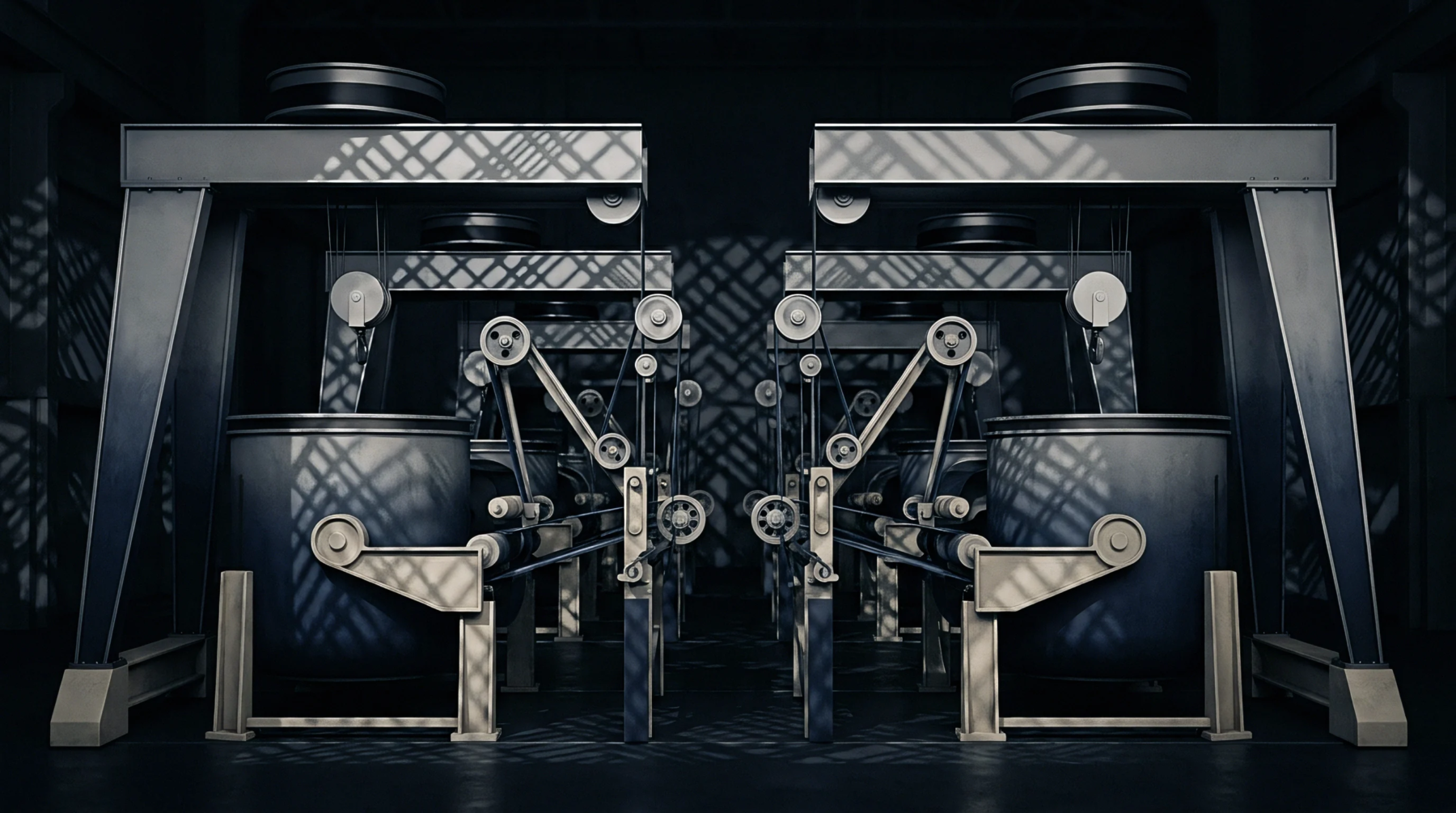
Industrial liquid exchange process for textile finishing moves the fabric and the wash water in opposite directions to maximize the concentration gradient and reduce the total volume of water required. Counter-current washing identifies the most efficient method for removing unfixed dyes, chemicals, or impurities from a continuous length of cloth. It governs the design of modern ranges where fabric passes through a series of connected tanks.
This configuration applies to high volume production lines for cotton, synthetic, and blended fabrics that require thorough cleaning after dyeing or printing.
Mechanical Sequence
The operation begins at the exit end of the machine where fresh, clean water enters the final washing compartment. This pure water encounters the fabric that is already nearly clean, which allows it to strip away the last traces of surface chemicals. As the water moves toward the front of the machine, it flows into the previous compartment through a series of weirs or pipes.
In each successive tank, the water becomes more loaded with contaminants, but it always meets fabric that is even more contaminated. This arrangement ensures that the cleanest water is always paired with the cleanest fabric, and the dirtiest water is paired with the dirtiest fabric. The concentration gradient remains high throughout the entire length of the machine, which drives the movement of chemicals out of the fibres.
Such a system allows for the removal of more impurities with less water than a traditional batch process. High speed rollers and spray bars are often added to each stage to increase the mechanical action and further improve the cleaning efficiency.
Resource Economy
Mills adopt this technology to meet environmental targets and lower the operational costs associated with water consumption and effluent treatment. Counter-current washing significantly reduces the energy required to heat the wash baths because a smaller volume of water needs to be brought to the processing temperature. The reduction in water use also means that the final effluent is more concentrated, which can simplify the recovery of certain chemicals or dyes.
These savings are measured in litres per kilogram of fabric processed, with modern machines achieving very low ratios. The consistency of the washing process also leads to better colour fastness and more uniform finishing results across the entire production run. By maintaining a steady flow of water and fabric, the mill can achieve a level of cleanliness that is difficult to replicate in discontinuous batch systems.
This stability is central to high quality textile manufacturing.
Process Limit
The effectiveness of the cleaning relies on the flow rate of the water and the dwell time of the fabric in each compartment. Counter-current washing reaches a limit if the fabric speed is too high for the chemicals to migrate out of the fibre structure. If the water flow is too low, the concentration of contaminants in the first tanks becomes so high that the washing action stops.
The temperature must also be carefully controlled, as different dyes and auxiliaries require different heat levels for effective removal. This method is not suitable for very delicate fabrics that cannot withstand the tension of a continuous range. It also requires a more complex piping and pumping system than a standard washing line.
The final cleanliness of the fabric is verified by testing the pH and the conductivity of the material as it leaves the last tank.