Air Jet Loom Beat up Motion Mechanics under High Warp Stress Conditions
Tune conjugate cam dwell and synchronize active backrest movement to suppress peak beatup tension below sixty percent of warp filament elastic limit.
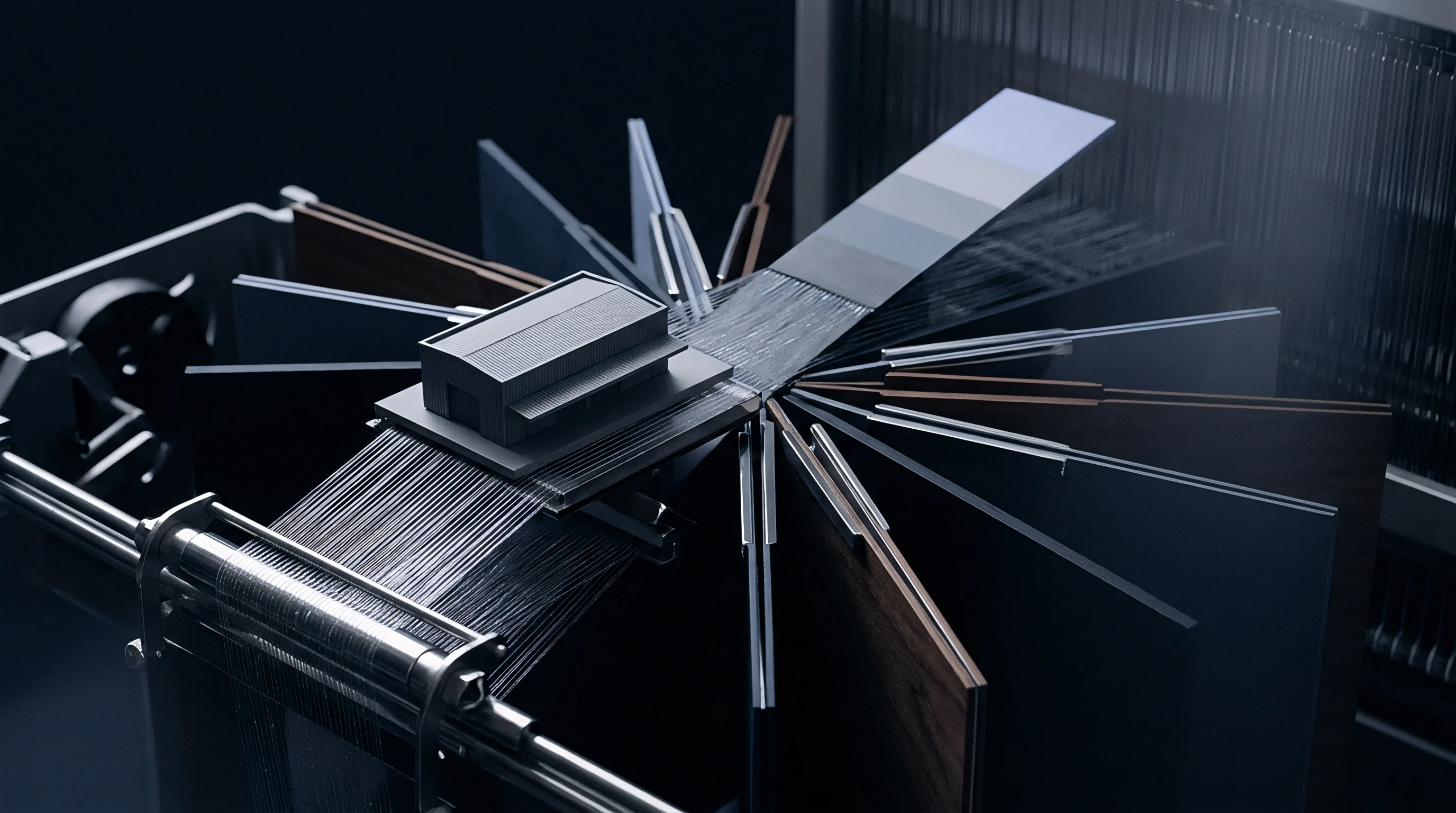

Kinematics
Loom mainshaft rotation translates angular velocity into linear sley acceleration through eccentric crank mechanisms or conjugate cam boxes. Operating speeds between 750 and 1100 picks per minute produce reed strike velocities exceeding 22 metres per second at front dead centre. When warp sheet tension exceeds 120 centinewtons per yarn end during dense industrial production, the mechanical work transferred during the dwell window spikes by forty percent.
Peak displacement reaches 48 millimetres. The mechanical linkage sustains severe reversing loads that distort the intended profile geometry across the cloth line.
Displacement Curves and Reed Acceleration Profiles
Four-bar linkages generate sinusoidal displacement paths characterized by continuous acceleration shifts through every degree of rotation. Conjugate cams alter this trajectory by introducing an extended dwell during weft insertion and an abrupt velocity rise during the forward swing. The reed face advances toward the cloth fell through a shortened angular arc, concentrating mechanical energy into an impact duration lasting less than twelve milliseconds.
Reed velocity drops to zero. Sley acceleration hits 28 gravities. These severe decel-accel transitions create harmonic oscillation within the extruded aluminum reed holder.
High tension in the sheet opposes the forward travel of the dents. The forward position of the reed undergoes physical deflection backwards when striking heavy yarn counts such as 1100 dtex continuous filament polyester or high-sett polyamide. This backward deflection changes the effective front dead centre position by up to 0.85 millimetres across the middle third of the reed space.
Pick spacing compresses three percent. Edge dents encounter zero fell displacement while central dents flex away from the yarn line, leaving an uneven pick density profile across the width of the greige roll.
Peak warp sheet tension during beatup rises to 185 centinewtons per end when sley dwell falls below forty-two degrees of shaft rotation.
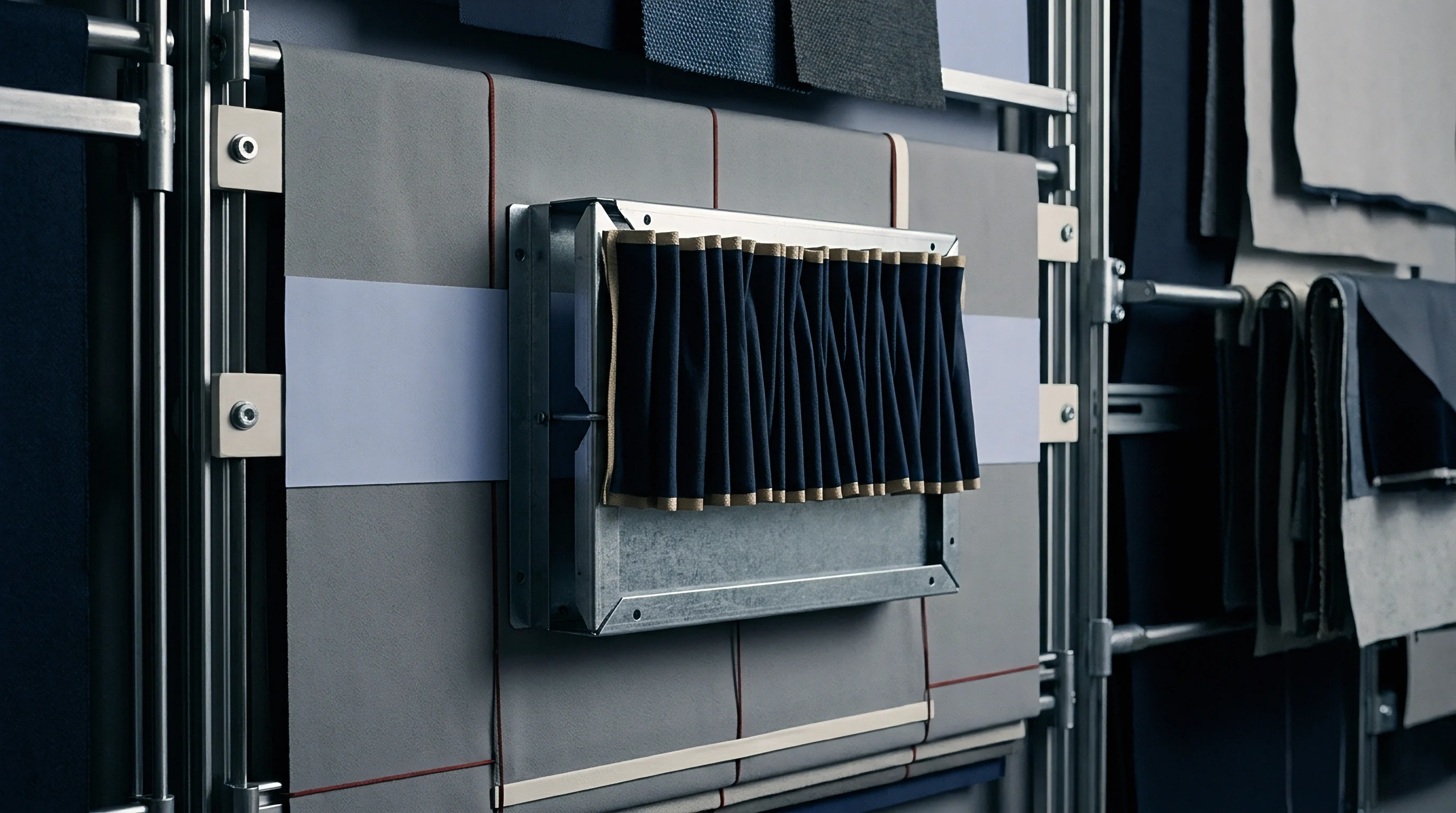
Dynamic Peak Loads at Front Dead Centre
The collision between the stainless steel dent wires and the newly inserted pick generates an instantaneous compressive stress wave. Total structural resistance combines yarn-on-yarn friction, geometric interlacing resistance, and the tensile counter-pull of the extended warp line. Tensile counter-forces exceed 14 kilonewtons across a 190-centimetre working width in high-density airbag constructions.
Tension spikes to 180 centinewtons. The drive motor draws 11 kilowatts.
The resulting mechanical shock propagates backwards through the heald eyes toward the drop wires and the backrest roller. Dynamic warp extension exceeds yield. Filament damage manifests as micro-fibrillation along the external sheath of synthetic multifilaments, reducing finished tensile ratings before wet finishing begins.
- Dents flexural fatigue initiates microscopic surface cracking at the braze joint connecting the carbon steel wires to the channel rim.
- Main bearings overheat under persistent radial reaction forces generated by premature reed collision against tight sheds.
- Clutch coupling slippage causes angular misregistration between the sley drive shaft and the auxiliary nozzle solenoid timing bank.
- Fell trajectory distortion produces visible start marks and diamond bars across the first three metres of every cut.
Mismatched kinematics between the eccentric drive and the cloth takeup roller cause reed chatter marks that fail ASTM D3990 visual standards and force the entire production roll into downgraded liquidation.

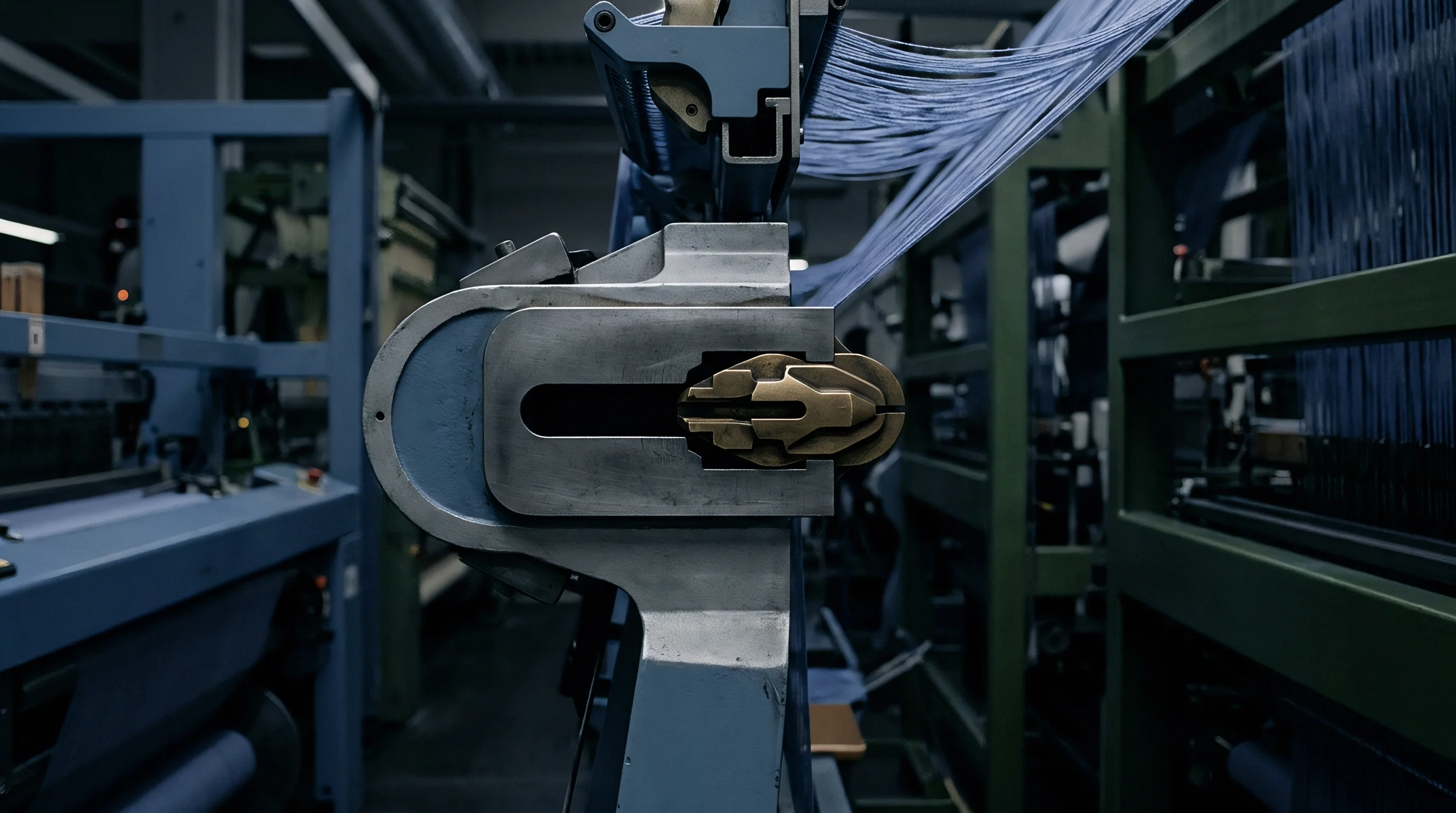
Sley
Structural rigidity of the oscillating horizontal beam dictates how evenly mechanical force enters the cloth fell. Cast ductile iron sley swords bolted to the main rocking shaft carry an extruded profile made from aerospace aluminum or carbon-composite alloy. Conjugate cam systems drive the swords from both loom frames to limit torsion along the beam.
Deflection along the central span creates differential beating forces between the selvedges and the center cloth section.
Will Conjugate Cam Timing Suppress Beatup Vibration?
Twin matched plate cams run inside continuous oil baths to govern positive forward push and return pull on the sley swords. The conjugate profile provides an extended dwell of 140 to 160 degrees for pneumatic weft transport, followed by rapid acceleration toward the front position. Dwell timing spans forty degrees.
Positive cam control limits the free vibration typical of older crank-driven assemblies. The physical mass of the sley assembly still exhibits natural resonance frequencies between 35 and 52 Hertz during operation above 850 picks per minute.
Operating a loom directly inside this natural harmonic band multiplies instantaneous deflection amplitudes. Reinforcing ribs along the extruded aluminum reed bed suppress bending modes, yet the dynamic force vector directed through the reed teeth during beatup still produces horizontal sley deformation. End breakage quadruples during beatup.
Loom speed drops sixty picks. Conjugate cam profiles reduce peak displacement deviations across the middle dents only when the cam tracks receive synthetic lubricants with viscosity ratings of ISO VG 220 or higher.

Inertial Deflection across Wide Profile Reeds
Increasing the nominal reed width from 190 centimetres to 340 centimetres triples the central deflection risk under heavy warp loading. The air jet profile reed carries an integrated air-guide channel formed directly into each dent tooth. Bivectorial deflection creates reed friction.
When high warp sheet tension exerts vertical and horizontal reaction vectors on the reed dents, the channel geometry closes by tiny increments.
| Drive Mechanism Type | Loom Speed (rpm) | Reed Width (cm) | Warp Tension (cN/end) | Max Beam Deflection (mm) | Energy Absorbed (J) |
|---|---|---|---|---|---|
| Eccentric Crank | 750 | 190 | 85 | 0.42 | 18.4 |
| Eccentric Crank | 850 | 280 | 135 | 0.98 | 31.2 |
| Conjugate Cam Box | 900 | 190 | 140 | 0.28 | 24.6 |
| Conjugate Cam Box | 1050 | 230 | 165 | 0.54 | 38.1 |
| Conjugate Cam Box | 800 | 340 | 175 | 0.89 | 46.5 |
Channel distortion disrupts the pneumatic laminar flow boundary generated by the relay nozzles. Sub-nozzle air jets misalign with the indented dent path, venting kinetic energy into the surrounding air instead of accelerating the weft tip. Weft insertion stops trigger instantly as trailing yarn tips stall before reaching the optical arrival sensor in the receiving waste selvedge box.
Denser sley structural beams eliminate flutter when the total moving mass remains centered over the rocking shaft axis.


Resistance
The push required to advance an inserted weft yarn into the cloth structure depends on crimp interchange mechanics. When warp tension remains exceptionally tight, the interlacing yarns refuse to yield spatial clearance for the incoming pick. The newly placed pick slides forward across dry yarn boundaries until frictional jamming occurs.
The cloth fell moves forward with the reed, springing backward the instant the dents retract.
Cloth Fell Displacement and Pick Compaction Forces
Advancing the pick into its final coordinate demands compressive force perpendicular to the yarn axis. In plain interlacement constructions with cover factors exceeding 22 under the Pierce system, the cloth fell migrates forward by 1.2 to 2.8 millimetres during dent contact. The yarn cannot seat into position through passive contact alone.
Sley movement forces the pick through a tight boundary where adjacent warp yarns must bend sharply around its perimeter.
- Initial contact takes place between four and six degrees before front dead centre, establishing initial mechanical contact with the loose pick.
- Progressive jamming compresses warp filaments laterally while the forward-surging reed raises instantaneous sheet tension by sixty percent.
- Maximum displacement pushes the cloth fell to its furthest forward position, forcing crimp redistribution throughout the prior three picks.
- Elastic springback releases built-up strain energy as the reed opens, snapping the fell rearward and generating yarn scuffing.
A cloth fell that springs back more than two millimetres during reed retraction creates abrasive friction that destroys filament cohesion.
Worked Calculation for High Density Filament Greige
Calculating the dynamic force profile requires evaluating a representative high-density industrial specification. Assume a 100 percent high-tenacity polyamide 6,6 plain industrial textile for containment applications, woven at a nominal reed width of 2.10 metres. Warp yarn linear density measures 470 dtex flat multifilament with zero turn, set at 23.5 ends per centimetre across the reed space.
Total active warp ends equal 4935 ends across the harness frames. Weft insertion operates at 22.0 picks per centimetre of 470 dtex yarn. Loom velocity runs at 800 picks per minute driven by conjugate cams.
Static base tension per end stands at 45 centinewtons, yielding a baseline warp sheet static load of 2220 newtons. Forward motion of the sley stretches the active warp length between the backrest roller and the cloth fell by an additional 1.8 millimetres over a total dynamic warp sheet span of 1250 millimetres. This geometric displacement adds an axial strain of 0.144 percent.
Given a tensile modulus of 4.2 newtons per tex for high-tenacity nylon 6,6, this elongation adds 28.4 centinewtons per yarn end. Peak static-plus-geometric tension reaches 73.4 centinewtons per end, giving an aggregate warp sheet resisting force of 3622 newtons.
Jamming resistance of the pick requires empirical beatup force equations developed by Brierley and Greenwood. The specific beatup force per unit width for tight plain interlacements equals:
F_beat = K (P_w / d_eff)^1.8 T_warp^0.5
Here K represents a surface friction factor of 0.082 for non-lubricated synthetic polymer filaments, P_w is the pick density (2.2 picks/mm), d_eff is the compressed yarn diameter (0.24 mm), and T_warp is the local tension (0.734 N/end). Substituting these figures yields a specific beatup force of 1.78 newtons per centimetre of reed width. Across the active 210-centimetre cloth width, the sley mechanism delivers an instantaneous horizontal impact load of 3738 newtons to compact the pick into the fell.
Total mechanical load resisting the reed drive at front dead centre combines the warp sheet resistance and the pick jamming impact:
Total Front Dead Load = Resisting Force + Jamming Force = 3622 N + 3738 N = 7360 N
The conjugate cam mechanism transmits 7.36 kilonewtons across the sword pins within an angular contact window of 7.5 milliseconds. Peak mechanical power absorption during this strike window hits 23.5 kilowatts. Yarn rupture halts production.
If the synthetic sizing film on the polyamide warp possesses an uneven moisture content above 7.5 percent, the coefficient of friction spikes from 0.082 to 0.145, elevating the front dead load beyond 10 kilonewtons and fracturing edge dent wires.
| Textile Construction | Yarn Count (Warp x Weft) | Sett (Ends x Picks / cm) | Peak Warp Tension (cN/end) | Beatup Force (N/cm) | Fell Travel (mm) |
|---|---|---|---|---|---|
| Downproof Taffeta | 50 dtex / 72f x 50 dtex | 54.0 x 42.0 | 38 | 0.85 | 0.92 |
| Industrial Airbag | 470 dtex x 470 dtex | 23.5 x 22.0 | 74 | 1.78 | 1.85 |
| Heavy Ballistic Greige | 1100 dtex x 1100 dtex | 14.0 x 13.5 | 165 | 3.62 | 2.78 |
| Filament Filter Twill | 280 dtex x 280 dtex | 38.0 x 31.0 | 58 | 1.25 | 1.34 |
Purchase specifications incorporating ISO 13934 break strength criteria void seller liability when suppliers discover unauthorized loom speed adjustments that increase the beatup impact beyond the certified yarn modulus boundary.

Shedding
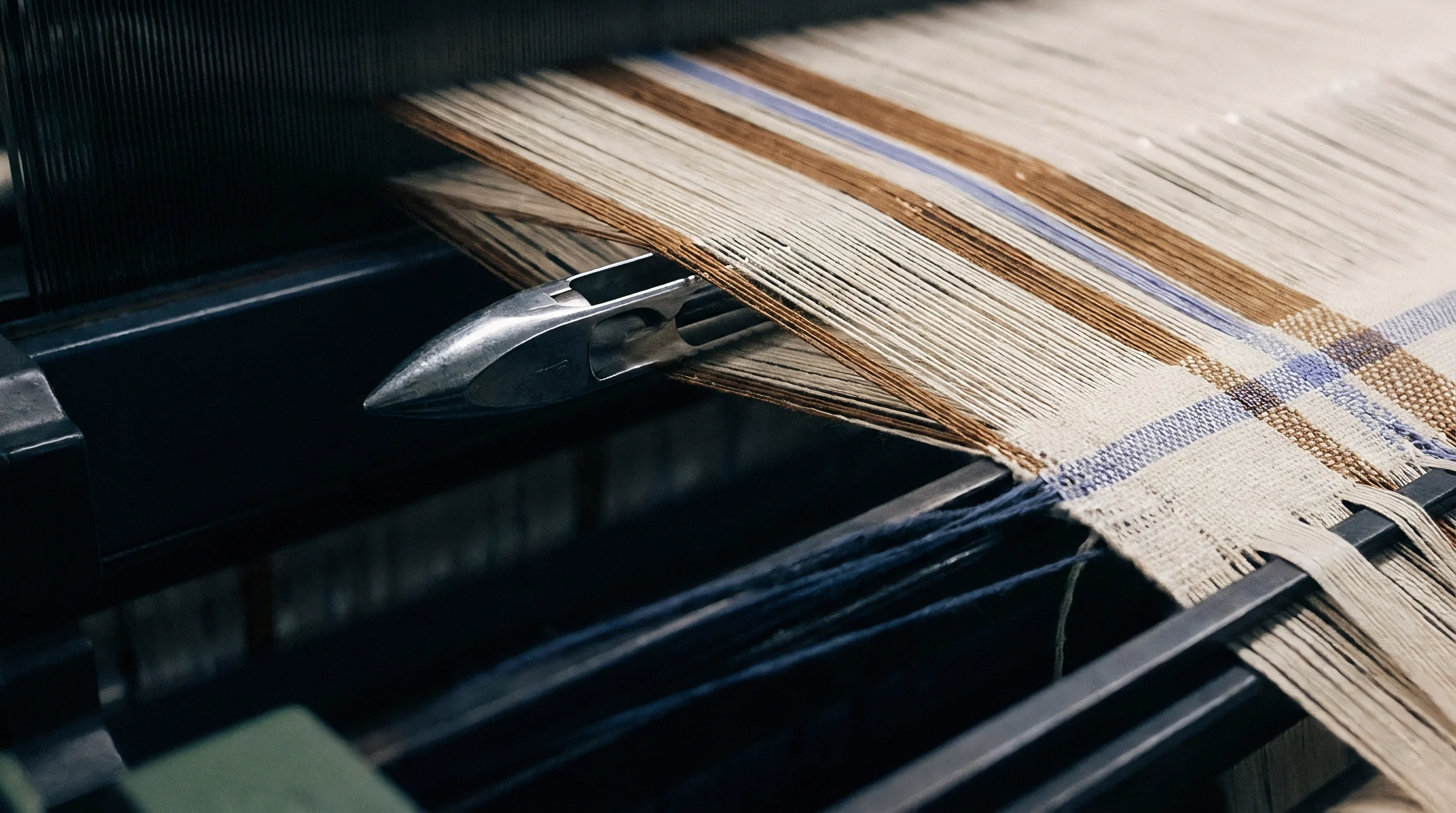
The geometric opening of warp sheets via positive cam or electronic dobby motions sets the angular boundary conditions for beatup. Shed height, asymmetric shed angles, and shed closure timing dictate whether the incoming pick is struck under crossed sheds or open sheds. High warp stress alters the shed geometry through elastic elongation of the harness cords and deflection of the heald frames.

Which Shed Timing Reduces Cloth Fell Drift?
Setting shed closure between 280 and 310 degrees of mainshaft rotation locks the newly inserted pick into crossed warp sheets prior to reed contact. Early shed closing grips the pick between the upper and lower sheets before the dents deliver their strike. The crossed geometry prevents the pick from recoiling backward when the reed withdraws toward back dead centre.
Early shed closing increases total beatup force because the reed must overcome the high tension of already crossed yarns.
Late shed timing positions the harness crossing between 340 and 360 degrees, striking the pick while the warp sheets remain partially open. The mechanical effort needed to seat the pick drops significantly under late timing settings. The unconstrained pick slips backward with the elastic rebound of the cloth fell, generating severe pick-spacing irregular bands throughout the cloth roll.
Loom technicians establish asymmetric shed geometries by elevating the backrest roller above the horizontal cloth line. This height offset increases tension in the upper sheet during shedding, slackening the lower sheet to clear the air jet sub-nozzles while stabilizing fell position during impact.

Heald Frame Acceleration and Thread Stoppages
Electronic dobby motions moving heavy harness frames at 900 cycles per minute generate vertical inertia forces exceeding 4500 newtons per frame. Flexible heald frames bow inward across their horizontal extrusions under the combined pull of ten thousand tight warp ends. Dent clearance measures 24 millimetres.
Frame bowing causes heald eyes near the frame center to lag behind the outer edges by as much as twelve degrees of shaft rotation. Unequal shed opening heights across the cloth width produce uneven pneumatic clearance for the flying weft.
Weft yarns trailing through an irregular shed path scrape against protruding warp ends. The resulting friction strips micro-filaments from texturized or low-twist yarns, forming loose balls of fibre that drift into the reed dents. High harness lift height increases warp yarn fatigue failures exponentially.
Reducing shed opening height from 28 millimetres to 20 millimetres preserves yarn tensile life, but demands micro-profile reeds and miniature air nozzles to prevent the picking air cone from contacting the warp sheet.
Technicians often explain pick density variances by asserting that seasonal humidity fluctuations altered the size pick-up rate on the warp beam.
Compensation
Dynamic tension variation within the warp sheet requires active mechanical counteraction to preserve cloth fell equilibrium. The cyclical opening of the shed combined with the forward punch of the sley creates severe cyclic stress amplitudes. Peak tensions during shed opening and beatup alternate with relaxation troughs during shed closing.
Uncontrolled stress cycling accelerates yarn creep and causes premature end breakages across the outer drop wire banks.

Warp Tension Modulation via Active Backrest Assemblies
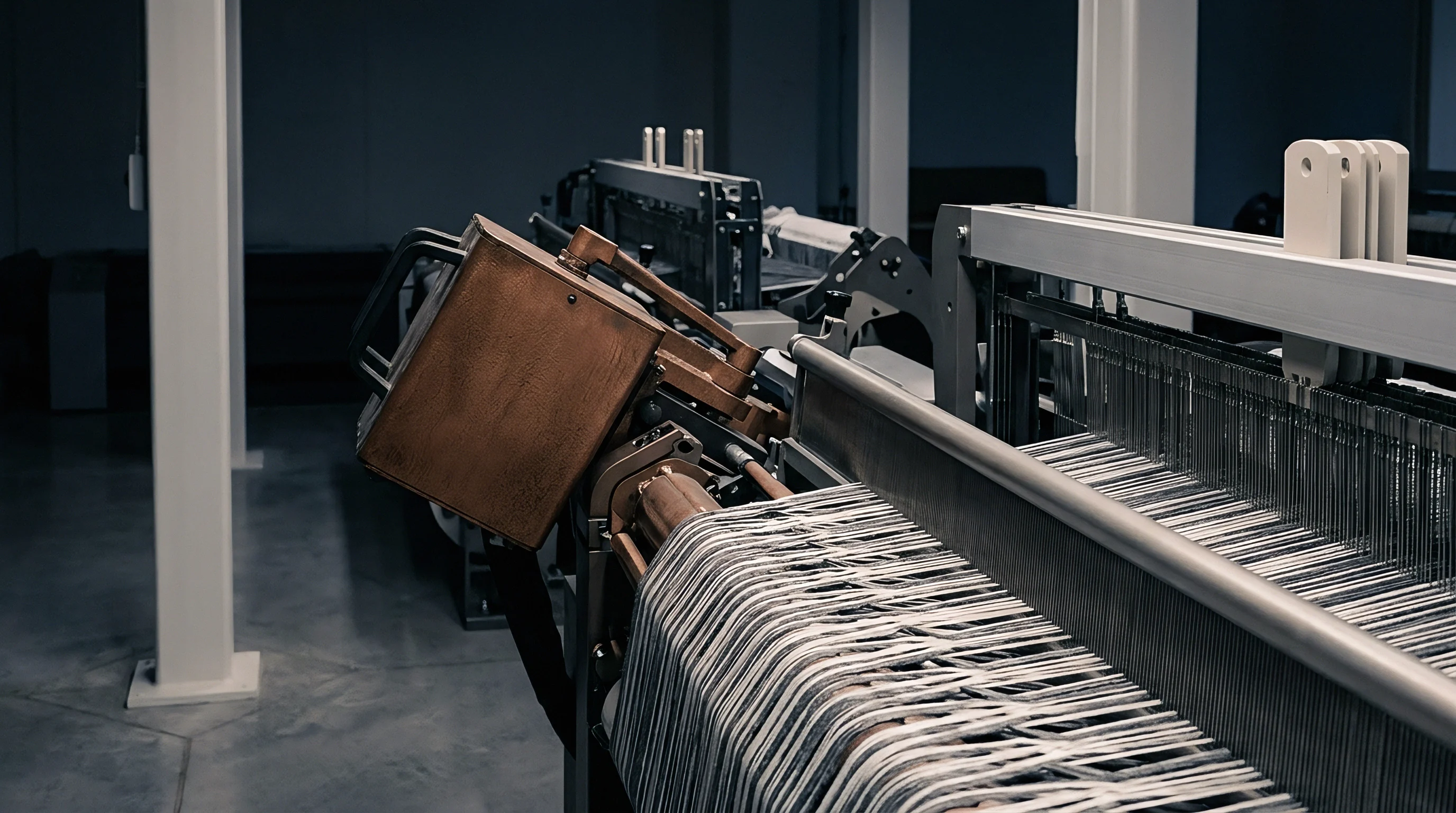
Oscillating backrest rollers driven by conjugate eccentrics move in direct mechanical synchronization with the loom mainshaft. When the shed opens and the reed moves forward to beat, the active backrest roller tilts forward toward the heald frames. This forward stroke releases physical warp length into the weaving zone, suppressing the tension spike.
Backrest deflection dampens the shock. When the shed closes and the reed swings backward, the backrest returns rearward, taking up slack to prevent yarn entanglement behind the drop wires.
Torsion bar spring arrangements absorb residual high-frequency shock waves that the mechanical linkage cannot track. Torsion springs tuned to the natural mass of the backrest pipe counteract frequencies between 12 and 18 Hertz. Defective torsion spring calibration allows the backrest to bounce out of phase with the mainshaft, multiplying the tension peak instead of dampening it.
Active backrest assemblies that reduce cyclical warp stress variations below twenty-five percent extend total life expectancy of profile reed dent wires by two million picks.
Electronic Letoff Synchronization and Dwell Tuning
Servo-driven electronic letoff systems decouple beam unrolling from mechanical drive linkages. Load cells positioned beneath the backrest roller bearings monitor total warp sheet load continuously, feeding millivolt signals to the motion controller. The controller adjusts the servo drive motor rotational speed to release warp yarn at a rate matching the takeup roller delivery.
Digital feedback response times under six milliseconds maintain baseline tension stability across varying beam diameters from 1000 millimetres down to empty core tubes.
Tuning the dwell angle of the conjugate sley cams provides mechanical stress relief for the yarn line. Extending the front dead centre dwell period from twelve degrees to twenty-two degrees of shaft rotation gives polymer chains within the yarn filaments time to undergo stress relaxation during the compaction window. The pick seats completely into the interlacement matrix under lower sustained force peaks, minimizing structural yarn bruising.
A technical dilemma remains regarding how close electronic letoff damping algorithms can approach instantaneous beatup shock compensation before the mechanical inertia of high-capacity beam flanges overrides closed-loop motor torque authority.