Greige Weave Density and Warp Crimp Baseline Calculations
Greige weave density and warp crimp baseline calculations establish accurate yarn consumption, target reed widths, and true finished fabric mass.
Sett
Greige Density Limits and On-Loom Machine Parameters
Warp thread counts under loom tension always differ from those measured after off-loom relaxation. On-loom warp density depends directly on reed width and harness draft, but releasing tension causes immediate fabric contraction that raises the ends per unit length. Calculating greige weave density therefore requires solid baseline figures for on-loom end counts, reed denting, and projected lateral shrinkage before wet processing changes the dimensions.
ISO 7211-2 testing specifies counting ends and picks per unit length with a travelling microscope or counting glass under standard atmospheric conditions of 20 degrees Celsius and 65 percent relative humidity. On-loom density calculations rely on reed count and threads per dent: a reed with 20 dents per centimetre carrying two ends per dent gives an on-loom warp density of 40 ends per centimetre. Once cut from the loom, tension relaxation causes an immediate structural contraction of two to five percent in plain woven cotton, raising the end count before wet treatment.
| Fabric Construction Type | On-Loom Warp Sett (ends/cm) | Off-Loom Greige Sett (ends/cm) | On-Loom Pick Sett (picks/cm) | Off-Loom Greige Sett (picks/cm) | Initial Width Contraction (%) |
|---|---|---|---|---|---|
| 24.0 | 25.2 | 20.0 | 20.6 | 4.8 | |
| 36.0 | 37.4 | 28.0 | 28.5 | 3.7 | |
| 48.0 | 49.8 | 32.0 | 32.6 | 3.6 | |
| 42.0 | 43.1 | 38.0 | 38.4 | 2.5 |
Sizing reed width correctly depends on an accurate projection of lateral greige contraction. If the target off-loom width is 160 centimetres and expected filling crimp causes a five percent width reduction, minimum warp width in the reed must be 168.4 centimetres. Underestimating this width forces the shed to run under excessive filling tension, creating defects like reed marks, selvage breakdown, and uneven picking.
Choosing reed density requires balancing yarn diameter against clear space inside the dent. Crowding ends into a single dent increases friction, causing yarn abrasion and broken filaments on air-jet and rapier looms. For high-density weaves with heavy end counts, spreading ends across a higher reed count with fewer ends per dent protects yarn integrity while preserving target off-loom warp density.
Miscalculating the difference between on-loom reed density and off-loom greige density produces off-spec grey width. Finishing plants then have to stretch the cloth past its elastic limit, leading to severe garment shrinkage after washing.
Contraction

Warp Crimp Mechanics and Yarn Length Determination
Yarn length inside a woven fabric exceeds actual fabric length because threads curve around intersecting yarns. ISO 7211-3 defines warp crimp percentage as the difference between straightened yarn length and the distance between its ends in the fabric, expressed relative to fabric length. Take-up percentage expresses that same length difference relative to the straightened yarn length.
Keeping crimp and take-up distinct prevents systematic errors in raw material allocation and thread mass calculations.
Warp crimp percentage measures straightened yarn length against fabric length, whereas take-up measures that same length difference relative to the unbent yarn length.
Measuring warp crimp accurately requires extracting threads from a conditioned sample under standardized tension. ISO 7211-3 specifies a preliminary load based on linear density ~ typically 0.5 cN per tex for spun yarns and 0.75 cN per tex for continuous filaments ~ to remove crimp undulations without stretching the fiber itself. Too little tension leaves residual crimp and underestimates yarn usage, while too much tension stretches the strand and inflates crimp figures.
Why Do Warp Crimp Differential Ratios Shift across High-Speed Air-Jet Looms?
Air-jet looms running at insertion rates above 2,000 metres per minute generate dynamic shed tensions that alter crimp balance. High main-nozzle pressure sends filling yarn through the shed under momentary peak tension, bending warp ends sharply around the taut filling pick. This elevates warp crimp and flattens filling crimp.
At higher speeds, early shedding locks warp threads around the filling before insertion tension drops, setting higher greige crimp than slower projectile or shuttle looms produce.
- Sample Preparation requires cutting a greige fabric strip parallel to the warp threads, measuring exactly 500 millimetres in length under standard atmospheric conditioning without applying tension during marking.
- Thread Extraction involves carefully unravelling ten individual warp ends from the center of the sample, avoiding edge yarns that suffered tension loss during selvage trimming.
- Tensioned Measurement requires mounting each strand into an automated crimp tester, applying a precise load of 0.5 cN per tex, and recording the extended length to the nearest 0.5 millimetre.
- Baseline Computation calculates the individual crimp percentage for all ten strands, averaging the values to establish the greige warp crimp baseline for the specific loom setup.
Converting warp crimp percentage into warp take-up percentage relies on direct algebraic transformation. Let C represent warp crimp percentage and T represent warp take-up percentage. The mathematical conversions follow these expressions:
C = 100
T = 100
Calculating yarn needs with crimp instead of take-up underestimates required yarn mass by several percentage points. A fabric with 12 percent warp crimp has a take-up factor of 10.71 percent. Ordering yarn on a straight 12 percent addition over-allocates raw material, inflating landed fabric costs unnecessarily.
When warp crimp measurements fluctuate across a single weaving beam, natural yarn elongation variations across ring-spun lots often account for the difference.

Cover
Peirce Geometric Models and Structural Jamming Limits
Fabric cover factor measures the area of the fabric plane covered by warp and filling yarns. Peirce’s geometric model treats yarns as circular, incompressible cylinders following smooth helical paths around each other. Calculating warp cover factor requires warp end density and yarn diameter derived from linear density and fiber density.
In metric units, warp cover factor equals warp ends per centimetre multiplied by the square root of yarn count in Tex, divided by ten.
Calculating yarn diameter requires assuming a specific packing density inside the strand. Ring-spun cotton yarn has a standard fiber density of 1.54 grams per cubic centimetre, with a packing coefficient of 0.60 to 0.65. Its theoretical diameter in millimetres equals 0.037 multiplied by the square root of yarn count in Tex divided by yarn bulk density.
Synthetic continuous filament yarns have higher packing coefficients, between 0.80 and 0.85, giving smaller diameters for an equivalent Tex rating and altering the cover factor accordingly.
| Construction Metric | Cotton Plain Weave | Polyester Twill 2/2 | Polyester/Cotton Poplin | Nylon Taffeta |
|---|---|---|---|---|
| Warp Count (Tex) | 29.5 | 16.7 | 14.8 | 5.5 |
| Filling Count (Tex) | 29.5 | 16.7 | 14.8 | 5.5 |
| Warp Density (ends/cm) | 24.0 | 42.0 | 52.0 | 58.0 |
| Filling Density (picks/cm) | 20.0 | 28.0 | 28.0 | 44.0 |
| Warp Cover Factor (K_w) | 13.04 | 17.16 | 20.00 | 13.60 |
| Filling Cover Factor (K_f) | 10.86 | 11.44 | 10.77 | 10.32 |
| Total Fractional Cover (K_c) | 0.743 | 0.798 | 0.866 | 0.739 |
| Jamming Ratio (% of Limit) | 81.5 | 89.2 | 96.4 | 80.8 |
Total fabric cover factor cannot be calculated by simply adding warp and filling cover factors together, because threads overlap at intersections. The fractional cover formula accounts for this geometry:
K_c = K_w + K_f – (K_w K_f)
Where K_w is fractional warp cover and K_f is fractional filling cover. When fractional cover approaches 0.90 in plain weaves, the fabric reaches its mechanical jamming limit. Adjacent warp ends contact each other, preventing further pick insertion without distorting the structure or chafing yarn in the reed.
Fractional cover factor reaching ninety percent in plain weaves indicates structural jamming where threads contact adjacent ends, preventing clean shedding.
Walz formula adjustments modify theoretical cover calculations by accounting for yarn flattening caused by weaving tension. Under high beat-up force, round yarns deform into elliptical cross-sections, increasing effective strand width by 10 to 15 percent. This increases visual cover while reducing clear space between threads, lowering the pick density at which jamming occurs.
Designing fabrics near theoretical cover limits creates high beat-up resistance, leading to loom stoppages, broken picks, and uneven filling density.

Mass
Yield Arithmetic and Square Metre Baseline Calculations
Calculating theoretical mass per square metre of greige fabric requires combining yarn count, thread density, warp crimp, and filling crimp into a single equilibrium equation. Standard calculations assume conditioned yarn mass at moisture regain levels defined in ISO 139 and ASTM D1909. Omitting crimp from mass calculations underestimates fabric weight, causing commercial disputes when finished cloth falls short of minimum mass specs.
The total weight of one square metre of greige cloth equals warp yarn mass plus filling yarn mass, adjusted for their crimp values. The formula expressing greige mass in grams per square metre (GSM) follows this structure:
GSM = +
Where N_w is warp ends per centimetre, N_f is filling picks per centimetre, Tex_w and Tex_f are yarn linear densities in Tex, and C_w and C_f are warp and filling crimp percentages.
Baseline calculations for a greige cotton twill workwear fabric illustrate how structural inputs build the reference mass:
- Warp Yarn Specification defined as 30.0 Tex ring-spun cotton operating at an off-loom density of 32.0 ends per centimetre with a measured baseline warp crimp of 9.5 percent.
- Filling Yarn Specification defined as 35.0 Tex ring-spun cotton operating at an off-loom density of 22.0 picks per centimetre with a measured baseline filling crimp of 6.0 percent.
- Warp Weight Contribution calculated as 32.0 multiplied by 30.0, multiplied by 1.095, divided by 10, producing exactly 105.12 grams per square metre.
- Filling Weight Contribution calculated as 22.0 multiplied by 35.0, multiplied by 1.060, divided by 10, producing exactly 81.62 grams per square metre.
- Total Theoretical Greige Mass summing warp and filling contributions to yield 186.74 grams per square metre before greige quality inspection.
Standard purchase contracts referencing ASTM D3776 define acceptable greige mass variation within plus or minus two point five percent of target specification.
Linear metre mass depends directly on usable cuttable width. For a greige fabric measuring 160 centimetres wide, multiplying the calculated square metre mass of 186.74 GSM by 1.6 metres yields 298.78 grams per linear metre. Converting this figure into commercial linear yield gives the running metres produced per 100 kilograms of greige fabric off the loom.
ASTM D3776 Standard Test Methods for Mass Per Unit Area of Fabric provides the benchmark protocol for checking physical weight against calculations. Discrepancies over two percent between calculated mass and physical cut samples point to non-conforming yarn linear density, unrecorded size pick-up during sizing, or uncalibrated loom take-up motion.
Under standard commercial terms in international gray cloth contracts, buyer acceptance remains bound to agreed mass tolerances, releasing the buyer from payment obligations for shipment weight deficits beyond contract limits.
Disparity
Greige to Finished State Dimensional Variations
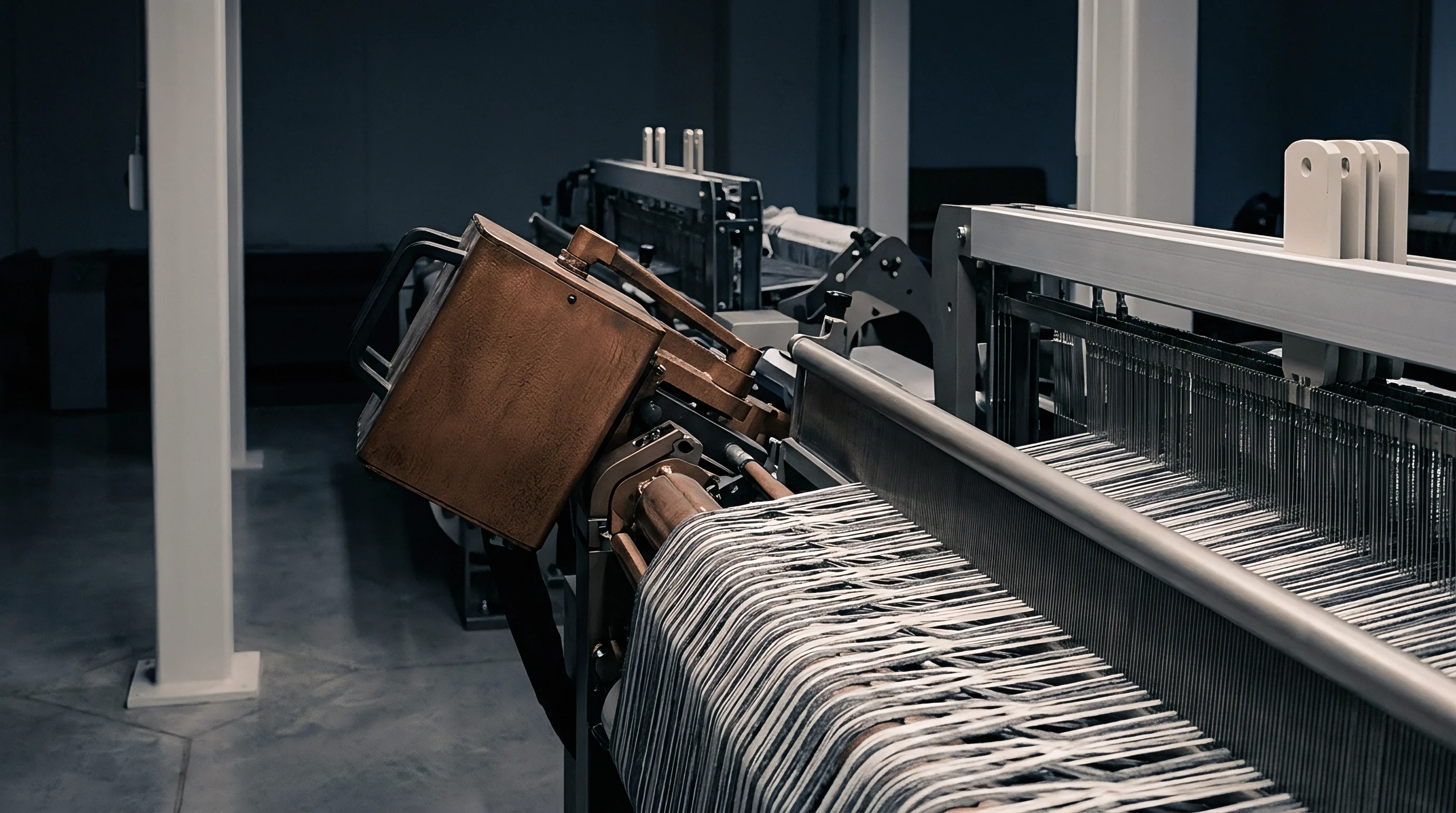
Transforming greige cloth into finished fabric involves exposure to moisture, heat, and tension during scouring, bleaching, dyeing, and stenter drying. These steps release residual stress locked into fibers during spinning and weaving, triggering dimensional shifts that alter thread density and crimp. Greige baseline calculations serve as the essential anchor; without them, predicting finished fabric performance and linear consumption is impossible.
Relaxation shrinkage happens when water and steam penetrate the cotton fiber matrix, disrupting hydrogen bonds and allowing bent yarns to seek lower energy states. During wet relaxation, warp crimp typically increases, while filling crimp shifts depending on the tension applied by dyeing ranges or stenter frames. If a stenter overfeeds fabric longitudinally by three percent, warp crimp increases further, raising finished warp density while shortening overall fabric length.
Crimp interchange is the transfer of crimp between yarn systems under tension. When a finishing frame pulls greige fabric tightly along its length, warp ends straighten, dropping warp crimp from ten percent down to five percent. This force pushes filling yarns into deeper undulations, raising filling crimp from six percent to twelve percent.
The structural result is immediate width loss and higher filling density per centimetre.
- Greige Receipt Audit records baseline thread counts, fabric width, mass per square metre, and unspun yarn crimp figures immediately upon roll receipt.
- Desizing and Scouring removes starch or synthetic sizing agents, triggering initial aquatic relaxation and relieving mechanical weaving strains.
- Stenter Setting and Overfeed Tuning controls longitudinal tension and lateral extension, intentionally locking target warp and filling crimp ratios into the heat-set or dried structure.
- Finished State Quality Control measures final ends and picks per centimetre alongside ISO 6330 wash shrinkage to confirm structural stability.
Synthetic fibers like polyester and polyamide undergo thermal relaxation during heat setting, typically executed between 180 and 210 degrees Celsius. Heat setting shrinks synthetic filaments, increasing yarn bulk and pushing thread density upward. A polyester greige fabric with 30 ends per centimetre can easily contract to 33 ends per centimetre after heat-setting, altering cover factor and hand feel completely if the original greige baseline was poorly calculated.
Uncalculated sizing agent mass accumulation can distort true greige density baseline calculations during incoming quality verification.
Margin
Commercial Yield Tolerances and Landed Sourcing Costs
Translating technical calculations into commercial purchasing specifications requires setting strict tolerances for yarn consumption, warp crimp variance, and finished yield. Mill quotes based on estimated greige thread counts often mask raw material substitution or undersized warp preparation. A tight greige specification eliminates ambiguity by detailing exact thread densities, yarn counts, acceptable crimp ranges, and minimum off-loom width.
Small variations in warp crimp produce outsized impacts on total yarn procurement. On a bulk production contract for 100,000 linear metres of woven cotton fabric requiring a finished width of 150 centimetres and target warp density of 40 ends per centimetre, an assumed eight percent warp crimp requires 6.48 million metres of warp yarn (accounting for reed expansion). If production crimp shifts to ten percent from improper loom tensioning, warp yarn usage increases by 120,000 metres.
At a yarn cost of $0.05 per thousand metres, this uncalculated shift adds $6,000 in raw material costs to a single production run.
| Parameter / Condition | Baseline Spec (8% Crimp) | High-Crimp Shift (10% Crimp) | Low-Crimp Shift (6% Crimp) |
|---|---|---|---|
| Target Fabric Length (m) | 100,000 | 100,000 | 100,000 |
| Reed Width (m) | 1.62 | 1.65 | 1.59 |
| Total Warp Ends | 6,000 | 6,000 | 6,000 |
| Required Warp Yarn (m) | 648,000,000 | 660,000,000 | 636,000,000 |
| Warp Mass (30 Tex) (kg) | 19,440 | 19,800 | 19,080 |
| Raw Material Cost Variance ($) | Base Reference | +$1,728 (Cost Penalty) | -$1,728 (Quality Risk) |
Loom-state technical dossiers provided by weaving mills should include validated test reports covering ISO 7211-2 and ISO 7211-3 data for every yarn lot. Sourcing managers use these baseline numbers to audit mill yield performance and settle commercial claims on lightweight deliveries. When physical test samples show lower mass than specified, comparing measured crimp against the baseline dossier proves whether the mill reduced yarn density or altered loom tension during production.
Contractual specifications should explicitly tie purchase prices to conditioning standards. Yarn linear density and fabric mass vary with moisture regain, so unconditioned measurements taken in high-humidity weaving sheds inflate delivery weights. Standard supply agreements require conditioning samples for 24 hours in a standard laboratory atmosphere before determining trade weight, preventing buyers from paying fiber prices for absorbed moisture.
Integrating warp crimp calculations, thread density limits, and greige cover factors into early fabric engineering ensures accurate cost modeling, predictable finishing behavior, and compliance with international trade specifications.