Evaluating Crimp Interchange and Dimensional Drift in Continuous Wet Processing
Continuous wet processing alters warp and weft crimp balance; controlling web tension and stenter overfeed stabilizes finished fabric dimensions.

Web
Continuous wet processing applies longitudinal forces that transform fabric geometry across industrial finishing lines. When grey woven cloth enters continuous washing ranges, pad baths, or bleaching steamers, mechanical driven rollers exert constant longitudinal tension along the warp direction. Tension stretches warp yarns.
This tension forces the wavy, undulated path of the warp threads to flatten out. In woven fabric geometry, this curvature of yarns around each other is defined as crimp. Warp crimp reduction during continuous transport triggers an automatic structural rearrangement known as crimp interchange.
As warp threads straighten under axial load, they exert downward compression at every yarn crossover point, forcing the intersecting weft yarns to bend further around them.
Fabric geometry shifts rapidly. The loss of warp crimp transfers structural wave curvature directly into the weft system. Consequently, while the fabric gains overall length in the machine direction, it contracts in width across the cross-machine direction.
High tension flattens crimp. This physical phenomenon dictates the initial dimensional shift of grey cloth before thermal setting or chemical fixations take effect.

Peirce Geometry and Tension Dynamics
Woven textiles exist as three-dimensional flexible structures defined by the interlacing of warp and weft yarns. Peirce geometry models this relationship by treating yarns as flexible circular cylinders of diameter d wrapped around one another at fixed spacing. The fractional crimp c for warp yarns (c1) and weft yarns (c2) is mathematically expressed as the ratio of thread length unraveled from the fabric (L) to the nominal fabric length (l):
c = fracL – ll
During grey woven cloth manufacturing, warp yarns undergo sizing and high loom tension, while weft yarns are inserted under minimal tension. This balance yields distinct initial crimp values for each yarn system. When tension is applied to the warp web during continuous wet processing, the yarn cross-over geometry adjusts to balance internal bending moments.
The vertical displacement between warp yarn centers decreases, forcing weft yarn centers further apart vertically. This geometric interchange alters both warp thread spacing and weft thread density per unit length.
Warp Strain and Weft Crimp Transfer
Machine tension along the machine direction forces warp yarns to straighten. This straightening reduces warp crimp percentage while simultaneously increasing weft crimp percentage. The structural response depends on fiber content, yarn twist factor, weave architecture, and applied bath tension.
Tight weaves, such as high-density plain poplins, experience rapid crimp interchange because the tight yarn cross-over points transmit vertical forces immediately. Loose weaves, such as 3/1 twills or satin constructions, absorb initial tension through yarn mobility before full interchange occurs.
| Weave Architecture | Grey Warp Crimp (%) | Finished Warp Crimp (%) | Grey Weft Crimp (%) | Finished Weft Crimp (%) | Width Shift (%) |
|---|---|---|---|---|---|
| Plain Weave (100% Cotton 30s) | 8.5 ± 0.4 | 3.2 ± 0.3 | 4.2 ± 0.3 | 9.1 ± 0.5 | -4.8 ± 0.3 |
| 2/1 Twill (100% Cotton 20s) | 7.2 ± 0.3 | 2.8 ± 0.2 | 5.0 ± 0.3 | 8.8 ± 0.4 | -3.9 ± 0.2 |
| 3/1 Twill (Cotton/Polyester 40s) | 6.8 ± 0.3 | 3.0 ± 0.2 | 4.6 ± 0.3 | 7.9 ± 0.4 | -3.2 ± 0.2 |
| 5-Harness Satin (100% Cotton 40s) | 5.4 ± 0.2 | 2.2 ± 0.2 | 5.8 ± 0.4 | 8.4 ± 0.4 | -2.7 ± 0.2 |
Warp tension exceeding 150 Newtons per metre on continuous processing lines forces up to three percent warp extension while inducing five percent width contraction across unconstrained cotton weaves.
Unchecked warp tension during wet processing alters thread counts per centimetre, forcing apparel cutters to re-engineer marker efficiency layouts or suffer panel alignment failures.

Hydration
Liquid bath immersion introduces chemical and physical forces that alter yarn cross-sectional dimensions. Water swells cellulosic fibers. When hydrophilic fibers like cotton, viscose, or linen enter aqueous washing or dyeing liquors, water molecules penetrate the amorphous regions of the cellulose polymer matrix.
Hydrogen bonds break and reform around water molecules, causing individual fibers to expand primarily in diameter rather than length. Cotton fibers expand in cross-sectional area by 20 to 30 percent upon complete water saturation. Caustic mercerization baths containing 24 to 28 degrees Baumé sodium hydroxide elevate this swelling effect to 40 to 50 percent area expansion.
Yarn cross-overs lock tight. As individual fibers swell, the overall diameter of both warp and weft yarns increases significantly. This diameter expansion increases the path length that intersecting yarns must travel around one another.
Even without external mechanical tension, yarn swelling generates internal strain that shifts crimp equilibrium. Weft threads bend further. The increased yarn volume forces the warp threads into tighter undulations unless longitudinal tension preventswarp movement, in which case weft yarns absorb the structural displacement entirely.
When Does Fibre Swelling Force Weft Crimp Expansion?
Cellulosic fibers absorb water molecules into amorphous regions within seconds of immersion. Fiber diameter enlargement expands the outer radius of yarn bundles. Because the physical length of individual fibers remains relatively constant, this cross-sectional expansion forces the outer yarns to follow a longer, more tortuous path around intersecting threads.
When continuous processing ranges run at low web tension, yarn swelling forces both warp and weft crimp values upward, causing overall fabric area shrinkage. Conversely, when high machine tension clamps warp yarns in a straightened orientation, swelling forces weft threads to bend dramatically. The resulting increase in weft crimp manifests as significant fabric width contraction across the liquor bath zone.
High bath temperatures accelerate the relaxation of internal spinning stresses. Thermal energy destabilizes hydrogen bonding networks within natural fibers and synthetic polymer chains alike, permitting yarn structure relaxation under wet conditions. This thermal-wet relaxation releases strains trapped inside yarns during spinning, winding, and weaving processes.

Caustic Mercerization and Swelling Stress
Concentrated sodium hydroxide solutions induce structural alterations in cotton yarns. Caustic liquor breaks the crystalline lattice of Cellulose I, transforming it into the hydrated Sodium-Cellulose I complex prior to washing out as Cellulose II. This transformation untwists the natural convolutions of cotton fibers, rounding their cross-sections and constricting lumen volume.
The accompanying lateral expansion of yarns creates severe spatial competition at weave interlock points.
- Warp Crimp Flattening occurs when longitudinal tension applied across mercerizer timing cylinders prevents warp yarns from swelling in path length, transferring swelling displacement to the weft system.
- Weft Crimp Spikes emerge when unconstrained weft threads absorb lateral compaction forces, expanding weft crimp by up to four percentage points above grey state metrics.
- Edge Jamming develops along fabric selvedges where yarn density variations produce localized structural resistance to lateral contraction.
- Hygral Expansion Drift manifests during subsequent drying cycles when swollen fibers release moisture, leaving relaxed yarn geometries altered from initial greige specifications.
Compliance with ISO 6330 laundering procedures reveals dimensional drift that stems directly from unrelaxed yarn swelling stresses established during continuous caustic scouring.
Whether real-time acoustic emission monitoring can isolate the exact transition point between fibre relaxation swelling and permanent thread structural displacement during high-speed liquor immersion remains open to field testing.


Pinning
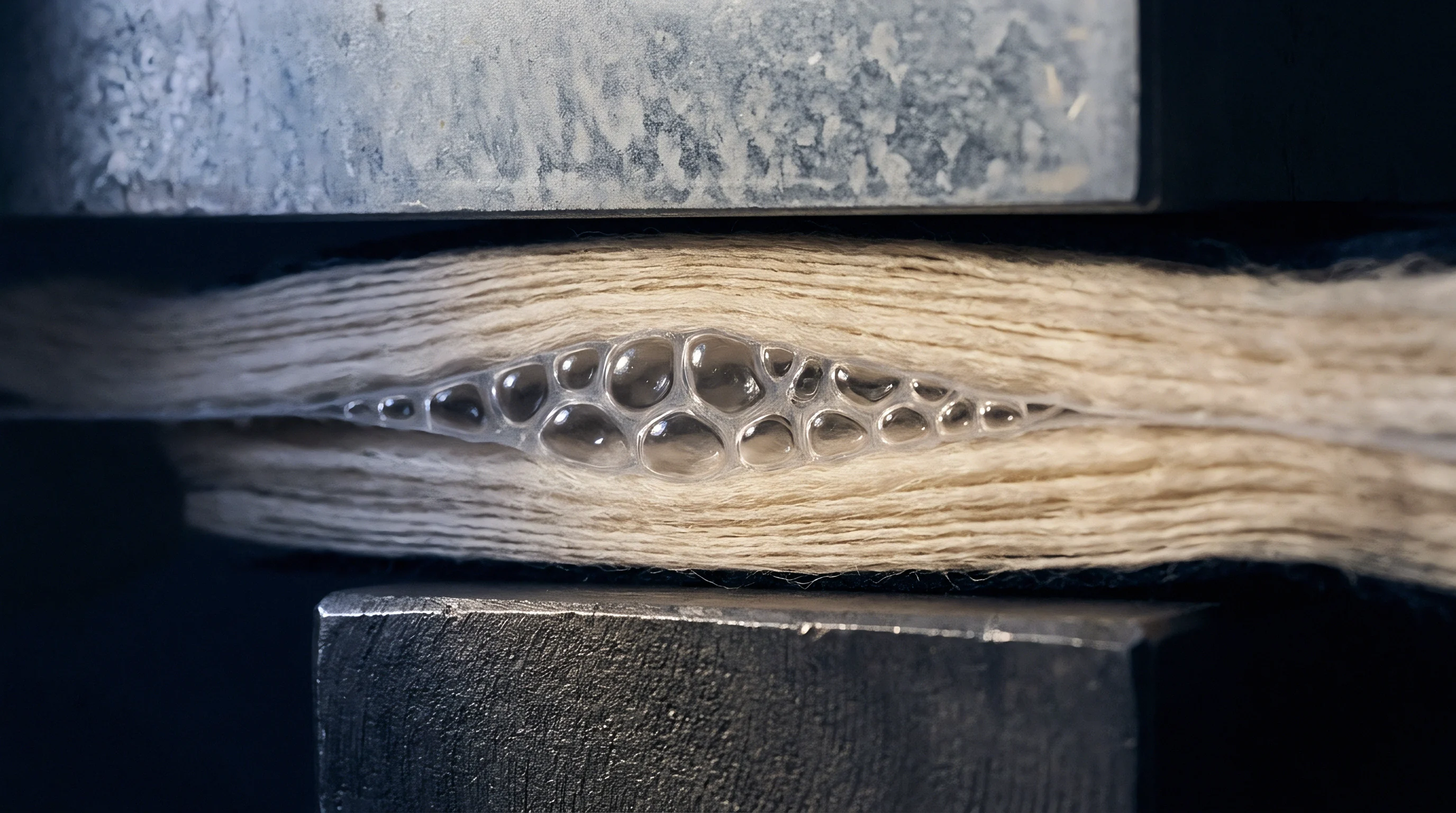
Mechanical control inside the stenter chamber governs final fabric width and residual strain relaxation. Pins hold fabric edges. The stenter frame utilizes pin chains or clip tracks to grip fabric selvedges, carrying the wet web through heated drying and thermal setting zones.
To counteract warp strain induced by prior continuous wet processing ranges, modern stenter systems utilize differential speed overfeed mechanisms. Overfeed systems feed fabric onto the pin chain at a linear speed faster than the chain transport speed. Overfeed restores original warp crimp.
Controlling overfeed permits warp yarns to relax, buckle gently, and regain their natural crimp geometry before heat evaporates moisture and fixes yarn positions. Moisture unlocks yarn hydrogen bonds. Proper pin entry adjustment combined with targeted overfeed percentage offsets the dimensional drift induced by continuous washing and dyeing ranges.
Excess heat freezes structural strain. If overfeed settings fall below the wet relaxation capacity of the warp yarns, residual warp strain remains locked within the fabric, leading to downstream garment shrinkage during home laundering.
Stenter Overfeed and Mechanical Relaxation
Overfeed mechanisms introduce fabric into the drying zone faster than the main chain speed. Setting an overfeed rate of +8 percent introduces 108 metres of wet fabric onto 100 metres of pin chain track. This speed differential provides physical space along the longitudinal direction for warp threads to retract.
The retraction restores warp crimp, relieving stored axial tension. As warp crimp recovers, weft crimp decreases proportionally, allowing the fabric width to widen to target specifications without exerting excessive tension on weft threads.
Thermal evaporation inside stenter chambers sets the final crimp balance. As moisture content drops below eight percent for cotton or zero point five percent for synthetic fibers, hydrogen bonds reform to stabilize yarn interlocks in their relaxed geometry. Thermal heat setting for synthetic components like polyester or elastane requires chamber temperatures between 180 and 195 degrees Celsius, fixing polymer crystalline structures around the newly established crimp state.
Differential Speed Reel Corrections
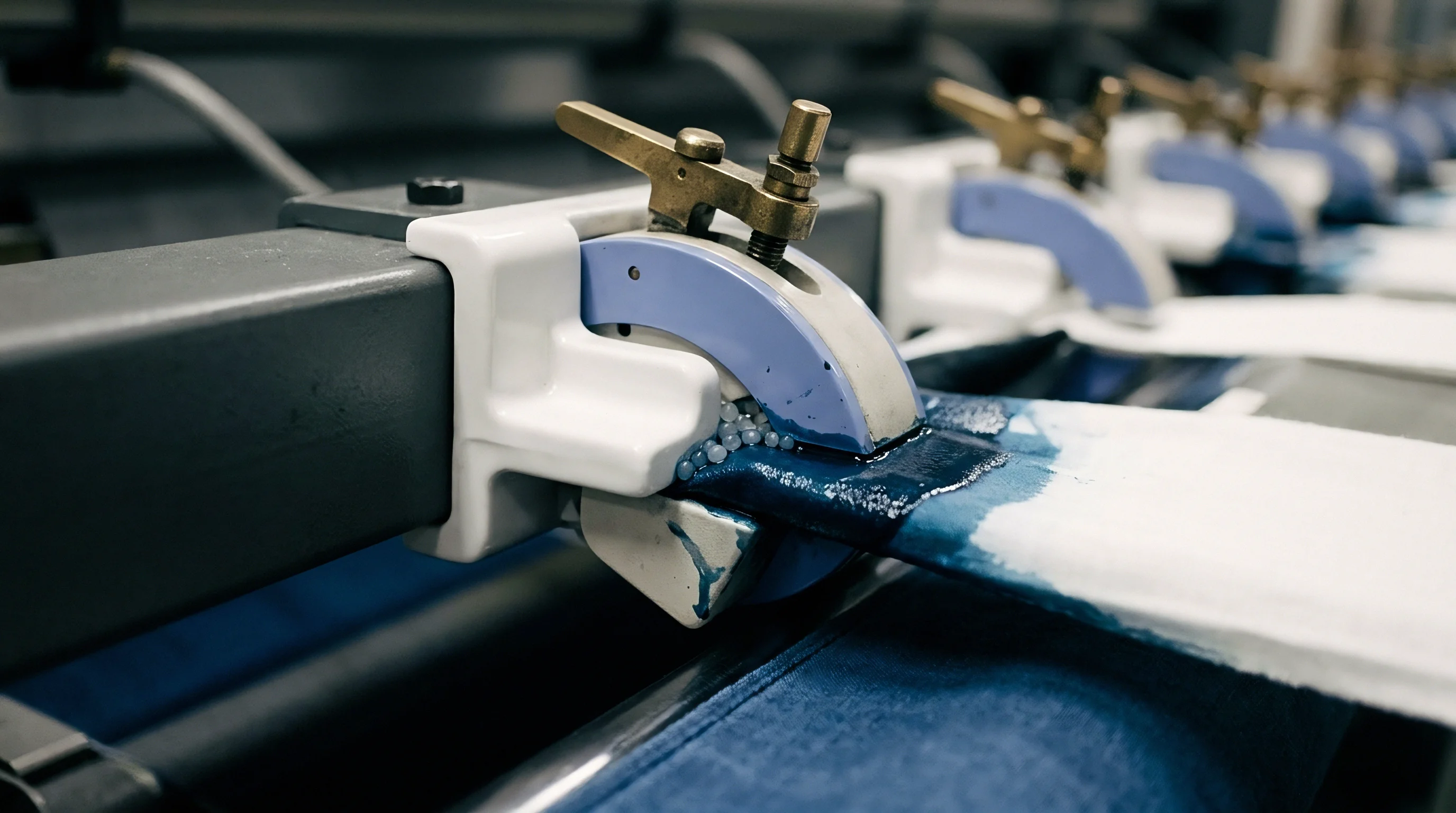
Tension variations across the width of continuous processing equipment introduce skew and bow defects. Differential speed reels and optical sensors at the stenter entry detect diagonal thread distortions. The following mechanical sequence restores orthogonal yarn geometry prior to pin mounting:
- Measure grey fabric warp and weft crimp percentages using unraveled thread lengths under standardized tension according to ISO 7211-5.
- Calibrate in-feed load cells on the continuous washing range to maintain web tension below thirty Newtons total width load.
- Set stenter rail width to match target finished width plus two percent allowance for cooling relaxation.
- Adjust overfeed drive to inject warp length into the pin chain at a rate matching measured wet warp contraction.
- Verify skew and bow alignment across the cooling zone exit rollers using non-contact optical sensor arrays.
| Overfeed Setting (%) | Pin Width (mm) | Drying Temp (°C) | Residual Warp Shrinkage (%) | Residual Weft Shrinkage (%) | Skew Angle (°) |
|---|---|---|---|---|---|
| +2.0 | 1520 | 160 | 6.4 ± 0.3 | 1.1 ± 0.1 | 1.8 ± 0.2 |
| +6.0 | 1500 | 160 | 3.2 ± 0.2 | 1.8 ± 0.2 | 1.2 ± 0.1 |
| +10.0 | 1480 | 160 | 1.2 ± 0.1 | 2.9 ± 0.2 | 0.5 ± 0.1 |
| +14.0 | 1460 | 160 | -0.8 ± 0.1 | 4.2 ± 0.3 | 0.8 ± 0.1 |
| Data measured on 100% Cotton 2/1 Twill (210 g/m²) following ISO 5077 testing after five ISO 6330 4N wash cycles. | |||||
Sufficient stenter overfeed allows the wet fabric to shrink back to its equilibrium crimp geometry before thermal setting locks the yarn cross-over points.
Dyehouse technicians maintain that residual dimensional drift stems from yarn lot variations rather than improper overfeed balancing across drying zones.

Metrics
Standardized laboratory testing converts physical fabric changes into reproducible numerical values. Testing procedures isolate structural properties before and after continuous wet processing stages. Evaluating yarn crimp requires pulling unraveled threads straight without stretching the inherent fiber crimp structure.
Specialized crimp testers apply a standardized light tension, typically calculated in millinewtons per tex based on yarn linear density, to extend the thread to its straightened length. Thread counts alter after washing.
Accurate measurement of warp and weft crimp provides direct insight into how continuous processing equipment alters fabric density. When warp crimp drops while weft crimp increases, the physical count of ends per centimetre decreases while picks per centimetre increase. Fabric mass per unit area alters accordingly.
Calculating mass changes from crimp values forms the core of grey-to-finished fabric construction reconciliation.

Standard Test Methods ISO 7211-5 and ISO 5077
Laboratory evaluation of yarn crimp relies on unravelling threads under controlled tensile loads as specified in ISO 7211-5 (Textiles ~ Woven fabrics ~ Construction ~ Methods of analysis ~ Part 5: Determination of yarn crimp in fabric). Ten warp and ten weft specimens measuring 500 millimetres in length are extracted from fabric samples conditioned under ISO 139 standard atmosphere (20 degrees Celsius, 65 percent relative humidity). The unraveled yarn length (Lu) under standard tension is compared against the initial fabric length (Lf), yielding percentage crimp (C):
C = fracLu – LfLf × 100
Dimensional drift after continuous processing is evaluated using ISO 5077 (Textiles ~ Determination of dimensional change in washing and drying) alongside washing procedures specified in ISO 6330. Benchmarks placed on fabric rolls before wet processing track dimensional movements across continuous washing, mercerizing, dyeing, and stentering operations. Comparing initial distance marks against post-treatment distances yields directional shrinkage or growth metrics.

Worked Derivation of Finished Mass and Sett
A quantitative calculation illustrates structural shifting from greige weave to finished cloth. Consider a 100% cotton 2/1 twill grey fabric batch entering a continuous wet processing range. Assumptions for this worked calculation are defined as follows:
- Greige Lot Size ~ 20,000 linear metres at a cuttable width of 160 centimetres.
- Yarn Linear Densities ~ Warp count Nk,warp = 19.7 tex (30s Ne); Weft count Nk,weft = 19.7 tex (30s Ne).
- Greige Sett ~ 42 ends/cm (eg); 24 picks/cm (pg).
- Greige Crimp ~ Warp crimp c1,g = 8.0%; Weft crimp c2,g = 4.5%.
- Greige Mass ~ Measured baseline mass of 210 g/m² according to ISO 3801.
During continuous processing under uncontrolled warp tension, the fabric experiences warp elongation and weft contraction. Laboratory analysis of the finished fabric yields the following modified crimp values: finished warp crimp c1,f = 3.2% and finished weft crimp c2,f = 7.8%. Calculating the resulting structural metrics demonstrates the impact of crimp interchange:
Step 1: Determine Warp Length Extension Ratio (RL):
RL = frac1 + c1,g1 + c1,f = frac1 + 0.0801 + 0.032 = frac1.0801.032 = 1.0465
The lot length expands by 4.65 percent, resulting in a finished length of 20,930 linear metres.
Step 2: Determine Weft Width Contraction Ratio (RW):
RW = frac1 + c2,g1 + c2,f = frac1 + 0.0451 + 0.078 = frac1.0451.078 = 0.9694
The cuttable width contracts by 3.06 percent, reducing width from 160.0 cm to 155.1 cm.
Step 3: Calculate Finished Thread Density (Sett):
Finished ends per centimetre (ef):
ef = fracegRW = frac420.9694 = 43.3 ends/cm
Finished picks per centimetre (pf):
pf = fracpgRL = frac241.0465 = 22.9 πcks/cm
Step 4: Calculate Finished Mass per Unit Area (Mf) via ISO 3801 formula accounting for size desizing mass loss of 4.0 percent (Lsize = 0.04):
Mf = left × frac100 – Lsize10000
Mf = left × frac0.9610000
Mf = left × 0.000096 = 1366.63 × 0.000096 = 131.2 g/m2 (pure fiber mass)
Adding wet finishing chemicals and softeners (2.5% add-on) yields a final finished mass of 201.5 g/m².
| Fabric Parameter | Greige Baseline | Finished Target Spec | Measured Output | Deviation (%) |
|---|---|---|---|---|
| Warp Crimp (%) | 8.0 ± 0.2 | 6.0 ± 0.3 | 3.2 ± 0.2 | -46.7 |
| Weft Crimp (%) | 4.5 ± 0.2 | 6.5 ± 0.3 | 7.8 ± 0.3 | +20.0 |
| Warp Density (ends/cm) | 42.0 ± 0.5 | 44.0 ± 0.5 | 43.3 ± 0.5 | -1.6 |
| Weft Density (picks/cm) | 24.0 ± 0.5 | 24.5 ± 0.5 | 22.9 ± 0.5 | -6.5 |
| Cuttable Width (cm) | 160.0 ± 1.0 | 158.0 ± 1.0 | 155.1 ± 1.0 | -1.8 |
| Mass per Area (g/m²) | 210.0 ± 3.0 | 205.0 ± 3.0 | 201.5 ± 3.0 | -1.7 |
Fabric mass per unit area increases in direct proportion to weft crimp accumulation when stenter overfeed prevents warp elongation.
Standard purchasing addendums invoking ISO 5077 with a maximum three percent dimensional change limit compel mills to absorb re-processing charges whenever unrelaxed warp crimp causes excessive garment length reduction.
Recovery
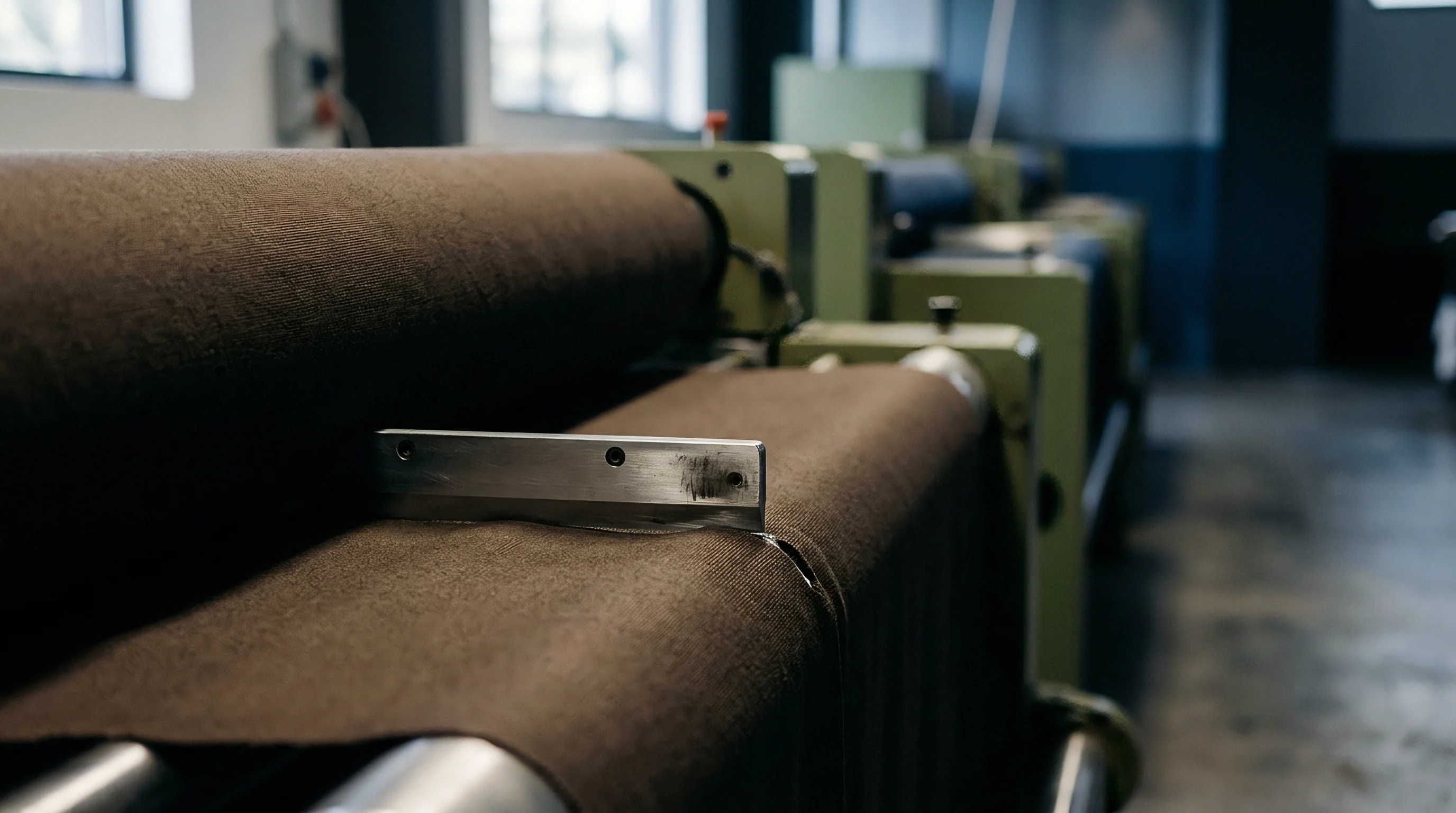
Commercial fabric contracts specify usable width, weight tolerances, and maximum shrinkage allowances. Marker efficiency drops immediately. Width loss caused by uncontrolled weft crimp expansion directly reduces cuttable roll area on garment cutting tables.
When continuous processing ranges stretch warp length at the expense of cuttable width, apparel manufacturers lose pattern layout efficiency. Narrow rolls increase apparel waste.
Financial margins depend on precise yields. Gain in linear roll length rarely offsets loss in usable garment panel yield per metre. Unrelaxed stresses cause panel distortion.
When garments made from structurally unbalanced fabric undergo home laundering, stored warp tension releases, causing panels to shorten while twisting along side seams. Managing continuous processing tension protects landed fabric value and prevents garment return claims.
Commercial Yields and Landed Fabric Cost
Dimensional changes during wet finishing directly dictate total finished garment yield. An unpredicted width reduction from 158 centimetres to 155 centimetres forces pattern makers to drop one garment panel per marker row. This width loss increases fabric consumption per garment by three to five percent, converting a profitable bulk garment order into a net loss for the buying house.
Continuous wet processing lines running at excessive speeds often prioritize linear metre output over crimp relaxation balance. While the mill gains additional billable fabric length, the buyer receives fabric prone to severe dimensional drift. Writing strict crimp interchange balance parameters into fabric purchase orders transfers the commercial risk back to the textile mill.

Mill Route Specifications and Cutter Tolerances
Purchasing agreements specify performance thresholds to prevent downstream manufacturing losses. Strategic procurement terms must incorporate explicit continuous processing constraints:
- Cuttable Width Guarantee defines minimum usable fabric width excluding pin-hole selvedges under ISO 22198, establishing price deductions for rolls under tolerance.
- Maximum Tension Cap limits line tension across continuous scouring, dyeing, and washing ranges to thirty Newtons per metre width.
- Mandated Overfeed Floor mandates a minimum stenter overfeed setting of plus six percent for cellulosic woven fabric qualities.
- Batch Shrinkage Audit requires pre-shipment ISO 5077 testing on five percent of bulk rolls, rejecting lots exceeding three percent dimensional change.
Matching stenter overfeed to true yarn crimp capacity preserves cuttable width and stabilizes garment dimensions across commercial laundering cycles.