
Quantifying Fiber Waste Rates in Commercial Air Jet Spinning
Air jet spinning waste ranges from three to nine percent, driven by short fiber index and nozzle pressure, directly shifting yarn yield and blend ratios.
Air jet spinning waste ranges from three to nine percent, driven by short fiber index and nozzle pressure, directly shifting yarn yield and blend ratios.

Real-time SWIR line-scan ratio classification isolates translucent polyolefin in unopened cotton tufts at high velocity with low good-fiber ejection loss.
Targeting 1450 nm and 2200 nm shortwave infrared bands differentiates polypropylene and organic contaminants from cotton lint with high optical contrast.

Auditing mass balance in camel and cashmere dehairing requires converting all stream weights to oven-dry mass plus stream-specific standard regain.

Commercial mass regain adjustments recalculate dehaired specialty fibre billing weight by converting net scale mass to clean dry keratin plus official allowances.

Raw cashmere value hinges on clean down yield and optical verification of residual coarse hair content below zero point five percent by mass.
Acceptance sampling for cotton honeydew requires negative binomial statistical modeling and thermomechanical spot counts to control spatial clustering risks.

Determining viscose wool dry mass ratios through ISO 1833 requires selective chemical dissolution, reagent mass correction, and commercial regain adjustments.

Mechanical opening separates cotton and polyester blends when differences in fiber density, crimp, and friction cause differential transport and waste drop.

Accurate comber noil extraction calculations require mass balance testing under conditioned moisture standards, balancing waste removal against secondary resale value.

Commercial raw cotton mass requires adjusting gross scale weight for official moisture regain and non-lint content under standardized oven-dry test protocols.

Physical segregation verification in rayon chains requires dedicated pulp steeping lines, chemical marker validation, and container seal mass balance audits.

Purifying dissolving pulp to pure alpha-cellulose before isotope ratio mass spectrometry prevents residual lignin from distorting species and origin calls.

Dissolving pulp sourcing for rayon yarn relies on alpha cellulose purity specifications, alkali solubility controls, and commercial air dry tonnage audits.

Customs audits reclassify fiber blends when suppliers apply origin regain rates instead of destination statutory rules to oven-dry laboratory separation data.
Calculate weighted regain by multiplying dry fiber fractions by standard regain rates, applying this factor to clean dry mass for final invoice weight.

Baseline moisture allowances convert raw lot weight into commercial mass using ISO regains to prevent paying yarn prices for ambient water.

Adjust landed textile valuation disputes by converting gross scale weights to ISO 6741 dry mass plus commercial regain using dockside moisture sample reports.
Commercial mass arbitration of maritime viscose transport converts scale weights to oven-dry fiber mass under ISO 6741 using official regain factors.

Converting laboratory dry chemical reports to standard commercial regain mass prevents tariff misclassification and aligns invoice billing with landed net weight.

Commercial weight equals dry polymer mass multiplied by one plus the standard commercial regain percentage, converting tested moisture levels into trade invoices.

Boundary layer suction and laminar air knives suppress flake flutter and optical refraction jitter, securing sub-50 ppm purity on high-speed polymer chutes.

Optoelectronic blowroom sorters combine polarized, UV, and SWIR sensors with high-speed valve arrays to detect and eject synthetic polymers from cotton tufts.

Foreign matter extraction balances trash reduction against fiber damage, requiring Shirley analyzer and AFIS testing to price true clean lint yield.

Seasonal raw cotton purity shifts alter chemical extraction mass ratios, triggering customs tariff reclassifications across chief weight thresholds.

Commercial yarn weight verification relies on oven-dry mass determination modified by standard moisture regain percentages to determine billable weight.
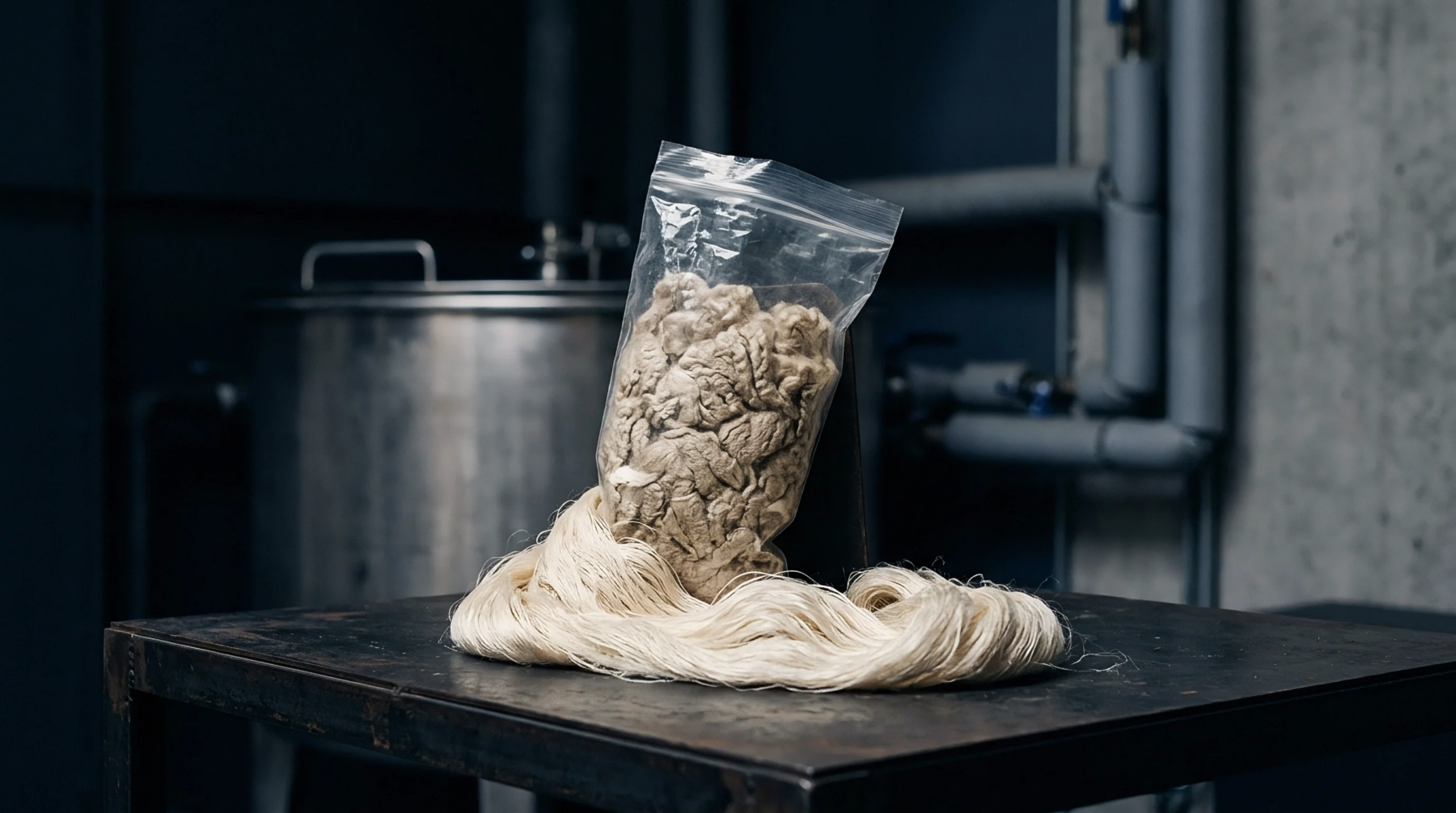
Quantitative fibre blend analysis uses selective chemical dissolution, gravimetric desiccation, and microscopic counting to verify trade declarations.

Fabric structural crimp converts raw yarn length into finished fabric areal weight, driving yarn consumption ratios and landed linear metre costs.

Combing long-staple cotton to eighteen percent noil suppresses short fibers below six percent, locking ends into yarn cores to secure Grade 4 pilling life.

Customs composition disputes resolve by aligning chemical solvent dissolution test methods, ISO 6741 dry mass regains, and contract retest clauses.
Expertise is a utility, not a secret. sentiention™ publishes its working knowledge as open reference: intelligence layer covering the materials it sources, the markets it enters, and the reference that serves both.