
Scope Certificates against Transaction Certificates in a GOTS Order
A Scope Certificate proves facility qualification, but only a Transaction Certificate verifies the organic status of a specific textile shipment lot.

A Scope Certificate proves facility qualification, but only a Transaction Certificate verifies the organic status of a specific textile shipment lot.

Commission dyeing defect liability requires contractual tripartite agreements, pre-process greige verification gates, and analytical fault isolation.

Greige qualification governs wet processing uptake through conditioned mass accounting, chemical size identification, capillary absorbency, and bow tolerances.

Combing long-staple cotton to eighteen percent noil suppresses short fibers below six percent, locking ends into yarn cores to secure Grade 4 pilling life.

Warp and weft crimp exchange during wet finishing balances longitudinal overfeed and lateral rail draft to set fabric weight and arrest post-wash shrinkage.

Preparation of heavy cotton twill requires 85-degree flame singeing, dual-dip enzymatic desizing, open-width alkaline scouring, and 28 Baumé mercerization.

Dimensional and cover loss disputes require binding retain-swatch testing under ISO 5077 to isolate mill finishing strain from spreading room tension.
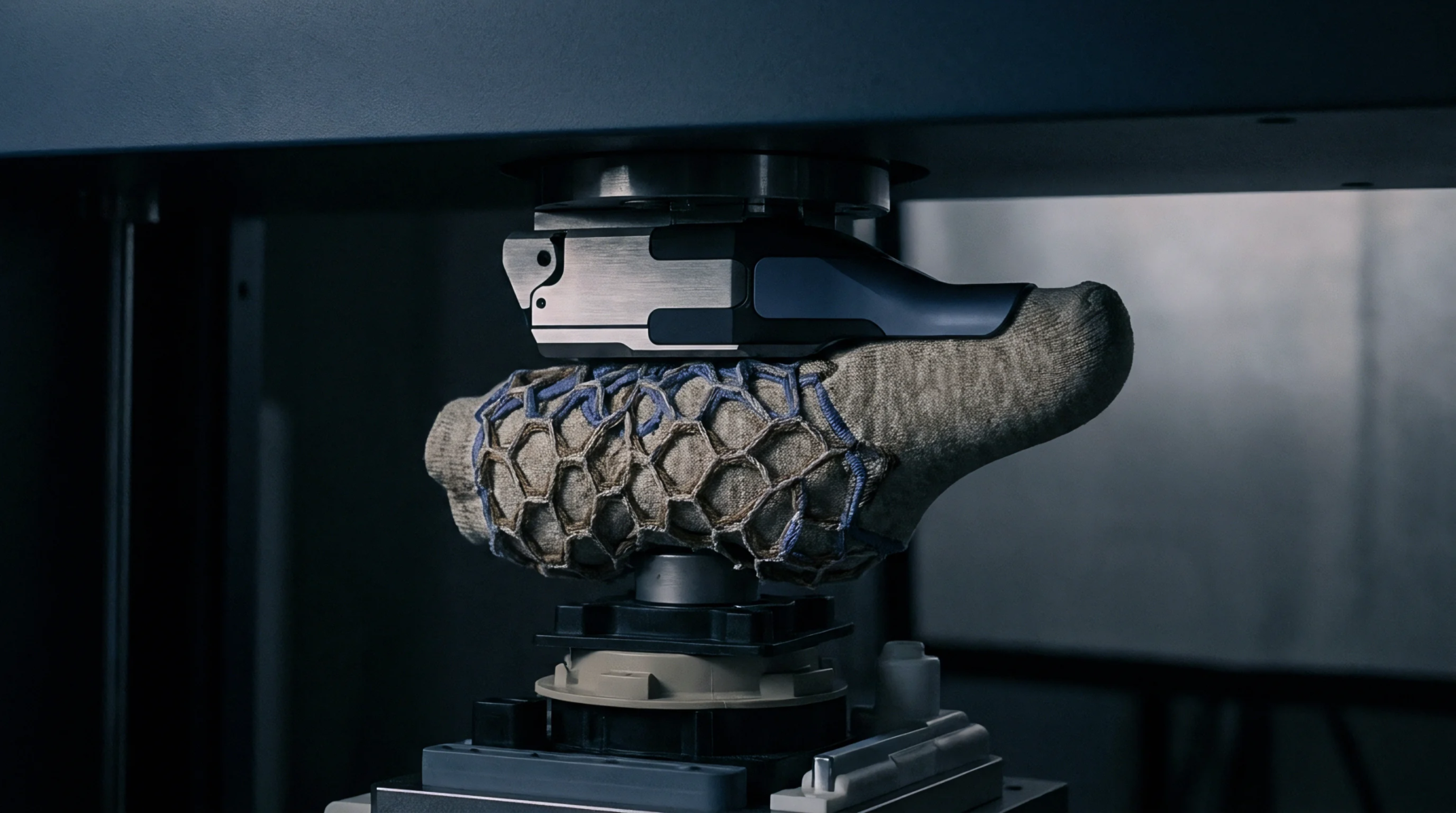
Verify woven fabric order compliance by mapping target market regulations to finish chemistry and requiring ISO 17025 test reports per dye lot.

Standard atmospheric conditioning eliminates sorption hysteresis errors, securing accurate fabric weight, thread density, and commercial mass billing.

Customs composition disputes resolve by aligning chemical solvent dissolution test methods, ISO 6741 dry mass regains, and contract retest clauses.

An OEKO-TEX certificate scope covers only explicitly listed article descriptions, leaving chemically modified sister constructions uncertified without separate testing.

Controlling latent fabric skew and metamerism in subcontracted chains demands unified yarn torque standards, identical dye trichromies, and strict inter-mill dockets.

Tri-illuminant shade approval aligns lab dips with bulk by enforcing primary D65 visual matching alongside secondary TL84 and Illuminant A metameric tolerances.

Micro-spatial finish distribution anisotropy creates subterranean chemical voids that cause premature hydrostatic failure despite acceptable macroscopic spray ratings.

Standardized chemical limit verification in primary dyeing requires lot-level analytical testing linked to transaction certificates rather than factory scope documents.

Dynamic web tension locks yarn crossovers into high-resistance capillary slit pores, requiring controlled positive overfeed to maintain open fluid transport.

Enzymatic tryptic digestion of damaged animal fibers requires kinetic rate normalization to prevent severe quantitative misclassification in fiber identification

Verify physical receiving weights against transaction certificate balances using standard moisture regain adjustments before authorizing batch production.

Stratified edge to middle textile sampling eliminates Consumer Risk by capturing process chemical gradients that simple random attribute inspection hides.

Verify binary cotton polyester ratios using 75.0% sulfuric acid at 50 °C with calibrated d-factor corrections and official regain conversion to secure customs tariff compliance.

Determining required loom reed width requires converting unraveled weft yarn takeoff data into take-up fractions and adding wet processing shrinkage allowances.

Automated mass balance verification relies on real-time algorithmic conversion loss reconciliation across multi-tier supplier ledgers.

Assembling valid textile customs clearance files requires aligning invoice line weights with transaction certificate sequences and accredited laboratory test reports.

High warp cover factors drastically spike air jet loom beat-up forces, requiring optimized size films and asymmetric shed timing to prevent stop marks and yarn damage.

Cyclic trimer solvent extraction requires cold petroleum ether finish stripping before 1,4-dioxane Soxhlet extraction and RP-HPLC verification to prevent failures.

Empirical laboratory testing of raw liquid chemical auxiliaries prior to vat injection is mandatory to prevent subcontracted dyehouse contamination.

Single-pass printhead arrays incur higher capital depreciation and fluid purge waste than multi-pass engines, demanding strict contract coverage caps.

Verify that physical manufacturing dates fall completely within active scope certificate validity windows before paying for certified goods.

Determining the run length crossover requires balancing rotary screen engraving overhead against high digital ink costs at the precise yardage where unit expenses equalize.

Low liquor ratio jet extraction of hydrolyzed reactive dyes demands high thermal energy combined with prior electrolyte removal to shift partition equilibrium.
Expertise is a utility, not a secret. sentiention™ publishes its working knowledge as open reference: intelligence layer covering the materials it sources, the markets it enters, and the reference that serves both.